
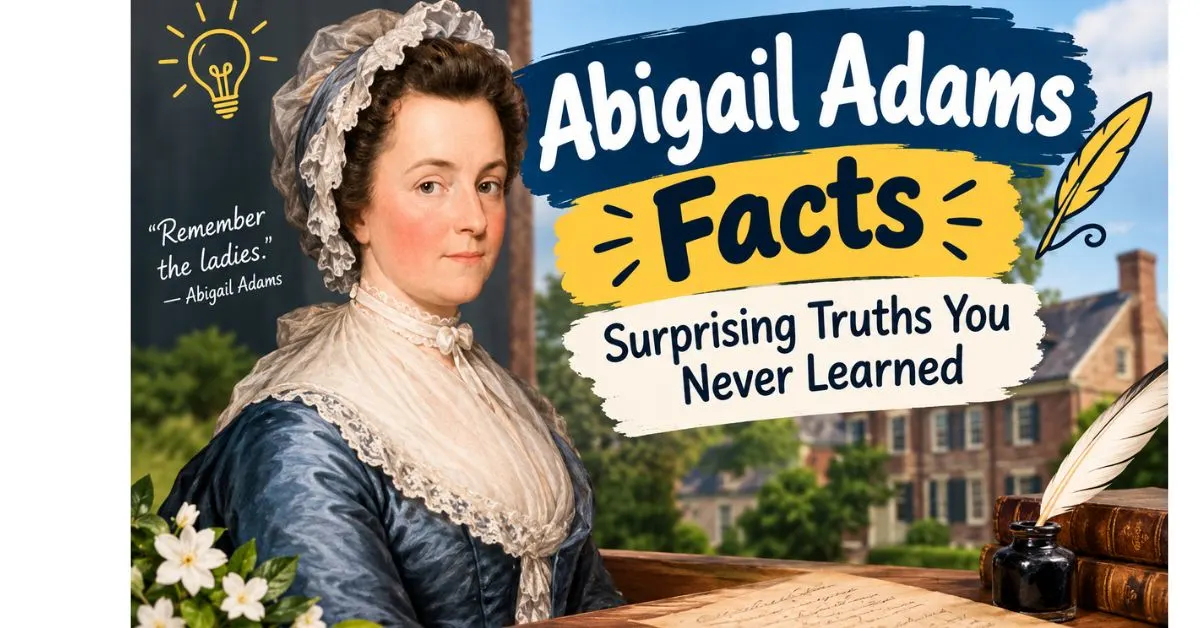
Abigail Adams Facts Surprising Truths You Never Learned
Abigail Adams (1744–1818) was the second First Lady of the United States, the wife of John Adams, and the mother of John Quincy Adams, and the most famous of all Abigail Adams facts is her 1776 plea to “remember the ladies.” Most of us met her as a textbook footnote, a patient wife waiting in Massachusetts.
She was far more. Reading her Revolutionary War letters, you feel the fear, humor, and stubborn intellect of a woman running a farm alone while history happened to her husband. This guide gathers verified Abigail Adams facts from Biography.com, Mental Floss, and the National Park Service, so you can see why she still shapes debates about women’s rights.
Abigail Adams Facts Who Was Abigail Adams?
Abigail Adams served as the second First Lady of the United States from 1797 to 1801. She was the wife of President John Adams and the mother of President John Quincy Adams, a rare double distinction in American political history that only Barbara Bush later matched.
Yet her fame rests on more than family ties. Historians prize her letters as a window into Revolutionary War life in Massachusetts, and admirers remember her as an early advocate for women’s education, property rights, and the abolition of slavery. She never held office, but she shaped those who did.
Abigail Adams Facts Quick Facts
Before diving deeper, here is the short version. Abigail Smith was born in Weymouth, Massachusetts, married lawyer John Adams in 1764, raised a family through war and separation, and died at her Quincy home in 1818. The table keeps the core biography handy for quick reference.
Notice the birthday detail, because it trips up many readers. Sources list both November 11 and November 22, 1744. Both are correct, depending on whether you use the old Julian calendar or the modern Gregorian one, which Britain and its colonies finally adopted in 1752.
| Fact | Detail |
| Full name | Abigail Smith Adams |
| Born | November 22, 1744 (November 11 by the Julian calendar), Weymouth, Massachusetts |
| Parents | Rev. William Smith and Elizabeth Quincy Smith |
| Married | John Adams, October 25, 1764 |
| Children | Six; four lived to adulthood |
| Role | Second First Lady of the United States, 1797–1801 |
| Died | October 28, 1818, Quincy, Massachusetts, age 73 |
| Resting place | United First Parish Church, Quincy |
| Year | Milestone |
| 1764 | Marries John Adams |
| 1775 | Watches the Battle of Bunker Hill from near her home |
| 1776 | Writes the famous “Remember the Ladies” letter on March 31 |
| 1784 | Joins John in Paris; London follows in 1785 |
| 1797 | Becomes First Lady |
| 1800 | Moves into the unfinished White House in November |
| 1818 | Dies at Peacefield on October 28 |
Abigail Adams Facts About Her Birth and Childhood
Abigail grew up in Weymouth, the daughter of Reverend William Smith, a Congregational minister, and Elizabeth Quincy Smith, whose family carried real influence in colonial Massachusetts. Often frail as a girl, she never attended school, which was perfectly normal for girls in the 1700s.
Her education came from home instead. Her mother taught her to read and write, and she devoured the libraries of her father and uncle, from Shakespeare and Milton to the Bible. That hunger, and the frustration behind it, later fueled her campaign for women’s education.
There’s a Bit of Confusion About When She Was Born
Colonial Britain used the Julian calendar until 1752, when it jumped eleven days to the Gregorian system. That is why Abigail’s birthday appears as November 11 in older records and November 22 in modern ones. Same baby, same Weymouth parsonage, two calendars, and one lasting trivia question.
Spelling Wasn’t Her Strong Suit
Abigail’s letters are full of spellings like “perticular” and “benifit,” and she knew it, once apologizing for a badly written note. Standardized spelling barely existed, yet her embarrassment reveals the cost of missing formal schooling. Her ideas stayed razor sharp, and readers have forgiven the typos for centuries.
Abigail Adams Facts Marriage to John Adams
Abigail and John were third cousins who had known each other as children, but the spark came when she was in her teens and he was a Harvard-educated lawyer nine years older. They married on October 25, 1764, and settled in Braintree, Massachusetts, building a partnership of books and politics.
John’s law practice and later his service in the Continental Congress kept him away for years, so Abigail ran the household, raised the children, and managed the farm. Letters became their marriage. They called each other “My Dearest Friend,” and trusted each other’s judgment on politics as much as family.
John and Abigail Exchanged Over 1,100 Letters
Historians believe the couple exchanged more than 1,100 letters, now preserved by the Massachusetts Historical Society. They describe the vote for independence, battles near Boston, and tender longing across long separations. For readers today, this correspondence is the richest primary source on the Revolutionary home front and the Adams marriage.
Abigail Adams’s Children
Abigail had six children Nabby in 1765, John Quincy in 1767, Susanna in 1768, Charles in 1770, Thomas Boylston in 1772, and a stillborn daughter in 1777. Susanna died as a toddler, and Charles later died of alcoholism in 1800, a grief that shadowed the Adams household.
Abigail Adams Facts During the Revolution, Adams Made Bullets for the American Cause
On June 17, 1775, Abigail and seven-year-old John Quincy watched the Battle of Bunker Hill erupt near Charlestown. Among the dead was Joseph Warren, the Adams family doctor and a Revolutionary general. Her grief hardened into action, and her Braintree home became a small outpost of the rebellion.
She melted her pewter spoons into musket balls for rebel forces and sheltered patriot soldiers and Boston refugees under her roof. Meanwhile, she handled finances, the farm, and the children’s lessons, which is exactly why historians treat her as a full partner in the war effort, not a spectator.
Abigail Adams’ Sound Intellectual Reasoning
While John served in Philadelphia, Abigail managed rents, crops, and tenants, even buying land and speculating in currency to keep the family solvent. His letters show he valued her political judgment and often asked her advice. “What a politician you have made me,” she joked, though she needed no tutoring.
Abigail Adams Facts She Was an Early Women’s Rights Advocate
On March 31, 1776, Abigail wrote John that the new code of laws should “remember the ladies” and treat women more generously than earlier generations had. She warned that women would foment a rebellion rather than obey laws made without their voice or representation. It was bold, witty, and serious.
John answered with a laugh, and the request went nowhere. Still, Abigail kept pressing for women’s education and property rights for the rest of her life. In 2026 that famous letter turns 250 years old, which makes it one of the most timely facts about Abigail Adams to share.
Abigail Adams Facts She Vehemently Opposed Slavery
In 1774, Abigail told John she wished there were not a single slave in the province, even though her own father had held enslaved people. Two years later she called out the hypocrisy of rebels demanding liberty while depriving others of theirs, a stinging moral argument for her time.
Her conviction went beyond letters. She believed liberty and equal rights belonged to all people, and she viewed slavery as a stain that could undermine American democracy. Historians still point to her antislavery writing when studying how women of the founding era engaged with public morality.
Adams Once Personally Taught a Young Black Man That She Barely Knew
Before John’s inauguration, Abigail taught a free Black servant boy to read and write, then enrolled him in a local school. When a neighbor objected, she replied that he was as much a freeman as any young man and deserved an education to earn his living.
Abigail Adams Facts 1784 to 1788 Time in Europe
In 1784, Abigail crossed the Atlantic with her daughter Nabby to join John in Paris, where he served as an American diplomat. The adjustment was hard at first, but she grew fond of Parisian theater and opera, and the city gave her a taste of European culture.
In 1785 the family moved to London, where John became the first American minister to the Court of St. James’s. Abigail found Londoners cold-mannered and missed home, yet the posting let her watch diplomacy up close. The family returned to Massachusetts in 1788 and settled at Peacefield in Quincy.
Abigail and Thomas Jefferson Had a Rocky Personal History
In Paris, Abigail and Thomas Jefferson bonded over gardens and songbirds. Their friendship cooled after Jefferson defeated John in 1800, but a gracious condolence letter after the death of his daughter in 1804 reopened the door. By 1811, John and Jefferson were writing as friends again, and Abigail rejoined.
Abigail Adams Facts About Her Political Involvement
As First Lady in Philadelphia, Abigail rose early, ran the household, and spent afternoons hosting visitors. She advised John on policy so openly that critics nicknamed her “Mrs. President.” Contemporaries understood she was his most trusted confidante and, informally, his public relations adviser.
She did not always agree with him. During the 1798 XYZ Affair with France she wanted war, while John pursued a cheaper, peaceful solution. She did back the Alien and Sedition Acts of 1798, a position historians have criticized as hostile to free speech and immigrants.
John and Abigail Really Hated Alexander Hamilton
The Adamses loathed Alexander Hamilton. John once mocked his humble origins, and in 1800 Hamilton published a scorching pamphlet attacking the president, which helped sink his re-election bid. Abigail shared the contempt, warning John in 1797 that Hamilton’s ambition made him dangerous and untrustworthy.
Abigail Adams Facts Second First Lady of the United States
John Adams won the 1796 election and became the second president, which made Abigail the second First Lady. Philadelphia served as the capital, and she balanced entertaining, correspondence, and household duty. Her warmth and sharp mind made her a magnet for diplomats, congressmen, and citizens seeking the president’s ear.
She was also a practical adviser. Visitors often approached her first when they wanted access to John, and she gave him the woman’s point of view on issues. Letters show he sought her counsel on appointments, strategy, and even his presidential ambitions long before the White House years.
She Missed John’s Inauguration
John was sworn in on March 4, 1797, and wrote that the times were critical and he needed her. But a brutal New England winter and his dying mother kept Abigail in Massachusetts. She arrived that spring, and the president faced history without his closest adviser.
She Was the First Presidential Wife to Live in the White House
Abigail and John moved into the unfinished President’s House in November 1800, making her the first presidential wife to live there. She complained that no room was truly finished, and the building was cold and damp, so she hung laundry in the East Room. They stayed about four months.
Abigail Adams Facts About Her Later Life and Death
After John lost the 1800 election to Jefferson, the Adamses returned to Peacefield in Quincy in 1801. Abigail told her son she had few regrets about leaving public life. She ran the farm, cared for family, and supported John Quincy’s rising career while managing her own long-standing health problems.
Grief followed. Her daughter Nabby died of cancer in 1814. Abigail herself died on October 28, 1818, at age 73, with typhoid fever named as the cause in most accounts, and rests at United First Parish Church in Quincy beside John. Seven years later, John Quincy became president.
Other Interesting Abigail Adams Facts
Some details stay with you long after the history lesson ends. Abigail is one of only two women in American history to be both the wife and the mother of a president, the other being Barbara Bush. Visitors can still walk through the Old House at Peacefield in Quincy.
Her letters are still taught, quoted, and debated, not only for politics but for their humor and warmth. Whether you study the Revolutionary War, women’s history, or the First Ladies, these extra Abigail Adams facts show a person far richer than a footnote beside her husband.
A Light Infantry Company Once Named Itself After Her
In 1798, a Massachusetts volunteer light infantry company asked Abigail’s permission to rename itself the Lady Adams Rangers. Flattered, she agreed. It is a charming reminder that her contemporaries saw her as a public figure worth honoring, long before modern historians started doing the same thing.
She Was a Dog Lover
The Adams family kept several dogs, including two mutts named Juno and Satan. Juno became Abigail’s devoted companion, trotting beside her after the White House years. In an 1811 letter to her granddaughter, she joked that Juno was gray with age, just like her mistress.
11. FAQ Section
What is Abigail Adams best known for?
Abigail Adams is best known as the wife of President John Adams and mother of President John Quincy Adams. She is also remembered for her letters, especially her 1776 request that John “remember the ladies,” which made her an early voice for women’s rights and education.
When was Abigail Adams born?
Abigail Adams was born on November 22, 1744, in Weymouth, Massachusetts, by the modern Gregorian calendar. Older sources list November 11, 1744, because colonial Britain still used the Julian calendar until 1752, which ran eleven days behind.
How many children did Abigail Adams have?
Abigail Adams had six children Nabby, John Quincy, Susanna, Charles, Thomas Boylston, and a stillborn daughter in 1777. Four lived to adulthood. John Quincy Adams went on to become the sixth president of the United States.
Was Abigail Adams the first First Lady to live in the White House?
Yes. Abigail Adams was the first presidential wife to live in the White House, moving in with John in November 1800. The mansion was still unfinished, cold, and damp, and the couple stayed only about four months before John’s term ended.
How did Abigail Adams influence John Adams?
Abigail acted as John’s unofficial adviser, confidante, and eyes and ears. Their letters show him asking for her opinions on policy and his own presidential aspirations. Critics even nicknamed her “Mrs. President” because her influence over his decisions seemed so strong.
How did Abigail Adams die?
Abigail Adams died at her home in Quincy, Massachusetts, on October 28, 1818, at age 73. Most accounts name typhoid fever as the cause. She is buried at United First Parish Church, alongside her husband John and son John Quincy Adams.

Hi, I’m Benjamin, the person behind FactsAboutDog.com. 🐶
I’m passionate about dogs and love sharing interesting, fun, and educational facts about our furry friends. Through FactsAboutDog.com, I aim to make learning about dogs simple, enjoyable, and informative for dog lovers everywhere.
From amazing dog facts to breed information and fascinating animal knowledge, my goal is to help readers discover something new every day.
Explore the world of dogs with Benjamin at FactsAboutDog.com!