
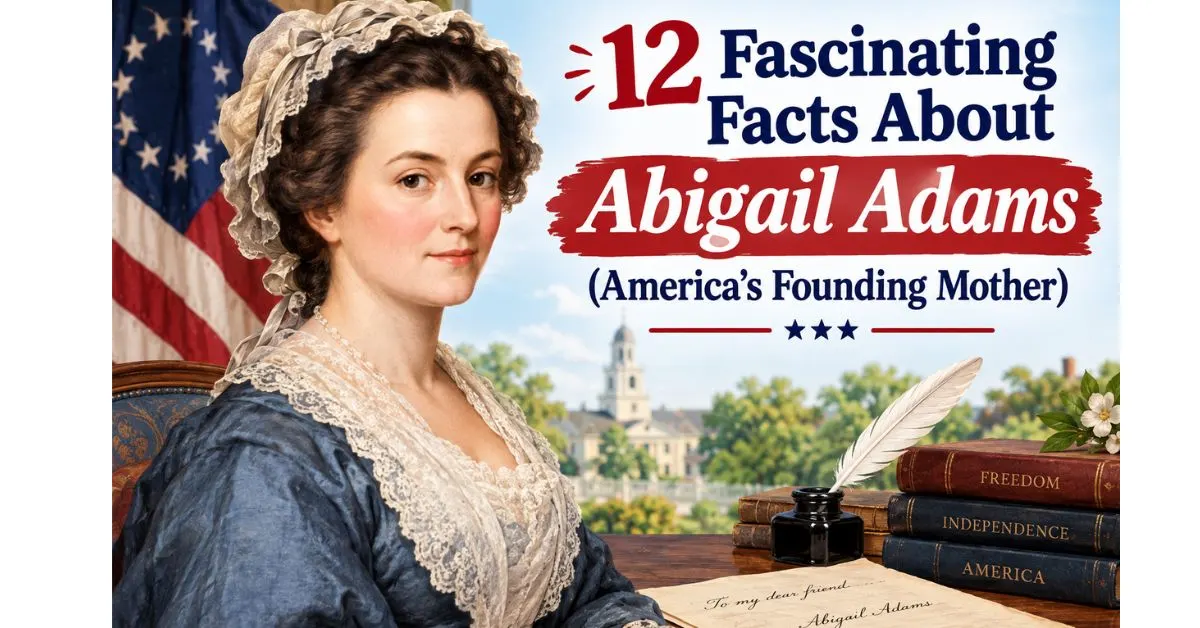
12 Fascinating Facts About Abigail Adams (America’s Founding Mother)
Abigail Adams was never content to sit quietly in the background of history, and that is exactly why these facts about Abigail Adams still feel fresh today. As someone who has spent years reading early American letters, I still get chills reading her handwriting on a Massachusetts farm two centuries ago. She managed a household, ran a family farm, and quietly shaped the politics of a brand-new nation.
If you’ve ever wondered how one woman became both a president’s wife and a president’s mother, this list of facts about Abigail Adams answers that question directly. We’ll walk through her letters, her politics, her friendships, and her fights all backed by primary sources and historical records, so you leave with the real story, not just trivia.
Facts About Abigail Adams: Confusion Still Surrounds Her Real Birth Date
Most timelines list Abigail Adams’s birthday as November 11, 1744, but the modern Gregorian calendar actually places it on November 22. This calendar mix-up happened because colonial New England still used the outdated Julian system. It’s a small but genuinely fascinating quirk in her biography.
Britain didn’t switch to the Gregorian calendar until 1752, well after Abigail’s birth in Weymouth, Massachusetts. Historians and biography sites still list both dates, which is why fact-checkers researching Abigail Adams often stumble on this exact discrepancy first.
Facts About Abigail Adams: She Never Had Formal Schooling and Taught Herself Everything
Frequent childhood illness and the norms of colonial New England meant Abigail never attended a formal school. Instead, she taught herself from her father’s and grandfather’s private libraries, reading Shakespeare, history, and philosophy on her own terms and pace.
Her brother-in-law later introduced her to French and classical literature, sharpening the sharp political mind she’d later use as an advisor and correspondent. This self-driven education became the foundation for her lifelong advocacy of women’s schooling.
Facts About Abigail Adams: Her Letters Were Full of Honest Spelling Mistakes
Because standardized spelling wasn’t taught to colonial girls, Abigail’s letters contained charming errors like “perticular” and “benifit.” She was self-conscious about it, once apologizing for her “very incorrect Letter,” even though her ideas were sharper than most men’s around her.
Facts About Abigail Adams: She Melted Her Own Spoons Into Bullets During the Revolution
During the chaos of the Battle of Bunker Hill in 1775, Abigail watched smoke rise over Charlestown with her young son, John Quincy, beside her. When cannon fire shook their farmhouse, she didn’t freeze; she acted, melting pewter spoons into musket balls for rebel soldiers.
This wartime resourcefulness reflects a recurring theme in facts about Abigail Adams: she treated the Revolutionary War as a shared burden, not a distant event. She also sheltered patriot troops and Boston refugees at the family’s Braintree farm during that same turbulent year.
Facts About Abigail Adams: She and John Exchanged Over 1,100 Letters
John Adams’s law career, congressional work, and diplomatic missions kept him away from home for years at a stretch. Abigail and John bridged that distance through more than 1,100 surviving letters, an archive historians now treat as one of the richest firsthand records of the founding era.
These letters cover independence, war strategy, farm management, and tender affection alike. Abigail once called John her “dearest friend,” and their correspondence remains a cornerstone reference whenever historians discuss facts about Abigail Adams and the Revolutionary home front.
Facts About Abigail Adams: She Told John to “Remember the Ladies”
On March 31, 1776, while John prepared for debates that shaped the Declaration of Independence, Abigail wrote her most famous line: remember the ladies, and don’t put “unlimited power” into husbands’ hands. It’s arguably the single most quoted moment in early American women’s rights history.
John brushed it off with a joking reply, and formal legal change didn’t follow. Still, Abigail kept pushing for women’s education and property rights throughout her life, making this letter a genuine landmark among facts about Abigail Adams and her political legacy.
Facts About Abigail Adams: Her Friendship with Thomas Jefferson Went Cold, Then Warm Again
Abigail and Jefferson bonded in Paris in 1784 over gardens, songbirds, and lively conversation, becoming genuine transatlantic pen pals. Jefferson privately called her “one of the most estimable characters on earth,” a rare compliment from the future third president.
Their warmth cooled sharply after Jefferson defeated John Adams in the bitter 1800 election. Years later, a condolence letter from Abigail after Jefferson’s daughter died helped thaw the friendship, and by 1811 the two founding families were writing warmly again.
Facts About Abigail Adams: She Vehemently Opposed Slavery
Long before abolition became a mainstream political cause, Abigail wrote plainly that she wished “there was not a slave in the province.” She pointed out the glaring hypocrisy of American revolutionaries demanding liberty while enslaving other human beings, a stance well ahead of most peers.
She also personally tutored a free Black servant boy in reading and writing, then enrolled him in a local school despite a neighbor’s objections. Her sharp response defending his right to education is one of the more striking, lesser-known facts about Abigail Adams’s character.
Facts About Abigail Adams: She Was the First Presidential Wife to Live in the White House
When the Adams family moved to the new capital in November 1800, Abigail became the first presidential spouse to occupy the still-unfinished White House. Rooms lacked plaster, insulation was poor, and she famously used the unfinished East Room to dry the family’s laundry.
Guests at an awkward Christmas gathering reportedly shivered through the cold, half-finished mansion. Despite the discomfort, Abigail managed the household with her usual practical resolve, a detail that appears in nearly every serious account of facts about Abigail Adams’s presidency years.
Facts About Abigail Adams: She Was Mom to a Future President, John Quincy Adams
Abigail personally educated her son John Quincy Adams during John’s long absences, pushing him toward history, poetry, and public service from an early age. He would go on to become the sixth president of the United States, making Abigail one of only two women in American history to be both a president’s wife and a president’s mother.
Her hands-on parenting and constant political conversation clearly shaped his worldview and diplomatic career. Historians frequently cite this dual legacy first among memorable facts about Abigail Adams whenever discussing her lasting influence on the early republic.
Facts About Abigail Adams: She Survived a Smallpox Inoculation on Purpose
At a time when inoculation was new, controversial, and genuinely risky, Abigail chose to undergo the smallpox procedure deliberately rather than risk catching the disease naturally. She later arranged inoculations for her household during outbreaks, prioritizing family safety over popular fear.
This decision reveals a scientifically minded, pragmatic side often overlooked in casual retellings. It’s a small but telling entry among facts about Abigail Adams that shows her willingness to embrace evidence over superstition, even when it frightened her contemporaries.
Facts About Abigail Adams: She Spent Years in Europe and Met King George III
When John served as America’s first ambassador to Britain, Abigail joined him in London from 1785 to 1788, curtsying before the very king America had just fought a war against. She earlier spent time in Paris too, observing French customs with sharp, often skeptical wit.
Despite the diplomatic glamour, she repeatedly wrote that she preferred her quiet New England farm to European court life. This grounded homesickness is a recurring, humanizing thread running through facts about Abigail Adams’s years abroad as a diplomat’s wife.
Facts About Abigail Adams: Her Later Life and Death in Quincy, Massachusetts
After John lost re-election in 1800, the couple retired to their Quincy farm, finally enjoying steady time together after decades of separation. Abigail remained politically engaged through letters until her health declined, and personal grief—including her daughter Nabby’s death from cancer—marked her final years.
Abigail Adams died of typhoid fever on October 28, 1818, at age 73, with John at her bedside. She was buried at Quincy’s United First Parish Church, later joined by John and their son John Quincy, cementing one of the most complete family legacies in facts about Abigail Adams and the founding generation.
Quick-Reference Table: Abigail Adams at a Glance
| Fact Category | Key Detail |
| Born | November 22, 1744 (Gregorian) / November 11, 1744 (Julian), Weymouth, MA |
| Died | October 28, 1818, Quincy, MA (age 73) |
| Married John Adams | October 25, 1764 |
| Letters exchanged with John | Over 1,100 |
| Famous quote | “Remember the ladies” (March 31, 1776) |
| First Lady years | 1797–1801 |
| Notable son | John Quincy Adams, 6th U.S. President |
| Historic distinction | First presidential wife to live in the White House |
FAQ Section
What is Abigail Adams best known for?
She’s best known for her “remember the ladies” letter urging John Adams to consider women’s legal rights while drafting new laws, and for being both a president’s wife and a president’s mother.
How many letters did Abigail and John Adams write to each other?
Their surviving correspondence totals more than 1,100 letters, spanning courtship, war, diplomacy, and the presidency.
Did Abigail Adams support women’s rights?
Yes. She advocated for women’s education and property rights throughout her life, though she never publicly championed women’s suffrage, which was virtually unheard of in her era.
Was Abigail Adams the first First Lady to live in the White House?
Yes, she moved into the still-unfinished White House in November 1800, famously drying laundry in the unfinished East Room.
What did Abigail Adams do during the Revolutionary War?
She managed the family farm and finances alone, melted pewter spoons into musket balls for soldiers, sheltered refugees, and kept John informed through detailed political letters.
How did Abigail Adams die?
She died of typhoid fever on October 28, 1818, at her home in Quincy, Massachusetts.

Hi, I’m Benjamin, the person behind FactsAboutDog.com. 🐶
I’m passionate about dogs and love sharing interesting, fun, and educational facts about our furry friends. Through FactsAboutDog.com, I aim to make learning about dogs simple, enjoyable, and informative for dog lovers everywhere.
From amazing dog facts to breed information and fascinating animal knowledge, my goal is to help readers discover something new every day.
Explore the world of dogs with Benjamin at FactsAboutDog.com!





One Comment