
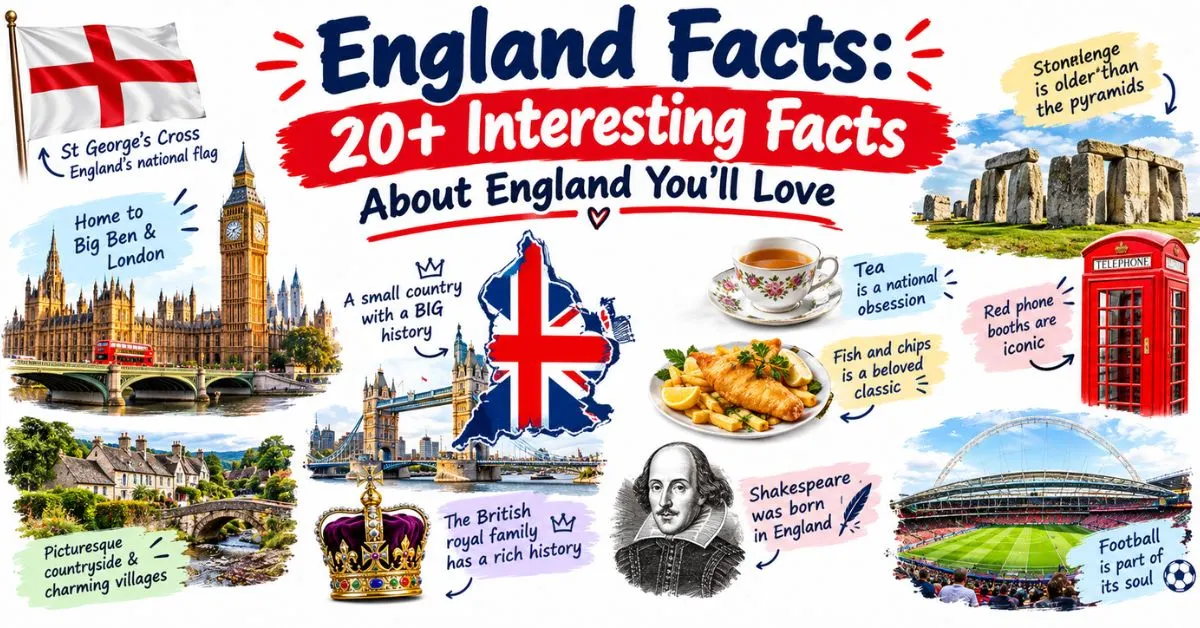
England Facts: 20+ Interesting Facts About England You’ll Love
What’s the most interesting fact about England? It’s probably not what you expect England has laws against swearing, a competition where people chase cheese down a cliff, and a garden that can legally kill you. Having researched British history and culture for years, I’ve pulled together the interesting facts about England that locals actually talk about, not just the ones in every travel brochure.
This isn’t a recycled list. Every fact here is pulled from verified history, English law, and cultural records, covering everything from the Norman Conquest to the English Channel. If you’ve ever felt like England facts online all sound the same, this guide digs deeper into the royal family, Stonehenge, the English language, and the quirky traditions that make this island nation genuinely one of a kind.
England vs. the UK vs. Great Britain
One of the most common mix-ups when people search for interesting facts about England is the terminology itself. England is just one of four nations making up the United Kingdom, alongside Scotland, Wales, and Northern Ireland. Great Britain refers only to the island shared by England, Scotland, and Wales.
England is the largest of the four by population and land area, home to over 56 million people. The capital city, London, sits along the River Thames and anchors the country’s political, cultural, and economic life making this distinction essential before exploring any deeper English history.
London Bridge Is No Longer in London
Here’s a genuinely surprising English history fact: the original London Bridge was dismantled and shipped to Lake Havasu City, Arizona, in the 1970s. An American businessman bought it, rebuilt it stone by stone, and created an English-themed village around it in the Arizona desert.
French Was Once the Official Language of England
Among the most fascinating interesting facts about England is that English wasn’t always dominant. After William the Conqueror’s 1066 Norman invasion, French became the language of the nobility, law, and administration for nearly 300 years, reshaping English culture permanently.
Roughly 7,000 French words entered English during this period everyday terms like “hotel,” “soup,” and “honesty.” English only returned to official use once Henry IV took the throne in 1399, the first fluent English-speaking monarch in over two centuries, restoring the English language to the royal court.
Winchester Was England’s First Capital
Long before London took the crown, Winchester served as the capital of Anglo-Saxon Wessex, particularly under King Alfred the Great in the 9th century. Its cathedral dates to 642 AD, making it one of England’s oldest centers of royal power and religious history.
Stonehenge Is Older Than the Great Pyramids
Few interesting facts about England capture the imagination like Stonehenge. This ancient stone circle on Salisbury Plain predates the Great Pyramid of Giza by roughly 500 years and the Roman Empire by millennia, making it one of the oldest surviving monuments on Earth.
Archaeologists believe Stonehenge served as a burial ground, religious site, and possibly an astronomical observatory for hunter-gatherer and early farming communities. Its true purpose remains debated, which only deepens the mystery surrounding England’s prehistoric landscape and ancient heritage.
England’s Annual Cheese Rolling Competition
No list of interesting facts about England is complete without Cooper’s Hill. Every year in Gloucestershire, competitors chase an eight-pound wheel of Double Gloucester cheese down a dangerously steep hill, reaching speeds up to 70 miles per hour as it tumbles toward the finish line.
This bizarre English tradition dates back to at least 1826, with possible pagan origins. Injuries are common, ambulances wait at the bottom, and the first person across the line simply wins the cheese a strange but beloved piece of English countryside culture.
Wife-Carrying Is Also a Traditional Sport
In Dorking, Surrey, the annual Wife-Carrying Race sends husbands sprinting through a 380-meter obstacle course while carrying their partners. The winning English couple takes home a cash prize, while the last-place finishers receive a consolation bag of dog food.
All the Swans in England Belong to the Crown
Among England’s strangest legal facts: every unmarked mute swan in open waters legally belongs to the monarch. This English royal tradition dates to the 12th century, when swans were considered a delicacy reserved for aristocratic banquets and feasts.
A Queen’s Swan Marker still oversees the annual swan census on the Thames River. Harming a royal swan has historically carried serious legal consequences, reflecting how deeply English common law intertwines with centuries-old royal customs and wildlife protection.
The King Owns All the Dolphins in British Waters
A 1324 statute under King Edward II declared marine animals within English waters including dolphins, whales, and sturgeons property of the Crown. This 700-year-old English law technically remains in effect, meaning King Charles III legally owns these creatures today.
England Is the Birthplace of Many Famous Scientists
England’s contribution to global science is one of its most impressive interesting facts. Isaac Newton developed calculus and the laws of gravity; Charles Darwin reshaped biology with evolutionary theory; Stephen Hawking advanced modern cosmology all born and educated on English soil.
Universities like Oxford and Cambridge, among the oldest in the world, have produced generations of English researchers, authors, and world leaders. This academic legacy continues to shape England’s reputation as a global center for scientific discovery and innovation.
An Englishman Invented the World Wide Web
Sir Tim Berners-Lee, an English computer scientist, invented the World Wide Web in 1989 while working at CERN in Switzerland. He was simply trying to help fellow scientists share documents more easily across different computer systems.
His invention of hypertext links and standardized web protocols fundamentally changed how humanity communicates. It’s a quietly remarkable English history fact that something as global as the internet traces back to one English scientist solving a workplace problem.
England Won the FIFA World Cup in 1966
Football runs deep in English culture, and England’s single World Cup victory remains a defining national memory. The English national team beat West Germany 4–2 at Wembley Stadium in 1966, a result still celebrated across English football culture today.
The English Premier League has since become one of the most-watched sports leagues globally, with clubs like Manchester United and Liverpool drawing international fandoms. England’s women’s team added to this legacy by winning the UEFA Euros in 2022.
England Also Produced Legendary Rock Bands
Beyond football, England gave the world The Beatles, The Rolling Stones, Led Zeppelin, Pink Floyd, and Queen. These English rock bands sold hundreds of millions of albums worldwide, cementing England’s lasting influence on global music culture.
Many Iconic Literary Figures Come From England
England’s literary history begins with William Shakespeare, whose 16th-century plays introduced countless phrases still used in English today, like “all that glitters isn’t gold.” His influence on the English language is arguably unmatched by any other writer.
Since Shakespeare, England has produced literary giants including Charles Dickens, Jane Austen, Roald Dahl, Agatha Christie, and J.K. Rowling. This unbroken literary tradition is one of the clearest threads connecting England’s past to its modern global cultural identity.
England Has Laws Against Public Swearing
Despite England’s polite reputation, public profanity has technically been illegal for centuries. An English law dating to 1623 forbade “profane swearing and cursing,” and the Public Order Act of 1986 later criminalized “insulting words” in public spaces.
Although a 2011 court ruling softened enforcement, public swearing in England remains officially against the law. It’s one of those surprising English legal facts that contradicts the country’s famously reserved, tea-drinking stereotype in a genuinely funny way.
Henry VIII Also Taxed Beards
English monarchs have a history of unusual taxation. A 1585 beard tax, often attributed to the Tudor period, reportedly charged men based on their social rank for the privilege of wearing facial hair one of English history’s stranger legal quirks.
There’s a Garden in England That Could Kill You
The Poison Garden at Alnwick Castle in Northumberland holds over 100 species of toxic and deadly plants, locked behind iron gates warning visitors not to touch, smell, or taste anything inside. It’s one of England’s most unexpectedly dangerous attractions.
Species inside include cherry laurel, which releases cyanide when broken, and coca plants, the source of cocaine. This macabre English garden draws over 600,000 visitors annually, proving danger can be a surprisingly effective tourism strategy in the English countryside.
A King Was Once Gifted a Polar Bear
In 1252, King Haakon IV of Norway gifted King Henry III a live polar bear an animal no one in England had ever seen. Handlers reportedly let it swim and fish in the Thames River, drawing enormous crowds of curious Londoners.
Interesting Facts About England Wrapped Up
From cheese chasing to royal swans, these interesting facts about England reveal a country shaped by centuries of law, monarchy, science, and eccentric tradition. England’s history isn’t just castles and crowns it’s oysters, beard taxes, and poisonous gardens too.
Whether you’re planning a trip or just deepening your knowledge of English culture, these facts show why England continues to fascinate people worldwide. Its blend of ancient history and modern influence makes it one of the most endlessly interesting countries on Earth.
FAQ Section
What are 5 interesting facts about England?
England has an annual cheese-rolling competition, Stonehenge predates the pyramids, French was once its official language, public swearing is technically illegal, and an Englishman invented the World Wide Web.
What is England best known for?
England is best known for its monarchy, Stonehenge, Shakespeare, the Premier League, and London landmarks like Big Ben and the Tower of London.
What is England famous for inventing?
England is credited with inventing the World Wide Web, sparkling wine (methode champenoise), modern football rules, and the steam engine’s industrial applications.
What is the capital of England?
London is the capital of England and also serves as the capital of the United Kingdom.
What is the national dish of England?
Chicken tikka masala is widely considered England’s unofficial national dish, despite originating from British-Indian culinary fusion rather than traditional English cooking.
Does England have mountains?
England has hills and fells rather than true mountains, with Scafell Pike in the Lake District being its highest peak at 978 meters.
Who was the first king of England?
Athelstan, grandson of Alfred the Great, is widely regarded as the first king to rule all of England, beginning in 927 AD.
What are three interesting facts about the UK?
The UK Parliament dates to the 13th century, the London Underground is the world’s oldest metro system (opened 1863), and the UK comprises four distinct nations.

Hi, I’m Benjamin, the person behind FactsAboutDog.com. 🐶
I’m passionate about dogs and love sharing interesting, fun, and educational facts about our furry friends. Through FactsAboutDog.com, I aim to make learning about dogs simple, enjoyable, and informative for dog lovers everywhere.
From amazing dog facts to breed information and fascinating animal knowledge, my goal is to help readers discover something new every day.
Explore the world of dogs with Benjamin at FactsAboutDog.com!


One Comment