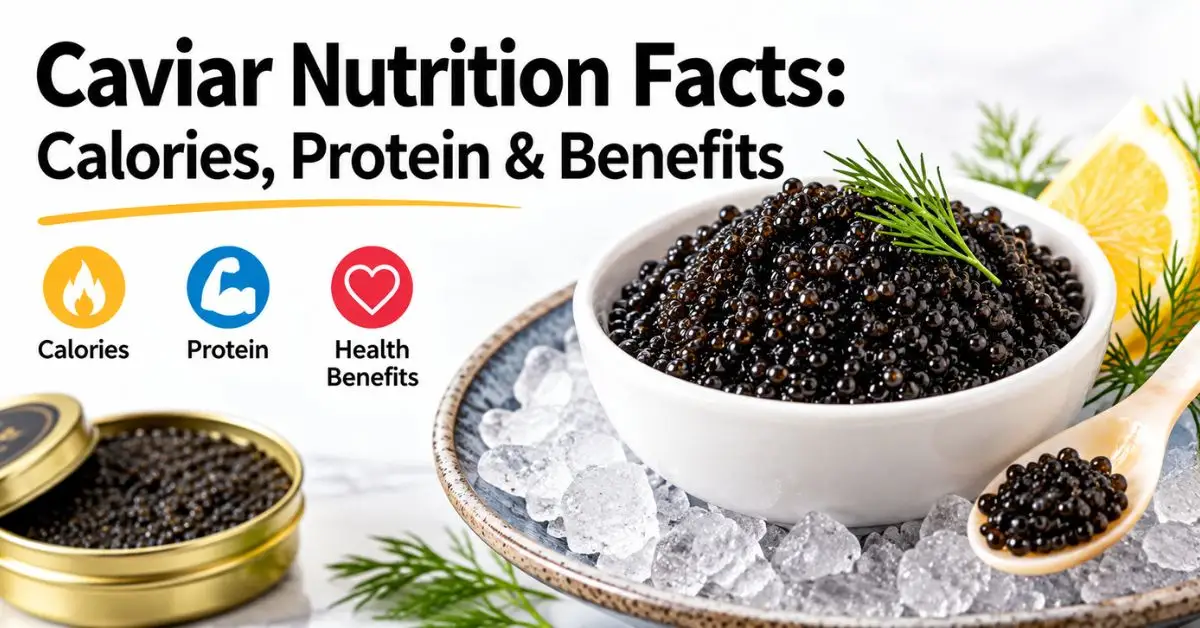
Caviar Nutrition Facts: Calories, Protein & Benefits
Caviar nutrition facts show that a single one-ounce serving delivers roughly 75 calories, 7 grams of complete protein, close to 1,800 mg of combined EPA and DHA omega-3s, and over 200% of your daily vitamin B12 all from cured sturgeon roe. For most people, caviar still reads as pure indulgence: a champagne-toast prop, not something you’d actually check against a Nutrition Facts panel.
Having spent time cross-referencing tins from Osetra to salmon roe against USDA FoodData Central and current FDA labeling rules, I’ve found the real story sits in the label, not the price tag. This guide breaks calories, protein, omega-3s, sodium, and vitamins down per serving so you can decide, with real numbers, whether caviar earns a spot on your plate.
Caviar Nutrition Facts at a Glance
The fastest way to understand caviar nutrition facts is a reference table, not a paragraph. USDA Standard Reference data for “fish, caviar, black and red, granular” gives a consistent baseline, though your specific tin’s label shaped by species, cure, and salt level should always be the final word for that product.
Use gram weight, not spoon size, to compare two labels fairly. A tablespoon (16 g) and an ounce (28 g) are the two serving sizes you’ll see most often on US labels and in nutrition databases, so the table below shows both side by side.
| Nutrient | Per 1 tbsp (16 g) | Per 1 oz (28 g) | % Daily Value (per oz) |
| Calories | 42 | 75 | — |
| Protein | 3.9 g | 7.0 g | 14% |
| Total fat | 2.9 g | 5.1 g | 7% |
| Carbohydrate | 0.6 g | 1.1 g | <1% |
| Sodium | 240 mg | 425 mg | 18% |
| Cholesterol | 94 mg | 167 mg | 56% |
| Vitamin B12 | 3.2 mcg | 5.7 mcg | 236% |
| Iron | 1.9 mg | 3.4 mg | 19% |
| Selenium | 10.5 mcg | 18.6 mcg | 34% |
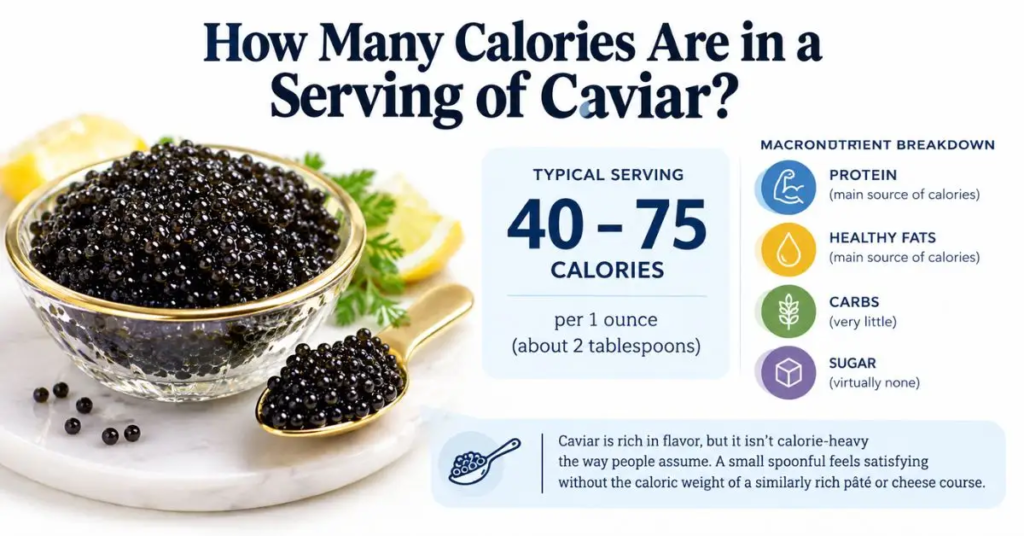
How Many Calories Are in a Serving of Caviar?
Caviar is rich in flavor, but it isn’t calorie-heavy the way people assume. A typical serving is one ounce roughly two tablespoons and it lands somewhere between 40 and 75 calories depending on the species and how the roe was cured, according to USDA reference values.
Most of those calories come from protein and healthy fat, not carbohydrate; caviar carries virtually no sugar and only trace carbs. That macronutrient split is why a small spoonful feels satisfying without the caloric weight of a similarly rich pâté or cheese course.
How Much Protein Does Caviar Contain?
One ounce of caviar contains about 7 grams of protein, and because it comes from fish eggs, it’s a complete protein meaning it supplies all nine essential amino acids your body can’t make on its own. That’s a meaningful concentration for such a small portion.
Amino acids from caviar’s protein support muscle repair, enzyme production, and tissue maintenance. Note that some US labels skip a protein %DV entirely; the FDA doesn’t require one unless the package makes a protein claim, so the grams-per-serving figure is what to track.
Caviar Fat Content and Omega-3 Benefits
About 3 to 6 grams of fat sit in a one-ounce serving, and the type matters more than the quantity. Caviar is unusually concentrated in omega-3 fatty acids specifically EPA and DHA the same marine fats prized in salmon and other fatty fish.
A single ounce supplies close to 1,800 mg of combined EPA and DHA, well above the 250–500 mg per day most health authorities recommend for cardiovascular maintenance. That concentration is a large part of why caviar nutrition facts read so favorably despite the rich mouthfeel.
Vitamins and Minerals in Caviar Nutrition Facts
Beyond protein and fat, caviar delivers meaningful micronutrients in a compact form: vitamin B12, selenium, iron, magnesium, and smaller amounts of vitamins A, D, and E. Vitamin B12 stands out hardest one ounce supplies well over 200% of the daily recommended value.
Selenium acts as an antioxidant mineral tied to immune regulation, while iron and magnesium support oxygen transport and energy metabolism. Worth noting: caviar contains no dietary fiber and is naturally gluten-free, which fits it into most special-diet frameworks.
How to Read Sodium on a Caviar Label
Salt is what cures the roe, so sodium is the number to watch. A typical ounce runs 240 to 425 mg depending on brand and cure method roughly 18% of the FDA’s 2,300 mg daily sodium reference for most adults in one serving.
The FDA calls 20% DV “high” and 5% DV “low” per serving, so caviar sits near that upper boundary. “Malossol,” often translated as “little salt,” describes the curing style but isn’t a substitute for reading the milligrams printed on the actual label.
May Promote Heart Health
Omega-3 fatty acids are among the most studied nutrients for cardiovascular support, and caviar delivers both EPA and DHA in a bioavailable, whole-food form. Research links regular omega-3 intake to lower triglycerides, improved cholesterol balance, and reduced platelet clumping.
Caviar carries no trans fat and negligible carbohydrate, which keeps its overall fat profile favorable even with the sodium factored in. That said, most of this evidence comes from omega-3 research broadly direct human studies on caviar intake and heart outcomes are still limited.
May Improve Brain and Mental Health
DHA is a structural fat in brain tissue, and adequate DHA intake has been associated with better cognitive performance and a lower risk of age-related decline. Caviar’s B12 content adds to this by supporting the nerve-insulating myelin sheath.
Some research also connects omega-3 intake to mood regulation, with lower blood levels of EPA and DHA observed in people experiencing depression. These links are promising but largely drawn from omega-3 research generally, not caviar-specific human trials.
May Support Your Immune System
Selenium plays a direct role in immune regulation by supporting antioxidant selenoproteins and increasing antibody production, and caviar is a genuine source of it at roughly one-third of the daily value per ounce. Omega-3s add anti-inflammatory support on top of that.
Together, these nutrients help maintain the barrier function of skin, gut, and lung tissue the body’s first lines of defense. As with the other benefit categories here, most supporting research is on the isolated nutrients, not caviar consumption specifically.
Comparing Caviar to Other High-Protein Luxury Foods
Foie gras, aged cheese, and charcuterie share the tasting-menu spotlight with caviar, but their nutrition profiles diverge sharply. Ounce for ounce, caviar tends to carry fewer calories than rich pâtés while delivering more omega-3 fat than most dairy-based appetizers.
| Food (per 1 oz) | Calories | Protein | Omega-3s |
| Caviar | ~75 | 7 g | ~1,800 mg EPA+DHA |
| Salmon | ~58 | 6 g | ~400–650 mg |
| Foie gras | ~130 | 2.5 g | minimal |
| Aged cheese | ~110 | 7 g | minimal |
Unlike heavily processed charcuterie, quality caviar is simply roe, salt, and sometimes a preservative a shorter ingredient list than most of what shares its serving plate. That simplicity is a meaningful part of why its nutrient density holds up so well per gram.
Is Caviar Healthy to Eat?
The direct answer is yes, in sensible portions. Caviar is nutrient-dense, delivers complete protein, and is one of the more concentrated whole-food sources of omega-3s available genuinely rare qualities for a food eaten by the spoonful rather than the plateful.
The tradeoff is sodium and, to a lesser extent, cholesterol. For healthy adults eating it occasionally a tasting portion of 15 to 30 grams, a few times a month caviar fits comfortably into a balanced diet. Anyone managing blood pressure should treat portion size with more care.
FAQ Section
How much protein is in one ounce of caviar?
One ounce of caviar contains about 7 grams of complete protein, supplying all nine essential amino acids in a single small serving.
Is caviar high in sodium?
Yes, relatively a typical ounce contains 240 to 425 mg of sodium, or roughly 18% of the FDA’s daily reference value, because the roe is cured in salt.
Does caviar have omega-3 fatty acids?
Yes. A one-ounce serving supplies close to 1,800 mg of combined EPA and DHA, well above the 250–500 mg most health authorities recommend daily.
Are sturgeon caviar and salmon roe nutrition facts the same?
No. They’re different species with different processing and salt levels, so their label values differ always compare two products at the same gram weight rather than assuming parity.
Can caviar fit into a balanced diet?
Yes, in traditional serving sizes. Its nutrient density means a small portion delivers meaningful protein, healthy fat, and vitamins without a large calorie load.
Does the caviar label include the nutrition from blinis or crème fraîche?
No. The Nutrition Facts panel reflects the packaged caviar only; separately purchased accompaniments need to be calculated from their own labels.

Hi, I’m Benjamin, the person behind FactsAboutDog.com. 🐶
I’m passionate about dogs and love sharing interesting, fun, and educational facts about our furry friends. Through FactsAboutDog.com, I aim to make learning about dogs simple, enjoyable, and informative for dog lovers everywhere.
From amazing dog facts to breed information and fascinating animal knowledge, my goal is to help readers discover something new every day.
Explore the world of dogs with Benjamin at FactsAboutDog.com!