60+ Interesting Facts About Iron That Will Surprise You
Iron is quietly running your bloodstream, your city’s skyline, and the planet beneath your feet right now. I’ve spent years digging through metallurgy reports and nutrition science, and iron still surprises me it’s the fourth most abundant element in Earth’s crust, the main ingredient in steel, and the reason your blood is red. If you’ve ever wondered why this unassuming gray metal matters so much, you’re not alone; most people underestimate it entirely.
This guide pulls together the most reliable, research-backed interesting facts about iron, covering its chemistry, its physical properties, its role inside the human body, and its everyday uses in construction and manufacturing. Whether you’re a student, a parent helping with homework, or just curious, you’ll walk away understanding why iron, not gold or aluminum, is arguably civilization’s most important metal.
Interesting Facts About Iron
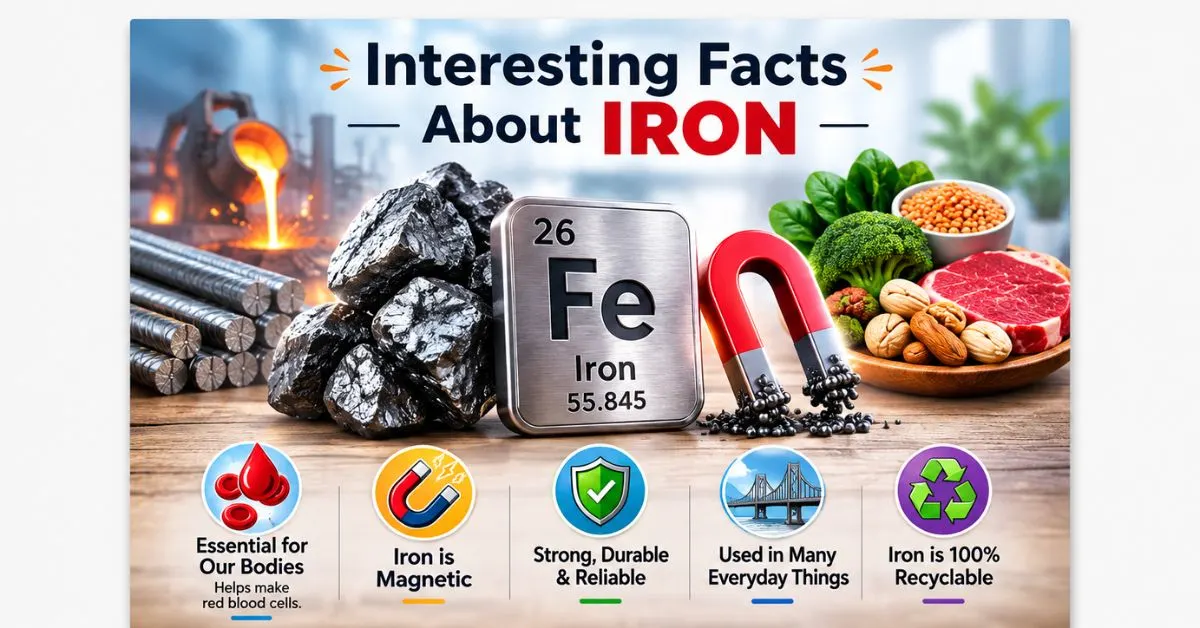
Iron earns its reputation as one of the most important elements on the periodic table, and the numbers back it up. It’s a ferrous metal that’s malleable, ductile, and naturally magnetic, sitting at atomic number 26 with the chemical symbol Fe borrowed from the Latin word ferrum. Understanding these basics sets up everything else on this list.
Beyond raw chemistry, iron’s story touches biology, astronomy, and human history all at once. It’s essential for hemoglobin production, it forms inside dying stars, and it launched an entire era of human technology. Few elements connect so many different fields the way iron does, which is exactly why it deserves closer attention.
Iron Is One of the Most Abundant Elements on Earth
Iron makes up roughly 5% of Earth’s crust, ranking as the fourth most abundant element after oxygen, silicon, and aluminum. It’s mined from ore-bearing rock and refined through smelting. This natural abundance is exactly why iron and steel remain so affordable and widely used worldwide.
Iron Is Essential for All Living Organisms
Hemoglobin, the oxygen-carrying protein in red blood cells, depends entirely on iron to function properly. Without adequate dietary iron, your body cannot manufacture enough healthy blood cells. This single nutritional fact explains why iron deficiency is one of the most common health concerns globally.
Iron Has Been Used by Humans for Thousands of Years
Long before modern metallurgy, ancient civilizations shaped iron into tools, weapons, and jewelry, some pieces dating back over 5,000 years. This extensive use eventually ushered in the Iron Age. Few materials have shaped human technological progress as consistently across so many centuries.
Iron Is Magnetic
Iron is the most naturally magnetic element on the periodic table, a property called ferromagnetism. This is why compasses, electromagnets, and MRI machines rely on it so heavily. Interestingly, not every iron alloy behaves this way some stainless steels resist magnetization entirely.
Iron Is Found in Stars
Massive stars forge iron in their cores through nuclear fusion, right up until the star can no longer sustain the reaction. When these stars explode as supernovae, iron scatters across space. Some of that stellar iron eventually became part of Earth itself.
Iron Can Rust
Exposing iron to oxygen and moisture triggers oxidation, forming the reddish-brown compound we call rust. This chemical reaction gradually weakens the metal’s structural integrity. Manufacturers often alloy iron with chromium or nickel specifically to slow this natural corrosion process.
Iron Is Used to Make Steel
Steel is simply iron combined with carbon, and roughly 90% of all refined metal produced today becomes steel. You genuinely cannot manufacture steel without iron as its foundation. This single alloy underpins nearly every modern skyscraper, vehicle, and bridge in existence.
Iron Deficiency Is a Common Nutritional Disorder
Low iron intake causes iron deficiency anemia, marked by fatigue, weakness, and reduced immune function. Women, pregnant individuals, and endurance athletes face higher risk due to increased iron needs. A balanced diet rich in lean meat, beans, and leafy greens helps prevent it.
Iron Is a Vital Nutrient for Plants
Plants require iron to synthesize chlorophyll, the pigment responsible for photosynthesis. Without enough iron, leaves turn pale yellow, a condition called chlorosis. This mineral dependency links iron directly to global food production and ecosystem health in ways many people overlook.
Iron Meteorites Come From Outer Space
Meteorites called siderites contain 90% to 95% iron, remnants of shattered asteroids that survived atmospheric entry. Ancient Egyptian iron beads dating to roughly 3200 BC were forged from meteoric iron. This cosmic origin makes early ironworking history genuinely extraordinary.
Fun and Interesting Facts About Iron for Students and Kids
Kids often connect better with iron once they realize it’s inside their own bodies, not just in bridges and buildings. Iron helps carry oxygen through blood, gives Mars its reddish color, and even shows up in breakfast cereal fortification. These relatable examples make chemistry feel tangible.
Classroom-friendly framing also helps students remember iron’s role in history and science together. It powered the Industrial Revolution, forms the Eiffel Tower’s structure, and gets recycled endlessly without losing its useful properties. That blend of everyday relevance and big-picture science keeps young learners genuinely engaged.
| Quick Kid-Friendly Fact | Why It’s Cool |
| Iron is in your blood | Carries oxygen via hemoglobin |
| Mars looks red because of iron | Iron oxide (rust) coats its surface |
| The Eiffel Tower is iron | Weighs around 10,000 tons |
| Iron can be recycled forever | No loss of strength or quality |
| Iron comes from meteorites too | Ancient beads were made from space rocks |
More Interesting Facts About Iron — Ten Fun Iron Trivia Picks
Some of the best iron trivia comes from unexpected corners of language and history rather than a lab. The idiom “too many irons in the fire,” for instance, dates to 1500s blacksmithing, when overloading a forge risked ruining every tool at once. Trivia like this makes iron memorable beyond the periodic table.
History buffs will appreciate that iron’s very name traces back to the Anglo-Saxon word “iren,” while its scientific label, ferrum, gave us terms like “ferrous” metals. The Iron Age itself ran from roughly 1200 to 600 BCE, following the Bronze Age once smelting techniques matured enough for widespread use.
Iron’s Scientific Name Is Ferrum
The periodic table lists iron under its Latin name, ferrum, giving us the abbreviation Fe at atomic number 26. Metal alloys containing iron are classified as “ferrous” metals. The everyday English word “iron,” meanwhile, comes from the older Anglo-Saxon term “iren.”
In History, Iron Describes an Entire Period of Human Development
The Iron Age spanned roughly 1200 to 600 BCE, following directly after the Bronze Age ended. Although iron was more abundant than bronze, refining it into usable steel took longer to master. Once perfected, iron tools and weapons reshaped agriculture, warfare, and trade.
Too Many Irons in the Fire Causes Stress
This common idiom dates back to mid-1500s blacksmithing practices and traditional forge work. An inexperienced smith heating too many iron pieces at once risked ruining several simultaneously. Today the phrase simply means feeling overwhelmed by juggling too many responsibilities.
Interesting Facts About Iron’s Chemistry
Iron’s chemical story stretches back to Mesopotamia around 4000 BCE, though true smelting didn’t emerge until roughly 1500 BCE with the Hittites. As a transition metal in Group 8, iron carries an atomic mass near 55.845 g/mol and a silvery-gray appearance at room temperature. These fundamentals anchor every other fact on this list.
Chemically, iron readily loses electrons to form Fe2+ and Fe3+ ions, enabling compounds like iron oxide and iron sulfate. It melts at roughly 1,538°C and boils near 2,862°C, reactive enough to bond easily with oxygen and other elements. This reactivity is precisely why unprotected iron corrodes so quickly outdoors.
Discovery and History
Evidence of early iron use surfaces in Mesopotamia around 4000 BCE, though true smelting only emerged near 1500 BCE. The Hittites are widely credited with developing this pioneering iron-smelting technique first. Ancient Greek philosophers, including Thales of Miletus, later documented iron’s distinctive magnetic behavior.
Basic Chemistry
Iron belongs to Group 8 of the periodic table, classified as a transition metal with notable reactivity. It commonly forms Fe2+ and Fe3+ ions, producing familiar compounds like iron oxide and iron sulfate. Its ferromagnetic nature also makes it essential for manufacturing magnets and electrical devices.
Interesting Facts About Iron’s Physical Properties
Iron’s physical behavior explains why engineers and manufacturers reach for it constantly. It’s malleable enough to hammer into thin sheets, ductile enough to draw into wire, and dense enough at 7.87 grams per cubic centimeter to suit heavy machinery. These traits rarely coexist so conveniently in a single element.
Temperature and environment also shape how iron performs under pressure. It withstands extreme heat up to its 1,538°C melting point, yet turns brittle in freezing conditions unless alloyed properly. Add solid electrical conductivity and moderate reflectivity, and you get a metal suited for nearly every industry imaginable.
| Physical Property | Iron’s Behavior |
| Malleability | Hammers into thin sheets without breaking |
| Ductility | Draws into thin wire for electrical use |
| Magnetism | Naturally ferromagnetic |
| Melting Point | 1,538°C (2,800°F) |
| Density | 7.87 g/cm³ |
| Corrosion Resistance | Low alone; improves when alloyed |
Malleability
Iron hammers or rolls into thin sheets without fracturing, a property engineers call malleability. This makes it valuable for structural components across construction and heavy manufacturing sectors. Without this trait, shaping iron into usable building materials would be far more difficult.
Ductility
Iron draws into thin wires without losing structural strength, a property known as ductility. This quality proves crucial for electrical wiring and cabling applications worldwide. Combined with decent conductivity, ductile iron cores remain genuinely useful in electrical infrastructure today.
Magnetic Properties
As a ferromagnetic material, iron becomes magnetized and attracts other magnetic substances naturally. This behavior powers magnets, electromagnets, and countless electronic devices we rely on daily. Iron’s magnetism even contributes meaningfully to generating Earth’s own protective magnetic field.
High Melting Point
Iron melts at approximately 1,538°C, or roughly 2,800°F, a genuinely high threshold for metals. This resilience under extreme heat suits automotive parts, machinery components, and large-scale construction projects. Few common metals tolerate this much thermal stress without losing structural integrity.
Conductivity
Iron conducts both electricity and heat reasonably well, making it useful for wiring and cookware alike. Its thermal conductivity distributes heat evenly across cooking pans and radiators. This dual conductivity is part of why iron remains a practical industrial workhorse.
High Density
At 7.87 grams per cubic centimeter, iron ranks among the denser common metals available. This weight advantage benefits heavy machinery, vehicles, and structural components needing substantial mass. Density like this is exactly why iron feels so much heavier than aluminum.
Corrosion Resistance
Left alone, iron corrodes readily when exposed to moisture and oxygen, forming familiar reddish rust. Alloying it with chromium or nickel dramatically improves resistance, producing stainless steel varieties. This single innovation transformed iron from a rust-prone metal into a durable modern material.
Reflectivity
Iron reflects a moderate amount of light, a property exploited in mirror manufacturing and architecture. Coated with a reflective layer, iron-based mirrors became historically significant before modern glass alternatives emerged. This reflectivity also adds aesthetic appeal to iron sculptures and building facades.
Interesting Facts About Iron’s Most Common Uses
Iron’s usefulness extends far beyond raw chemistry into practically every major industry. Construction relies on steel beams and reinforced structures, while transportation depends on iron alloys for automobiles, trains, and railway tracks. These applications alone account for a massive share of global iron consumption.
Manufacturing, healthcare, and household goods round out iron’s everyday footprint. From surgical instruments to cookware and appliances, iron and its alloys appear in objects most people touch daily without realizing it. This sheer versatility is precisely why global steel production still exceeds a billion tonnes annually.
| Industry | How Iron Is Used |
| Construction | Steel beams, bridges, structural framing |
| Transportation | Cars, trains, ships, railway tracks |
| Manufacturing | Machinery, tools, appliances |
| Medical | Hemoglobin function, surgical instruments |
| Household | Cookware, furniture, electronics |
Construction
Iron underpins the construction industry primarily through steel, used in bridges, buildings, and infrastructure projects. Heavy machinery like cranes and bulldozers also depend on iron’s inherent strength. This combination of durability and affordability keeps iron central to nearly every large-scale build.
Transportation
Automobiles, trains, ships, and airplanes all rely on iron and its alloys for structural integrity. These materials withstand the physical stresses transportation demands over years of continuous use. Railway tracks specifically depend on iron’s strength for smooth, reliable, long-distance travel.
Manufacturing
Manufacturers use iron extensively to produce machinery, tools, and everyday household appliances like stoves and refrigerators. Its malleability allows relatively easy shaping into countless different product designs. This adaptability explains why iron remains foundational across so many manufacturing sectors worldwide.
Medical Applications
Iron’s biological role centers on hemoglobin, the protein transporting oxygen throughout the human bloodstream. Doctors frequently prescribe iron supplements for patients diagnosed with iron deficiency anemia. Beyond biology, iron and steel also form surgical instruments and diagnostic equipment like MRI machinery.
Household Items
Cookware, furniture, and decorative pieces frequently rely on iron for its heat conductivity and durability. Cast iron pans, in particular, remain popular for even heat distribution during cooking. Iron also appears inside many electronic devices, including computers, smartphones, and televisions.
20 Interesting Facts About Iron at a Glance
Sometimes the fastest way to absorb information is a straightforward list rather than lengthy explanation. These bite-sized interesting facts about iron cover chemistry, biology, and culture in one convenient reference. Skim them before a test, a trivia night, or simply out of curiosity.
Together, these facts reinforce just how deeply iron threads through daily life, from the minerals in soil to cultural traditions like military decorations. Reviewing them alongside the detailed sections above should leave you with a genuinely well-rounded understanding of this essential metal.
| # | Fact |
| 1 | Iron’s chemical symbol, Fe, comes from the Latin word “ferrum” |
| 2 | It’s the fourth most abundant element in Earth’s crust |
| 3 | Iron is essential for humans, animals, and plants alike |
| 4 | The human body holds around 4 grams of iron |
| 5 | Iron is malleable, ductile, and naturally magnetic |
| 6 | Its melting point sits near 1,535°C |
| 7 | Iron is the core ingredient in steel production |
| 8 | The Iron Age began roughly 1200 BCE |
| 9 | Iron occurs in hematite, magnetite, and taconite minerals |
| 10 | Humans have shaped iron into tools for millennia |
| 11 | Iron supports construction, transportation, and manufacturing |
| 12 | Iron deficiency causes fatigue and weakness |
| 13 | Iron helps produce oxygen-carrying red blood cells |
| 14 | Iron strengthens immune system function |
| 15 | Excess iron can become toxic to organs |
| 16 | The body recycles iron through an internal cycle |
| 17 | Iron forms part of many essential enzymes |
| 18 | Iron helps cells generate usable energy |
| 19 | Iron appears in cultural symbols like the Iron Cross |
| 20 | Iron remains one of history’s most consequential elements |
FAQ: People Also Ask About Iron
Is iron the most abundant metal on Earth?
Iron is the most abundant metal in Earth’s overall composition, especially within the planet’s core, though aluminum is slightly more abundant within the crust specifically. This distinction often causes confusion in casual iron trivia discussions.
Why is iron called ferrum?
Iron’s chemical symbol, Fe, comes from “ferrum,” the Latin word for the metal. This naming convention gave rise to related terms like “ferrous” metals, which describe iron-containing alloys throughout metallurgy and chemistry.
How much iron does the human body actually need?
Adult men generally need about 8 mg of iron daily, while women ages 19–50 typically need around 18 mg due to menstrual blood loss. Pregnant women and endurance athletes often require even more.
Is all iron magnetic?
Not entirely. Pure iron is strongly ferromagnetic, but some iron alloys, including certain stainless steels, resist magnetization unless manufacturers deliberately expose them to an external magnetic field.
What foods are highest in iron?
Iron-rich foods include red meat, poultry, fish, beans, spinach, and iron-fortified cereals. Combining these with vitamin C sources improves how efficiently your body absorbs dietary iron.
Why does Mars look red?
Mars appears red primarily because of iron oxide, or rust, coating much of its surface. This same oxidation process happens on Earth whenever iron meets oxygen and moisture.

Hi, I’m Benjamin, the person behind FactsAboutDog.com. 🐶
I’m passionate about dogs and love sharing interesting, fun, and educational facts about our furry friends. Through FactsAboutDog.com, I aim to make learning about dogs simple, enjoyable, and informative for dog lovers everywhere.
From amazing dog facts to breed information and fascinating animal knowledge, my goal is to help readers discover something new every day.
Explore the world of dogs with Benjamin at FactsAboutDog.com!