
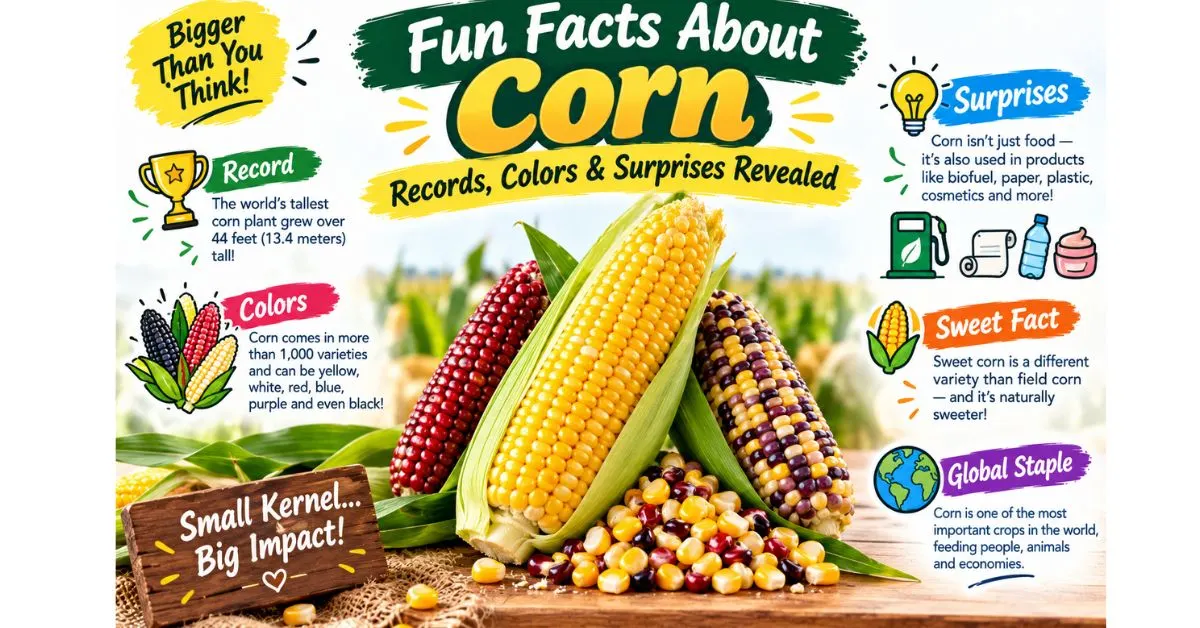
Fun Facts About Corn Records, Colors & Surprises Revealed
Corn began as a scruffy wild grass called teosinte in Mexico about 9,000 years ago, and that’s only the first of many fun facts about corn. As someone who loves digging into crop history, I know how frustrating thin lists that repeat the same trivia can be.
Below, you’ll find verified facts, from maize naming and record-breaking stalks to colorful kernels, popcorn science, and the latest USDA production data. Each section answers a question readers actually ask, so you can learn something genuinely new, share it with the kids at your table, or finally win your next trivia night.
Fun Facts About Corn Corn Comes From Mexico
Corn comes from Mexico, where ancient farmers began cultivating a wild grass called teosinte roughly 9,000 years ago. Through patient selective breeding, those tiny seed heads slowly became the domesticated crop we know today. Remarkably, modern corn no longer exists in the wild.
From Mexico, the crop spread across North America and, after Columbus’s voyages, reached Europe, where it became a staple food. Next time you bite into a tortilla or a bowl of cornflakes, you’re tasting a story that stretches back thousands of years.
Fun Facts About Corn Corn Is Also Called Maize
Corn and maize are the same plant. European explorers took the name maize from the word “mahiz,” used by Indigenous people in the Americas for the tall green stalks they grew. In Europe, the crop was first called Indian corn, which eventually shortened to simply corn.
Which word you use depends on where you live. In the U.S., we say corn. Elsewhere, “corn” can mean any cereal grain, so maize is the clearer, internationally recognized name. That’s why global trade and science writing often favor maize.
Fun Facts About Corn Corn Is a Vegetable, Fruit and Grain
Corn wears three hats. In the kitchen, we treat fresh sweet corn like a starchy vegetable, much like potatoes. Dried kernels, however, are grains that can be milled into flour, which is why corn counts as a whole grain in many nutrition guides.
Botanically, corn is also technically a fruit, because each kernel develops from the plant’s flower and holds a seed, much like a tomato. Its natural sugars are also why corn can be turned into syrup. So the honest answer to “which is it?” is all three, depending on who’s asking.
Fun Facts About Corn Corn Comes in Many Different Colors
Yellow may be the color you picture, but corn grows in nearly every shade imaginable red, blue, purple, black, brown, pink, white, and green. Yellow simply dominates farm fields and grocery shelves. The colors come from the kernel’s natural pigments, which vary across traditional varieties.
My favorite example is Glass Gem corn, a dazzling Indian flint variety whose kernels look like polished stones in red, blue, yellow, and brown. Colorful ears like this are popular for crafts and fall decorations, and they remind us how much diversity lives inside one humble crop.
Fun Facts About Corn The World Record for a Corn Plant Height Is Over 48 Feet
An average corn plant grows around 8 feet tall, which already towers over most kids. But in 2021, Jason Karl grew a stalk measuring 14.69 meters, just over 48 feet, in New York, breaking his own earlier record. That’s roughly the height of a four-story building.
Typical plants range from roughly 5 to 11 feet, so a 48-foot giant is truly extraordinary. Walk through a fall corn maze and even ordinary stalks make you feel tiny. The record shows how far careful plant breeding and growing conditions can push one humble crop.
Fun Facts About Corn Corn Has an Even Number of Rows on Each Cob
Count the kernel rows on any ear of corn and you’ll almost always land on an even number. Most varieties carry between 8 and 20 rows, and a typical ear holds about 800 kernels arranged in 16 rows. It’s a curious pattern that’s easy to test at the dinner table.
Here’s another detail that delights kids every kernel on the ear has its own strand of silk. Those silky threads catch pollen from the tassel above, and each pollinated strand becomes one kernel. Kernel counts can range from roughly 500 to 1,200 per ear.
| Corn measure | Typical figure |
| Kernels per ear | About 800 (range 500-1,200) |
| Kernel rows per ear | 16 is common (range 8-20) |
| Silk strands per ear | One per kernel |
| Average plant height | About 8 feet |
| Record plant height | 14.69 m (over 48 feet) |
| Weight of a bushel | 56 pounds |
Fun Facts About Corn What Are the Different Types of Corn?
Corn isn’t one single thing. Farmers grow several types, including dent, sweet, flint, flour, pod, and popcorn, and most of what’s grown in America isn’t the kind you eat off the cob. Each type has its own texture, starch level, and best purpose.
That variety explains why the grocery-store corn on the cob you love represents only a sliver of the crop. Understanding the main types makes every other corn fact easier to follow, from tortilla chips to ethanol fuel. Here are the three types you’ll meet most often.
Dent Corn
Dent corn gets its name from the small dimple that forms on each kernel as it dries. Also called field corn, it’s the most widely grown corn in the United States, used mostly for livestock feed, ethanol, and thousands of bio-based products, plus some corn flour for tortillas and chips.
Sweet Corn
Sweet corn is the type people actually eat fresh, harvested while kernels are still soft and sugary. It makes up only about 1% of the corn grown in the United States. Field corn, by contrast, is harvested after the plant dries and has far more starch.
Flint Corn
Flint corn, often called Indian corn, has hard, colorful kernels and is more common in Central and South America. There, it’s used much like field corn, mainly as livestock feed. It’s not grown much in the United States, though it turns up at a few agritourism attractions.
Sweet corn vs. field corn fun facts
Timing matters for sweet corn. Fresh ears can lose up to 40% of their sugar after roughly six hours at room temperature, so fresh-picked ears taste best. Field corn, meanwhile, waits in the field until the plant dries, then goes to feed and fuel.
| Type | Also known as | Main use | Where it’s common |
| Dent | Field corn | Livestock feed, ethanol, flour, bio-based products | Most-grown corn in the U.S. |
| Sweet | None | Eaten fresh | Grocery stores, about 1% of U.S. corn |
| Flint | Indian corn | Livestock feed | Central and South America |
| Popcorn | None | Crunchy snack | Varies, kernels come in several colors |
Fun Facts About Corn Corn Is More Than Food
Corn isn’t just for eating. The plant and its kernels end up in cosmetics, glue, fabric, crayons, paint, laundry detergent, plastics, medicines, and even fireworks. One reason is that corn has four building blocks, starch, oil, protein, and fiber, each useful in different industries.
Cornstarch thickens gravy and also appears in biodegradable cups and pill coatings. Dextrin, made from starch, acts as an adhesive in stamps and envelopes and helps bind fireworks. Corn protein even shows up in fish food, so your aquarium guppies may be eating corn too.
Surprising Corn Facts and Uses
Here’s a number that surprises most readers roughly 99% of U.S. corn is field corn, and it feeds a long list of industries. A bushel used for ethanol yields about 2.8 gallons of fuel, plus 18 pounds of livestock feed and 1.8 pounds of corn oil.
Fun Facts About Corn Popcorn Is Made Because of the Corn Kernels Exploding
Popcorn kernels pop because each one has a tough outer hull sealing in a tiny bit of moisture. When heated, that water turns to steam and pressure builds. Around 180°C (356°F), the hull bursts and the starchy inside puffs out into the fluffy snack we love.
Popcorn is similar to field corn, but its hull is especially sturdy, and different varieties grow different kernel colors. That sturdy hull is the secret without it, steam would leak out and the kernel would never pop. So next movie night, thank the hull.
Fun Facts About Corn Corn Is Eaten in Different Countries in Different Ways
Few crops travel as well as corn. Mexico builds iconic dishes around it tamales, pozole, tacos, enchiladas, and tortillas. In Brazil, Romania, and Serbia, cooks make corn porridge under different local names, proving that one simple kernel can inspire very different comfort foods.
In East Africa, thick maize porridge is called ugali, while Malawi and Zambia call it nshima, Zimbabwe says sadza, and South Africa calls it pap. Same grain, different traditions. If you love cornbread or grits, you’re part of that global family.
Fun Facts About Corn The Biggest Producers
The United States is the world’s largest corn producer, responsible for about one-third of global output. USDA projections for the 2025/26 season put the U.S. crop near 432 million metric tons, out of a world total of roughly 1,296 million. China ranks second, followed by Brazil.
Those numbers keep shifting with weather, trade, and planting decisions, so treat them as a snapshot rather than a permanent record. What stays constant is corn’s importance it feeds livestock, fuels cars, and supports farm families and rural towns across the Corn Belt.
More fun facts about corn
Corn grows on every continent except Antarctica, and one acre covers about a football field. A bushel weighs 56 pounds, about a large bag of dog food, and one bushel can sweeten roughly 400 cans of soda. Big numbers, but they’re only the beginning.
Maize and food security
Maize plays a major role in global food security. Rice, wheat, and corn together supply almost two-thirds of the food energy people eat worldwide. In parts of Sub-Saharan Africa, maize accounts for about 20% of food calories, making it a lifeline for millions.
Fun Facts About Corn Corn Is a Sustainable Solution
Modern corn farming looks very different from past generations. Growers now lean on precision technology and regenerative practices to protect land and water. The figures below come from the Wisconsin Corn Growers Association, an industry group, so read them as the farmers’ perspective rather than independent findings.
Healthy soil
Tilling less, planting cover crops, and adding plant diversity all improve soil health. The Wisconsin Corn Growers Association says these regenerative practices helped farmers reduce soil erosion by 67% over the past 30-plus years, keeping valuable topsoil in fields where crops can use it.
Clean water
Precision technology lets farmers place nutrients like nitrogen and phosphorus exactly where plants need them. The group reports today’s growers use about 50% less fertilizer than previous generations, which helps keep excess nutrients out of nearby creeks, streams, and rivers.
Climate
Growing crops pull carbon dioxide from the air and store it in soil, according to the same group. It also says farmers have cut overall energy use by more than 40% in recent decades through technology and efficient equipment. Those are industry-reported figures, so check them against independent research.
Air
Ethanol made from corn burns cleaner than gasoline, and the group says it cuts climate-changing air pollution by nearly 50%. It also points to corn-based bioplastics as a possible renewable alternative to single-use plastics. Whether those benefits hold depends on how the corn is grown and processed.
These fun facts about corn show a crop far bigger than a summer side dish it’s history, science, food, and fuel in one golden package. Corn keeps surprising us, and there’s always another kernel of trivia waiting to be discovered.
Notes
“As someone who loves digging into crop history” aur “My favorite example” personal lines hain. Agar yeh aap par sach nahi baithti to badal dein.
Production numbers USDA ke 2025/26 projections hain USDA ke February 2026 estimate mein US production 432.3 million tons aur world production lagbhag 1,295.9 million tons thi, aur US almost one-third global production ka zimmedar tha. Publish karte waqt latest USDA WASDE se dobara check kar lein.Popcorn section mein maine Seed World ke “starch explodes” wale simple claim ki jagah steam-pressure wali sahi explanation likhi hai.
Height ke competitors mein farq hai purane sources 35 feet 3 inches batate hain, jabke 2021 ka record 48 feet (14.69 m) hai.
11. FAQ Section
(Competitor content se bani hain, asli Google PAA nahi.)
Where does corn come from?
Corn comes from Mexico, where ancient farmers domesticated a wild grass called teosinte roughly 9,000 years ago. Selective breeding turned it into the maize we grow today.
Is corn a vegetable, fruit, or grain?
It’s all three. Fresh sweet corn is eaten as a starchy vegetable, dried kernels are grains, and botanically each kernel is a fruit that holds a seed.
Why does corn have an even number of rows?
Kernels develop in paired rows, so counts are almost always even. Most ears have between 8 and 20 rows, and 16 rows is typical.
What is the difference between sweet corn and field corn?
Sweet corn is picked soft and sugary and eaten fresh. Field corn is starchier, harvested dry, and used mainly for livestock feed, ethanol, and processed products.
How many kernels are on an ear of corn?
A typical ear has about 800 kernels in 16 rows, though counts can range from roughly 500 to 1,200.
Which country grows the most corn?
The United States, which produces about one-third of the world’s corn, followed by China and Brazil.

Hi, I’m Benjamin, the person behind FactsAboutDog.com. 🐶
I’m passionate about dogs and love sharing interesting, fun, and educational facts about our furry friends. Through FactsAboutDog.com, I aim to make learning about dogs simple, enjoyable, and informative for dog lovers everywhere.
From amazing dog facts to breed information and fascinating animal knowledge, my goal is to help readers discover something new every day.
Explore the world of dogs with Benjamin at FactsAboutDog.com!