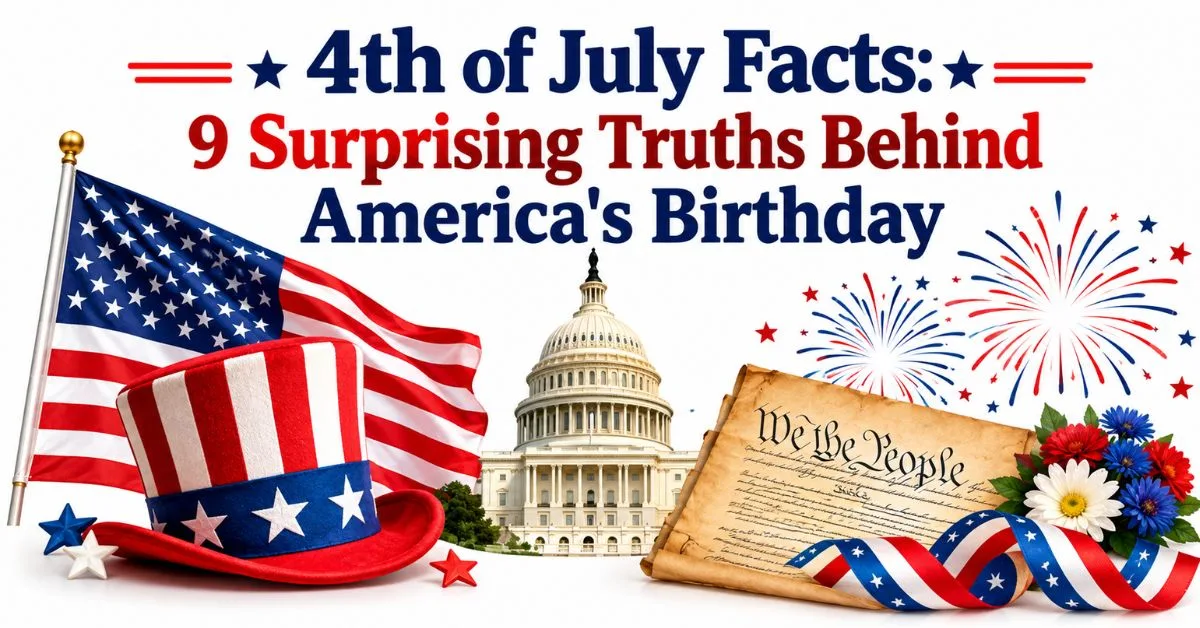
4th of July Facts: 9 Surprising Truths Behind America’s Birthday
Here’s the direct answer: the most surprising 4th of July fact is that independence wasn’t actually declared on July 4th at all. Every year, I watch families gather for fireworks and burgers, repeating the same story we all learned in school and every year, the real history turns out to be stranger and more interesting than the textbook version.
As someone who digs into American history every summer before the holiday, I’ve noticed the same pain point again and again: people want facts they can actually trust, not recycled trivia. This guide pulls together verified, well-sourced 4th of July facts about the Declaration of Independence, the flag, fireworks, and more the kind of details that make your Independence Day cookout conversation genuinely memorable.
4th of July Facts: Independence Wasn’t Declared on July 4th
The Continental Congress actually voted for independence on July 2, 1776, not the Fourth. This single mix-up sits at the center of nearly every list of 4th of July facts, and it still trips up trivia night regulars every summer. John Adams even predicted July 2 not July 4 would become the holiday.
What actually happened on July 4 was the formal adoption of the written Declaration of Independence, the document explaining that decision to the world. That distinction between voting and adopting is subtle, but it’s the foundation for nearly every other Independence Day fact people get wrong at the dinner table.
4th of July Facts About the Declaration’s Surviving Copies
One of the lesser-known 4th of July facts involves the document itself: 26 original copies of the Declaration of Independence are known to still exist today. These rare parchments, sometimes called Dunlap broadsides, were printed the night of July 4 for distribution to the colonies and military commanders.
Historians and archivists continue searching for additional copies, since only a fraction of the original print run has ever been located. Museums, universities, and the National Archives safeguard the surviving originals, treating each one as a irreplaceable piece of the founding story of the United States.
4th of July Facts: The Riot Sparked by the First Public Reading
Here’s a fact that rarely makes it into classroom lessons: George Washington’s reading of the Declaration on July 9, 1776, actually triggered a riot in New York City. Angry colonists, reacting partly to British naval ships occupying the harbor, tore down a statue of King George III.
That toppled statue was later melted down into tens of thousands of musket balls for the Revolutionary Army a striking example of symbolism turning directly into ammunition. It’s one of the more dramatic 4th of July facts connecting the Declaration’s public rollout to the ongoing Revolutionary War effort.
4th of July Facts About the Declaration’s 56 Signers
Among the most repeated 4th of July facts is this one: 56 men signed the Declaration of Independence, yet only two John Hancock and Charles Thomson actually signed on July 4 itself. The rest added their names gradually, with many signatures coming weeks or months later.
Many of these signers never became household names the way Jefferson, Adams, or Franklin did. Some risked their fortunes and safety for a cause history barely remembers them for, which is a humbling reminder that America’s independence was a genuinely collective, high-stakes gamble.
4th of July Facts: When Independence Day Became a Federal Holiday
Independence Day wasn’t made a federal holiday until 1870 nearly a century after the Declaration was adopted. Massachusetts had already recognized July 4 as an official state holiday back in 1781, but it took Congress decades longer to catch up nationally.
Even after 1870, federal employees didn’t receive it as a paid holiday until 1941. This slow, uneven path from spontaneous celebration to official federal recognition is one of the more overlooked 4th of July facts, showing how gradually American traditions can take hold.
4th of July Facts About America’s First Fireworks Display
Fireworks have been part of Independence Day since the very beginning: the first Fourth of July fireworks display lit up the sky in 1777, just one year after the colonies declared independence. Philadelphia held a spontaneous celebration featuring fireworks, bonfires, and bells.
That single display sparked a tradition that now includes roughly 16,000 fireworks shows across the country every year. Watching a modern fireworks finale feels emotional once you realize you’re continuing something Americans have done, uninterrupted, for nearly 250 years.
4th of July Facts: The Oldest Parade Is in the Smallest State
A quirky but well-documented fact: the oldest continuous Fourth of July parade in the country takes place in Bristol, Rhode Island the smallest state in the union. The tradition has run for well over two centuries without stopping.
Small towns like Bristol show how Independence Day traditions often survive best at the local level, far from the national spotlight. It’s a reminder that some of the richest 4th of July facts live in community history rather than in Washington, D.C.
4th of July Facts About the 27 Versions of the U.S. Flag
Between 1777 and 1960, the official United States flag went through 27 different versions. Twenty-five of those changes involved only the star pattern, adjusting as new states joined the union a visual timeline of American growth stitched directly into the flag.
This constant evolution makes the flag one of the most tangible symbols tied to Independence Day facts. Every added star represents a real historical milestone, connecting the flag flown at today’s barbecue directly back to the expanding, changing nation it represents.
4th of July Facts: The President Who Died From a Holiday Meal
Not every Fourth of July story is celebratory. President Zachary Taylor died in 1850 after falling ill from spoiled fruit and iced milk consumed during a July 4th celebration in Washington, D.C. He passed away just days later.
Taylor’s death remains one of the darker, stranger 4th of July facts, alongside the eerie coincidence that Presidents Adams, Jefferson, and Monroe all died on the Fourth of July in later years. It’s proof this holiday carries more history than fireworks alone.
Frequently Asked Questions
What are 5 facts about the 4th of July?
Independence was voted on July 2, not July 4; only two men signed the Declaration on July 4 itself; the first fireworks display happened in 1777; July 4 didn’t become a federal holiday until 1870; and the U.S. flag has had 27 official versions since 1777.
Why is July 4th celebrated?
July 4th is celebrated because that’s the date the Continental Congress formally adopted the Declaration of Independence in 1776, announcing the colonies’ separation from Great Britain, even though the actual vote for independence happened two days earlier.
Did America declare independence on July 4?
No the vote for independence took place on July 2, 1776. July 4 is the date the written Declaration of Independence was formally adopted and dated, which is why that date stuck as the official holiday.
How many people signed the Declaration of Independence on July 4?
Only two people, John Hancock and Charles Thomson, signed on July 4, 1776. The remaining 54 signers added their names over the following weeks and months as the formal parchment copy was prepared.
What is a fun fact about the American flag on July 4th?
The U.S. flag has gone through 27 official versions since 1777, with 25 of those changes made only to the star pattern as new states joined the union making it a living timeline of the country’s growth.

Hi, I’m Benjamin, the person behind FactsAboutDog.com. 🐶
I’m passionate about dogs and love sharing interesting, fun, and educational facts about our furry friends. Through FactsAboutDog.com, I aim to make learning about dogs simple, enjoyable, and informative for dog lovers everywhere.
From amazing dog facts to breed information and fascinating animal knowledge, my goal is to help readers discover something new every day.
Explore the world of dogs with Benjamin at FactsAboutDog.com!