Harry Potter Facts and Trivia the Wizarding World Never Forgets
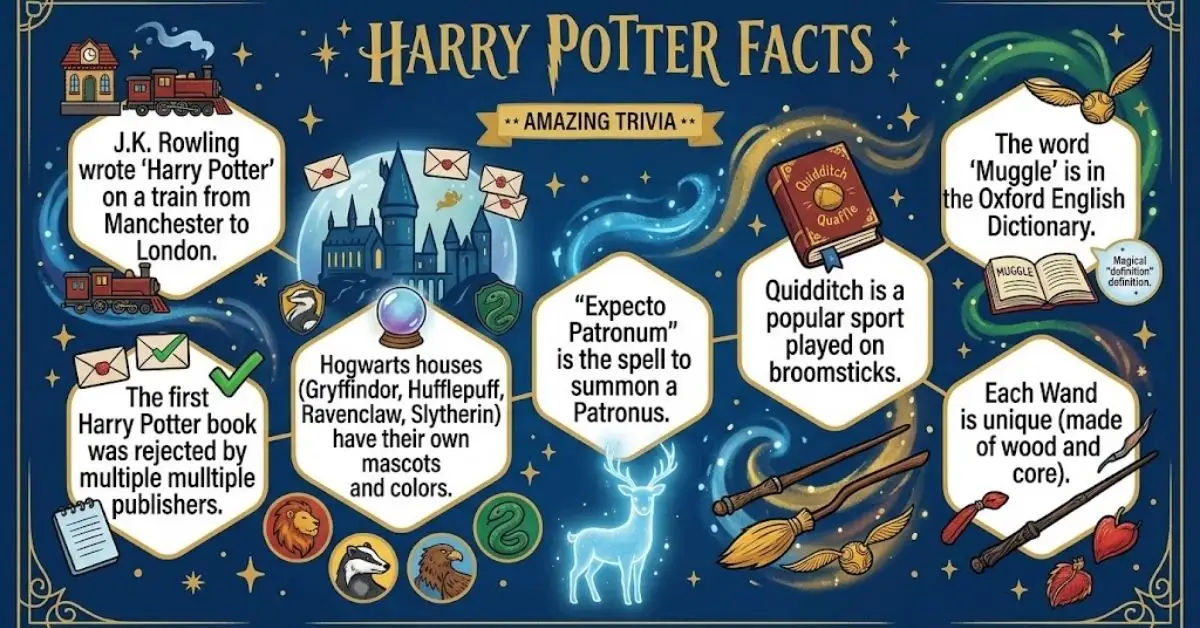
The most fascinating Harry Potter facts show that J.K. Rowling wove real mythology, history, and pieces of her own life into Hogwarts, Gryffindor, Quidditch, and even Voldemort’s name. Nothing in the wizarding world is accidental every name, color, and number carries hidden meaning.
As a longtime reader who has revisited the series more times than I can count, I built this list to separate real canon from fan myth. If you’ve ever wanted the actual Harry Potter facts behind the magic not recycled trivia this is your Pensieve.
Every Potterhead loves swapping Harry Potter facts at trivia night, and the wizarding world rewards close readers. J.K. Rowling planted callbacks between Sorcerer’s Stone and Deathly Hallows that only reveal themselves on a reread, turning casual fans into obsessive researchers of Hogwarts lore.
From Quidditch’s origin story to Dumbledore’s real name meaning “bumblebee,” these Harry Potter facts prove Rowling’s worldbuilding ran far deeper than the films could show. Even the house colors and character surnames double as clues, rewarding fans who dig past the surface plot.
Harry Potter Facts About How Character Names Reveal Hidden Meanings
Some of the richest Harry Potter facts hide in plain sight inside character names. Draco Malfoy and Voldemort both draw from French mal foi means “bad faith,” while vol de mort means “flight of death,” fitting a villain obsessed with escaping his own mortality.
Rowling confirmed the silent “t” in Voldemort follows French pronunciation, meaning most fans have mispronounced it for decades. This is one of those wizarding world details that reshapes how you hear every audiobook narration and film line afterward, once you actually know it.
Harry Potter Facts About How Names Hint at Major Plot Points
Beyond flavor, character names function as literal foreshadowing among the best Harry Potter facts for careful readers. Remus Lupin’s name references the Roman myth of wolf-raised brothers and the Latin lupinus, “wolfish” quietly revealing his werewolf secret before Prisoner of Azkaban confirms it outright.
Even the wolfsbane potion Snape brews is a real plant historically used against wolves. Rowling later said Lupin’s condition was a deliberate metaphor for HIV and the stigma surrounding chronic illness, adding real emotional weight beneath the fantasy.
Harry Potter Facts About Sirius Black’s Secret First Appearance
One of the most rewarding Harry Potter facts for rereaders: Sirius Black is mentioned in chapter one of Sorcerer’s Stone, three books before he actually appears. Hagrid casually says, “Young Sirius Black lent me it,” referring to the flying motorcycle.
Most readers forget this tiny detail entirely by the time Sirius becomes central to Prisoner of Azkaban. It’s a perfect example of Rowling planting seeds early proof that the wizarding world was mapped out with long-game precision from book one.
Harry Potter Facts About Why Bathrooms Matter in the Books
It sounds silly, but genuine Harry Potter facts confirm bathrooms drive major plot moments in nearly every book the troll fight, Moaning Myrtle’s ghost, the Chamber of Secrets entrance, and Harry’s duel with Draco in Half-Blood Prince all happen there.
Wizarding World even revealed that Hogwarts didn’t originally have plumbing; witches and wizards simply vanished the evidence before adopting Muggle methods. It’s a quirky bit of Hogwarts history that adds unexpected worldbuilding depth to something readers usually overlook.
Harry Potter Facts About Why Seven Is the Most Powerful Number
Numerology sits at the center of the most cited Harry Potter facts: seven books, seven Weasley children, seven Quidditch players per team, seven years at Hogwarts, and seven Horcruxes containing pieces of Voldemort’s soul.
A 13th-century witch named Bridget Wenlock is credited in Hogwarts lore with discovering the number’s magical properties. Three shows up almost as often three Deathly Hallows, three Unforgivable Curses reinforcing how deliberately Rowling structured the wizarding world’s mythology.
Harry Potter Facts About How Dementors Personify Depression
Among the most emotionally resonant Harry Potter facts, Rowling revealed Dementors were directly inspired by her own experience with depression. She described the feeling as “that cold absence of feeling that really hollowed-out feeling,” which became the Dementors’ defining trait.
This context reframes Prisoner of Azkaban entirely: the creatures aren’t just monsters, they’re a literalized mental-health metaphor. Harry’s Patronus charm becomes a symbol of resilience rather than just a combat spell against dark magic.
Harry Potter Facts About What the Hogwarts House Colors Represent
Fans love these visual Harry Potter facts: Rowling confirmed the four Hogwarts houses connect to zodiac elements through their colors. Gryffindor’s red and gold tie to fire, Slytherin’s green and silver to water, Hufflepuff’s yellow and black to earth, and Ravenclaw’s blue and bronze to air.
Fawkes the phoenix reinforces Gryffindor’s fire symbolism, since Dumbledore sorted into Gryffindor himself owns a Patronus in the shape of a phoenix. Small details like this show how tightly Rowling linked house identity to elemental mythology.
Harry Potter Facts About the Real Nicolas Flamel
Not every wizarding world detail is invented some of the best Harry Potter facts involve real history. Nicolas Flamel, the alchemist guarding the Sorcerer’s Stone, was a genuine medieval scholar who really did pursue the legendary Philosopher’s Stone before dying in 1418.
Real alchemy also inspired the book’s British title. Historical alchemists searched for ways to turn lead into gold and achieve immortality, which is exactly why Rowling borrowed Flamel’s name for her fictional stone’s creator.
Harry Potter Facts: Frequently Asked Questions
What is the most surprising Harry Potter fact?
Many fans are shocked that Dumbledore’s name means “bumblebee” in Old English, chosen because Rowling imagined him humming to himself while walking Hogwarts’ halls.
Are any Harry Potter facts based on real history?
Yes. Nicolas Flamel, mandrakes, wolfsbane, and the alchemical color symbolism in the house colors are all rooted in real historical and botanical sources.
Why is the number seven so important in Harry Potter facts?
Rowling used seven as a recurring magical number seven books, seven years at Hogwarts, and seven Horcruxes tied to Hogwarts’ own in-world numerology lore.
Did J.K. Rowling reveal facts not in the books?
Yes, through interviews and the Wizarding World website, she’s confirmed extra details like Dumbledore’s sexuality, Lupin’s HIV metaphor, and the Dementors’ depression symbolism.
Is Voldemort’s name pronounced with a silent “t”?
According to Rowling, yes following French pronunciation rules, since “Voldemort” derives from French for “flight of death.”
Harry Potter facts like these are exactly why the series still rewards rereading decades later every name, number, and color was chosen with intention, and there’s always one more detail waiting to be noticed.

Hi, I’m Benjamin, the person behind FactsAboutDog.com. 🐶
I’m passionate about dogs and love sharing interesting, fun, and educational facts about our furry friends. Through FactsAboutDog.com, I aim to make learning about dogs simple, enjoyable, and informative for dog lovers everywhere.
From amazing dog facts to breed information and fascinating animal knowledge, my goal is to help readers discover something new every day.
Explore the world of dogs with Benjamin at FactsAboutDog.com!