
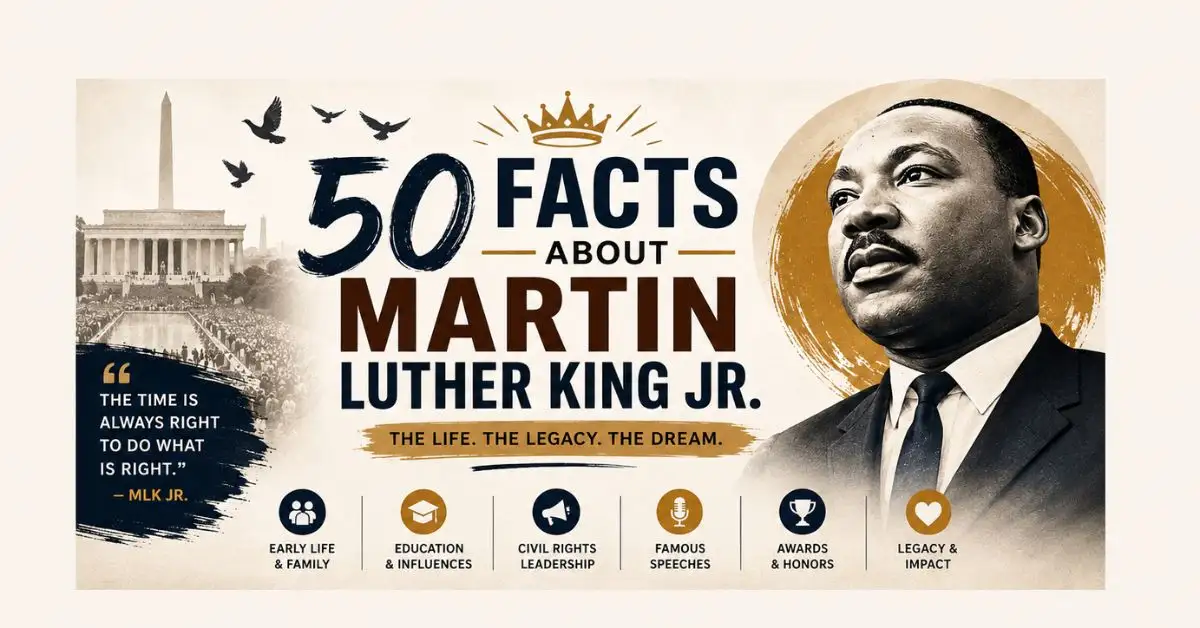
50 Facts About Martin Luther King Jr. You Should Know
Martin Luther King Jr. was an American Baptist minister and civil rights leader whose commitment to nonviolent resistance helped reshape the fight for racial equality in the United States. Born in Atlanta in 1929, he became nationally prominent during the Montgomery Bus Boycott and later helped lead campaigns connected to voting rights, desegregation, and economic justice.
When researching these Martin Luther King Jr. facts, one detail stands out: his public leadership lasted less than 13 years, yet his influence reached legislation, education, religion, politics, and American culture. The facts below bring together his family, education, speeches, civil rights campaigns, philosophy, awards, and legacy using historical sources rather than folklore.
50 facts about Martin Luther King Jr.: Martin Luther King Jr was the child of a schoolteacher and a pastor.
King was born into a deeply religious Atlanta family connected to Ebenezer Baptist Church, the Black Baptist tradition, and the broader African American church. His father and grandfather were ministers, while his mother, Alberta Williams King, came from a family with strong church leadership.
His childhood in Atlanta exposed him both to family support and the realities of segregation. Those early experiences became part of the background against which his later ideas about racial equality, Christian responsibility, justice, and social change developed.
Facts 1–6
- Martin Luther King Jr. was born on January 15, 1929, in Atlanta, Georgia.
- His birth name was Michael King Jr.
- His father later changed both of their names to Martin Luther King, influenced by the Protestant reformer Martin Luther.
- King grew up in Atlanta’s Sweet Auburn community.
- His father, Martin Luther King Sr., was a prominent Baptist minister.
- His family had several generations of Baptist ministry behind it.
50 facts about Martin Luther King Jr.: You can describe Martin Luther King Jr. as a gifted student.
King’s education moved unusually quickly. He skipped grades and entered Morehouse College at 15, later studying at Crozer Theological Seminary and Boston University. His academic path combined sociology, theology, philosophy, and religious studies before he became a national civil rights leader.
Education was not separate from his activism. At Morehouse, King became increasingly interested in political questions and social problems, while theological mentors such as Benjamin E. Mays helped him see Christianity as a potential force for social transformation.
Facts 7–13
- King entered Morehouse College at age 15 in 1944.
- He earned a sociology degree from Morehouse College in 1948.
- He studied at Crozer Theological Seminary in Pennsylvania.
- He graduated from Crozer as valedictorian in 1951.
- He studied for his doctorate at Boston University.
- King earned his doctorate in systematic theology in 1955.
- Benjamin E. Mays strongly influenced his spiritual and intellectual development.
50 facts about Martin Luther King Jr.: Martin Luther King Jr gave a speech during the March on Washington.
The March on Washington for Jobs and Freedom became one of the defining moments of the Civil Rights Movement. On August 28, 1963, approximately 250,000 people gathered near the Lincoln Memorial, where King delivered his famous “I Have a Dream” address.
The speech connected racial equality with the nation’s democratic ideals. Its setting also mattered: the Lincoln Memorial linked King’s message to the unfinished struggle over freedom and citizenship in American history. The event helped build public pressure surrounding civil rights legislation.
Facts 14–20
- The March on Washington took place on August 28, 1963.
- The march was formally called the March on Washington for Jobs and Freedom.
- About 250,000 people attended.
- King spoke from the steps of the Lincoln Memorial.
- His “I Have a Dream” speech became one of the most recognized speeches in American history.
- The march helped increase national attention on racial discrimination.
- The Civil Rights Act of 1964 followed this period of intensified national civil rights pressure.
50 facts about Martin Luther King Jr.: Even before his iconic speech at Lincoln, Martin Luther King Jr also delivered other great speeches.
King’s public speaking career involved much more than one famous address. His “Give Us the Ballot” speech in 1957, Nobel Peace Prize acceptance speech in 1964, “Beyond Vietnam” speech in 1967, and final “I’ve Been to the Mountaintop” address each reflected different stages of his thinking.
His speeches increasingly connected civil rights, voting rights, peace, poverty, economic justice, and human dignity. That broader message is important because King was not focused only on ending segregation; his later work addressed economic inequality and the Vietnam War as well.
Facts 21–27
- King delivered “Give Us the Ballot” at the Lincoln Memorial in 1957.
- He gave his Nobel Peace Prize acceptance speech in Oslo in 1964.
- His “Beyond Vietnam” speech was delivered at Riverside Church in New York City in 1967.
- King spoke publicly against the Vietnam War.
- His final major speech was “I’ve Been to the Mountaintop.”
- He delivered that final speech on April 3, 1968, in Memphis.
- His speeches repeatedly connected freedom with justice, peace, and human dignity.
50 facts about Martin Luther King Jr.: Gandhi inspired Martin Luther King Jr.’s non-violence philosophy.
Mahatma Gandhi was one of the most important influences on King’s approach to social change. King also encountered Henry David Thoreau’s ideas about civil disobedience. Together with his Christian beliefs, these influences helped shape his commitment to organized, nonviolent resistance.
King’s philosophy was more than simply avoiding physical conflict. It emphasized confronting injustice while refusing to dehumanize opponents. The King Center describes his movement as combining protests, grassroots organizing, civil disobedience, and nonviolent resistance to pursue legal equality.
Facts 28–34
- King studied Gandhi’s philosophy of nonviolent resistance.
- King also encountered Thoreau’s ideas about civil disobedience.
- King visited India in 1959 to learn more about Gandhi’s legacy.
- His Christian faith was another major foundation of his philosophy.
- King helped make nonviolent resistance a central strategy of the modern U.S. Civil Rights Movement.
- His philosophy focused on defeating injustice rather than treating people as enemies.
- The idea of the Beloved Community became an important part of his vision for social justice.
50 facts about Martin Luther King Jr.: Martin Luther King Jr. took part in a marching event known as “Bloody Sunday.”
The Selma voting rights campaign became a major chapter in the struggle for African American voting rights. In March 1965, demonstrators attempted to march from Selma to Montgomery, Alabama. The events drew national attention and strengthened pressure for federal voting-rights protections.
King participated in the later Selma-to-Montgomery march, where thousands of people ultimately reached the Alabama state capital. The campaign became closely associated with the Voting Rights Act of 1965, signed by President Lyndon B. Johnson later that year.
Facts 35–40
- The Selma campaign focused heavily on voting rights.
- The first Selma march occurred on March 7, 1965.
- The day became known as Bloody Sunday.
- King participated in a later Selma-to-Montgomery march.
- About 25,000 people gathered at the Alabama State Capitol at the conclusion of the successful march.
- President Lyndon B. Johnson signed the Voting Rights Act of 1965 after the Selma campaign.
50 facts about Martin Luther King Jr.: Before Martin Luther King Jr’s death, he campaigned to end poverty.
King’s later activism expanded beyond segregation and voting rights. He increasingly argued that racial equality could not be separated from economic justice, poverty, housing, employment, and working conditions. His Poor People’s Campaign sought to unite disadvantaged Americans around economic demands.
In Memphis, King supported striking sanitation workers in the final campaign of his life. This period shows how his agenda had developed from a primary focus on legal segregation toward a wider vision of social and economic justice.
Facts 41–45
- King increasingly focused on poverty during the final years of his life.
- He helped develop the Poor People’s Campaign.
- The campaign sought greater economic opportunity for disadvantaged Americans.
- King traveled to Memphis in 1968 to support sanitation workers.
- Economic justice had become a central part of his later public work.
50 facts about Martin Luther King Jr.: Martin Luther King Jr. received many accolades after his death.
King’s influence continued to grow after his death. He received major national honors, while institutions, public buildings, streets, schools, and memorials were named in his honor. His legacy is also preserved through the King Center, National Park Service, Stanford King Institute, and Martin Luther King Jr. Memorial.
His birthday became a federal holiday, observed on the third Monday of January. Today, MLK Day is closely associated with community service and reflection on racial equality and nonviolent social change. In 2026, the federal holiday fell on January 19.
Facts 46–50
- King received the Nobel Peace Prize in 1964 at age 35.
- He received the Presidential Medal of Freedom posthumously in 1977.
- He was posthumously awarded the Congressional Gold Medal in 2004.
- The Martin Luther King Jr. Memorial in Washington, D.C., opened in 2011.
- Martin Luther King Jr. Day is a U.S. federal holiday observed on the third Monday of January.
King died on April 4, 1968, in Memphis, Tennessee, at age 39. His public leadership had lasted only a fraction of a lifetime, but the movements he helped lead contributed to landmark changes in American civil rights law and inspired generations of activists.
The most meaningful lesson from these 50 facts about Martin Luther King Jr. is that his legacy was larger than one speech. His work connected faith, voting rights, racial equality, peaceful protest, economic justice, and community action. That broader context explains why his influence remains part of American history today.
FAQ Section
When was Martin Luther King Jr. born?
Martin Luther King Jr. was born on January 15, 1929, in Atlanta, Georgia. His birth name was Michael King Jr., and his father later changed both of their names to Martin Luther King.
How old was Martin Luther King Jr. when he died?
Martin Luther King Jr. was 39 years old when he died on April 4, 1968, in Memphis, Tennessee.
What was Martin Luther King Jr. famous for?
He was famous for leading major parts of the American Civil Rights Movement through nonviolent activism, public speaking, organizing, and civil disobedience. His work contributed to the movement that helped achieve major civil rights legislation.
Why did Martin Luther King Jr. win the Nobel Peace Prize?
King received the 1964 Nobel Peace Prize for his nonviolent struggle for civil rights and racial justice. He was 35 years old at the time.
What was Martin Luther King Jr.’s most famous speech?
His most famous speech was “I Have a Dream,” delivered during the March on Washington at the Lincoln Memorial on August 28, 1963.
What did Martin Luther King Jr. believe?
King believed that racial injustice should be challenged through nonviolent resistance, civil disobedience, community organizing, and moral action. His later work also emphasized economic justice, poverty, and peace.
When is Martin Luther King Jr. Day?
Martin Luther King Jr. Day is observed on the third Monday of January each year and is a U.S. federal holiday.
What did Martin Luther King Jr. accomplish?
Among his major accomplishments were helping lead the Montgomery Bus Boycott, founding and leading the Southern Christian Leadership Conference, supporting voting-rights campaigns, helping organize the March on Washington, and receiving the 1964 Nobel Peace Prize.

Hi, I’m Benjamin, the person behind FactsAboutDog.com. 🐶
I’m passionate about dogs and love sharing interesting, fun, and educational facts about our furry friends. Through FactsAboutDog.com, I aim to make learning about dogs simple, enjoyable, and informative for dog lovers everywhere.
From amazing dog facts to breed information and fascinating animal knowledge, my goal is to help readers discover something new every day.
Explore the world of dogs with Benjamin at FactsAboutDog.com!