
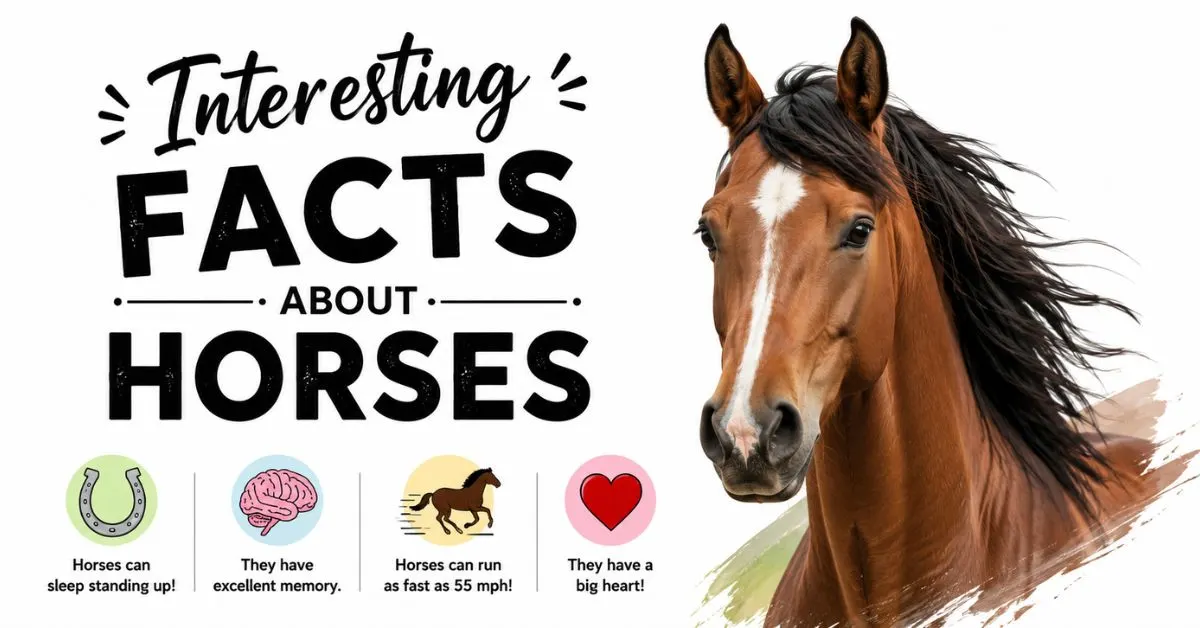
50 Interesting Facts About Horses That Will Surprise You
Horses are remarkable mammals with extraordinary vision, powerful bodies, complex social behavior, and a history closely connected with humans. These interesting facts about horses reveal why the animals can sleep standing, see almost around themselves, communicate through subtle body language, and move with remarkable speed.
After researching horse anatomy, behavior, domestication, and breed history, one thing becomes clear: the familiar image of a horse grazing in a field only tells part of the story. From newborn foals that become mobile within hours to the unusual mechanics of the equine hoof and digestive system, there is much more to discover.

Interesting and fun facts about horses
10 Fun Facts about Horses
Horses were domesticated thousands of years ago and have since become important companions, working animals, athletes, and cultural symbols. They belong to the equine family alongside zebras and donkeys, while their closest living relatives help explain several unusual characteristics found in modern horses.
Their biology is especially fascinating. Horses have large eyes, a remarkably broad field of vision, specialized legs that help them rest while standing, and a digestive system unlike that of many familiar mammals. Their behavior also reflects their origins as social prey animals living in groups.
Did you know that the eyes of a horse are bigger than those of any other land mammal?
A horse has exceptionally large eyes positioned on the sides of its head. This arrangement gives horses an extremely wide field of view, allowing them to monitor much of their surroundings. Their vision is particularly useful for detecting movement, although their depth perception differs from ours.
Horses are called different names depending on their gender.
An adult male horse is called a stallion, while an adult female is a mare. A castrated male is generally called a gelding. Knowing these terms makes it easier to understand horse breeding, riding, veterinary, and equestrian discussions.
Baby horses even have different names!
A baby horse is called a foal. A young male is a colt, while a young female is a filly. These age and sex terms are among the simplest pieces of horse vocabulary, but they reveal how detailed traditional equestrian language can be.
Newborn horses can walk shortly after birth.
Foals develop mobility remarkably quickly. Healthy newborns can usually stand and begin walking within hours of birth. This rapid development has an important evolutionary advantage because horses are prey animals and young members of a herd need to become mobile quickly.
There are fewer bones in a horse than in humans.
A typical horse skeleton contains about 205 bones, compared with 206 in the typical adult human skeleton. Horse anatomy is shaped around efficient movement, with long limbs, a strong spine, and a single functional hoof supporting each limb.
The oldest horse lived over twice as long as he was supposed to.
Most well-cared-for horses commonly live around 25 to 30 years, although individual longevity varies. Old Billy is widely cited as the longest-lived domestic horse, reportedly reaching 62 years. Exceptional records like this should not be confused with the normal lifespan of horses.
Horses can sleep standing up or lying down.
This is one of the best-known horse facts, but the biology behind it is impressive. Horses possess a system involving muscles, tendons, and ligaments that allows them to rest while standing. They still need periods of lying down for deeper sleep.
Horses have a lookout…
Horses are social herd animals, and group living provides protection. In a relaxed herd, animals may rest at different times rather than all becoming vulnerable simultaneously. This behavior reflects the horse’s evolutionary history as a grazing prey species.
Horses don’t smile to show happiness.
The familiar horse expression that looks like a smile is often the flehmen response. A horse curls its upper lip and changes the position of its nostrils, helping it process interesting scents. So that dramatic “grin” is more about smell than happiness.
Their diet is plant-based.
Horses are herbivores and naturally spend substantial amounts of time grazing. Grass and forage such as hay form the foundation of many horses’ diets. Their digestive system is adapted to frequent intake of fibrous plant material rather than large occasional meals.
The fastest horse ran over double the usual speed!
A typical horse can gallop around 27 mph, while exceptional recorded speeds can be much higher. TwinSpires also highlights a reported speed of about 55 mph in a quarter-mile race. Speed varies considerably with breed, individual ability, conditioning, surface, and measurement method.
There’s no need to worry about the horse population…
Horse numbers are difficult to pin down precisely because populations include domestic, feral, and wild horses across many countries. The Fact Site cites an estimate of about 60 million horses worldwide, while welfare organizations also use global estimates in that general scale.
Horses have exceptional vision!
A horse’s eye placement provides a very broad field of view. This is an important adaptation for an animal that needs to notice potential threats while grazing. However, broad vision does not mean horses see everything with perfect detail or depth.
Horses can’t see in full color.
Horses are not completely color-blind. Their color vision differs from human color vision, and research indicates that horses can distinguish some colors better than others. Their visual world is therefore different rather than simply “black and white.”
Horses float when they run.
During a gallop, there is a moment when all four hooves leave the ground. This creates the famous “flying” appearance captured in photographs. The discovery helped correct older artistic depictions of galloping horses and became an important moment in the history of motion photography.
Their teeth take up tons of room.
Horse teeth are substantial relative to their body structure because they are adapted for grinding fibrous vegetation. A horse’s dental condition can also provide clues about age and health. Regular dental care is therefore an important part of responsible horse management.
Horses’ brains are pretty small.
The horse brain is relatively small compared with the animal’s overall body size. Brain size alone, however, does not tell us how intelligent an animal is. Horses demonstrate learning, memory, social awareness, and the ability to respond to human cues.
They’re not so different than us people.
Horses communicate through facial expressions and body language, giving humans useful clues about their emotional state. Their ears, eyes, nostrils, posture, and movements can all contribute to communication. Learning to read these signals is an important part of good horsemanship.
Horses do not have a gag reflex.
Horses have an unusual digestive system and are unable to vomit. Their powerful lower esophageal sphincter and anatomy make backward movement of stomach contents extremely difficult. This is one reason digestive problems such as colic can be particularly serious in horses.
Horses have their own form of measurement.
Horse height is traditionally measured in hands rather than simply feet and inches. One hand equals four inches. Measurements are taken from the ground to the withers, the area at the top of the shoulder where the neck meets the back.
There are way more types of horses than you would have thought!
There are hundreds of recognized horse breeds, with estimates varying according to how breeds are defined and counted. Breeds have been developed for different purposes, including racing, ranch work, agriculture, riding, driving, and specialized sport.

The tallest horse ever was over seven hands taller than a normal horse.
Sampson, a Shire horse, is widely reported as one of the tallest horses ever recorded, reaching approximately 21.2 hands. His size demonstrates the extraordinary range of body dimensions produced through selective breeding among domestic horses.
The smallest horse was barely taller than a foot.
The Fact Site identifies Einstein as a remarkably small horse at around 14 inches. Other records, including Thumbelina, have also attracted worldwide attention. These extraordinary examples show just how dramatically horse size can vary among specialized lines.
Horses are thirsty animals!
Water is essential to equine health, and a horse’s requirements change according to body size, diet, weather, activity, and environmental conditions. Habitat For Horses notes that water needs can rise considerably in hot weather or during demanding physical activity.
Horses can be bred to make a different species.
Horses can hybridize with closely related equines. A horse and zebra can produce a zebroid, while horse-donkey hybrids include the familiar mule. These hybrids demonstrate the close evolutionary relationships among members of the equine family.
Horses can be cloned.
The first commercially notable horse cloning milestones occurred in the early 2000s. Horse cloning demonstrated that equine genetic material could be used to produce genetically near-identical animals, opening scientific and breeding discussions about reproduction and preservation.
It’s easy to tell if a horse needs a blanket!
A horse’s comfort depends on much more than simply whether its ears feel cool. Coat condition, weather, wind, shelter, body condition, age, health, and acclimatization all matter when evaluating whether additional protection is appropriate. Good horse care requires looking at the whole animal and environment.
Horses have been used in the police force since the 17th Century.
Mounted police have a long history, particularly in cities where horses once provided practical transportation before motor vehicles became widespread. Police horses are still used in some places today, including for patrols, ceremonial duties, crowd management, and community engagement.
The oldest horses have been around as long as the Egyptian Pyramids.
The Arabian horse is often described as one of the world’s oldest established horse breeds, with a history extending back thousands of years. Breed history is complex, but Arabian horses have had an especially strong influence on later horse breeding programs.
In some places, horse meat is a delicacy.
Horse meat has been consumed historically in several parts of the world, although attitudes and laws differ greatly by country and culture. In the United States, horse slaughter and consumption have been controversial subjects, making this a cultural topic as much as a biological one.
Horses can remember more than you think…
Horse memory is one of the most fascinating areas of equine behavior. Research and practical observations indicate that horses can remember learned information, people, places, and experiences. Their ability to recognize and respond to human emotional cues makes their social memory especially interesting.
Quick Horse Facts Table
| Horse fact | Quick answer |
| Scientific name | Equus ferus caballus |
| Animal group | Mammal |
| Diet | Herbivorous |
| Typical lifespan | About 25–30 years |
| Horse skeleton | About 205 bones |
| Baby horse | Foal |
| Young male | Colt |
| Young female | Filly |
| Adult male | Stallion |
| Adult female | Mare |
| Castrated male | Gelding |
| Common measurement | Hands |
| One hand | 4 inches |
| Typical galloping speed | About 27 mph |
| Horse vision | Very broad field of view |
| Can sleep standing? | Yes |
| Can horses vomit? | No |
| Group of horses | Herd |
The exact figures can vary by breed, individual animal, measurement method, and source, so these values should be treated as useful general reference points rather than universal limits.
Why These Horse Facts Matter
What makes horses special isn’t simply their speed or appearance. Their anatomy reflects millions of years of evolution, while domestication shaped an extraordinary relationship between horses and people. Their wide vision helps detect danger, herd behavior provides social security, and their digestive system reflects their grazing lifestyle.
For readers in the United States, horses also have a particularly visible place in culture. Mustangs, ranch horses, racehorses, police mounts, therapy horses, and family-owned riding horses all represent different parts of the modern American relationship with equines.
Conclusion
These interesting facts about horses show that the animals are far more complex than their graceful appearance suggests. From nearly panoramic vision and specialized sleep to extraordinary memory, rapid foal development, unusual digestion, and centuries of partnership with humans, every part of horse biology tells an intriguing story.
Whether you are a lifelong horse lover, a student researching animal facts, or simply curious about these remarkable mammals, understanding their anatomy and behavior makes every encounter more meaningful. The next time you see a horse standing quietly in a pasture, remember that there is a surprisingly sophisticated animal behind that peaceful expression.
FAQ Section
What are 5 interesting facts about horses?
Five memorable facts are that horses can sleep standing up, have an exceptionally wide field of vision, cannot vomit, can walk shortly after birth, and communicate extensively through body language.
What is the most interesting fact about a horse?
One of the most surprising is that horses can rest while standing because of a specialized system involving their limbs. They can also lie down when they need deeper sleep.
What are 10 fun facts about horses?
Horses can sleep standing, see across a very broad field, walk shortly after birth, live around 25–30 years on average, have about 205 bones, communicate through body language, eat a plant-based diet, use a unique height measurement called the hand, cannot vomit, and live socially in groups.
How fast can a horse run?
Many horses can gallop around 25–30 mph, while exceptional horses can exceed 40 mph. Reported record speeds vary depending on the type of race and measurement method.
Can horses sleep standing up?
Yes. Horses can take standing rest because their limb anatomy allows them to stabilize their legs. They also lie down for deeper stages of sleep.
How many bones does a horse have?
A typical horse has approximately 205 bones, which is one fewer than the 206 bones commonly counted in an adult human skeleton.
What is a baby horse called?
A baby horse is called a foal. A young male is a colt and a young female is a filly.
How many horse breeds are there?
There are hundreds of horse breeds worldwide. Exact totals differ because organizations use different definitions and registries when determining what counts as a distinct breed.

Hi, I’m Benjamin, the person behind FactsAboutDog.com. 🐶
I’m passionate about dogs and love sharing interesting, fun, and educational facts about our furry friends. Through FactsAboutDog.com, I aim to make learning about dogs simple, enjoyable, and informative for dog lovers everywhere.
From amazing dog facts to breed information and fascinating animal knowledge, my goal is to help readers discover something new every day.
Explore the world of dogs with Benjamin at FactsAboutDog.com!