
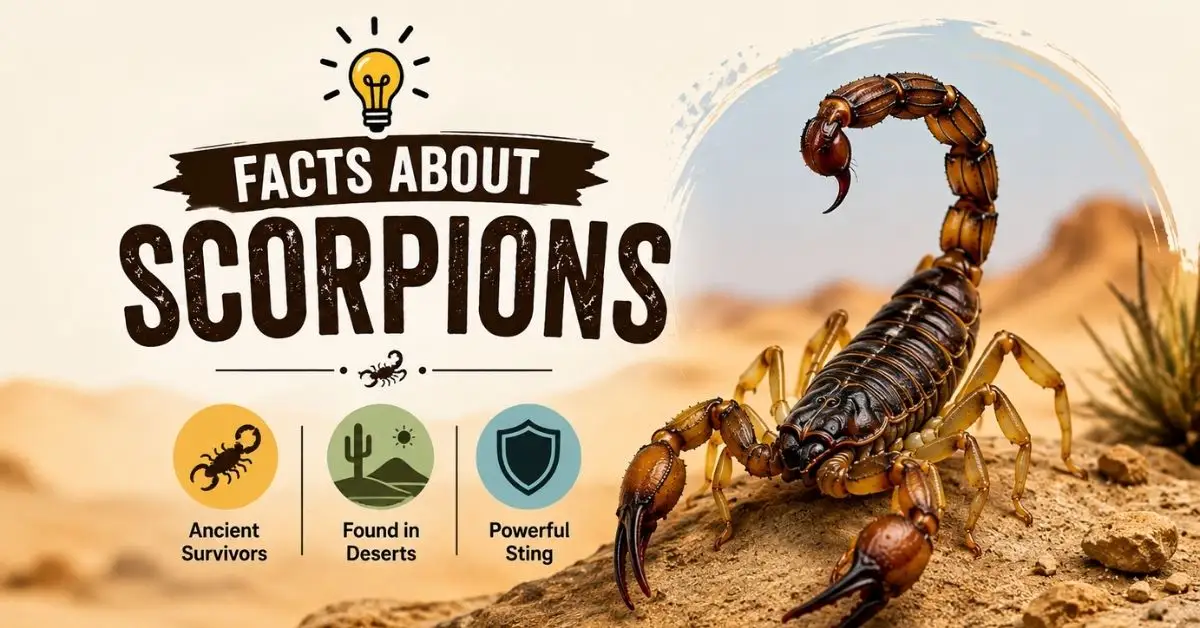
Facts About Scorpions: 25 Amazing Facts You Should Know
Scorpions are arachnids, not insects, and their eight legs, pincers, segmented tail, venom, and remarkable survival skills make them some of Earth’s most fascinating desert predators. After researching their biology and U.S. species, I found that the most surprising facts about scorpions involve UV fluorescence, nocturnal behavior, exoskeletons, live birth, and venom.
If you picture every scorpion as a deadly creature hiding in the desert, there is good news: that image is incomplete. Most species are not medically dangerous to people. Understanding their habitat, prey, burrows, predators, stings, and adaptations makes these mysterious arthropods much easier to appreciate and much less frightening.
Facts About Scorpions: Fast scorpion facts
Scorpions belong to the order Scorpiones and class Arachnida. They have eight legs, a pair of pedipalps, a segmented abdomen, and a tail ending in a telson. They are carnivores and commonly hunt insects and other arthropods, usually becoming active after sunset.
They occur on every continent except Antarctica, although they are especially associated with deserts and other warm, dry environments. In the United States, scorpions occur mainly across the South and Southwest, with more than 100 described U.S. species according to University of Arizona resources.
| Scorpion fact | Quick answer |
| Scientific order | Scorpiones |
| Animal group | Arachnids |
| Legs | 8 |
| Diet | Carnivorous |
| Activity | Mostly nocturnal |
| Main U.S. range | South and Southwest |
| Notable U.S. species | Arizona bark scorpion |
| Special feature | Fluorescence under UV light |
Facts About Scorpions: They Give Birth to Live Young
One of the most remarkable facts about scorpions is that females give birth to live young rather than laying external eggs like many insects. Newborns emerge with soft exoskeletons and climb onto their mother’s back, where they remain protected until their first molt.
The number of babies varies by species. Arizona bark scorpions, for example, can carry dozens of young. The mother provides protection during a vulnerable period when the babies cannot yet function independently. Once their first exoskeleton hardens, the young disperse and begin hunting for themselves.
Facts About Scorpions: They Have Long Life Spans
Scorpions can live surprisingly long lives for arthropods. ThoughtCo notes that wild individuals commonly live for several years, while some scorpions kept in captivity have reached much older ages. Lifespan varies considerably between species, habitat, environmental conditions, and available food.
Arizona bark scorpions provide a useful U.S. example, with the National Park Service reporting lifespans of roughly five to seven years. Their ability to conserve energy, shelter during difficult conditions, and tolerate food scarcity contributes to their reputation as exceptionally resilient animals.
Facts About Scorpions: They Are Ancient Organisms
Scorpions have an extraordinarily old evolutionary history. Fossil evidence indicates that scorpion-like animals existed hundreds of millions of years ago, and some early relatives were associated with aquatic environments before scorpions became established on land. Their body plan has remained remarkably recognizable.
That ancient lineage helps explain why scorpions seem almost perfectly designed for survival. Their pincers, sensory structures, exoskeleton, venom system, and ability to conserve energy represent adaptations refined across immense stretches of evolutionary time rather than a recent appearance.
Facts About Scorpions: They Can Survive Just About Anything
Scorpions are masters of energy conservation. Their low metabolic demands allow some species to endure extremely long periods with little food. They shelter beneath rocks, inside crevices, or in burrows, avoiding the hottest part of the day before emerging to hunt at night.
Their survival toolkit is broader than simply tolerating heat. Scorpions can withstand challenging environments and obtain moisture from their food. Some species also use burrowing behavior to escape temperature extremes. These adaptations help explain their success across deserts, grasslands, forests, caves, and other habitats.
Facts About Scorpions: Scorpions Are Arachnids
Despite their intimidating appearance, scorpions are not insects. They are arachnids, placing them in the same broad class as spiders, ticks, mites, and harvestmen. Their four pairs of walking legs are one of the easiest visual clues separating them from six-legged insects.
Their anatomy also includes specialized pedipalps, or pincers, used for capturing prey and handling objects. At the rear, the telson contains venom-producing structures and the stinger. This combination of gripping appendages and venom delivery gives scorpions an unusually effective hunting system.
Facts About Scorpions: Scorpions Dance Before Mating
Scorpion reproduction can look surprisingly romantic—or surprisingly dangerous. During courtship, a male and female may grasp each other’s pedipalps and perform a coordinated movement called a promenade à deux. The male eventually positions a spermatophore so the female can take up the sperm.
The behavior is more than an entertaining “dance.” Courtship helps coordinate reproduction between two animals equipped with venom and powerful pincers. In captivity, females have sometimes consumed males after mating, although this should not be treated as a universal feature of scorpion reproduction.
Facts About Scorpions: They Glow in the Dark
Under ultraviolet light, many scorpions fluoresce with a striking blue-green appearance. The fluorescence comes from compounds associated with the hardened outer cuticle. Researchers use UV lamps at night because glowing scorpions become dramatically easier to locate in their natural habitat.
This is one reason a nighttime desert search can suddenly become an unforgettable wildlife experience. Scientists still study exactly why fluorescence evolved and what biological role, if any, it serves. Recently molted scorpions may fluoresce differently because their new cuticle has not fully developed.
Facts About Scorpions: They Eat Just About Anything
Most scorpions are opportunistic predators. Their prey can include insects, spiders, worms, and other arthropods, while larger species may tackle small lizards or rodents. They typically use their pedipalps to seize prey before delivering venom with the telson when necessary.
Scorpions are generally nocturnal hunters, which means their hunting strategy is built around darkness rather than speed alone. Their sensory hairs can help detect vibrations and environmental movement, allowing them to locate prey and respond to threats when visibility is poor.
Facts About Scorpions: Scorpions Are Venomous
The scorpion’s famous tail actually ends in a structure called the telson, which contains venom glands and the sharp aculeus used to inject venom. A scorpion can regulate venom delivery, allowing it to use this costly resource according to the situation.
Venom is primarily a tool for subduing prey and defending against predators. The danger to humans varies enormously by species. In the United States, the Arizona bark scorpion (Centruroides sculpturatus) is the species of greatest medical concern, particularly in parts of the Southwest.
Facts About Scorpions: Scorpions Aren’t That Dangerous to People
The frightening reputation of scorpions deserves some context. Most scorpion stings are painful but not life-threatening, although severity depends on the species and the person affected. Young children can be more vulnerable to serious effects, making suspected medically significant stings worth taking seriously.
In the U.S., the Arizona bark scorpion is the major species associated with serious envenomation. The CDC recommends contacting a qualified healthcare provider or Poison Control after a sting, while avoiding unnecessary handling of the animal. Prevention includes shaking out shoes and clothing and using care around outdoor hiding places.
FAQ Section
Are scorpions insects?
No. Scorpions are arachnids, members of the class Arachnida. They have eight legs, whereas insects have six. Scorpions are more closely grouped with spiders, ticks, mites, and harvestmen than with beetles, ants, or flies.
How many species of scorpions are there?
The exact number depends on taxonomy and ongoing species descriptions. University of Arizona currently describes close to 2,000 described species, while Smithsonian research in 2026 referenced roughly 3,000 species globally. The number continues to change as scientists identify and classify species.
Do scorpions glow in the dark?
Scorpions can fluoresce under ultraviolet light because compounds in their cuticle absorb UV radiation and emit visible light. This makes many species remarkably easy to spot with a black light during nighttime surveys.
What do scorpions eat?
Scorpions mainly eat insects and other arthropods, including spiders. Depending on the species and size, their prey can also include worms, lizards, and small rodents. They are generally nocturnal predators that locate and capture prey using specialized sensory and gripping structures.
Are scorpions dangerous to humans?
Most scorpion species are not considered highly dangerous to humans, but some produce medically important venom. In the United States, the Arizona bark scorpion is the principal species of medical concern. Severe symptoms require prompt medical attention, particularly in children.
Where do scorpions live in the United States?
Scorpions are particularly common in the South and Southwest. Arizona, California, Nevada, New Mexico, Utah, Texas, and surrounding areas contain multiple species, with the Arizona bark scorpion especially associated with desert regions of the Southwest.
How many legs does a scorpion have?
A scorpion has eight legs because it is an arachnid. It also has a pair of pedipalps that look like claws or pincers, but those are not counted as walking legs.

Hi, I’m Benjamin, the person behind FactsAboutDog.com. 🐶
I’m passionate about dogs and love sharing interesting, fun, and educational facts about our furry friends. Through FactsAboutDog.com, I aim to make learning about dogs simple, enjoyable, and informative for dog lovers everywhere.
From amazing dog facts to breed information and fascinating animal knowledge, my goal is to help readers discover something new every day.
Explore the world of dogs with Benjamin at FactsAboutDog.com!