25 Shocking Facts About the Nervous System You Never Knew
The nervous system is one of the most fascinating and complex structures in the human body, acting as the master control network that governs every thought, movement, and sensation we experience. From the moment we wake up to the second we fall asleep, this intricate system silently coordinates countless processes, relying on the brain, spinal cord, and a vast web of neurons to transmit signals at incredible speeds.
It allows us to feel pain, react to danger, regulate our heartbeat, and even process emotions. Understanding basic facts about the nervous system reveals just how remarkable our biology truly is, showing how electrical impulses and chemical messengers work together seamlessly to keep us alive, alert, and functioning every single day.
Nervous System Facts at a Glance
| Fact | Detail |
| Neurons in the brain | Roughly 86 billion |
| Cranial nerve pairs | 12 |
| Spinal nerve pairs | 31 |
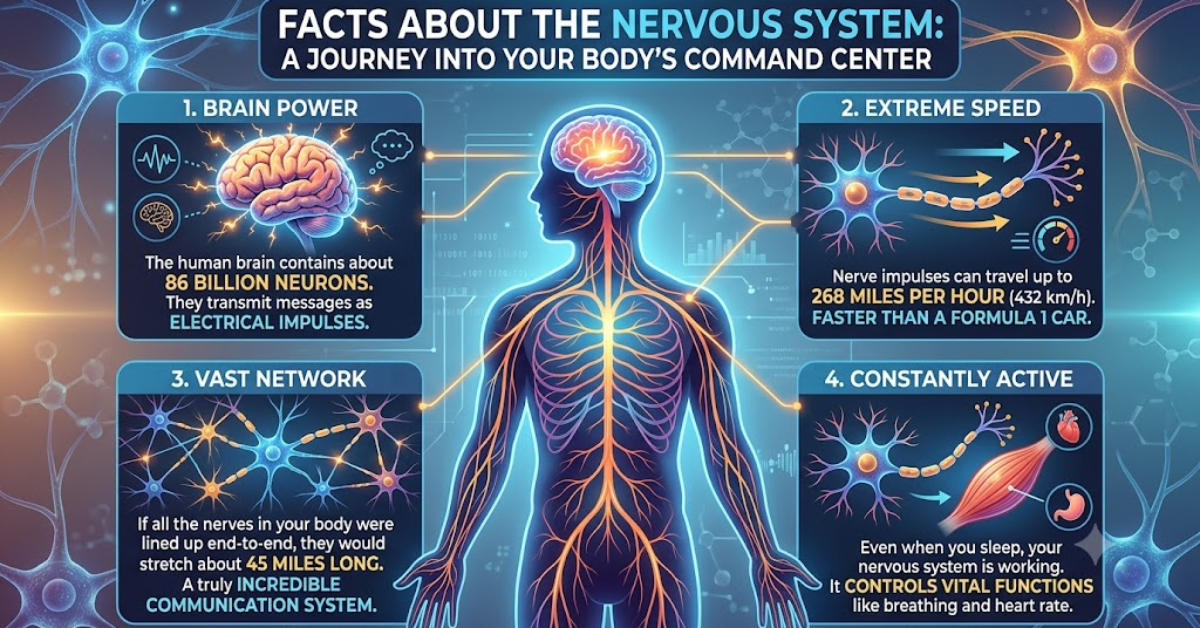
| Fastest nerve conduction speed | Up to ~120 m/s (268 mph) in some myelinated fibers |
| Brain’s share of body weight | About 2% |
| Brain’s share of resting energy use | About 20% |
What Is the Nervous System?
The nervous system is the body’s communication and control network. It gathers sensory information, processes it, and sends out signals that direct movement, organ function, and thought.
It has two main divisions:
| Division | Main Parts | Role |
| Central Nervous System (CNS) | Brain, spinal cord | Processes information, makes decisions |
| Peripheral Nervous System (PNS) | Cranial nerves, spinal nerves | Carries signals between the CNS and the rest of the body |
A simple way to remember it: brain + spinal cord = CNS. CNS + all outlying nerves = the full nervous system.
Nervous System vs. Brain: What’s the Difference?
People often use “brain” and “nervous system” interchangeably, but the brain is only one part of a larger system. The brain plus the spinal cord form the CNS; add every peripheral nerve branching from them, and you get the complete nervous system.
Brain Anatomy: The Basics
The cerebrum is the largest part of the brain and handles conscious thought, voluntary movement, and sensory processing. It’s divided into four lobes:
| Lobe | Primary Function |
| Frontal lobe | Reasoning, planning, voluntary movement |
| Parietal lobe | Touch, spatial awareness |
| Temporal lobe | Hearing, memory |
| Occipital lobe | Vision |
Other key structures:
- Cerebellum coordinates balance and fine motor control
- Brainstem regulates breathing, heart rate, and other survival functions
- Hippocampus helps form new long-term memories
- Amygdala processes fear and emotional responses
- Hypothalamus regulates temperature, hunger, and hormone release
The brain has no pain receptors of its own, which is why neurosurgeons can operate on conscious patients without the brain tissue itself causing pain.
Amazing Facts About the Spinal Cord
The spinal cord is a bundle of nerve tissue running from the brainstem down through the vertebral column. It’s roughly 18 inches (45 cm) long in adults.
- It relays signals between the brain and the rest of the body.
- Spinal nerves 31 pairs in total branch off the spinal cord to reach the trunk and limbs.
- It’s protected by the vertebrae (spinal bones), the meninges (protective membranes), and cerebrospinal fluid, which cushions it against impact.
- Spinal cord injuries can disrupt communication between the brain and body below the injury site, which is why fast medical treatment after trauma is critical.
Fun Facts About Neurons
Neurons are the specialized cells that transmit information. Each has three main parts:
- Cell body — contains the nucleus and keeps the neuron alive
- Dendrites — receive incoming signals
- Axon — sends signals onward, often insulated by myelin, a fatty coating that speeds transmission
Key facts:
- Neurons communicate using an action potential, a brief electrical impulse that travels down the axon.
- At the end of the axon, the signal crosses a tiny gap called a synapse, where chemical messengers called neurotransmitters carry the message to the next cell.
- Many neurons can form thousands of synaptic connections, though the exact number varies widely by neuron type and brain region.
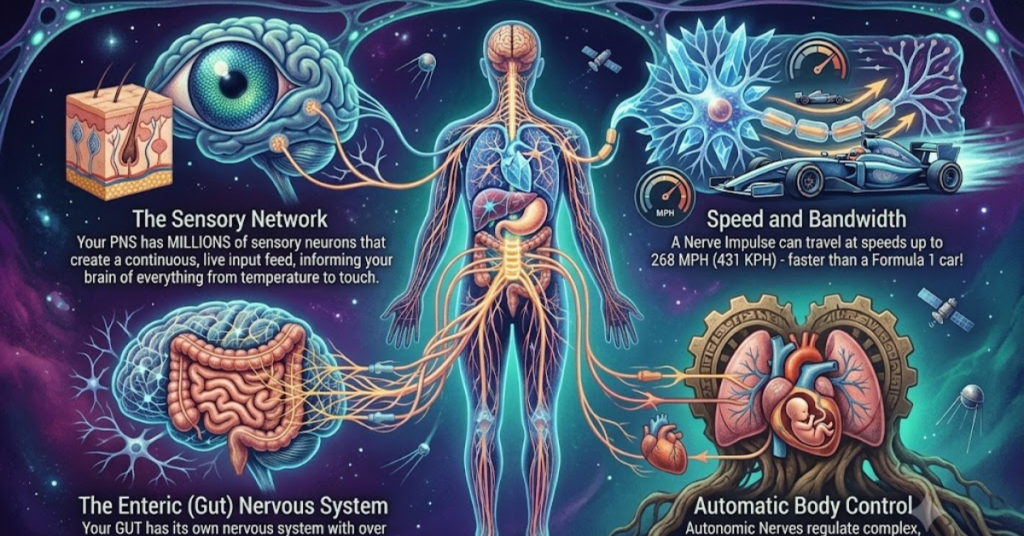
- Nerve fibers with thicker myelin coatings conduct signals faster; some of the fastest myelinated fibers reach around 120 m/s (268 mph), while thinner, unmyelinated fibers conduct far more slowly.
Fun Facts About Glial Cells
Glial cells don’t transmit signals themselves, but they’re essential support cells that outnumber neurons in many brain regions.
- They supply neurons with nutrients and remove waste.
- Some glial cells produce the myelin that insulates axons.
- Others help form the blood-brain barrier, a protective filter that keeps harmful substances out of brain tissue while letting nutrients through.
Fun Facts About Neurotransmitters
| Neurotransmitter | Main Role |
| Dopamine | Motivation, reward, movement control |
| Serotonin | Mood regulation, sleep |
| Acetylcholine | Muscle activation, memory |
| GABA | Calms neural activity |
| Glutamate | Main excitatory signal in the brain |
An imbalance in these chemicals is linked to several neurological and mental health conditions, which is why many medications target neurotransmitter levels.
Fun Facts About Neuroplasticity
Neuroplasticity is the brain’s ability to reorganize itself by forming new neural connections.
- It’s strongest during childhood but continues throughout adulthood.
- Learning a new skill, language, or instrument physically changes neural pathways.
- Neuroplasticity is also part of how the brain compensates after certain injuries, though recovery ability varies by injury type and severity.
Fun Facts About the Autonomic Nervous System
The autonomic nervous system controls involuntary functions like heart rate and digestion. It has two branches that generally work in opposition:
| Branch | Nickname | Effect |
| Sympathetic nervous system | “Fight-or-flight” | Raises heart rate, sharpens alertness under stress |
| Parasympathetic nervous system | “Rest-and-digest” | Lowers heart rate, supports digestion and recovery |
The enteric nervous system, embedded in the gut wall, is sometimes nicknamed the “second brain” because it can regulate digestion largely on its own some estimates suggest it contains more neurons than the spinal cord, though exact comparisons vary by study.
Fun Facts About Reflexes
A reflex is a fast, automatic response to a stimulus. Many simple reflexes like pulling your hand from a hot surface are processed largely through circuits in the spinal cord, allowing a faster reaction than waiting for the brain to consciously interpret the signal. The brain typically still receives information about the stimulus, just slightly after the reflex has already occurred.
Senses and Movement
| Neuron Type | Function |
| Sensory neurons | Carry information from the senses to the CNS |
| Motor neurons | Carry instructions from the CNS to muscles |
Your senses sight, hearing, smell, taste, touch, and balance (via the vestibular system in the inner ear) all rely on sensory neurons feeding data to specific brain regions for interpretation:
- Vision is processed mainly in the occipital lobe.
- Hearing and language comprehension involve the temporal lobe.
- Touch and spatial awareness are handled by the parietal lobe.
- Smell has a more direct pathway to emotion-processing regions than the other senses, which is one reason certain scents can trigger strong memories.
- Pain is detected by specialized sensory receptors and relayed through the spinal cord to the brain for interpretation.
Sleep and Memory
- During sleep, the brain consolidates short-term memories into longer-term storage.
- The hippocampus plays a central role in this process.
- Sleep also supports clearance of metabolic waste that accumulates in brain tissue during waking hours.
Common Nervous System Disorders
According to NIH/NINDS and standard medical references, common nervous system conditions include:
- Parkinson’s disease progressive loss of dopamine-producing neurons, affecting movement
- Alzheimer’s disease progressive impairment of memory and cognition
- Epilepsy recurring bursts of abnormal electrical activity in the brain
- Multiple sclerosis the immune system damages myelin, disrupting nerve signals
- Stroke interrupted blood flow damages brain tissue; rapid treatment significantly affects outcomes
- Migraine a neurological condition involving abnormal brain activity, not just “a bad headache”
- Peripheral neuropathy nerve damage outside the brain and spinal cord, often affecting sensation
- ALS (amyotrophic lateral sclerosis) progressively affects motor neurons controlling voluntary muscle movement
- Huntington’s disease an inherited condition that gradually damages nerve cells, affecting movement and cognition
- Meningitis inflammation of the meninges, the protective membranes around the brain and spinal cord
This section is for general education only and isn’t a substitute for medical advice.
Nervous System Development and Aging
- Basic nervous system structures begin forming within the first few weeks after conception.
- Childhood brains show especially high neuroplasticity, which is part of why early learning happens so rapidly.
- With aging, nerve conduction can slow somewhat and some cognitive processes change, though many aspects of brain function remain adaptable throughout life.
Nervous System Facts Compared to Everyday Things
| Fact | Everyday Comparison |
| Fastest myelinated nerve signals (~268 mph) | Faster than a Formula 1 car at top speed |
| Brain’s 20% energy use at 2% of body weight | Like one small appliance drawing a fifth of a household’s total power |
| Reflex response time (tens of milliseconds) | Quicker than the blink of an eye |
| 86 billion neurons | Roughly the same order of magnitude as stars estimated in the Milky Way |
Surprising but Verified Nervous System Facts
- Some nerve signals travel faster than a Formula 1 car, though speed varies enormously by fiber type.
- The brain represents about 2% of body weight but uses roughly 20% of resting energy.
- Glial cells, not neurons, make up a large share of total brain cells in many regions.
- The enteric nervous system can trigger digestive reflexes even when disconnected from the brain.
- Reflex arcs can produce a protective movement before the brain has consciously registered pain.
- Smell signals reach emotion-related brain regions through a shorter pathway than any other sense, which is why certain odors can instantly evoke old memories.
- Because the brain has no pain receptors, some brain surgeries can be performed while a patient is awake and talking.
Nervous System Myths
- Myth: You only use 10% of your brain. Brain imaging shows activity distributed across nearly the whole brain, even during simple tasks.
- Myth: Brain size alone determines intelligence. Neural connectivity and efficiency matter far more than raw size.
Frequently Asked Questions
- What are some interesting facts about the nervous system?
The nervous system sends signals throughout the body at very high speeds. The human brain contains billions of nerve cells called neurons.
- What is the nervous system?
The nervous system is the body’s communication and control network. It helps the brain receive information, process it, and control body actions.
- What are the major components of the nervous system? How do they work?
The major components are the brain, spinal cord, and nerves. They work together to send and receive signals between the brain and the rest of the body.
- What is the nervous system and its influence on human behavior?
The nervous system controls how we think, feel, learn, react, and behave. It connects the brain with the body and responds to internal and external signals.
- What are the different functions of the nervous system?
Its main functions include sensing, processing information, controlling movement, regulating organs, and producing responses. It also supports memory, emotions, and learning.
Final Thoughts
The nervous system is a tightly coordinated network of electrical and chemical signaling from split-second reflexes in the spinal cord to slow-building changes in neural wiring through neuroplasticity. Understanding its major parts, from neurons and glial cells to the CNS and PNS, makes it easier to appreciate just how much coordinated work goes into every movement, thought, and heartbeat.

Hi, I’m Benjamin, the person behind FactsAboutDog.com. 🐶
I’m passionate about dogs and love sharing interesting, fun, and educational facts about our furry friends. Through FactsAboutDog.com, I aim to make learning about dogs simple, enjoyable, and informative for dog lovers everywhere.
From amazing dog facts to breed information and fascinating animal knowledge, my goal is to help readers discover something new every day.
Explore the world of dogs with Benjamin at FactsAboutDog.com!