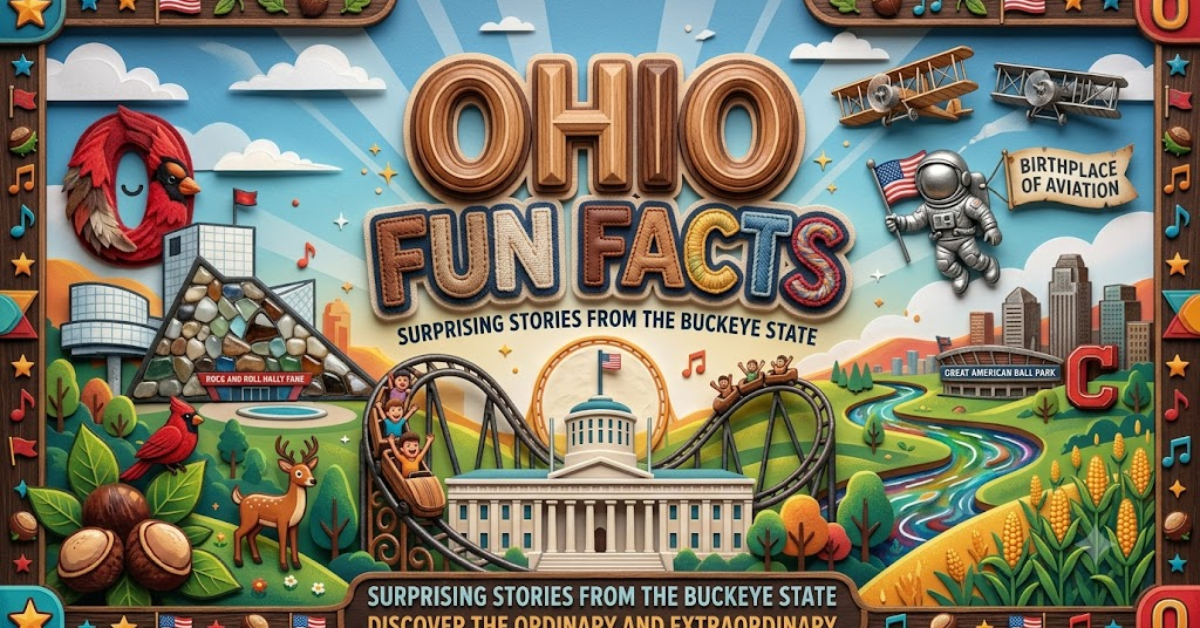
100+ Fun Facts About Ohio You Never Knew
Ohio, often called the Buckeye State, is a fascinating region in the American Midwest packed with rich history, culture, and natural beauty. From its rolling landscapes to its bustling cities, Ohio offers a unique blend of small-town charm and big-city energy that makes it one of the most interesting states to explore.
Known for its contributions to aviation history, sports, and innovation, Ohio has produced countless influential figures and groundbreaking achievements. Whether you’re curious about its geography, economy, wildlife, or historical landmarks, this state has plenty of surprising and lesser-known facts waiting to be discovered. In this article, we’ll dive into some amazing facts about Ohio that highlight why it truly stands out among American states.
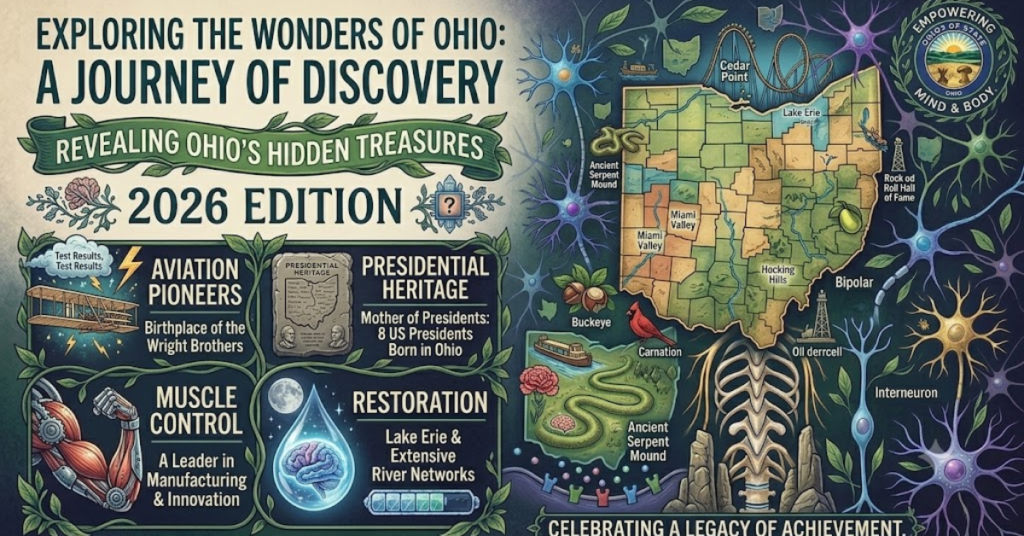
Ohio at a Glance: Quick State Facts
| Fact | Detail |
| Capital | Columbus |
| Largest City | Columbus |
| Statehood | March 1, 1803 (17th state) |
| Nickname | The Buckeye State |
| Population | Roughly 11.8 million (per recent Census Bureau estimates; figures change with each release) |
| Counties | 88 |
| Area | About 44,826 square miles |
| Bordering States | Michigan, Pennsylvania, West Virginia, Kentucky, Indiana |
| State Bird | Northern Cardinal |
| State Tree | Ohio Buckeye |
| State Flower | Scarlet Carnation |
| State Motto | “With God, All Things Are Possible” |
Where Is Ohio Located?
Ohio sits in the Midwest, in the region historians call the Old Northwest Territory. Lake Erie forms its entire northern border, giving Ohio direct access to the Great Lakes.
What Is Ohio Known For?
Ohio is known for manufacturing history, college football, aviation firsts, amusement parks, and being a key presidential and political swing state.
Why Is Ohio Called the Buckeye State?
The nickname comes from the Ohio buckeye tree. Settlers thought the tree’s nut resembled a deer’s eye, and the name stuck for the tree and for Ohioans themselves.
What Does the Name Ohio Mean?
“Ohio” comes from the Seneca (Iroquoian) word ohi:yo’, generally translated as “great river” or “good river,” originally describing the Ohio River.
When Did Ohio Become a State?
Ohio became the 17th U.S. state on March 1, 1803.
How Old Is Ohio?
As of 2026, Ohio has been a state for 223 years.
How Many Counties Are in Ohio?
Ohio has 88 counties, mostly small enough that 19th-century residents could reach the county seat and back in a day by horse.
How Many People Live in Ohio?
Ohio’s population is roughly 11.8 million, among the most populous U.S. states, based on recent U.S. Census Bureau estimates.
What Is the Capital of Ohio?
Columbus is Ohio’s capital, home to state government and Ohio State University.
What Is the Largest City in Ohio?
Columbus is also Ohio’s largest city by population, having overtaken Cleveland and Cincinnati decades ago.
Ohio Geography Facts
Ohio’s landscape ranges from flat farmland to Appalachian hills, shaped largely by ancient glaciers.
How Big Is Ohio?
Ohio covers about 44,826 square miles modest in size but dense in population and industry.
What States Border Ohio?
- Michigan (north)
- Pennsylvania (east)
- West Virginia (southeast)
- Kentucky (south)
- Indiana (west)
Lake Erie forms Ohio’s entire northern boundary.
What Is the Geography of Ohio Like?
What Are Ohio’s Major Regions?
- Till Plains fertile farmland in western Ohio
- Appalachian Plateau hilly, forested eastern/southeastern terrain
- Lake Erie Plains lowlands along the northern shoreline
- Bluegrass Region a small southern pocket resembling Kentucky’s landscape
Ohio’s Highest Point
Ohio’s highest natural point is Campbell Hill, near Bellefontaine, at 1,549 feet.
Ohio’s Lowest Point
Ohio’s lowest elevation, about 455 feet, sits along the Ohio River at the Indiana border.
Ohio’s Major Rivers
Key rivers include the Ohio River, Scioto River, Cuyahoga River, Miami River, Muskingum River, and Maumee River.
Lake Erie Facts
Lake Erie is the shallowest of the five Great Lakes and forms Ohio’s entire northern border, supporting fishing, shipping, and tourism.
Ohio’s Great Lakes Connection
Ohio is one of eight U.S. Great Lakes states, connecting it to international shipping via the St. Lawrence Seaway.
Ohio Climate and Weather Facts
Ohio has a humid continental climate warm, humid summers and cold winters, with heavy lake-effect snow near Cleveland.
Ohio History Facts
How Ohio Got Its Name
Ohio takes its name from the Ohio River, itself named using the Seneca word for “great” or “good river.”
Ohio Before Statehood
Long before European settlement, Ohio was home to the Adena and Hopewell cultures, known for large earthworks such as the Newark Earthworks, now preserved as historic monuments.
Ohio’s Statehood in 1803
Ohio’s 1803 admission made it the first state formed from the Northwest Territory established under the Ordinance of 1787.
The History of Ohio’s 88 Counties
Ohio’s counties were established between the late 1700s and mid-1800s, many named after Revolutionary War figures and early statesmen.
Ohio During the American Civil War
Ohio sent a large number of troops to the Union Army and produced key generals, including Ulysses S. Grant and William Tecumseh Sherman.
Ohio’s Role in the Underground Railroad
Because Ohio bordered the slave state of Kentucky across the Ohio River, it became a major Underground Railroad corridor, with safe houses still preserved today.
Ohio and the Industrial Revolution
Akron became known as the “Rubber Capital of the World” thanks to Goodyear and Firestone, while Cleveland grew as an oil-refining hub under Standard Oil.
Ohio’s Role in American Transportation
Ohio sat at the crossroads of the National Road and the Ohio and Erie Canal, key routes linking the East Coast to the growing Midwest.
Ohio State Symbols
The Great Seal of Ohio
The Great Seal depicts a sunrise over farmland with wheat and arrows, symbolizing agriculture and the original 17 states.
The Ohio State Flag
Ohio’s flag is a swallow-tailed pennant, or “burgee” — one of the few non-rectangular state flags in the U.S. Its 17 stars represent Ohio as the 17th state.
The Ohio State Bird
The Northern Cardinal, official since 1933.
The Ohio State Tree
The Ohio Buckeye, named state tree in 1953.
The Ohio State Flower
The Scarlet Carnation, adopted in 1904.
The Ohio State Fossil
The Isotelus trilobite, designated in 1985.
The Ohio State Insect
The ladybug, adopted in 1975.
The Ohio State Gemstone
Ohio Flint, historically used by Indigenous peoples for tools.
The Ohio State Motto
“With God, All Things Are Possible,” adopted in 1959.
Ohio Nature and Wildlife Facts
Ohio’s Forests and Natural Areas
The Wayne National Forest, per the U.S. Forest Service, is Ohio’s only national forest, covering over 240,000 acres in the southeast.
Ohio Wildlife Facts
Ohio is home to white-tailed deer, black bears in the southeast, coyotes, and river otters, successfully reintroduced after near-disappearance in the 20th century.
Birds You Can Find in Ohio
Common species include the Northern Cardinal, bald eagle, great blue heron, and migratory songbirds along the Mississippi and Atlantic flyways.
Fish and Aquatic Life in Ohio
Lake Erie supports a major walleye and yellow perch fishery, making it a top freshwater fishing destination.
Ohio’s State Parks and Natural Attractions
Ohio has more than 75 state parks, including Hocking Hills State Park and Cuyahoga Valley National Park, Ohio’s only national park.
Famous People From Ohio
U.S. Presidents Born in Ohio
Seven U.S. presidents were born in Ohio: Ulysses S. Grant, Rutherford B. Hayes, James A. Garfield, Benjamin Harrison, William McKinley, William Howard Taft, and Warren G. Harding.
Neil Armstrong and Ohio’s Space History
Neil Armstrong, the first person to walk on the moon, was born in Wapakoneta, Ohio. Astronaut and senator John Glenn, the first American to orbit Earth, was also an Ohio native.
Famous Inventors From Ohio
Thomas Edison was born in Milan, Ohio, and the Wright brothers developed their early aircraft designs in Dayton.
Famous Athletes From Ohio
Notable Ohio athletes include LeBron James (Akron) and track legend Jesse Owens.
Ohio Sports Facts
Professional Sports Teams in Ohio
| Team | Sport | City |
| Cleveland Browns | NFL | Cleveland |
| Cincinnati Bengals | NFL | Cincinnati |
| Cleveland Cavaliers | NBA | Cleveland |
| Cleveland Guardians | MLB | Cleveland |
| Cincinnati Reds | MLB | Cincinnati |
| Columbus Blue Jackets | NHL | Columbus |
| Columbus Crew | MLS | Columbus |
Ohio State Buckeyes Sports Facts
The Ohio State Buckeyes football program has won multiple national championships and holds one of college football’s biggest rivalries against Michigan.
Ohio’s Famous Sports Venues
The Pro Football Hall of Fame is located in Canton, Ohio.
Ohio Inventions and Firsts
Ohio has ties to several notable inventions and historic milestones — though “first” claims in invention history often depend on definition.
Famous Inventions Connected to Ohio
Ohio-linked innovations include an early electric traffic signal installed in Cleveland in 1914, the cash register, and the hot dog bun.
Ohio’s Aviation History
Dayton, Ohio, played a foundational role in powered flight — the Wright brothers designed and tested their early aircraft there before their first flight at Kitty Hawk, North Carolina.
Ohio’s Connection to the Wright Brothers
All of the Wright brothers’ design, engineering, and bicycle-shop testing happened in Dayton, even though the first powered flight took place in North Carolina.
Ohio’s Role in Space Exploration
Ohio has a notable history of producing astronauts, including Neil Armstrong and John Glenn, and Wright-Patterson Air Force Base near Dayton remains central to U.S. aerospace research.
Interesting Ohio Cities and Places
Columbus Facts
Ohio’s capital and largest city, known for Ohio State University and a fast-growing tech sector.
Cleveland Facts
Home to the Rock and Roll Hall of Fame and the Cleveland Clinic, on the shores of Lake Erie.
Cincinnati Facts
Known for its distinct chili style and historic river-trade architecture along the Ohio River.
Toledo Facts
Nicknamed the “Glass City” for its long glass-manufacturing history.
Akron Facts
Once the “Rubber Capital of the World,” and hometown of LeBron James.
Dayton Facts
Celebrated as the home of the Wright brothers, with one of the highest concentrations of patents per capita in U.S. history.
Famous Landmarks and Attractions in Ohio
Top attractions include Cedar Point amusement park in Sandusky, the Rock and Roll Hall of Fame, Hocking Hills, and the Pro Football Hall of Fame.
Ohio Food and Cultural Facts
Famous Foods From Ohio
- Cincinnati chili, served over spaghetti
- Buckeyes, a peanut butter-and-chocolate candy shaped like the buckeye nut
- Tomato juice, Ohio’s official state beverage
Ohio Festivals and Traditions
Ohio hosts hundreds of local festivals annually, including the Ohio State Fair and numerous county fairs.
Ohio Music and Entertainment Facts
Cleveland’s early role in rock radio is part of why the Rock and Roll Hall of Fame was built there.
Weird and Unusual Ohio Facts
- Ohio’s flag is one of the only non-rectangular state flags in the country.
- Sugarcreek, Ohio, is home to a giant cuckoo clock landmark.
Fun Ohio Facts for Kids
- The buckeye nut is considered good luck but is mildly poisonous if eaten raw.
- Ohio’s flag isn’t a rectangle — it’s a pennant shape called a “burgee.”
25 Quick Ohio Facts You Can Learn in Minutes
- Ohio became a state in 1803.
- It was the 17th state admitted to the Union.
- Ohio has 88 counties.
- Columbus is both the capital and largest city.
- Ohio’s population is roughly 11.8 million.
- The state bird is the Northern Cardinal.
- The state tree is the Ohio Buckeye.
- The state flower is the Scarlet Carnation.
- Ohio’s motto references “With God, All Things Are Possible.”
- Seven U.S. presidents were born in Ohio.
- Neil Armstrong was born in Wapakoneta, Ohio.
- The Wright brothers developed their aircraft in Dayton.
- Ohio borders Lake Erie.
- Ohio’s highest point is Campbell Hill.
- Ohio’s flag is a non-rectangular pennant shape.
- Cedar Point is one of the world’s most-visited amusement parks.
- Cincinnati chili is a distinct regional dish.
- Akron was once the “Rubber Capital of the World.”
- Toledo is nicknamed the “Glass City.”
- Ohio has five bordering states.
- Ohio’s state insect is the ladybug.
- Ohio played a major role in the Underground Railroad.
- The Pro Football Hall of Fame is in Canton.
- Ohio’s state fossil is the Isotelus trilobite.
- Ohio’s lowest point sits along the Ohio River.
Ohio Trivia Questions and Answers
Test yourself: Ohio’s nickname, statehood year, county count, and bordering Great Lake are all covered in the FAQ section directly below.
Frequently Asked Questions About Ohio
- What is interesting about Ohio?
Ohio is known as the “Birthplace of Aviation” because the Wright brothers were from Dayton. It also has a rich history in sports, industry, and U.S. politics.
- What is Ohio best known for?
Ohio is best known for the Rock and Roll Hall of Fame, Cedar Point, the Wright brothers, and being an important swing state in U.S. elections.
- What are some facts about Cleveland, Ohio that most people don’t know or understand about the city and its culture?
Cleveland has a strong music, food, sports, and arts culture, and it is home to the Rock and Roll Hall of Fame. The city also played an important role in the growth of American industry.
- Why is Ohio considered significant in American history?
Ohio has produced several U.S. presidents and played an important role in westward expansion, industry, and transportation. Its location also made it strategically important during major periods of U.S. history.
- What are some interesting facts about Youngstown, Ohio?
Youngstown was once a major steel-producing center and became famous for its steel industry. Today, it is known for its industrial heritage, arts, and cultural attractions.
Sources & Methodology
Compiled from public sources: U.S. Census Bureau, Ohio.gov, Ohio DNR, U.S. Forest Service, and the National Park Service. Population and ranking figures are estimates and may shift with future data releases.
Conclusion
From Ohio’s geography and statehood to its inventors, astronauts, and state symbols, these facts show why the Buckeye State holds such a distinctive place in American history.

Hi, I’m Benjamin, the person behind FactsAboutDog.com. 🐶
I’m passionate about dogs and love sharing interesting, fun, and educational facts about our furry friends. Through FactsAboutDog.com, I aim to make learning about dogs simple, enjoyable, and informative for dog lovers everywhere.
From amazing dog facts to breed information and fascinating animal knowledge, my goal is to help readers discover something new every day.
Explore the world of dogs with Benjamin at FactsAboutDog.com!