Facts About Deers: 35 Amazing Deer Facts You’ll Love
Deer are hoofed mammals in the Cervidae family, and they range from tiny pudu to enormous moose. If you have ever watched a white-tailed deer disappear into the trees, you have seen just one small part of a surprisingly complex animal.
These facts about deers explore their antlers, habitat, diet, senses, fawns, speed, and social behavior. Drawing on wildlife references and National Park Service information, this guide separates genuine biology from common misconceptions so you can understand what makes deer such successful survivors.
Facts About Deers: Size & description
Deer vary dramatically in size, body shape, and coat color. The pudu is among the smallest living deer, while the moose is the largest living member of the deer family. This huge size range is one reason the word “deer” describes a surprisingly diverse group of mammals.
White-tailed deer are especially familiar in the United States. Their coats can appear reddish-brown during summer and more gray-brown during winter. Their famous white tail can be raised like a flag when they are alarmed or fleeing.
| Deer fact | What it means |
| Family | Cervidae |
| Young | Fawn |
| Female | Doe |
| Male | Buck or stag |
| Largest living deer | Moose |
| Smallest living deer | Pudu |
| Typical diet | Plants |
| Antlers | Usually males; both sexes in caribou |
Facts About Deers: Habitat
Deer are remarkably adaptable and occupy forests, grasslands, wetlands, mountains, scrublands, and even developed areas. Their success comes partly from their ability to find food and shelter in changing landscapes rather than depending on one narrow habitat.
In the United States, white-tailed deer occur across much of the continental country, while mule deer are especially associated with western North America. Some populations also live surprisingly close to people, feeding around yards, agricultural land, roadsides, and suburban green spaces.
Facts About Deers: Habits
Many deer are most active around dawn and dusk, a pattern known as crepuscular activity. These quieter hours can provide favorable temperatures and lower-risk opportunities for feeding. Deer may also alter their movement according to food availability, weather, predators, and human activity.
Deer communicate through several channels, including scent, vocalizations, posture, and visual signals. White-tailed deer can raise the underside of the tail as an alarm display, while scent glands provide information connected with identity, sex, and social behavior.
Facts About Deers: Diet
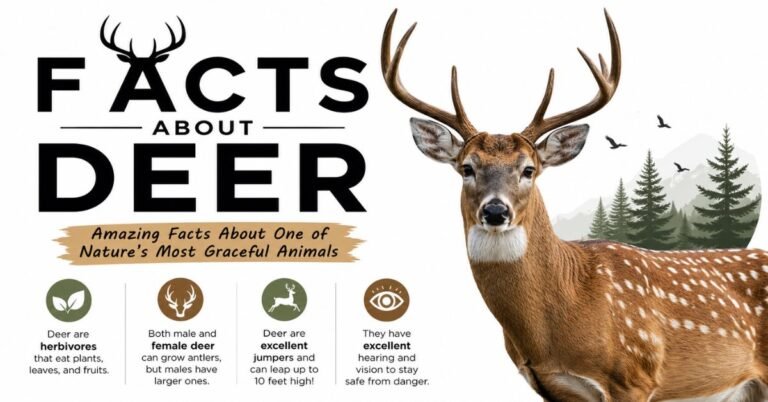
Deer are herbivores, although their exact menu changes with species, habitat, and season. White-tailed deer may browse leaves, shrubs, twigs, acorns, fruits, grasses, and other available vegetation. Their flexible feeding habits help them survive in both natural and human-modified environments.
Deer also have specialized digestive systems for processing fibrous plant material. Like other ruminants, they regurgitate partially digested food and chew it as cud. This process allows them to extract nutrients from vegetation that would be difficult for many other mammals to digest.
Facts About Deers: Offspring
Baby deer are called fawns, and many white-tailed does give birth to one or more fawns during late spring or early summer. Newborn fawns have reddish-brown coats with white spots that provide camouflage against vegetation and dappled woodland light.
One of the most misunderstood facts about deers concerns a fawn lying alone. A mother may deliberately leave her baby hidden while she feeds, returning periodically to nurse it. Finding a quiet fawn by itself does not automatically mean it has been abandoned.
Baby Deer (Fawns) Facts
Fawns depend heavily on camouflage during their earliest days. Their spotted coats, limited scent, and tendency to remain motionless help reduce the chance of detection by predators. The mother staying away for periods of time is therefore part of a survival strategy, not neglect.
Facts About Deers: Antlers v. Horns
Antlers and horns are not the same thing. Deer antlers are bony structures that are normally shed and regrown, whereas true horns consist of a permanent bony core covered by a keratin sheath. Antlers also commonly branch, making them visually distinctive.
For most deer, males grow antlers, which play an important role in competition during breeding season. Caribou, also called reindeer, are the notable living exception in which females also grow antlers. Chinese water deer are unusual because they lack antlers and instead possess elongated upper canine teeth.
| Feature | Antlers | Horns |
| Material | Bone | Bone core + keratin |
| Usually branched | Yes | No |
| Shed periodically | Yes | No |
| Deer example | Buck antlers | Not typical of deer |
Facts About Deers: Unique Deer Species
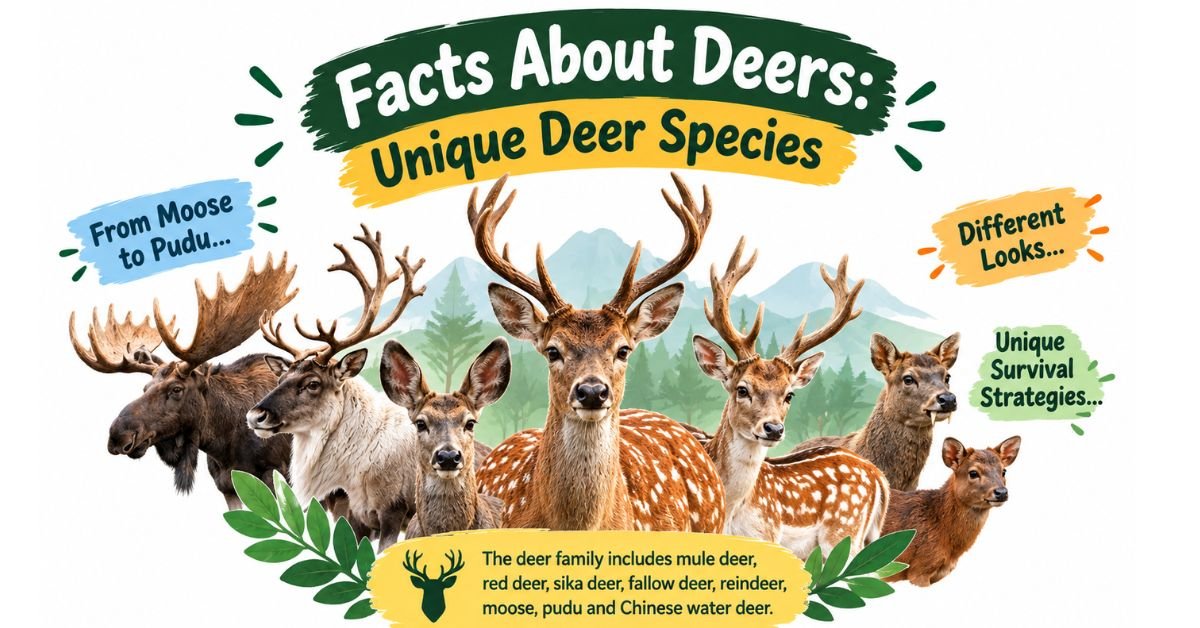
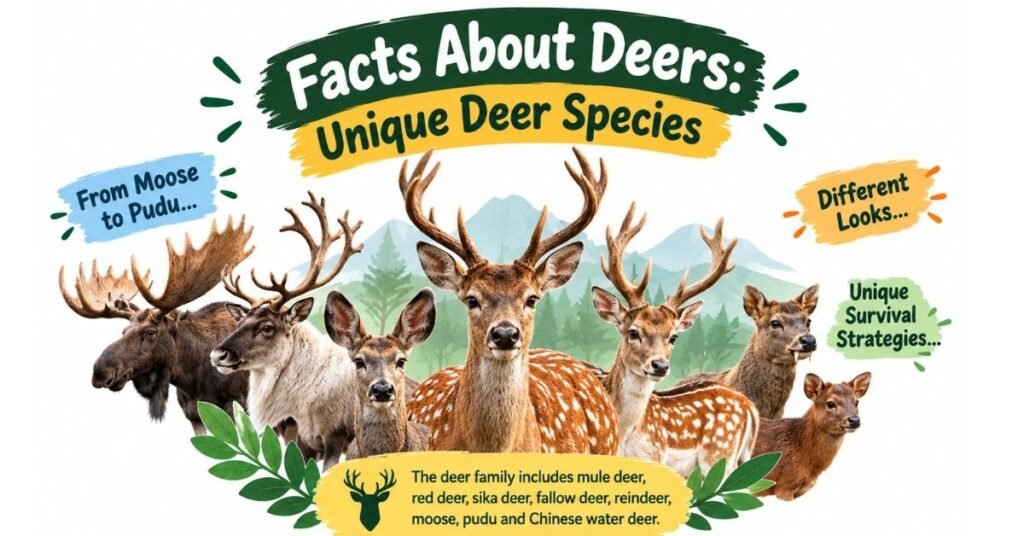
The deer family includes far more than the familiar white-tailed deer. Mule deer, red deer, sika deer, fallow deer, reindeer, moose, pudu, and Chinese water deer all belong to the broader Cervidae family, but they have evolved very different appearances and survival strategies.
The Chinese water deer is particularly memorable because it lacks antlers and has prominent canine teeth. Mule deer are recognizable for their large ears, while reindeer are exceptionally adapted to cold environments. This diversity shows why deer should not be treated as a single uniform animal.
Facts About Deers: Deer and Human Interaction
Humans have interacted with deer for thousands of years. Deer have provided meat, hides, and antlers, while also appearing in cultural traditions, stories, and mythology. Today, however, deer can create challenges when abundant populations overlap with farms, gardens, roads, and suburbs.
In the United States, deer-vehicle collisions are an important human-wildlife issue, particularly during periods of increased movement such as the breeding season. Respecting wildlife space and driving carefully in deer habitat can reduce risks for both people and animals.
Facts About Deers: Fun and Surprising Deer Facts
Here are some quick facts worth remembering:
- The correct plural of deer is “deer,” not “deers.”
- A male deer is commonly called a buck.
- A female deer is called a doe.
- A baby deer is called a fawn.
- A group of deer is commonly called a herd.
- Deer belong to the Cervidae family.
- Moose are the largest living members of the deer family.
- Pudu are among the smallest living deer.
- Deer are primarily herbivores.
- Deer have specialized digestive systems for plant material.
- Antlers are shed and regrown.
- Caribou females grow antlers too.
- Chinese water deer lack antlers.
- Deer communicate using scent, sounds, and body language.
- White-tailed deer can raise their tails when alarmed.
- Many deer are most active around dawn and dusk.
- Deer can swim across bodies of water.
- Fawns use camouflage as an important defense.
- Deer can live in suburban environments.
- Deer species occur in many climates around the world.
Deer or Deers?
If you are writing about these animals, use deer as both the singular and plural form: “one deer,” “two deer,” or “many deer.” “Deers” is not the standard English plural.
How fast do deer run?
Speed varies by species, terrain, and circumstances. White-tailed deer can reach roughly 35–40 mph in short bursts, giving them a powerful advantage when escaping predators. Their survival also depends on agility, quick turns, and jumping ability rather than speed alone.
How high can a deer jump?
Some deer can clear obstacles around 8 feet or more, while reported jumping distances can also be substantial. Their powerful hindquarters and flexible movement help them cross fences, vegetation, streams, and other obstacles while escaping danger.
Do deer have gallbladders?
Most deer do not have gallbladders. CoolKidFacts highlights this unusual anatomical characteristic, noting that bile moves from the liver toward the intestine rather than being stored in a gallbladder.
What is a baby deer called?
A baby deer is called a fawn. White-tailed fawns are commonly born with white spots and rely heavily on concealment during their earliest stage of life.
Are deer nocturnal?
No. Deer are generally not considered strictly nocturnal. Many species are especially active around dawn and dusk, which is why people often notice deer during early morning or evening drives.
Do all female deer have antlers?
No. Female deer generally do not grow antlers. Caribou/reindeer are the major living exception, with both males and females capable of growing them.
Facts About Deers: What Makes Them So Fascinating?
The most interesting facts about deers are really facts about adaptation. A deer can turn vegetation into energy through specialized digestion, grow and shed antlers, hide a vulnerable fawn through camouflage, communicate through scent, and move rapidly when danger appears.
The next time you see a white-tailed deer standing quietly beside a trail, remember that the stillness is deceptive. Beneath that calm appearance is an animal shaped by predators, seasons, competition, food availability, and thousands of generations of evolution.
FAQ Section
What is the plural of deer?
The plural of deer is deer, not “deers.” You can say “one deer,” “two deer,” or “a herd of deer.” The word stays the same whether you are talking about one animal or several.
How fast do deer run?
White-tailed deer can reach speeds of about 35–40 mph in short bursts. Their speed, agility, quick turns, and powerful legs help them escape predators and cross difficult terrain.
How high can a deer jump?
A deer can jump surprisingly high, with some deer able to clear obstacles around 8 feet or more. Their strong hind legs allow them to leap over fences, vegetation, and other obstacles when escaping danger.
Do deer have gallbladders?
Most deer do not have gallbladders. Instead, bile produced by the liver moves directly toward the digestive tract. This unusual anatomical feature is one of the lesser-known facts about deer.
What is a baby deer called?
A baby deer is called a fawn. Many white-tailed fawns are born with white spots that help them blend into vegetation. Young fawns often remain still and hidden while their mothers are away feeding.
Are deer nocturnal?
Deer are not strictly nocturnal. Many species are crepuscular, meaning they are especially active around dawn and dusk. Their activity can also change depending on food, weather, predators, and human activity.
Do all female deer have antlers?
No, most female deer do not have antlers. Caribou, also known as reindeer, are the major exception, because females as well as males can grow antlers.

Hi, I’m Benjamin, the person behind FactsAboutDog.com. 🐶
I’m passionate about dogs and love sharing interesting, fun, and educational facts about our furry friends. Through FactsAboutDog.com, I aim to make learning about dogs simple, enjoyable, and informative for dog lovers everywhere.
From amazing dog facts to breed information and fascinating animal knowledge, my goal is to help readers discover something new every day.
Explore the world of dogs with Benjamin at FactsAboutDog.com!