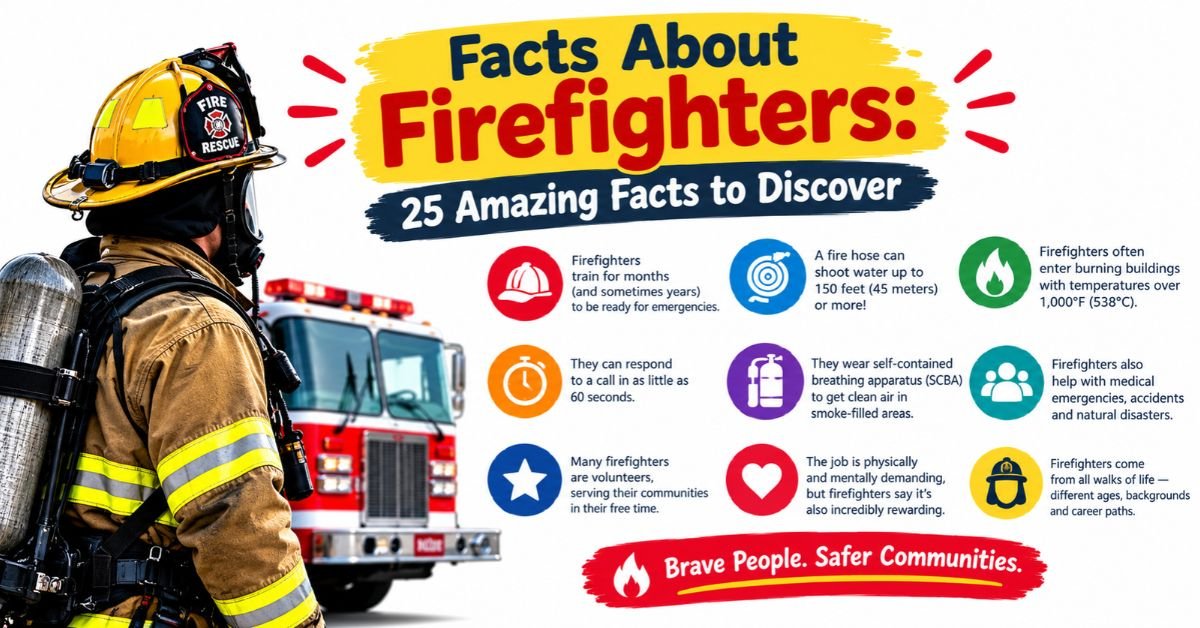
Facts About Firefighters: 25 Amazing Facts to Discover
Facts about firefighters reveal a profession that involves much more than putting out fires. Firefighters protect people, respond to medical emergencies, rescue animals, and help communities prepare for disasters. Their work combines specialized training, teamwork, protective equipment, and quick decisions under pressure.
From ancient Roman fire brigades to modern fire engines equipped with thermal cameras, firefighting has changed dramatically over the centuries. The following facts about firefighters explore their history, daily responsibilities, equipment, and lesser-known traditions, using U.S. fire-service information and historical sources to separate documented facts from popular assumptions.
Firefighting has ancient origins
Fact 1: Organized firefighting dates back thousands of years. Ancient communities developed ways to respond to destructive fires long before modern fire departments existed. One well-known example is ancient Rome, where Emperor Augustus established the Vigiles in AD 6. These organized groups served as nighttime watchmen and helped protect the city against fires.
Fact 2: Early firefighting equipment was very different from today’s engines. Before motorized fire trucks, communities relied on buckets, hand-operated pumps, and human-powered equipment. In colonial America, residents often formed bucket brigades, passing water from person to person. These early methods were labor-intensive and limited by the available water supply and the speed at which people could organize.
Fact 3: Benjamin Franklin helped organize early American firefighting. Franklin helped establish Philadelphia’s Union Fire Company in 1736. Volunteer organizations like this represented an important development in community fire protection, encouraging residents to work together and prepare for emergencies rather than relying entirely on individual efforts.
Fact 4: Fire prevention has always mattered alongside firefighting. Preventing a fire from starting can be more effective than trying to control it after it spreads. Modern departments support this goal through public education, inspections, smoke alarm awareness, and community risk reduction. Their work helps people understand how everyday decisions affect fire safety.
Firefighters are highly trained professionals.
Fact 5: Firefighters train for many different emergencies. Professional preparation can include fire suppression, search and rescue, first aid, hazardous materials awareness, and emergency vehicle operations. The exact qualifications depend on the department and position. In the United States, many recruits attend a fire academy, while some departments also require or prefer emergency medical certifications.
Fact 6: Physical fitness is an important part of the job. Firefighters may need to carry equipment, climb stairs, move debris, assist injured people, and work for extended periods. Strength and stamina matter, but so do coordination, communication, judgment, and the ability to follow established safety procedures during stressful situations.
Fact 7: Teamwork is essential during emergency calls. Firefighters work in coordinated crews rather than acting independently. A crew may have members assigned to different tasks, such as controlling the fire, searching an area, supplying water, or monitoring conditions. Clear communication helps teams coordinate actions and maintain accountability as an incident changes.
Fact 8: Training continues after recruitment. Firefighters regularly review procedures, practice skills, and learn to use new equipment. Departments may conduct drills involving ladders, breathing apparatus, rescue scenarios, and emergency communication. Repeated practice helps crews respond more consistently when an actual incident leaves little time to consider every step from scratch.
Firefighters work long and unpredictable hours.
Fact 9: Some firefighters work 24-hour shifts. Work schedules vary by department, staffing model, and assignment. Some career firefighters remain on duty at the station for a full day before a period off, while others work different shift patterns. Wildland firefighting can involve extended deployments away from home during major incidents.
Fact 10: A fire station is also a workplace where crews prepare between calls. When firefighters are not responding to emergencies, they may inspect equipment, clean vehicles, maintain supplies, exercise, train, and complete reports. Station life includes ordinary tasks, but these routines help ensure that essential equipment is ready when a call comes in.
Fact 11: Firefighters can be called out at any hour. Emergencies do not follow a convenient schedule. A crew may respond during the day, overnight, on weekends, or on holidays. The unpredictable nature of the work can affect sleep and family routines, making shift planning and adequate recovery important parts of occupational health.
Fact 12: Volunteer firefighters are a major part of the U.S. fire service. Many American communities, particularly smaller towns and rural areas, depend on volunteers. NFPA research reported that the United States had approximately 635,000 volunteer firefighters in 2023, down from about 827,000 in 2008.
This is an important reminder that firefighting is not always a full-time, paid career. Volunteers typically train and respond alongside other responsibilities, helping provide emergency coverage in places where maintaining an entirely paid department may be difficult.

Firefighters provide more than just firefighting services.
Fact 13: Medical emergencies account for most fire department calls. According to the USFA’s 2024 response statistics, emergency medical services and rescue accounted for 65.1% of reported fire department responses, while fires accounted for just 3.7%.
These numbers challenge the common image of firefighters spending every shift battling flames. Depending on the department, crews may spend far more time helping people with medical emergencies, responding to crashes, and performing other rescue duties than extinguishing fires.
Fact 14: Firefighters may help rescue people after vehicle crashes. Some departments provide rescue services at traffic collisions, working with EMS and other emergency responders. Their responsibilities can include assessing hazards, helping access damaged vehicles, and supporting the safe movement of injured people. The precise tasks depend on training, equipment, and local protocols.
Fact 15: Firefighters also help during natural disasters. Floods, severe storms, wildfires, and other emergencies may require rescue operations, evacuations, and assistance to affected residents. Fire departments coordinate with other agencies as needed. Their role reflects the broader emergency services mission: protecting life and property from multiple kinds of hazards.
Firefighters have specialized equipment.
Fact 16: Firefighter protective gear is designed for several hazards. Turnout gear generally includes a protective coat and trousers, helmet, gloves, boots, and other equipment appropriate to the assignment. These items help protect against heat, abrasion, and other hazards, but they do not make firefighters invulnerable to fire or hazardous environments.
Fact 17: Breathing apparatus helps firefighters work in dangerous atmospheres. A self-contained breathing apparatus, commonly called an SCBA, supplies breathable air from a carried cylinder. It is important in environments where smoke, toxic gases, or oxygen-deficient conditions may make normal breathing unsafe. Proper fit, inspection, training, and monitoring are essential to its use.
Fact 18: Fire engines and ladder trucks serve different purposes. A fire engine commonly carries hoses, water or water-supply equipment, and tools for fire suppression. A ladder truck typically supports elevated access, rescue, ventilation, and other specialized tasks. Equipment varies by department, and some vehicles combine several capabilities.
Fact 19: Protective equipment adds to the physical workload. Helmets, boots, clothing, breathing equipment, and carried tools create extra weight and can make movement more difficult. The total load varies with the equipment and assignment. This is one reason firefighters practice moving, climbing, and completing tasks while wearing their required protective equipment.
Senses Are Limited in a Burning Building
Fact 20: Smoke can make it extremely difficult to see. In a smoke-filled building, visibility may fall sharply, making familiar rooms and corridors hard to recognize. Firefighters rely on training, communication, protective equipment, and established search procedures rather than assuming they can see their surroundings clearly.
Fact 21: A breathing mask is more than a simple face covering. A properly fitted SCBA facepiece forms part of a breathing-protection system. Facial hair that crosses the sealing surface can interfere with a tight seal, which is why relevant respiratory-protection rules restrict facial hair in that area. Requirements depend on the equipment and applicable safety standards.
Fact 22: Heat and noise can complicate emergency decisions. Fire scenes can involve loud equipment, alarms, radio traffic, changing temperatures, and unfamiliar obstacles. Firefighters use communication protocols and coordinated roles to reduce confusion. These conditions also explain why emergency operations require repeated training and why responders must continuously reassess changing hazards.
The Role of Dalmatians in Firefighting
Fact 23: Dalmatians became associated with traditional firehouses. In the era of horse-drawn fire carriages, Dalmatians were valued for their compatibility with horses and their role around the equipment. Their historical association continued even after motorized fire engines replaced horse-drawn apparatus.
Fact 24: Today’s firehouse dogs are not limited to one breed. Dalmatians remain recognizable symbols of the fire service, but dogs of various breeds can serve as mascots or be trained for appropriate working roles. Search-and-rescue dogs, for example, may receive specialized training to help locate missing people. A mascot and a trained rescue dog have different responsibilities.
Pioneering Women in Firefighting
Fact 25: Women have a long history in firefighting. Molly Williams is widely recognized as an early Black woman associated with firefighting in New York City in the early nineteenth century. Historical accounts connect her service with the Oceanus Engine Company. Her story is an important reminder that women contributed to emergency response long before the profession became more inclusive in many departments.
Women now serve in many fire-service roles, including structural firefighting, wildland operations, emergency medical response, fire prevention, and leadership. Their career paths, training, and responsibilities depend on the same relevant job requirements and local standards that apply to their positions.
Fire Stations Have Interesting Traditions
Fire stations are workplaces, training centers, and places where crews build trust. Traditions can vary from department to department, but shared meals, ceremonial events, and station mascots can help create a sense of community.
One tradition is the apparatus push-in ceremony. Some departments celebrate the arrival of a new fire engine by having members and guests push it into the station bay. The custom recalls an era when horse-drawn equipment had to be returned to its place without simply backing a motorized vehicle into the building.
The Maltese Cross is another widely recognized fire-service symbol. It appears on badges, patches, and other firefighting items. Its use reflects longstanding fire-service symbolism, although specific designs and their meanings can vary between organizations.
These customs are more than decoration. They can connect current firefighters with earlier generations, celebrate service milestones, and help a department welcome new members.

Firefighters Use Advanced Technology
Modern fire departments use technology to improve situational awareness, communication, and incident coordination. Equipment varies with budgets, local risks, and the kind of emergencies a department handles.
Thermal imaging cameras can display differences in surface temperatures and help trained responders identify heat patterns in low-visibility conditions. They are useful tools, but they do not provide a perfect view through every material or guarantee that a person or hazard will always be detected.
Some departments use drones to assess large outdoor incidents, wildfire perimeters, and areas that are difficult to view from the ground. Aerial images can help incident commanders understand conditions and allocate resources, subject to operating rules and the capabilities of the aircraft.
Computer-aided dispatch, digital maps, radio systems, and incident-management software also help coordinate responses. As the U.S. fire service modernizes its reporting systems, reliable data can improve planning and help departments understand the emergencies they face. The USFA describes the National Emergency Response Information System (NERIS) as the successor to the older National Fire Incident Reporting System (NFIRS).
The most important point is that technology supports firefighters; it does not replace training, teamwork, judgment, or established safety procedures.
11. FAQ Section
The following are useful, search-intent-aligned FAQ questions for this topic. They are PAA-style questions, not a claim that these exact questions were verified in a live Google People Also Ask panel.
What are five interesting facts about firefighters?
Firefighters respond to medical emergencies as well as fires, use specialized breathing equipment, train for rescue operations, work in both paid and volunteer roles, and use technology such as thermal imaging cameras.
What do firefighters do besides put out fires?
They may provide emergency medical assistance, rescue people from dangerous situations, respond to vehicle crashes, support disaster operations, conduct fire safety education, and help prevent fires through community outreach.
How many firefighters are volunteers in the United States?
NFPA research reported approximately 635,000 volunteer firefighters in the United States in 2023. Volunteer staffing varies considerably by region, and many smaller communities depend heavily on volunteers.
Why do firefighters wear heavy protective gear?
Protective gear helps shield firefighters from heat, flames, abrasion, and other hazards. Breathing equipment provides air in dangerous atmospheres. The equipment must be used correctly and cannot eliminate every risk.
Why are Dalmatians associated with firefighters?
Dalmatians were historically associated with horse-drawn fire carriages. Their compatibility with horses helped establish their reputation around firehouses, and they remain familiar symbols of the fire service.
Who was Molly Williams?
Molly Williams is widely recognized as an early Black woman firefighter associated with New York City’s Oceanus Engine Company in the early nineteenth century. Her story is an important part of the history of women in firefighting.
Do firefighters respond to medical emergencies?
Yes. In the United States, EMS and rescue represented 65.1% of reported fire department responses in the USFA’s 2024 statistics. The exact services offered depend on the department and its local responsibilities.
What technology do modern firefighters use?
Depending on the department, firefighters may use thermal imaging cameras, radios, digital mapping, computer-aided dispatch, drones, and incident-management systems. These tools help responders assess conditions, communicate, and coordinate resources.
How long do firefighters work each shift?
Schedules vary. Some career firefighters work 24-hour shifts followed by time off, while others follow different schedules. Wildland firefighters may spend days or weeks deployed during major incidents.
What qualifications do firefighters need?
Requirements depend on the department and jurisdiction. Common requirements include a high school diploma or equivalent, fire academy training, physical and medical evaluations, and sometimes EMT certification. Applicants should check the specific department’s recruitment rules.
Conclusion
Facts about firefighters show that the profession combines history, science, teamwork, public service, and emergency response. Firefighters do far more than control flames: they provide medical assistance, rescue people, support disaster response, educate the public, and help communities reduce risks.
From ancient fire brigades and volunteer companies to modern protective equipment and thermal imaging, firefighting has evolved alongside the needs of society. Understanding these facts helps readers appreciate both the skills required for the job and the many ways firefighters support their communities.

Hi, I’m Benjamin, the person behind FactsAboutDog.com. 🐶
I’m passionate about dogs and love sharing interesting, fun, and educational facts about our furry friends. Through FactsAboutDog.com, I aim to make learning about dogs simple, enjoyable, and informative for dog lovers everywhere.
From amazing dog facts to breed information and fascinating animal knowledge, my goal is to help readers discover something new every day.
Explore the world of dogs with Benjamin at FactsAboutDog.com!