
ATTRCM Facts Spot the Signs Early Symptoms & Treatment ATTRCM facts in one line
transthyretin amyloid cardiomyopathy is a rare, underdiagnosed heart muscle disease in which misfolded protein deposits stiffen the heart and can lead to heart failure. After weeks reviewing American Heart Association and Cleveland Clinic guidance, I understand why unexplained breathlessness feels so frightening when nobody can explain it.
Many people hear “it’s just aging” for years while carpal tunnel, back pain and swollen ankles quietly pile up. This guide explains symptoms, hereditary and wild-type types, diagnosis, treatments like tafamidis, and outlook, so you can walk into your cardiologist’s office informed and confident. Everything here is paraphrased from trusted medical sources and is no substitute for your doctor.
Quick Facts: ATTRCM Facts You Need to Know First
ATTR-CM is a disease of the heart muscle where misfolded transthyretin protein piles up and thickens the walls. It is often missed and can be fatal. It looks a lot like ordinary heart failure. Early recognition is the single biggest lever patients and families haveEstimates put American cases anywhere from 50,000 to 150,000, yet fewer than 2% are thought to be formally diagnosed. Average diagnosis can take more than five years. Those numbers explain why so many people feel dismissed before anyone finally orders the right scan
| Feature | Hereditary (hATTR-CM) | Wild-type (wATTR-CM) |
| Cause | TTR gene variant | Age-related instability of normal TTR protein |
| Runs in families? | Yes | No |
| Typical onset | As early as the 30s, often 50s or later | Mostly men over 60–65 |
| US pattern | Common variant in about 3–4% of Black Americans | Most common type overall |
| Extra clues | Numbness or tingling in hands and feet | Carpal tunnel, spinal stenosis, tendon rupture |
Now that the snapshot is clear, let’s look at what is actually happening inside the heart.
What Is ATTR-CM and What Does It Do? Core ATTRCM Facts
Think of transthyretin as a delivery protein made mostly in the liver. In ATTR-CM it clumps into amyloid fibrils that settle in heart tissue and replace healthy cells, leaving the heart stiff and less able to relaxA stiff left ventricle cannot fill properly, so less blood leaves with each beat. Over time that strain can cause heart failure and rhythm problems. Because the same protein affects nerves, ligaments and tendons, ATTR-CM is really a whole-body condition showing up in the heart.
Hereditary ATTR-CM
Hereditary ATTR-CM stems from a variant in the TTR gene and can run through families. Symptoms may begin as early as the 30s, though they usually surface later. It is more frequent in parts of Portugal, Brazil, Sweden and Japan, and among people of African or Irish ancestry
Wild-Type ATTR-CM
Wild-type ATTR-CM has no gene variant and does not run in families. Normal TTR protein simply becomes unstable with age. It is the most common form, mostly affecting older men, and may bring carpal tunnel syndrome, spinal stenosis or tendon problems sometimes before heart symptoms appear.
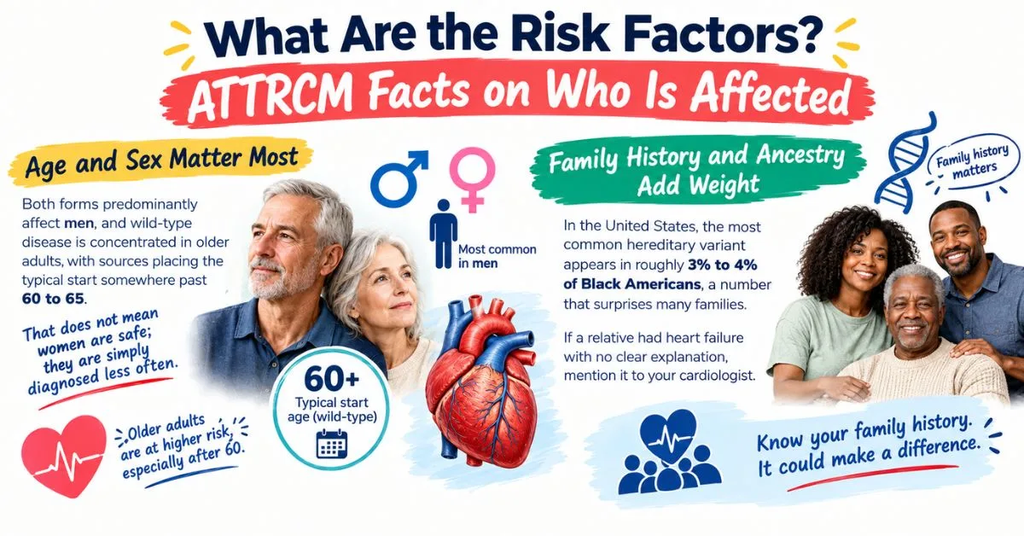
What Are the Risk Factors? ATTRCM Facts on Who Is Affected
Age and sex matter most. Both forms predominantly affect men, and wild-type disease is concentrated in older adults, with sources placing the typical start somewhere past 60 to 65. That does not mean women are safe; they are simply diagnosed less oftenFamily history and ancestry add weight. In the United States, the most common hereditary variant appears in roughly 3% to 4% of Black Americans, a number that surprises many families. If a relative had heart failure with no clear explanation, mention it to your cardiologist.
Risk Factors for Hereditary ATTR-CM
For the hereditary form, the risk list includes a relative with ATTR-CM or heart failure, older age, male sex and Black race. These factors stack. A man with a family history and unexplained thick heart walls has good reason to ask a specialist about it.
Risk Factors for Wild-Type ATTR-CM
For wild-type ATTR-CM, the two main risk factors are being older and being male. There is no gene variant to inherit, and one hospital source notes no evidence that lifestyle choices cause it. That can be a relief: nothing you did triggered this.That raises the obvious question of what actually drives the buildup.
ATTR-CM Causes: ATTRCM Facts on Misfolded Protein Buildup
Causes come down to a protein that will not hold its shape. Transthyretin normally travels as a stable four-part unit, but when it breaks apart, the pieces fold wrongly and stack into fibrils. Your bloodstream carries those clumps until they lodge in heart muscle.
In the hereditary form, a TTR gene change means the body builds faulty protein from the start. In wild-type disease, normal protein becomes structurally unstable as the years pass. Different triggers, same destination: stiff, thickened heart walls and a pump that works harder for less.
Knowing the mechanism makes the symptoms easier to read.
What Are the Symptoms? ATTRCM Facts on Warning Signs
Early symptoms mimic heart failure: shortness of breath at rest or with little effort, swelling in the lower legs, and chest congestion. Because these feel like normal aging or another heart condition, many people adapt quietly. Some have no symptoms at first, while others progress to advanced heart failure.
A story from a Mayo Clinic Connect thread captures the confusion. One member described lifelong breathlessness, carpal tunnel and spinal stenosis, and wondered whether the three fit together. They can be linked in ATTR-CM. Naming the pattern, not just each ache, often moves a diagnosis forward.
Cardiac Symptoms
Cardiac symptoms include shortness of breath, coughing or wheezing when lying down, swelling in the legs and feet, fatigue, dizziness, fainting, palpitations, and a fast or irregular heartbeat such as atrial fibrillation. Any new rhythm change deserves a prompt conversation with your doctor.
Non-Cardiac Symptoms
Non-cardiac clues can show up first. They include carpal tunnel syndrome, lower back pain, numbness or tingling in the hands and feet, stomach issues and eye problems. Carpal tunnel is one of the more commonly reported early signs, which is why it matters when it appears alongside breathlessness.
What Are the Complications?
Without treatment, ATTR-CM can worsen into heart failure, arrhythmias and conduction system disease such as heart block. Those problems can ultimately lead to stroke or sudden cardiac death. That sounds frightening, but it is exactly why early testing and a steady relationship with a cardiologist matter so much.
Because symptoms overlap so heavily with other conditions, diagnosis deserves its own spotlight.
How Is ATTR-CM Diagnosed? ATTRCM Facts on Testing
Suspicion usually starts with a routine electrocardiogram or echocardiogram that looks off, plus the right symptoms. Specialized tests then confirm it. The good news is that, when no abnormal blood protein is present, a nuclear imaging scan can often make the diagnosis without a biopsy. nih
Diagnosis is genuinely hard. The hereditary type can pose as long-standing high blood pressure or hypertrophic cardiomyopathy, so a first answer may be wrong. The wild type may stay silent until heart failure strikes. If treatment is not helping, ask your clinician about next steps.
How Doctors Diagnose This Condition
Doctors may combine an EKG, echocardiogram or cardiac MRI, a cardiac PYP scan to look for TTR amyloid deposits, a heart biopsy, and genetic testing. Not every patient needs every test. A cardiologist familiar with amyloidosis can choose the sequence that fits your situation.
| Test | What it contributes |
| EKG / echocardiogram | First clues such as thickened walls or rhythm changes |
| Cardiac MRI | Detailed picture of heart muscle |
| Cardiac PYP (nuclear) scan | Checks for TTR amyloid in the heart |
| Heart biopsy | Tissue confirmation when other tests are unclear |
| Genetic testing | Separates hereditary from wild-type |
Find a Specialist Who Knows ATTR-CM
Because diagnosis can take more than five years on average, a specialist can shorten the road. Look for a dedicated amyloidosis program. Bring a written symptom timeline, including carpal tunnel surgery, back pain and family history, so the clinician sees the full pattern at once.
Once the diagnosis is in hand, the conversation shifts to what can be done.
How Can ATTR-CM Be Treated? ATTRCM Facts on Treatment
There is no cure, but treatment has changed dramatically. Therapy now targets the underlying protein and eases heart failure at the same time. Newer drugs can slow or stop further buildup, though they cannot reverse damage already done, which is why starting early gives the best chance. clevelandclinic
Investigator Ahmad Masri describes the field’s shift from untreatable to having approved options. Still, real-world tafamidis data show about 54% survival at 65 months, so researchers say better therapies are needed. Treat those numbers as context, not a personal forecast. tctmd
Medications for ATTR-CM
Three drug options now exist. Tafamidis (Vyndamax, Vyndaqel) stabilizes the protein; acoramidis (Attruby) is another stabilizer for both types; vutrisiran (Amvuttra) is an injection every three months that lowers TTR production. Your cardiologist will weigh type, stage, and coverage before choosing.
| Drug | How it works | How it’s given | Key fact |
| Tafamidis | TTR stabilizer | Oral | First ATTR-CM therapy, FDA-approved May 2019 |
| Acoramidis | TTR stabilizer | Oral | FDA-approved November 2024 |
| Vutrisiran | Lowers TTR production | Injection every 3 months | HELIOS-B: 28% lower risk of death or cardiovascular hospitalization |
Sources: Cleveland Clinic; ICER summary in the Journal of Managed Care & Specialty Pharmacy; medRxiv 2026 preprint; Frontiers in Cardiovascular Medicine 2026. Doses and eligibility are decisions for your care team.
Managing Complications
Supportive care matters too. Diuretics relieve fluid, limiting salt helps, anticoagulants address clot risk with rhythm problems, antiarrhythmic medicines or ablation steady the heartbeat, and pacemakers help conduction trouble. Compression therapy can ease swelling. Care plans are individual, so follow your own team’s advice.
Organ Transplantation
In advanced heart failure, a heart transplant may be an option. Because the liver makes the abnormal protein, some patients have received both heart and liver transplants. Cleveland Clinic says this has been recommended less often in recent years because of newer therapies, though it remains highly effective when needed.
Treatment naturally leads to the question everyone is afraid to ask.
Outlook / Prognosis: ATTRCM Facts on Life Expectancy
Before modern drugs, studies put median survival at roughly 3.6 years for wild-type and 2.5 years for hereditary disease when untreated. Those older figures describe a different era. Today, earlier diagnosis and disease-modifying therapy are changing what the road ahead can look like.
In the HELIOS-B trial, vutrisiran cut the combined risk of death and cardiovascular hospitalization by 28%. Separately, a 2026 preprint found that sex and race shaped who started tafamidis and how they fared. Disparities in access are part of the story, so speaking up early matters.
What Is the Outlook for Someone With ATTR-CM?
ATTR-CM is progressive, so it gets worse over time, but early diagnosis and treatment are tied to a better outlook. Living with it is easier than it used to be thanks to better tests and medications. Real-world data show roughly 39% of tafamidis-treated patients died over a median 43 months.
Outlook is also shaped by how well you partner with your care team.
When Should I See My Healthcare Provider? ATTRCM Facts for Your Next Visit
See a cardiologist if you have heart failure that is not improving, or if breathlessness arrives alongside carpal tunnel, back pain, numbness or a family history. If you already have a diagnosis, regular visits confirm your treatment is working. Seek emergency care for symptoms of a heart attack.
Come with questions. Cleveland Clinic suggests asking which type you have, what treatments are recommended, their benefits and risks, which complications to watch for, and whether relatives should be tested. Write answers down. Appointments move quickly, and anxiety makes even prepared people forget half of what they planned to say.
Of course, no one navigates this alone, and families carry part of the load.
Caregivers Are in a Unique Position to Help: ATTRCM Facts for Families
Caregivers often notice what patients dismiss: numb legs and hands, slower walking, ankles that swell by evening. One caregiver quoted by Pfizer said the numbness was the thing that stood out. Keeping a shared log of symptoms gives the doctor evidence, not just impressions.
Family matters medically, too. Hereditary ATTR-CM can pass to relatives, so major medical centers point toward genetic testing and counseling when a variant is confirmed. Sharing results with siblings and adult children is an act of love, even when the conversation feels heavy.
A few quick answers before we wrap up.
FAQ
What is ATTR-CM?
ATTR-CM, or transthyretin amyloid cardiomyopathy, is a rare, serious heart condition in which misfolded transthyretin protein builds up in the heart muscle. The deposits make the heart stiff and thick, reducing its ability to pump and eventually leading to heart failure if untreated.
What are the 2 types of ATTR-CM?
The two types are hereditary ATTR-CM, caused by a TTR gene variant that can run in families, and wild-type ATTR-CM, which has no gene variant and is linked to aging. Wild-type is the more common form and mostly affects older men.
What happens to misfolded proteins over time?
The misfolded proteins clump together into amyloid fibrils and accumulate in the heart, nerves and other tissues. In the heart they thicken and stiffen the walls, which strains pumping and can end in heart failure and rhythm problems.
What are the common symptoms of ATTR-CM?
Common symptoms include shortness of breath, leg and ankle swelling, fatigue, palpitations and dizziness. Many people also have carpal tunnel syndrome, lower back pain from spinal stenosis, numbness or tingling, or stomach problems, sometimes appearing before any heart symptoms show up.
Why is ATTR-CM sometimes underdiagnosed or misdiagnosed?
Awareness is low and its symptoms mimic more common heart failure, high blood pressure heart disease and hypertrophic cardiomyopathy. Early signs are also easy to blame on aging. As a result, diagnosis can take over five years, and many cases are never identified.
How is ATTR-CM treated, and is it curable?
There is no cure, but medications such as tafamidis, acoramidis and vutrisiran can slow or stop further protein buildup, and heart-failure care manages symptoms. Transplant is rare. Treatments cannot reverse damage already done, so earlier diagnosis offers the biggest benefit.
Why speak to a doctor if you have a family history of heart failure?
Hereditary ATTR-CM is passed through families, and its symptoms can resemble other heart disease. Telling your doctor about a relative’s unexplained heart failure may prompt genetic testing and imaging that catch the disease earlier, when treatment tends to work best.
Get Support: Carrying These ATTRCM Facts Forward
Support is part of care. The American Heart Association says that managing a heart condition alone can make healthy changes harder, and its free Support Network connects patients and caregivers. Reaching out is not weakness; it is part of treatment.
The ATTRCM facts worth remembering: it is rare but underdiagnosed, it looks like heart failure, clues like carpal tunnel and back pain matter, and treatments now exist. If something does not add up, keep asking. This article is educational and cannot replace your cardiologist’s advice.

Hi, I’m Benjamin, the person behind FactsAboutDog.com. 🐶
I’m passionate about dogs and love sharing interesting, fun, and educational facts about our furry friends. Through FactsAboutDog.com, I aim to make learning about dogs simple, enjoyable, and informative for dog lovers everywhere.
From amazing dog facts to breed information and fascinating animal knowledge, my goal is to help readers discover something new every day.
Explore the world of dogs with Benjamin at FactsAboutDog.com!