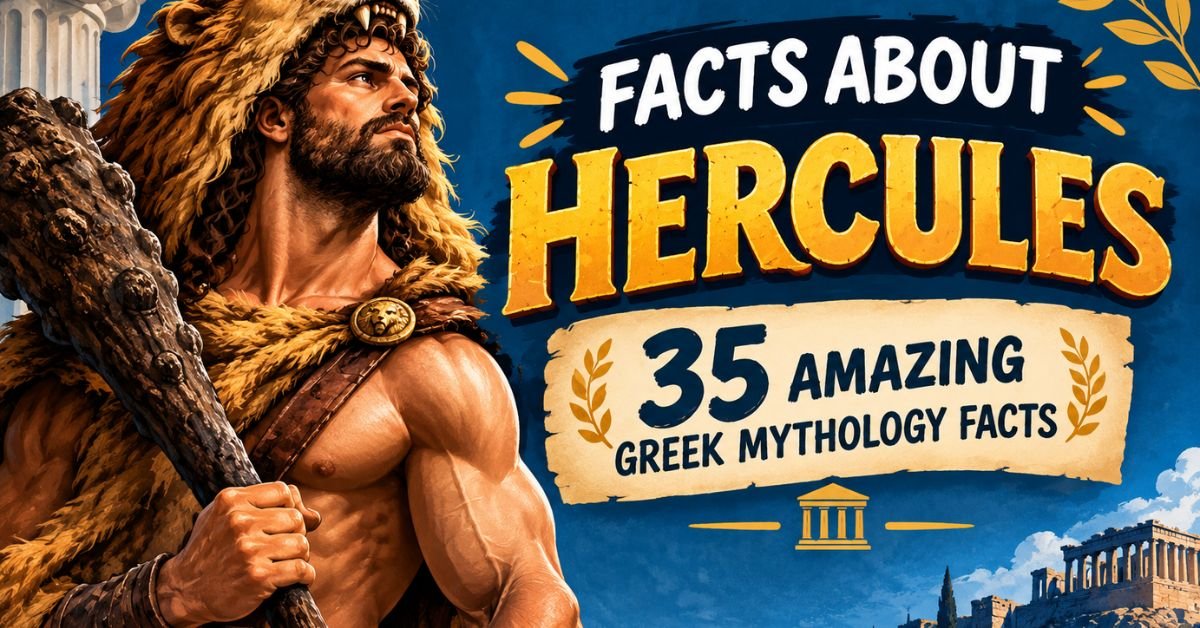
Facts About Hercules: 35 Amazing Greek Mythology Facts
Hercules was the legendary Greek hero known for extraordinary strength, the Twelve Labors, and a life shaped by gods, monsters, and hardship. Also called Heracles, he was the son of Zeus and Alcmene, making him a central figure in Greek mythology, heroic legends, and ancient religion.
What makes the story fascinating is that Hercules was more than a powerful warrior. His story involves Hera, Eurystheus, Delphi, Olympus, Cerberus, and difficult choices that made him surprisingly human. Looking beyond the famous movies reveals a complicated hero whose struggles helped make his legend last for thousands of years.
Facts About Hercules: Birth and Early Life
Hercules was born from Zeus and Alcmene, a mortal woman connected to the heroic family of Perseus. His original name was Alcaeus in some traditions before he became Heracles, a name associated with Hera. His unusual parentage made him both mortal and divine in different aspects.
One of the best-known early facts about Hercules involves Hera, serpents, and his remarkable strength. According to tradition, Hera sent snakes into his cradle, but the infant Hercules strangled them. He later received training in wrestling, archery, fencing, horseback riding, music, and chariot driving.
Facts About Hercules: Was Hercules a God?
Hercules was not originally a Greek god. He was a mortal hero with divine parentage because Zeus was his father. His unusual status explains why different traditions describe him as a demigod, hero, or eventually a deity after his mortal life ended.
His story eventually moves from human suffering to divine immortality. After his death, traditions describe Hercules being taken to Olympus and becoming a god. He was also associated with Hebe, the goddess of youth, after his apotheosis.
Facts About Hercules: The Twelve Labors
The Twelve Labors of Hercules are the heart of his legend. They were assigned through Eurystheus after Hercules sought purification following a period of madness caused by Hera in the mythology. The tasks tested his strength, endurance, intelligence, courage, and ability to survive seemingly impossible situations.
| # | Labor | Main Challenge |
| 1 | Nemean Lion | Defeat an almost invulnerable lion |
| 2 | Lernaean Hydra | Defeat a regenerating serpent |
| 3 | Ceryneian Hind | Capture a sacred deer alive |
| 4 | Erymanthian Boar | Capture the dangerous boar |
| 5 | Augean Stables | Clean enormous stables in one day |
| 6 | Stymphalian Birds | Drive away deadly birds |
| 7 | Cretan Bull | Capture the powerful bull |
| 8 | Mares of Diomedes | Capture the man-eating horses |
| 9 | Hippolyta’s Belt | Obtain the Amazon queen’s girdle |
| 10 | Cattle of Geryon | Bring back Geryon’s cattle |
| 11 | Golden Apples | Retrieve the Hesperides’ apples |
| 12 | Cerberus | Bring the Underworld guardian to the surface |
The famous sequence appears with variations in ancient sources, but the standard twelve include the Nemean Lion, Hydra, Ceryneian Hind, Erymanthian Boar, Augean Stables, Stymphalian Birds, Cretan Bull, Mares of Diomedes, Hippolyta’s Belt, Cattle of Geryon, Golden Apples, and Cerberus.
One especially interesting detail is that Hercules’ original tasks were not always treated as twelve from the beginning. Some traditions explain that two tasks were rejected because he received assistance with the Hydra and accepted payment for cleaning the Augean Stables, leading Eurystheus to demand replacements.
Facts About Hercules: Other Adventures and Deeds
Hercules’ reputation extends well beyond the Twelve Labors. Stories connect him with Jason and the Argonauts, Prometheus, Antaeus, Achelous, Troy, and the Gigantomachy. These adventures show that ancient storytellers treated Hercules as a flexible heroic figure who could appear across many different myths.
One memorable adventure involves Prometheus and Atlas. During the search for the Golden Apples, Hercules encountered Prometheus and later negotiated with Atlas. The episode highlights something often overlooked in Hercules stories: brute strength mattered, but cleverness and timing could matter just as much.
Facts About Hercules: Further Adventures & Slavery
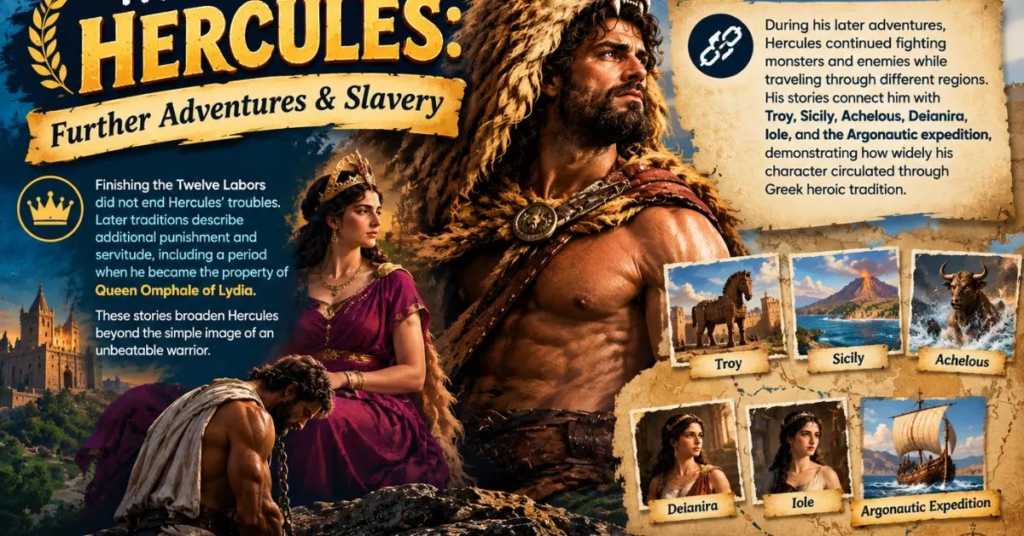
Finishing the Twelve Labors did not end Hercules’ troubles. Later traditions describe additional punishment and servitude, including a period when he became the property of Queen Omphale of Lydia. These stories broaden Hercules beyond the simple image of an unbeatable warrior.
During his later adventures, Hercules continued fighting monsters and enemies while traveling through different regions. His stories connect him with Troy, Sicily, Achelous, Deianira, Iole, and the Argonautic expedition, demonstrating how widely his character circulated through Greek heroic tradition.
Facts About Hercules: Relationships and Family
Hercules’ family life was complicated. He married Megara in an important tradition and later married Deianira. His relationships frequently intersect with the tragic side of Greek mythology, where love, jealousy, divine interference, and revenge can dramatically change a hero’s fate.
Deianira becomes particularly important near the end of his story. After an encounter involving the centaur Nessus, she eventually came into possession of a poisoned garment. Believing it could restore Hercules’ affection, she sent it to him, unknowingly setting in motion the events that led to his death.
Facts About Hercules: How Did Hercules Die?
Hercules’ death is one of the most tragic parts of the mythology. According to a major tradition, a poisoned garment connected with the centaur Nessus caused him unbearable suffering. Realizing what had happened, Hercules eventually prepared a funeral pyre on Mount Oeta.
His death did not represent the complete end of Hercules. Mythological tradition says that his mortal side perished while his divine nature was taken to Mount Olympus. This transformation from suffering mortal hero to immortal deity is one reason his story remained powerful in Greek and Roman culture.
Facts About Hercules: Death and Legacy
Hercules became much more than a character in a collection of monster stories. Ancient Greeks and Romans remembered him as a hero, protector, strongman, and eventually divine figure. Evidence of his worship appeared across the ancient Mediterranean, showing that his importance extended beyond storytelling.
His influence continues today through literature, sculpture, paintings, television, movies, comics, astronomy, and popular culture. The constellation Hercules is also named for the legendary hero. His enduring appeal comes partly from his imperfections: despite extraordinary strength, his life included mistakes, grief, punishment, perseverance, and eventual redemption.
Quick Hercules Facts
| Fact | Answer |
| Greek name | Heracles / Herakles |
| Roman name | Hercules |
| Father | Zeus |
| Mother | Alcmene |
| Famous for | Twelve Labors |
| Main task-giver | Eurystheus |
| Famous weapon/symbol | Club |
| Famous animal | Nemean Lion |
| Final Labor | Cerberus |
| Divine destination | Mount Olympus |
| Constellation | Hercules |
| Major theme | Strength, suffering, perseverance |
Overall, the most meaningful facts about Hercules are not simply about how strong he was. His legend combines Greek mythology, divine conflict, heroic trials, tragedy, family relationships, and immortality. From the cradle to Olympus, Hercules represents a hero who repeatedly faced impossible challenges and became one of the most recognizable figures of the ancient world.
11. FAQ Section
Who was Hercules?
Hercules was the Roman name for Heracles, one of the most famous heroes of Greek mythology. He was traditionally the son of Zeus and the mortal woman Alcmene and became famous for completing the Twelve Labors.
Was Hercules a god or a demigod?
Hercules began his mythological life as a mortal hero with a divine father. After his death, Greek tradition describes his apotheosis, meaning he became a god and joined the Olympians.
What are the 12 Labors of Hercules?
The Twelve Labors include defeating the Nemean Lion and Lernaean Hydra, capturing the Ceryneian Hind and Cretan Bull, cleaning the Augean Stables, obtaining Hippolyta’s Belt and the Golden Apples, and capturing Cerberus.
Why did Hercules have to perform the Twelve Labors?
The Labors were connected with atonement and purification after Hercules was driven into madness by Hera. He was directed to serve Eurystheus, who assigned the difficult tasks.
What was Hercules’ strongest achievement?
The Twelve Labors collectively represent his greatest achievement. The final task, capturing Cerberus, was especially remarkable because Hercules had to enter the Underworld and return with its three-headed guardian.
How did Hercules become a god?
After his mortal death, traditions say Hercules’ divine side survived and he was taken to Olympus. There he became immortal and joined the gods.
What is Hercules’ symbol?
The club is one of the principal symbols associated with Heracles. The Nemean lion’s skin is another famous visual attribute connected with the hero.
Is Hercules the same as Heracles?
Yes. Heracles is the Greek name, while Hercules is the Roman form that became more familiar in later Western culture.

Hi, I’m Benjamin, the person behind FactsAboutDog.com. 🐶
I’m passionate about dogs and love sharing interesting, fun, and educational facts about our furry friends. Through FactsAboutDog.com, I aim to make learning about dogs simple, enjoyable, and informative for dog lovers everywhere.
From amazing dog facts to breed information and fascinating animal knowledge, my goal is to help readers discover something new every day.
Explore the world of dogs with Benjamin at FactsAboutDog.com!