75 Fascinating Facts About Deer You Should Know Today
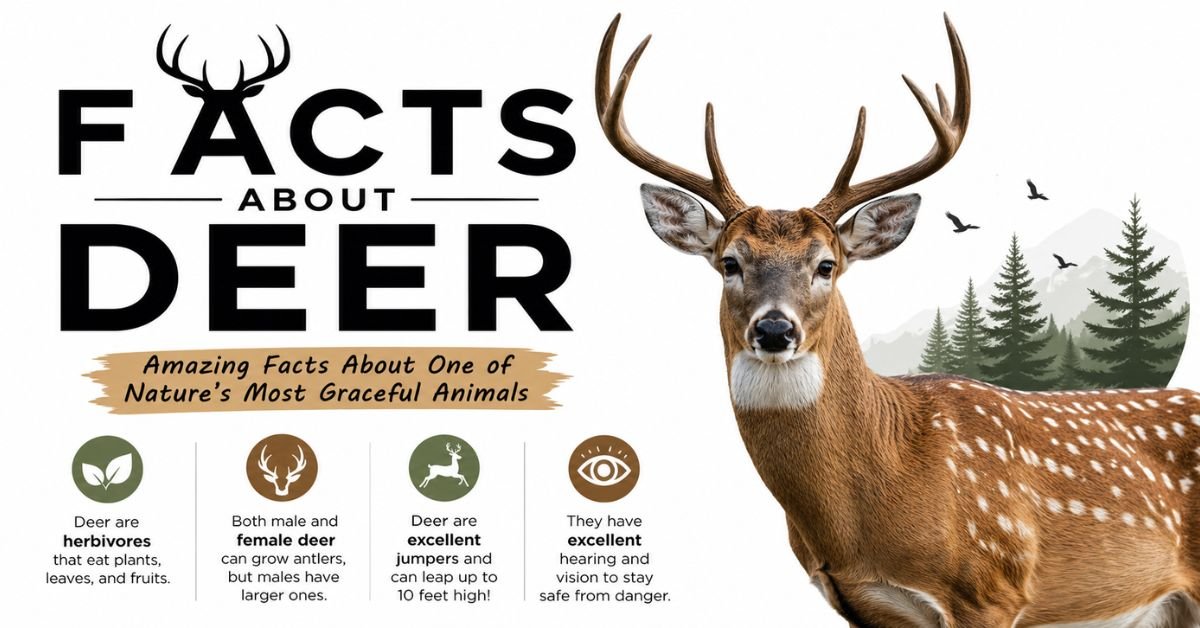
Deer are among the most fascinating wild animals, known for their graceful movements, keen senses, and ability to adapt to different environments. From forests and grasslands to mountains and wetlands, deer live across many parts of the world. These facts about deer reveal surprising details about their behavior, diet, communication, reproduction, and survival skills.
Did you know that deer can recognize danger quickly, communicate through body language, and use their powerful legs to escape predators? Learning about deer species, deer habitat, deer diet, and deer behavior can help you better understand these remarkable mammals. Whether you love wildlife or are researching animals for school, these interesting deer facts offer plenty of fascinating discoveries.
Fun Facts About Deer
| Fact | Answer |
| Scientific family | Cervidae |
| Species count | 43–47 |
| Baby / male / female | Fawn / Buck / Doe |
| Diet | Herbivore |
| Stomach chambers | 4 (rumen, reticulum, omasum, abomasum) |
| Largest species | Moose |
| Smallest species | Northern pudu |
| Antler exception | Reindeer/caribou females also grow antlers |
| Most active | Dawn and dusk (crepuscular) |
How Many Species of Deer Are There?
Sources vary, but there are 43 to 47 recognized species in the family Cervidae, depending on classification.
Where Do Deer Live Around the World?
Deer live on every continent except Australia and Antarctica, spanning tundra, forest, wetland, grassland, and rainforest habitats. India has the most native species of any country.
What Is a Deer?
A deer is a hoofed ruminant mammal in the family Cervidae, with slender legs and, in most species, annually shed antlers.
What Family Do Deer Belong To?
All deer belong to Cervidae, split into three subfamilies:
| Subfamily | Members |
| Cervinae (Old World) | Red deer, elk, muntjac, tufted deer |
| Capreolinae (New World) | White-tailed deer, mule deer, moose, caribou, roe deer |
| Hydropotinae | Chinese water deer (sole living member) |
What Are the Different Types of Deer?
White-tailed deer, mule deer, red deer, elk, moose, reindeer/caribou, roe deer, muntjac, pudu, and the fanged Chinese water deer are among the best-known types.
What Is a Group of Deer Called?
A herd — smaller gatherings of does and fawns are sometimes called a “bevy.”
What Is a Male Deer Called?
A buck (or “bull” in elk and moose).
What Is a Female Deer Called?
A doe (or “cow” in elk and moose).
What Is a Baby Deer Called?
A fawn, born with white spots that fade by 3–4 months old.
What Do Deer Eat?
Deer are browsers and grazers, eating grasses, leaves, twigs, fruit, and acorns depending on season.
Are Deer Herbivores?
Yes their teeth and digestive system are built entirely for plant material.
How Does a Deer’s Diet Change With the Seasons?
Spring brings tender grass, summer adds leaves and fruit, fall shifts to acorns and nuts for fat storage, and winter relies on woody browse like twigs and bark.
Do Deer Eat Grass?
Yes, especially young, protein-rich grass in spring and summer.
Do Deer Eat Fruits and Berries?
Yes — fallen fruit and berries are a favorite late-summer and fall food source.
Do Deer Eat Leaves, Bark, and Twigs?
Yes, particularly in winter when softer vegetation isn’t available.
How Do Deer Digest Their Food?
Through rumination: food is swallowed, regurgitated as cud, re-chewed, and swallowed again for microbial fermentation.
Do Deer Chew Their Cud?
Yes — like cattle and sheep, deer are ruminants that re-chew swallowed food.
How Many Stomachs Does a Deer Have?
One stomach with four chambers: rumen, reticulum, omasum, and abomasum.
Why Do Deer Have Four-Chambered Stomachs?
This structure lets microbes ferment tough plant cellulose that most animals can’t digest, with the abomasum finishing digestion using stomach acid.
How Fast Can Deer Run?
Most species reach burst speeds of 30–45 mph, though not for long distances.
How High Can Deer Jump?
Up to 8–9 feet clearing most residential fences easily.
How Far Can Deer Jump?
Up to 25–30 feet horizontally in a single startled leap.
Are Deer Good Swimmers?
Yes deer readily cross rivers and lakes to escape danger or reach new territory.
Can Deer Climb Steep Hills?
Yes, thanks to long legs and gripping, cloven hooves suited to rocky terrain.
Why Are Deer Such Good Runners?
Long legs, light bones, and powerful hindquarters let deer store and release energy like natural springs with each stride.
How Good Is a Deer’s Sense of Smell?
Very strong a deer’s nasal cavity is roughly ten times larger relative to body size than a human’s, letting them detect much fainter odors.
Can Deer See in the Dark?
Yes, thanks to a reflective layer behind the retina that amplifies low light.
Can Deer See Ultraviolet Light?
Research suggests deer eyes are sensitive to UV light, which may aid predator detection in low light.
How Good Is a Deer’s Hearing?
Deer hear a wider frequency range than humans, and their mobile, funnel-shaped ears pinpoint sound direction precisely.
Why Can Deer Move Their Ears in Different Directions?
Each ear has its own muscles, letting a deer monitor two directions for danger at once.
Can Deer Rotate Their Ears 180 Degrees?
Yes, nearly 180 degrees independently, like a radar dish.
Do Deer Have Good Night Vision?
Yes their reflective eye layer and wide field of view give them a strong low-light advantage over humans, per wildlife biology research.
What Is a Deer’s Tapetum Lucidum?
A reflective layer behind the retina that bounces light back through light-sensing cells, boosting night vision and causing “eyeshine.”
Do Deer Have a Strong Sense of Balance?
Yes a light frame and flexible joints let deer sprint, cut, and jump without losing footing.
Why Do Deer Have Long, Slender Legs?
Longer legs mean longer strides, which directly increase running speed and jumping distance.
Why Do Deer Have Hooves?
Hardened, keratin-covered hooves provide traction and protect the foot during fast, sustained movement.
Do Deer Have Upper Front Teeth?
No deer have a hard dental pad instead, pressing plants against it while cutting with lower incisors.
How Do Deer Use Their Scent Glands?
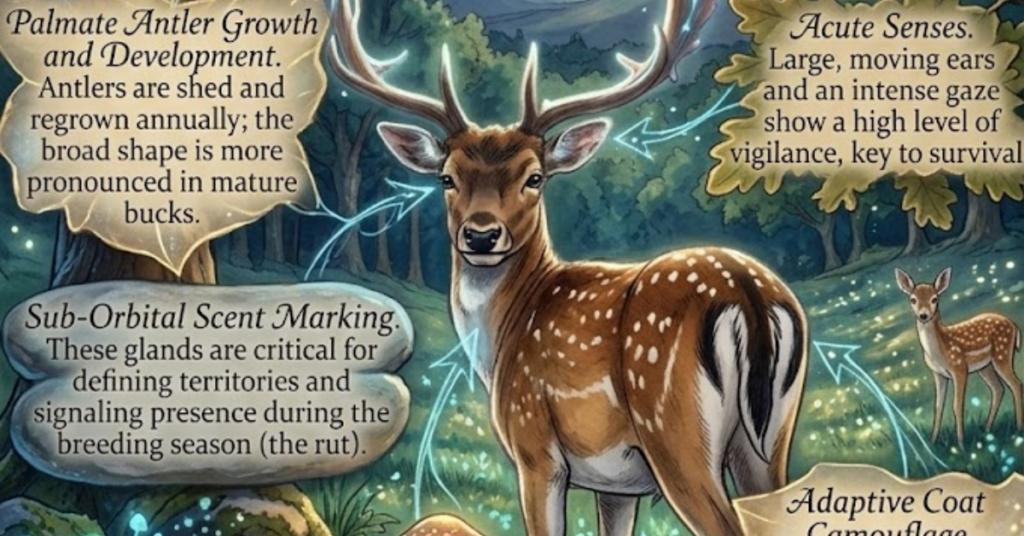
Glands on the legs, face, and between the hooves mark territory, signal alarm, and communicate reproductive status.
What Is a Deer’s Jacobson’s Organ?
A scent-detecting organ on the roof of the mouth, used mainly by bucks to assess a doe’s breeding readiness.
How Do Deer Communicate With Each Other?
Through body language, scent marking, and vocal sounds like grunts, bleats, and snorts.
Why Do Deer Raise Their Tails?
“Flagging” the tail exposes its white underside to warn nearby deer of danger.
What Does a Deer’s Tail Signal Mean?
A raised, flared tail signals alarm; a relaxed tail signals calm.
How Do Deer Warn Each Other of Danger?
Through tail flagging, hoof stomping, and loud snorts.
Do Deer Make Sounds?
Yes deer use grunts, bleats, snorts, and bawls to communicate.
What Sounds Do Deer Make?
Grunts (bucks during rut), bleats (fawns/does), snorts (alarm), and bawls (distress).
Why Do Some Male Deer Whistle?
Male elk produce a loud “bugle” call during the rut to challenge rivals and attract mates.
What Is “Pronging” in Deer?
A stiff-legged bound with all four feet leaving the ground at once, possibly signaling fitness to predators.
Why Do Deer Freeze When They Are Scared?
Because many predators detect movement first, standing still can make a deer far harder to spot.
How Do Deer Protect Themselves From Predators?
Through sharp senses, speed, camouflage, freezing, and herd vigilance rather than physical defense.
Are Deer Dangerous to Humans?
Rarely directly aggressive, but they cause significant harm indirectly through vehicle collisions.
Are Deer More Dangerous Than Sharks?
In the U.S., deer are linked to far more human fatalities than sharks each year, mostly through car accidents rather than direct attacks.
Why Do Deer Cause So Many Road Accidents?
They’re most active at dawn and dusk — exactly when driver visibility is lowest.
What Should You Do When You See a Deer on the Road?
Slow down, don’t swerve sharply, watch for more deer nearby, and brake firmly if a collision seems unavoidable.
Why Do Deer Cross Roads?
Roads often cut directly through their established routes between feeding, bedding, and water sites.
Why Do Deer Travel in Herds?
Herds offer more eyes and ears for spotting predators, plus shared warmth and social bonding.
Are Deer Social Animals?
Somewhat does and fawns are highly social, while bucks are more solitary outside the rut.
Do Deer Live Alone or in Groups?
Does form small family groups, bucks are often solitary or in bachelor groups, and larger herds may form in winter.
How Do Deer Establish Their Territories?
Mainly through scent marking and dominance displays rather than fixed year-round boundaries.
How Do Deer Mark Their Territory?
By rubbing antlers on trees (rubs), pawing and urinating on the ground (scrapes), and depositing gland scent.
What Are Deer Antlers Made Of?
True bone, initially covered in blood-vessel-rich skin called velvet.
Why Do Male Deer Have Antlers?
To compete for mates, establish dominance, and defend territory during breeding season.
Do Female Deer Have Antlers?
Generally no, except in reindeer and caribou, where both sexes grow them.
How Fast Do Deer Antlers Grow?
Antlers are among the fastest-growing mammalian tissues:
| Species | Growth Rate |
| White-tailed deer | ~¼ inch/day |
| Elk | ~1 inch/day |
| Moose | up to ~0.5 kg of bone/day |
Why Do Deer Shed Their Antlers?
Falling testosterone after the rut weakens the antler base until it detaches, making way for new growth.
How Often Do Deer Shed Their Antlers?
Once a year typically dropped in late winter, regrown through spring and summer.
What Is the Difference Between Antlers and Horns?
| Antlers | Horns |
| Bone, shed yearly | Keratin over bone, permanent |
| Usually males only | Usually both sexes |
| Often branched | Usually unbranched |
Do All Deer Species Have Antlers?
Almost all, except the Chinese water deer.
Which Deer Species Have Fangs Instead of Antlers?
The Chinese water deer, which uses long canine “tusks” to compete for mates.
How Are Fawns Born?
After a 6–7 month gestation, usually in spring, with one or two fawns per litter.
Why Do Baby Deer Have White Spots?
The spots mimic dappled sunlight, camouflaging fawns on the forest floor.
How Do Fawns Hide From Predators?
They lie motionless for hours while nearly scentless, relying on stillness rather than escape.
How Long Do Deer Live?
Most wild deer live 6 to 12 years, depending on species and predation pressure.
What Is the Lifespan of a Deer in the Wild?
Typically 6–12 years, with larger species in low-predation areas sometimes reaching 15–20.
What Is the Smallest Deer Species?
The northern pudu, standing about 13–14 inches tall.
What Is the Largest Deer Species?
The moose, reaching nearly 7 feet at the shoulder and up to 1,800 pounds.
Which Deer Species Is the Fastest?
Elk and caribou rank among the fastest, with some caribou reportedly approaching 50 mph in short bursts.
Do Deer Migrate?
Some do caribou/reindeer are known for long migrations, while many other species make shorter seasonal moves.
Why Do Some Deer Migrate?
To follow food availability and avoid deep snow between summer and winter ranges.
Which Deer Species Are Endangered?
Species like the Persian fallow deer and Bawean deer face serious threats from habitat loss and hunting.
What Are the Biggest Threats to Deer?
Habitat loss, vehicle collisions, overhunting, disease, and climate change.
How Do Deer Adapt to Different Habitats?
Through flexible diets, seasonal coat and fat changes, and behavioral shifts like migration.
Why Are Deer Important to the Ecosystem?
As both prey and vegetation managers, deer support predator populations and disperse seeds through grazing and droppings.
What Do Deer Symbolize in Different Cultures?
Celtic tradition links deer to gentleness, Native American cultures to grace and intuition, Japanese Shinto belief treats them as sacred messengers, and Chinese culture ties them to longevity.
10 Weird and Surprising Deer Facts
- Fawns are born nearly scentless.
- Chinese water deer have fangs, not antlers.
- Antlers can grow up to half an inch a day.
- Ears rotate almost 180 degrees independently.
- Some deer jump nearly 30 feet in one bound.
- Deer have no upper front teeth.
- Bucks may detect a doe’s scent from up to a mile away.
- Reindeer are the only deer where females also grow antlers.
- Deer cause far more human deaths than sharks, mainly via car accidents.
- Deer eyes glow in the dark due to a reflective layer.
10 Fun Deer Facts for Kids
- A baby deer is called a fawn.
- Deer can jump higher than a basketball hoop.
- A group of deer is called a herd.
- Deer chew their food twice that’s called chewing cud.
- Deer can move each ear separately.
- A boy deer is a buck; a girl deer is a doe.
- Deer are strong swimmers.
- Antlers fall off and regrow every year.
- Deer eat only plants.
- Fawns can stand just hours after birth.
Frequently Asked Questions About Deer
1. What are 5 facts about deer?
- Deer are hoofed mammals found in many parts of the world.
- Most male deer grow and shed antlers every year.
- Deer are mainly herbivores, eating grass, leaves, fruits, and plants.
- Many deer species are excellent runners and swimmers.
- Deer have a strong sense of hearing and smell, helping them detect danger.
2. How many stomachs do deer have?
Deer have one stomach with four compartments: the rumen, reticulum, omasum, and abomasum. This helps them digest tough plant material.
3. What is special about deer?
One of the most remarkable things about deer is their antlers, which are the fastest-growing bones in mammals and are usually regrown each year by males.
4. What are deer’s weaknesses?
Deer have relatively poor eyesight for detecting stationary objects, and young or inexperienced deer are especially vulnerable to predators. They also depend heavily on suitable food and safe habitat.
5. What is interesting and unique about deer?
A unique feature of deer is their ability to regrow antlers every year. They also use body language, sounds, scent, and movement to communicate with one another.
Conclusion
Deer survive on sharp senses, speed, camouflage, and a digestive system built for tough plant matter far more sophisticated than their calm backyard appearance suggests. From the tiny pudu to the towering moose, the deer family proves there’s always more going on than meets the eye.

Hi, I’m Benjamin, the person behind FactsAboutDog.com. 🐶
I’m passionate about dogs and love sharing interesting, fun, and educational facts about our furry friends. Through FactsAboutDog.com, I aim to make learning about dogs simple, enjoyable, and informative for dog lovers everywhere.
From amazing dog facts to breed information and fascinating animal knowledge, my goal is to help readers discover something new every day.
Explore the world of dogs with Benjamin at FactsAboutDog.com!