
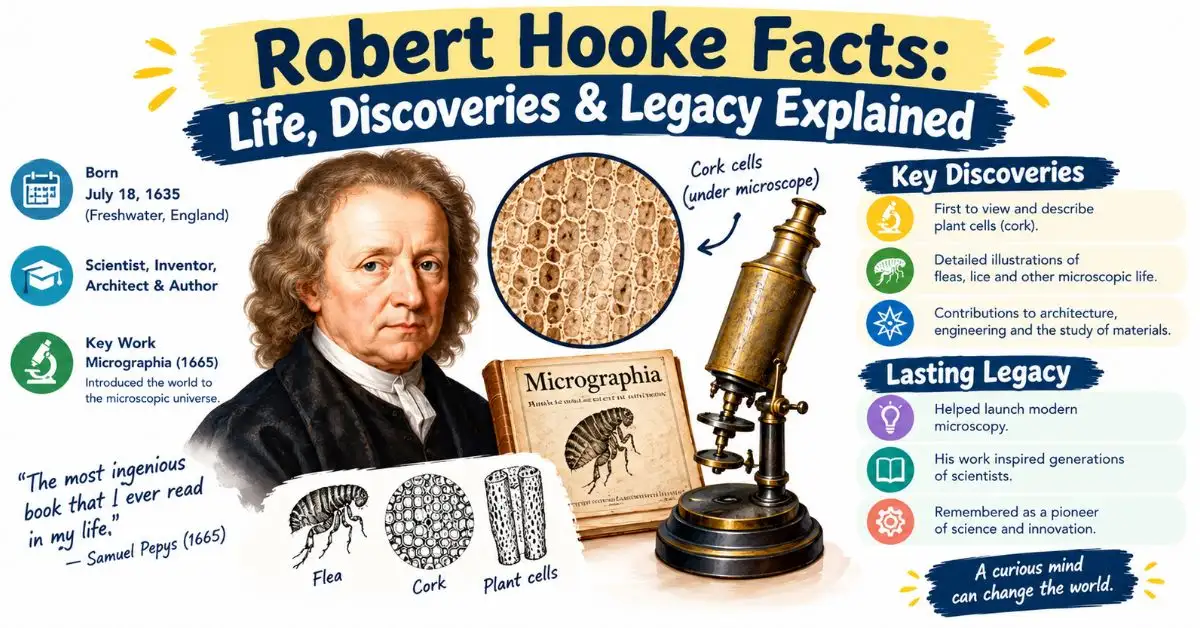
Robert Hooke Facts: Life, Discoveries & Legacy Explained
The single most important Robert Hooke fact is this: he was the 17th-century English scientist who first used the word “cell” to describe living tissue, and he did it while peering at a sliver of cork through a microscope he built himself. I’ve spent years reading primary-source science history, and Hooke’s story still catches me off guard not because of what he discovered, but because of how little credit history gave him. His law of elasticity, his microscope drawings, his gravity theory: all genuinely foundational, yet he’s often remembered as “the man who argued with Newton.”
If you’ve ever wondered why a scientist this important isn’t a household name, you’re not alone that’s the pain point this article solves. Below, every Robert Hooke fact is pulled from verified biographical sources, organized the way curious readers and students actually search for it, so you walk away with a clear, accurate, and genuinely interesting picture of the man.
Robert Hooke Facts Quick Reference Table
| Category | Detail |
| Born | July 18, 1635, Freshwater, Isle of Wight, England |
| Died | March 3, 1703, London, England (age 67) |
| Education | Westminster School; Christ Church, Oxford |
| Known For | Hooke’s Law, coining “cell,” Micrographia, microscopy |
| Key Roles | Curator of Experiments, Royal Society; Gresham Professor of Geometry; City Surveyor of London |
| Rival | Isaac Newton |

Who Was Robert Hooke? Key Robert Hooke Facts at a Glance
Here’s a Robert Hooke fact that surprises most people: he wasn’t just a scientist. He was simultaneously a physicist, astronomer, geologist, and practicing architect, often working on all four at once. This kind of range earned him comparisons to Leonardo da Vinci among historians, and it’s exactly the kind of cross-disciplinary curiosity that defined the entire Scientific Revolution era he lived through.
Robert Hooke’s fame rests on a handful of specific contributions: Hooke’s Law of elasticity, his pioneering microscopy work published in Micrographia, and his role as the Royal Society’s first Curator of Experiments. He also helped rebuild London as a surveyor after the Great Fire, working closely with Christopher Wren. Each of these threads is explored in detail in the sections ahead.
Robert Hooke Facts About His Early Life and Education
Robert Hooke was born in 1635 in Freshwater, on England’s Isle of Wight, to Cecily Gyles and John Hooke, an Anglican curate. As a child, Hooke was frail and often sick, which kept him home from formal schooling for long stretches. During that time, he taught himself mechanics by taking apart a brass clock and rebuilding a working wooden replica from memory an early hint of the inventor he’d become.
When his father died in 1648, young Hooke inherited roughly £40 and traveled to London, eventually enrolling at Westminster School before securing a place at Christ Church, Oxford, in 1653. At Oxford, he quickly mastered Latin, Greek, and Euclid’s geometry, and he supported himself as a chorister and servitor while building the mechanical and mathematical foundation his later science depended on.
Robert Hooke Facts: How He Became a Scientist
While still a student at Oxford, Hooke worked as a laboratory assistant to physician Thomas Willis, which connected him to the Oxford Philosophical Club the informal group of natural philosophers who later formed the Royal Society. Through that network, he met Robert Boyle, the chemist who would define the rest of Hooke’s early career.
Hooke spent seven formative years as Boyle’s assistant, during which he designed and built the air pump used in Boyle’s famous gas-pressure experiments. Many historians now argue Hooke deserves far more credit for “Boyle’s Law” than he’s traditionally received, since the equipment and much of the experimental insight came from Hooke’s own hands and precise engineering skill.
Robert Hooke Facts About His Role at the Royal Society
In 1662, at age 27, Hooke was appointed the Royal Society’s first Curator of Experiments a role that effectively made him the engine of the entire institution. His job was to design and demonstrate fresh experiments at every weekly meeting, and by most historical accounts, the young society could barely have functioned without his relentless output.
Hooke held this demanding post for decades, moving from Oxford to London and eventually becoming Gresham Professor of Geometry in 1665. One Royal Society librarian later wrote that Hooke was, “historically, the creator of the Royal Society,” a striking statement given how overshadowed his reputation became after his death, largely due to his prolonged rivalry with Isaac Newton.
Robert Hooke Facts: His Greatest Scientific Discoveries
Hooke’s scientific range is almost dizzying by modern standards: he studied gravity, light, combustion, fossils, and the rotation of planets, often years ahead of his peers. In 1664, he identified the rotation periods of Mars and Jupiter and observed Jupiter’s Great Red Spot astronomical observations that stood up to centuries of later scrutiny from professional astronomers.
Perhaps most significantly, Hooke proposed that gravity follows an inverse square law and that it applies to all celestial bodies, a claim he made years before Newton formalized the concept mathematically. This single insight triggered one of science history’s most famous priority disputes, overshadowing the sheer breadth of Hooke’s other geological, biological, and physical discoveries.
Robert Hooke Facts About Hooke’s Law of Elasticity
In 1660, Hooke discovered the relationship that now bears his name: that the force needed to stretch or compress a spring is directly proportional to the distance it’s deformed. He famously announced it as a scrambled anagram, “ceiiinosssttuv,” only publishing the solution ut tensio, sic vis, “as the extension, so the force” in 1678.
Hooke’s Law remains a cornerstone of modern physics and engineering, used daily in designing everything from mechanical watches to vehicle suspension systems. It’s a fitting legacy for a man who also invented the balance spring, a device that made accurate portable watches possible for the very first time in human history.
Robert Hooke Facts About Micrographia and Microscopy
In 1665, Hooke published Micrographia, widely considered the first scientific bestseller, filled with his own detailed illustrations of fleas, lice, and plant structures viewed through his custom-built compound microscope. Samuel Pepys called it “the most ingenious book that I ever read in my life” in his diary that same year.
Inside Micrographia, Hooke examined a thin slice of cork and noticed tiny box-like compartments, which reminded him of monks’ rooms in a monastery so he named them “cells,” coining biology’s most fundamental term. He also recorded the first-known observation of a microorganism, a microfungus called Mucor, nine years before Antonie van Leeuwenhoek’s celebrated discoveries.
Robert Hooke Facts About His Architectural Career
After the Great Fire of London destroyed much of the city in 1666, Hooke was appointed City Surveyor and became Christopher Wren’s closest architectural collaborator. Hooke personally performed more than half of the property-line surveys needed to rebuild London, work that required both mathematical precision and diplomatic skill to settle neighborly boundary disputes.
Hooke designed several landmark buildings himself, including the Monument to the Great Fire of London and the Royal College of Physicians, and he determined that the ideal shape for an arch is an inverted catenary curve a principle Wren applied directly to the dome of St. Paul’s Cathedral. Remarkably, Hooke earned more money from his architectural fees than from his entire scientific career combined.
Robert Hooke Facts About His Death and Lasting Legacy
Robert Hooke died on March 3, 1703, in London, blind and bedridden during his final year. A chest containing roughly £8,000 in money and gold was found in his room at Gresham College, alongside a personal library of more than 3,000 books evidence of the wealth and intellectual appetite he maintained until the end.
No authenticated portrait of Hooke survives today, a historical gap some attribute to the bitterness of his feud with Newton, though Hooke’s biographers largely dismiss that as myth. Despite the missing portrait, his legacy endures concretely: a lunar crater, a Martian crater, and an asteroid all bear his name, and the British Society for Cell Biology still awards an annual Hooke Medal in his honor.
FAQ Section
What is Robert Hooke best known for?
Robert Hooke is best known for two things: discovering and naming the biological “cell” after examining cork under a microscope, and formulating Hooke’s Law of elasticity, which describes how springs stretch in proportion to applied force.
Did Robert Hooke and Isaac Newton get along?
No. Hooke and Newton had a bitter, decades-long rivalry, largely over who first proposed the inverse square law of gravity. Hooke accused Newton of insufficient credit, and the dispute was so heated that Newton reportedly delayed publishing further work until after Hooke’s death.
What did Robert Hooke invent?
Hooke invented or significantly improved the balance spring for watches, the anchor escapement for pendulum clocks, an early compound microscope design, the universal joint (Hooke’s joint), and a practical Gregorian reflecting telescope.
How did Robert Hooke discover cells?
Hooke discovered cells in 1665 by examining a thin slice of cork bark under his custom microscope. He saw tiny, repeating box-like compartments and named them “cells” because they reminded him of the small rooms, or cells, in a monastery.
Why is there no portrait of Robert Hooke?
No verified portrait of Hooke survives. While some attribute this to Newton’s influence after becoming Royal Society president, biographer Allan Chapman considers that claim a myth rather than established fact; the loss remains historically unexplained.

Hi, I’m Benjamin, the person behind FactsAboutDog.com. 🐶
I’m passionate about dogs and love sharing interesting, fun, and educational facts about our furry friends. Through FactsAboutDog.com, I aim to make learning about dogs simple, enjoyable, and informative for dog lovers everywhere.
From amazing dog facts to breed information and fascinating animal knowledge, my goal is to help readers discover something new every day.
Explore the world of dogs with Benjamin at FactsAboutDog.com!