
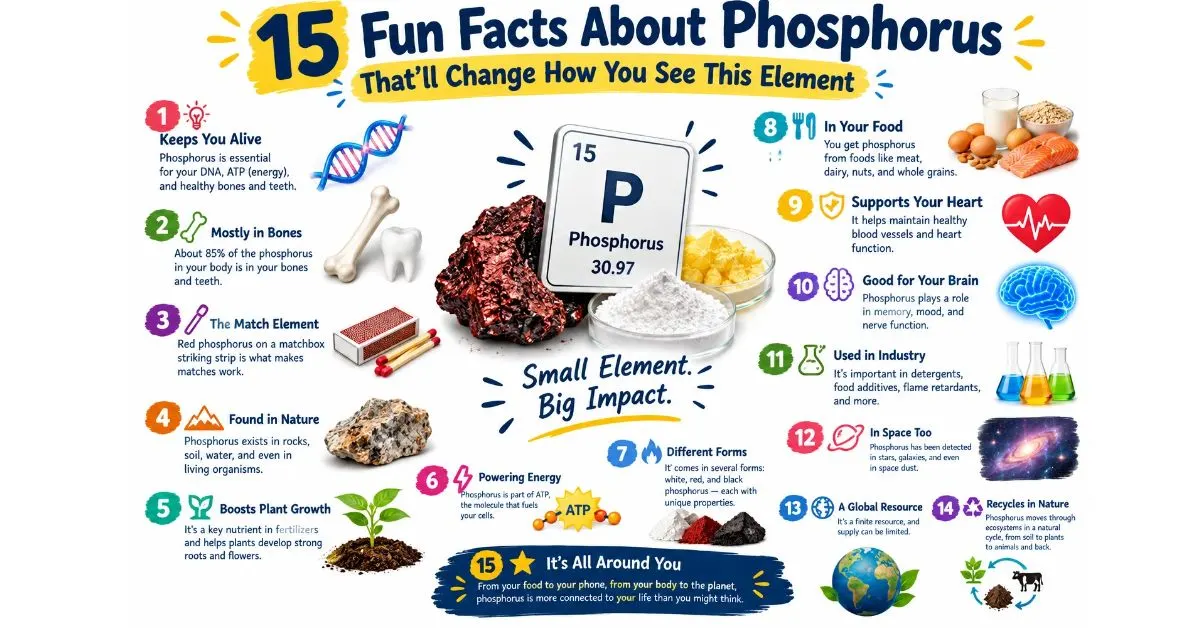
15 Fun Facts About Phosphorus That’ll Change How You See This Element
Phosphorus is the glowing, fire-starting, bone-building element hiding in your soda can, your matchbox, and literally every cell in your body. I still remember the first time a chemistry teacher struck a match in front of our class and explained that the tiny red stripe on the box not the match head was doing the real work. That single moment turned a periodic table entry into a story worth telling.
If you’ve ever wondered why this reactive nonmetal shows up in fertilizer, fireworks, and your own skeleton, you’re about to get the full picture. This guide walks through phosphorus allotropes, its discovery from urine, its role in agriculture, and the surprising ways it touches daily American life all explained in plain, human language, not textbook jargon.
Fun Facts About Phosphorus: Why It’s a Vital Element for Life
Every fun fact about phosphorus starts with one truth: without it, life as we know it simply doesn’t exist. Phosphorus anchors DNA, builds ATP (your body’s energy currency), and forms the phospholipid bilayer that holds every cell together. It’s the sixth most common element in the human body, concentrated mostly in bones and teeth.
Roughly 750 grams of phosphorus live inside the average adult, with about 85% stored in your skeleton. That’s a staggering amount for an element most people never think about. Nutritionists track it closely because low or excess phosphorus levels can signal real health problems, including kidney and heart issues.
Fun Facts About Phosphorus: It’s One of the Most Reactive Elements
Phosphorus doesn’t sit quietly on the periodic table white phosphorus is so reactive it bursts into flame on contact with ordinary air. This self-igniting behavior kicks in around 86°F, meaning a warm summer day alone could set it off. That’s why chemists store it submerged underwater, away from oxygen entirely.
This extreme reactivity isn’t a flaw; it’s exactly why phosphorus became useful for matches, flares, and even wartime signaling devices. The same property that makes it dangerous also makes it indispensable in industrial and military applications across the United States and beyond.
Fun Facts About Phosphorus: A Fascinating History Starting With Urine
In 1669, German alchemist Hennig Brand was chasing gold and instead discovered phosphorus by boiling down buckets of human urine. He called his glowing discovery “cold fire” because it shimmered in the dark without heat. It remains one of chemistry’s strangest origin stories.
The name itself comes from the Greek word phosphoros, meaning “bringer of light,” a fitting tribute to Brand’s eerie glowing residue. Centuries later, that accidental discovery evolved into an element powering agriculture, medicine, and manufacturing across the modern world.
Fun Facts About Phosphorus: White, Red, and Black Allotropes Explained
Not all phosphorus looks or behaves the same way. White phosphorus is waxy, poisonous, and glows faintly in the dark, while red phosphorus far more stable forms when white phosphorus is heated to about 250°C. A rarer black allotrope exists too, with a crystalline structure resembling graphite.
| Allotrope | Appearance | Key Trait |
| White | Waxy, pale | Highly toxic, self-igniting |
| Red | Dull, powdery | Stable, used in matchboxes |
| Black | Dark, crystalline | Most stable, least reactive |
This variety explains why phosphorus allotropes matter so much in industrial safety and product design the same element can be either a hazard or a household tool depending on its form.
Fun Facts About Phosphorus: The Element Behind Every Match Strike
That red strip on a matchbox isn’t decoration it’s red phosphorus, and it’s the real engine behind every lit match. When the match head rubs against it, friction converts a tiny bit of red phosphorus into white phosphorus, instantly igniting the chemical mixture on the matchstick tip.
Early matches actually used white phosphorus directly in the match head, which caused horrific health problems for factory workers exposed to its fumes a condition historically called “phossy jaw.” Modern safety matches moved phosphorus to the striking strip specifically to prevent this danger.
Fun Facts About Phosphorus: Its Crucial Role in the Steel Industry
Phosphorus plays a quieter but equally important role in metallurgy. Added in small, controlled amounts, it improves the strength and machinability of certain steel alloys, while uncontrolled phosphorus content can make steel brittle and prone to cracking under stress.
Steelmakers monitor phosphorus levels obsessively because the margin between “helpful additive” and “structural weakness” is razor-thin. This balancing act is one reason phosphorus refining remains a critical, closely regulated step in industrial steel production worldwide.
Fun Facts About Phosphorus: Why It’s Essential for Agriculture and Soil Fertility
Few fun facts about phosphorus matter more to everyday life than this one: it’s a core ingredient in nearly every commercial fertilizer. Phosphorus helps plants develop strong root systems, transfer energy, and produce the seeds and fruit that feed entire populations.
Experts increasingly worry about phosphorus scarcity, since mineable phosphate rock reserves are finite and concentrated in just a handful of countries. A serious supply disruption could ripple through global food systems, making phosphorus one of agriculture’s most quietly critical resources.
Fun Facts About Phosphorus: Yes, It’s Present in Your Soft Drinks
Here’s a fun fact about phosphorus that surprises almost everyone: it’s dissolved in many popular sodas as phosphoric acid, giving colas their sharp, tangy bite. It’s also used as a preservative, helping extend shelf life in bottled and canned beverages.
Nutrition researchers have flagged heavy soda consumption as a source of excess dietary phosphorus, particularly concerning for people managing kidney disease. So the fizzy drink in your fridge has a direct, if underappreciated, chemistry connection to this reactive element.
Fun Facts About Phosphorus: Vital and Dangerous for Aquatic Ecosystems
In lakes and rivers, phosphorus acts as a double-edged sword. Small, natural amounts support healthy aquatic plant growth, but agricultural runoff loaded with excess phosphorus fertilizer triggers algal blooms that choke oxygen out of the water and kill fish populations.
This phenomenon, known as eutrophication, has damaged waterways from the Chesapeake Bay to Lake Erie. Managing phosphorus runoff has become a major environmental priority for US water treatment agencies trying to protect fragile freshwater ecosystems.
Fun Facts About Phosphorus: A Key Component of Firework Displays
That same combustible energy that makes phosphorus dangerous also makes it spectacular. Phosphorus compounds contribute to the ignition and visual effects in many firework formulations, helping create the brilliant flashes and controlled burns audiences love on the Fourth of July.
Pyrotechnic engineers carefully balance phosphorus-based compounds with other chemicals to control burn rate, color, and timing. It’s a vivid, literal reminder that the same “bringer of light” discovered in 1669 still lights up American skies today.
FAQ Section
Is phosphorus essential for life?
Yes. Phosphorus is essential for life, forming the backbone of DNA, RNA, and ATP, while also building strong bones and teeth. Without it, basic cellular energy transfer would be impossible.
What is phosphorus best known for?
Phosphorus is best known for its role in matches, fertilizers, and its presence in bones and teeth, along with its extreme reactivity and tendency to glow faintly in the dark.
Why is white phosphorus dangerous?
White phosphorus is dangerous because it can spontaneously ignite in air at temperatures as low as 86°F and causes severe chemical burns on contact with skin.
Where is phosphorus found naturally?
Phosphorus occurs naturally in phosphate rock deposits, with major reserves concentrated in regions like Morocco, China, and parts of the Middle East, rather than as a free element.
Does phosphorus glow in the dark?
White phosphorus does emit a faint glow due to a slow oxidation reaction with air, which is actually the source of its name “bringer of light.”

Hi, I’m Benjamin, the person behind FactsAboutDog.com. 🐶
I’m passionate about dogs and love sharing interesting, fun, and educational facts about our furry friends. Through FactsAboutDog.com, I aim to make learning about dogs simple, enjoyable, and informative for dog lovers everywhere.
From amazing dog facts to breed information and fascinating animal knowledge, my goal is to help readers discover something new every day.
Explore the world of dogs with Benjamin at FactsAboutDog.com!