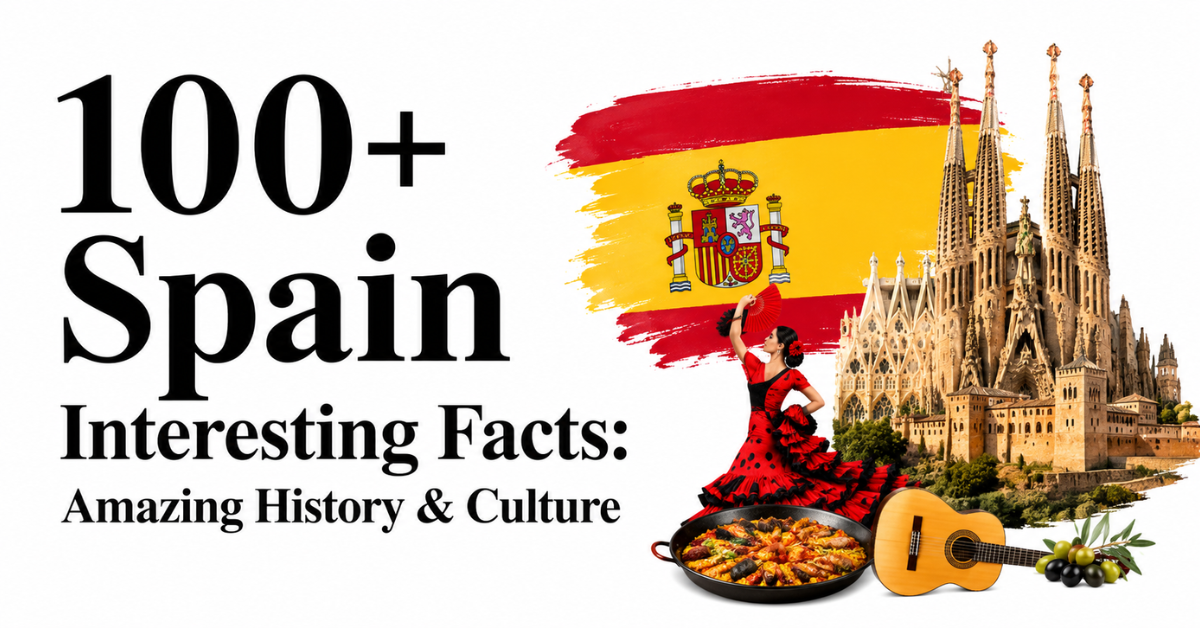
100+ Spain Interesting Facts: Amazing History & Culture
Spain is a country full of surprises, from ancient cities and royal palaces to sunny beaches and unique traditions. These Spain interesting facts reveal what makes the country so fascinating beyond its famous food and football culture. You’ll discover remarkable details about Spanish history, geography, language, festivals, architecture, and everyday life.
Spain is home to diverse regions, each with its own customs, landscapes, and culinary traditions. From historic landmarks such as the Alhambra to unusual local celebrations, there is always something new to learn. Whether you are planning a trip, studying Spain, or simply curious about the world, these facts will help you understand the country from a fresh and fascinating perspective.
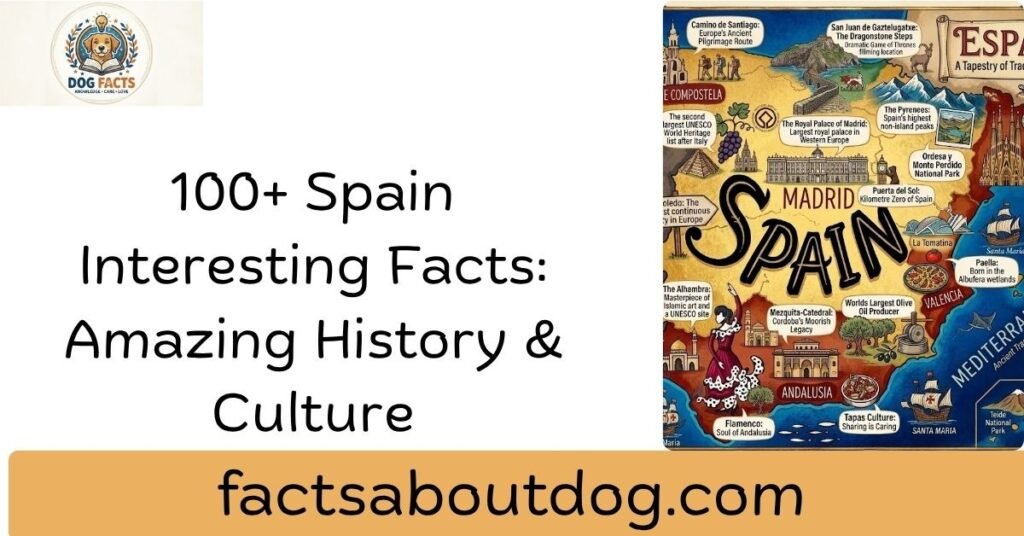
Spain at a Glance
| Fact | Detail |
| Official name | Kingdom of Spain |
| Capital | Madrid |
| Population | ~47.3 million (2024) |
| Area | 505,370 sq km |
| Official language | Castilian Spanish, with Catalan, Basque, and Galician co-official regionally |
| UNESCO World Heritage Sites | Nearly 50 among the highest of any country |
| Currency | Euro |
Spain’s Geography and Natural Wonders
- Spain sits in Southwestern Europe, bordering France, Portugal, Andorra, Gibraltar, and via Ceuta and Melilla Morocco in Africa.
- It’s the second-largest country in the EU by area and the fourth-largest in Europe overall.
- Spain has about 8,000 km of coastline along the Mediterranean, Atlantic, and Cantabrian Sea.
- Madrid, at 667 meters above sea level, is the highest capital city in the EU.
- The Tabernas Desert in Almería is Europe’s only true desert, and its dramatic terrain has made it a filming location for countless Western movies.
- Spain includes two island groups: the Balearic Islands (Mediterranean) and the Canary Islands (Atlantic).
- Mount Teide, a dormant volcano in the Canary Islands, is Spain’s highest peak at 3,718 meters.
Spain’s History Through the Ages
- Humans have inhabited Spain for over 35,000 years the Altamira cave paintings date back roughly 36,000 years.
- The Romans ruled Spain (Hispania) for centuries, leaving aqueducts, roads, and cities still visible today.
- The Visigoths took control after Rome’s decline, ruling until the early 8th century.
- In 711 CE, Muslim forces conquered most of the peninsula, founding Al-Andalus an era of major advances in science and architecture.
- The Reconquista, a centuries-long Christian reconquest, ended in 1492 with the fall of Granada.
- That same year, Spain funded Christopher Columbus’s voyage to the Americas, launching its era as a global empire.
- The 16th–17th centuries marked Spain’s Golden Age, controlling territory across the Americas, Europe, Asia, and Africa.
- The Spanish Civil War (1936–1939) led to nearly four decades of dictatorship under Francisco Franco.
- Spain transitioned to democracy after Franco’s death in 1975.
Spain’s Languages and Names
- Castilian Spanish is Spain’s official national language, spoken by roughly 480 million people worldwide.
- Catalan, Basque, and Galician are co-official in their respective regions.
- Basque (Euskara) is considered a language isolate it’s unrelated to any other known language family.
- Spaniards traditionally carry two surnames, one from each parent, unlike the single-surname system common elsewhere.
Spanish Culture and Daily Life
- The siesta tradition began partly as a practical response to Spain’s hot midday climate and agricultural work schedules.
- Spaniards typically eat dinner after 9 p.m., among the latest meal times in Europe.
- Spain has the second-highest number of bars per capita in the world, after Cyprus.
- Family and social life often center around long, shared meals rather than quick individual ones.
Spain’s Famous Festivals
- La Tomatina, held in Buñol, is the world’s largest food fight up to 150 tons of tomatoes thrown in under an hour.
- San Fermín in Pamplona is famous worldwide for its Running of the Bulls.
- Semana Santa (Holy Week) features elaborate religious processions across the country.
- Las Fallas in Valencia culminates in burning giant sculptures in the streets.
- On New Year’s Eve, Spaniards eat 12 grapes at midnight one per chime of the clock for good luck.
- El Gordo, Spain’s Christmas lottery, is the largest lottery draw in the world by prize pool.
Spanish Food and Drink
- Paella originated in Valencia, not as a nationwide dish, despite its global fame as “Spanish food.”
- Tapas are believed to have started as small snacks placed atop drinks some say to keep flies out of the glass.
- Spain is the world’s largest producer of olive oil, with most of it coming from Andalusia.
- Spain is also a major wine producer, with renowned regions like Rioja and Ribera del Duero.
- Jamón (cured ham) is a cultural staple, with entire shops dedicated to it.
- Churros, often eaten with thick hot chocolate, are a beloved Spanish breakfast treat.
Spanish Architecture and Landmarks
- The Sagrada Família in Barcelona has been under construction since 1882 and remains unfinished.
- Architect Antoni Gaudí designed the Sagrada Família and several other Barcelona landmarks, blending Gothic and Art Nouveau styles.
- The Alhambra in Granada is one of the finest surviving examples of Moorish architecture in the world.
- Restaurante Botín in Madrid, opened in 1725, holds the Guinness World Record for the oldest continuously operating restaurant.
- The Camino de Santiago, a pilgrimage route dating back over 1,000 years, still draws hundreds of thousands of walkers annually.
Spanish Art, Literature, Music, and Dance
- Pablo Picasso, Salvador Dalí, and Francisco Goya all hail from Spain and rank among history’s most influential artists.
- Miguel de Cervantes’s Don Quixote is widely considered one of the first modern novels and remains a cornerstone of world literature.
- Flamenco, born in Andalusia, blends music, singing, and dance rooted in Romani, Moorish, and Andalusian traditions.
- Spanish guitar techniques form the backbone of flamenco and have influenced music genres worldwide.
Sports in Spain
- Football (soccer) is Spain’s most popular sport, with clubs like Real Madrid and FC Barcelona among the most successful in the world.
- Spain’s national football team has won multiple World Cup and European Championship titles.
- Pelota, a fast-paced ball sport, has deep roots in the Basque Country.
Spain’s Famous Cities and Regions
| City | Known For |
| Madrid | Royal Palace, Prado Museum, highest EU capital |
| Barcelona | Sagrada Família, Gaudí architecture, Mediterranean coast |
| Seville | Flamenco roots, Moorish landmarks |
| Valencia | Birthplace of paella, Las Fallas festival |
| Granada | The Alhambra, Sierra Nevada backdrop |
| Bilbao | Basque culture, modern architecture |
Spain is also divided into 17 autonomous communities, each with distinct traditions, cuisine, and in some cases, its own language.
Spain’s Tourism and World Records
- Spain regularly ranks among the most visited countries in the world, rivaling France for the top spot.
- It operates one of the world’s most extensive high-speed rail networks.
Weird and Surprising Facts About Spain
- Spanish children don’t get visits from the Tooth Fairy instead, a mouse named Ratoncito Pérez collects lost teeth.
- Spain’s national anthem, the Marcha Real, has no official lyrics it’s one of the few purely instrumental anthems in the world.
- Thanks to diet, climate, and healthcare, Spaniards consistently rank among the longest-living populations on Earth.
Famous People From Spain
- Pablo Picasso pioneering painter and co-founder of Cubism.
- Antoni Gaudí visionary architect behind Barcelona’s most iconic buildings.
- Rafael Nadal tennis legend and multiple Grand Slam champion.
- Penélope Cruz internationally acclaimed actress.
Spain Facts for Kids
- Spain’s flag is red and yellow, with red symbolizing strength and yellow symbolizing generosity.
- Spain is about the size of California, with much more history packed in.
- Kids in Spain often stay up much later than kids elsewhere, since dinner starts so late.
- The Tabernas Desert has been used in movies as a stand-in for the American Wild West.
Frequently Asked Questions About Spain
1. What is something that you’d like to know about Spain?
Spain ke baare mein sabse interesting cheez uski diversity hai. Ek hi country mein different regional cultures, languages, foods, landscapes, historic cities, beaches aur traditions milti hain.
2. What are some little-known facts about the country of Spain?
Spain mein Spanish ke ilawa Catalan, Basque, Galician aur Valencian jaise regional languages bhi boli jati hain. Spain mein Europe ka kuch sabse purana prehistoric art bhi milta hai, aur iska territory mainland ke ilawa Balearic aur Canary Islands tak phaila hua hai.
3. What are some historical facts about Spain?
Spain ki history par Romans, Visigoths aur Muslim-ruled Al-Andalus ka gehra influence raha hai. 1492 mein Granada par Christian forces ka qabza hua aur isi saal Christopher Columbus ki Atlantic voyage ko Spanish monarchy ne support kiya.
4. What are some interesting facts about Spain?
Spain duniya ke sabse famous football countries mein se ek hai, lekin iski identity sirf football tak limited nahi. Flamenco, tapas, paella, Sagrada Família, Camino de Santiago aur diverse regional cultures Spain ko particularly interesting banate hain.
5. What are the facts about Spain that foreigners do not believe until they visit Spain?
Bahut se visitors ko surprise hota hai ke Spain ka lifestyle region to region kaafi different ho sakta hai. Yahan beaches aur sunny Mediterranean towns ke saath snowy mountains, green northern landscapes aur historic cities bhi milte hain, jabke local meal times bhi kai countries ke muqable mein kaafi late hote hain.
Final Thoughts
From Roman ruins to Gaudí’s unfinished basilica, Spain packs an extraordinary amount of history, culture, and flavor into one country. Whether you’re planning a trip or just love good trivia, these facts capture why Spain remains one of the world’s most fascinating and most visited destinations.

Hi, I’m Benjamin, the person behind FactsAboutDog.com. 🐶
I’m passionate about dogs and love sharing interesting, fun, and educational facts about our furry friends. Through FactsAboutDog.com, I aim to make learning about dogs simple, enjoyable, and informative for dog lovers everywhere.
From amazing dog facts to breed information and fascinating animal knowledge, my goal is to help readers discover something new every day.
Explore the world of dogs with Benjamin at FactsAboutDog.com!