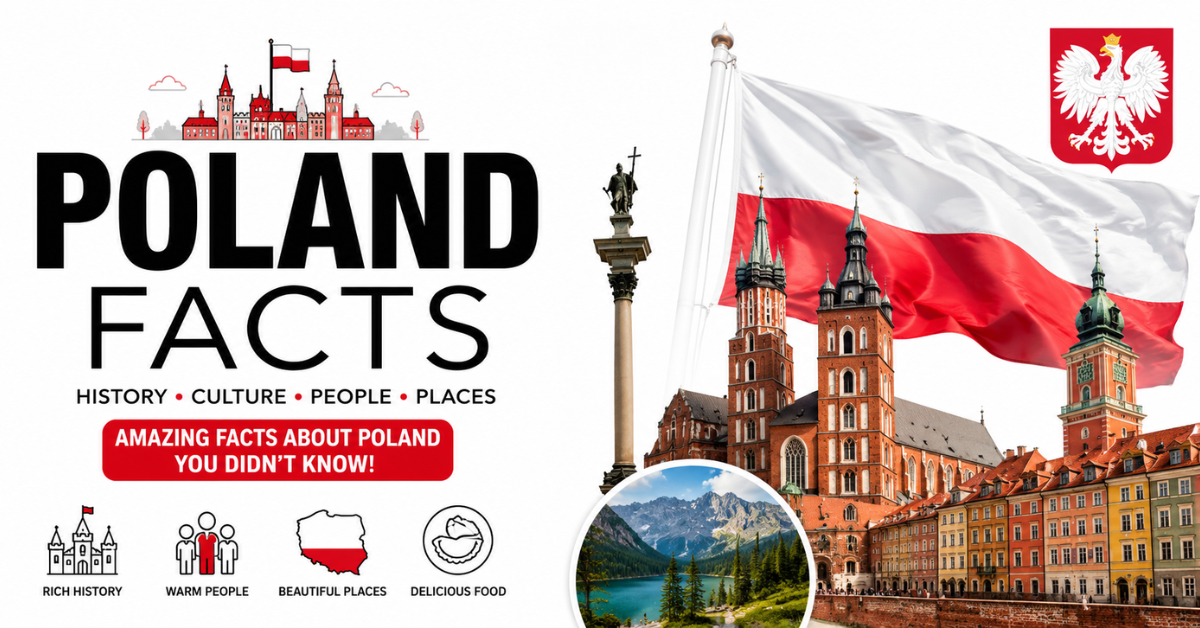
50+ Poland Facts That Will Surprise You
Poland is a fascinating European country filled with rich history, beautiful landscapes, vibrant cities, and unique traditions. From medieval castles and historic landmarks to stunning mountains and the Baltic Sea, Poland offers plenty of interesting stories to discover. Known for its strong cultural heritage, Poland has played an important role in European history while preserving its own distinctive identity.
Its capital, Warsaw, combines historic architecture with modern city life, while Kraków is famous for its charming old town and cultural treasures. In this guide to Poland facts, you’ll discover fascinating details about Polish history, geography, culture, food, wildlife, famous people, and Polish traditions that make this country truly remarkable and worth exploring.
Quick Facts About Poland
| Fact | Detail |
| Capital | Warsaw |
| Population | ~38 million |
| Area | 312,696 sq km |
| Currency | Polish złoty |
| Official language | Polish |
| Borders | 7 countries |
| Government | Parliamentary republic |
| EU & NATO member | Yes (EU: 2004, NATO: 1999) |
Poland Geography Facts
- Poland covers 312,696 sq km, ranking among the largest countries in Central Europe.
- It borders seven countries: Germany, Czechia, Slovakia, Ukraine, Belarus, Lithuania, and Russia (via Kaliningrad).
- Poland’s Baltic Sea coastline stretches roughly 770 km.
- The Vistula River, at 1,047 km, is Poland’s longest river and its most culturally significant waterway.
- Poland’s highest peak, Rysy, reaches 2,499 meters in the Tatra Mountains, part of the Carpathians.
- The country’s largest lake, Śniardwy, sits in the Masurian Lake District, home to over 1,300 lakes.
- Poland is divided into 16 voivodeships (provinces).
- The Błędów Desert, in southern Poland, is one of only a handful of natural desert landscapes in Europe and was used for military training during World War II due to its resemblance to North African terrain.
- Roughly 75% of Poland consists of lowland plains, with mountains concentrated along the southern border.
- Poland’s climate is temperate, with warm summers and cold, often snowy winters.
- The Polish coastline includes two natural harbors, centered on Gdańsk-Gdynia and Szczecin.
Poland History Facts
- Poland’s recorded statehood traces to 966 AD, when Duke Mieszko I was baptized, marking the country’s formal entry into Christian Europe.
- The Polish–Lithuanian Commonwealth (1569–1795) was one of the largest and most populous states in early modern Europe.
- Poland adopted Europe’s first modern constitution on May 3, 1791 the world’s second, after the United States.
- Between 1772 and 1795, Poland was progressively divided by neighboring powers in the Partitions of Poland, disappearing from the map for 123 years.
- Poland regained independence in 1918, after World War I.
- Nazi Germany’s invasion of Poland on September 1, 1939, is widely marked as the start of World War II in Europe.
- The Warsaw Uprising of 1944 was one of the largest resistance operations against Nazi occupation in the war.
- After the war, Poland became a communist state under Soviet influence until the Solidarity movement, led by Lech Wałęsa, helped bring about the fall of communism in 1989.
- Solidarity, founded in 1980 at the Gdańsk Shipyard, became the first independent trade union in a Soviet-bloc country and a major catalyst for change across Eastern Europe.
- Poland joined NATO in 1999 and the European Union in 2004.
- Poland’s post-1989 transition from a planned to a market economy is often cited as one of the most successful in the former Eastern Bloc.
Warsaw and Kraków Facts
- Warsaw, Poland’s capital, was over 85% destroyed during World War II and painstakingly rebuilt using historic paintings and archival records.
- Warsaw’s rebuilt Old Town is now a UNESCO World Heritage Site precisely because of that reconstruction effort.
- The Palace of Culture and Science, a 1955 gift from the Soviet Union, remains Poland’s tallest building.
- Kraków, Poland’s former royal capital, is home to Wawel Castle and one of Europe’s largest medieval market squares.
- Kraków’s Jagiellonian University, founded in 1364, is one of the oldest universities in the world.
- Unlike Warsaw, Kraków’s historic center survived World War II largely intact.
- Zakopane, near the Tatra Mountains, is considered Poland’s unofficial winter sports capital.
Polish Culture, Traditions, and Superstitions
- Poles traditionally celebrate their name day the feast day of the saint they’re named after often alongside or instead of a birthday.
- Each spring, Poles construct a straw doll called Marzanna, then burn it and cast it into a river to symbolically banish winter.
- Poland has strict naming laws: given names must be officially recognized and clearly indicate the child’s gender.
- Couples reaching their 50th wedding anniversary may be awarded a state honor, the Medal for Long Marital Life.
- In some traditional settings, Polish men greet women with a hand kiss as a formal courtesy a custom that’s faded significantly among younger generations but still appears at weddings and ceremonies.
- Politely declining an offer once, even food you want, is a common social custom, and hosts will often offer again.
- Catholic tradition remains deeply woven into Polish cultural and civic life, more so than in many other European countries.
- Mushroom foraging is a widely practiced autumn pastime across Poland, with hundreds of wild edible species found in its forests.
- Easter and Christmas traditions in Poland include distinctive customs like blessing food baskets and sharing an unleavened wafer, opłatek, before the Christmas Eve meal.
Polish Language Facts
- Polish is a West Slavic language closely related to Czech and Slovak.
- For English speakers, Polish can be especially challenging because of its complex grammar, noun cases, and consonant clusters not because of any single “hardest language” ranking.
- Despite the language’s complexity, English proficiency has grown significantly among younger Poles, especially in cities.
Polish Food and Drink Facts
- Pierogi dumplings filled with meat, cheese, potato, or fruit are Poland’s most internationally recognized dish, celebrated with a national holiday on October 8th.
- Bigos, a hearty stew of meat, sauerkraut, and cabbage, is also widely considered a national dish.
- Poland has one of the strongest historical claims to inventing vodka, with written references dating to 1405 court documents though Russia disputes the origin, and the debate remains unresolved.
- A popular Polish drink combines beer with raspberry syrup, called piwo z sokiem, favored for its sweeter, milder taste.
- On Polish television, it’s common for foreign films to be dubbed by a single narrator, known as a lektor, who reads all dialogue over the original audio track.
Poland’s Castles and Landmarks
- Malbork Castle, built by the Teutonic Knights in the 13th century, is widely described as the largest castle by land area and the largest brick castle in the world, and is a UNESCO World Heritage Site.
- Sopot Pier, on the Baltic coast, is regarded as the longest wooden pier in Europe.
- Wieliczka Salt Mine, near Kraków, has been in continuous operation since the 13th century and features underground chapels carved entirely from salt.
- Piwnica Świdnicka in Wrocław, dating to 1275, is considered one of Europe’s oldest restaurants.
- The Crooked Forest near Gryfino contains a grove of pine trees bent at sharp angles near their base, a phenomenon whose exact cause remains debated.
Poland’s UNESCO World Heritage Sites
Poland has approximately 16 UNESCO World Heritage Sites, including:
- The historic centers of Warsaw and Kraków
- Malbork Castle
- The Wieliczka Salt Mine
- Białowieża Forest (shared with Belarus)
- The Auschwitz-Birkenau Memorial, preserved as a site of historical remembrance
Kraków’s Old Town was among the first sites ever added to the UNESCO list, in 1978.
Poland Nature and Wildlife Facts
- Białowieża Forest is one of Europe’s largest and best-preserved remaining fragments of the primeval lowland forest that once covered much of the continent, home to over 800 European bison.
- The Masurian Lake District contains over 1,300 lakes and is one of Poland’s most popular natural destinations.
- Poland has a greater density of lakes than almost any other European country besides Finland.
- The Baltic coast includes wide sandy beaches and shifting dune systems near the Słowiński National Park.
Polish Science, Inventions, and Famous People
- Nicolaus Copernicus, born in Toruń in 1473, developed the heliocentric model that placed the Sun at the center of the solar system.
- Marie Curie, born in Warsaw, became the first person to win Nobel Prizes in two different scientific fields Physics and Chemistry.
- The modern bulletproof vest is credited to a Polish immigrant inventor working in the United States.
- Polish mathematicians made foundational contributions to breaking the German Enigma code, work later built upon by British codebreakers during World War II.
- Frédéric Chopin, born near Warsaw, remains one of history’s most celebrated classical composers.
Polish Literature, Arts, and Sports
- Poland has produced multiple Nobel Prize winners in Literature, including Henryk Sienkiewicz, Czesław Miłosz, and Wisława Szymborska.
- Robert Lewandowski, one of the world’s top footballers, is among Poland’s most recognized modern athletes.
- Polish men have repeatedly claimed titles in the World’s Strongest Man competition.
- Volleyball is one of Poland’s most popular spectator sports, with a passionate national following.
- Kayaking and canoeing are popular in the Masurian Lake District, with marked routes spanning hundreds of kilometers.
- Poland has a strong classical music tradition beyond Chopin, including composers like Krzysztof Penderecki.
Modern Poland Facts
- Poland’s population is approximately 38 million, making it one of the EU’s more populous member states.
- Poland uses the złoty, not the euro, despite EU membership.
- Poland has one of the largest economies in Central Europe, with strong manufacturing, technology, and agricultural sectors.
- Warsaw has become a growing tech and finance hub in the region since the 2000s.
- Poland’s rail network is one of the more extensive in Central Europe, connecting most major cities directly.
Unusual and Record-Breaking Facts About Poland
- Poland is one of the world’s largest exporters of Baltic amber.
- Malbork Castle’s land area makes it larger than most other historic fortress complexes on Earth.
- Poland is home to over 9,000 lakes in total, concentrated mostly in the north.
- Some Polish caves in the Tatra region number among the deepest and most extensive cave systems in Central Europe.
Poland Facts for Kids
- Poland’s flag is simply white on top, red on bottom among the simplest national flag designs in the world.
- Kids in Poland celebrate their name day almost like a second birthday.
- Poland is home to Europe’s heaviest land animal, the European bison, living wild in Białowieża Forest.
- The country’s most famous scientist, Copernicus, figured out that Earth orbits the Sun not the other way around.
Frequently Asked Questions About Poland
- What are some of the most interesting things about Poland that not everybody knows, but should?
Poland is home to one of Europe’s oldest salt mines, the world’s largest brick castle, and the unique Białowieża Forest, one of Europe’s last primeval forests. - What are the most surprising things Poland is historically famous for beyond common stereotypes like food and jokes?
Poland has a remarkable history of scientific discoveries, resistance movements, and cultural achievements, including the work of astronomer Nicolaus Copernicus. - What facts about Poland do people not believe until they come to Poland?
Many visitors are surprised by how modern Polish cities are, how beautiful the countryside is, and how diverse the country’s landscapes can be. - What are some of the most mind-blowing facts about Poland?
Poland has shifted and changed dramatically throughout history, yet it preserved its language and culture despite periods when the country disappeared from the map of Europe. - What are some funny facts about Poland, Polish people and culture?
Polish people often joke about their famously difficult language, where a simple-looking word can contain several consonants together and still be perfectly normal Polish!
Sources and References
Facts above draw on figures from sources including UNESCO, Statistics Poland, national geographic references (World Atlas, Wikipedia’s sourced entries on Polish geography and history), and established travel and cultural references on Polish castles, traditions, and cuisine.
Final Thoughts
From a thousand-year-old baptism to Europe’s last great primeval forest, Poland’s history and culture run far deeper than pierogi and vodka alone. Whether you’re researching for school or simply curious, these facts capture why Poland remains one of Central Europe’s most historically significant countries.

Hi, I’m Benjamin, the person behind FactsAboutDog.com. 🐶
I’m passionate about dogs and love sharing interesting, fun, and educational facts about our furry friends. Through FactsAboutDog.com, I aim to make learning about dogs simple, enjoyable, and informative for dog lovers everywhere.
From amazing dog facts to breed information and fascinating animal knowledge, my goal is to help readers discover something new every day.
Explore the world of dogs with Benjamin at FactsAboutDog.com!