
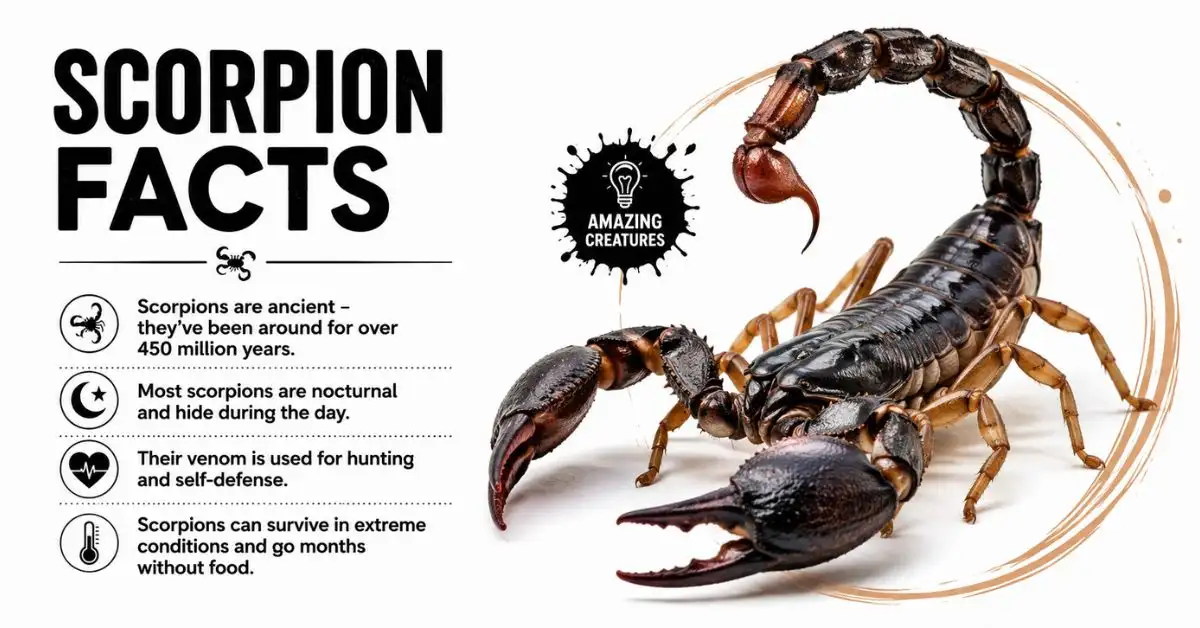
Scorpion Facts: Surprising Truths About This Ancient Arachnid
Scorpion facts reveal one of nature’s oldest survivors: an eight-legged arachnid armed with venomous pincers, a curved tail, and a lineage stretching back roughly 430 million years. Having spent years researching desert wildlife across Arizona, I’ve watched these resilient arthropods glow under UV light and shrug off heat that kills most insects.
If you’ve ever spotted a bark scorpion near your home and wondered whether it’s dangerous, you’re not alone scorpion stings send thousands of Americans to urgent care yearly. This guide breaks down verified scorpion facts, from anatomy and venom to habitat and lifespan, so you know exactly what you’re dealing with.
Scorpion Facts: Introduction
Scorpions are venomous arachnids belonging to the Arachnida class, making them closer relatives of spiders, ticks, and mites than of insects. Their armor-plated exoskeleton, curved metasoma, and pedipalps give them an unmistakable, prehistoric silhouette that has barely changed in hundreds of millions of years.
More than 1,300 to 2,000 recognized scorpion species roam six continents, absent only from Antarctica. Most are nocturnal ambush predators that rely on sensory hairs rather than sharp eyesight, using vibration detection to locate prey across sand, leaf litter, and rocky desert terrain after dark.
What Type Of Animal Is A Scorpion?
Scorpions are arachnids, not insects, placing them in the same phylum as spiders and camel spiders. All arachnids share eight legs plus a pair of pedipalps; a scorpion’s pedipalps evolved into grasping pincers used for hunting, defense, and courtship behavior.
Fast Scorpion Facts
For a quick reference, here’s a snapshot table of core scorpion statistics compiled from verified wildlife sources useful for students, homeowners, and curious readers who want the essentials without wading through paragraphs.
| Category | Detail |
| Scientific order | Scorpiones |
| Classification | Arachnida (Arthropoda phylum) |
| Species worldwide | 1,300–2,000+ |
| Habitat | Deserts, grasslands, rainforests, mountains |
| Diet | Insects, spiders, small vertebrates |
| Lifespan (wild) | 3–8 years typically; some up to 25 |
| Venomous species (lethal to humans) | ~25–40 worldwide |
| US species | ~90, only 1 potentially deadly |
Every entry in this scorpion facts snapshot is drawn from cross-checked wildlife and pest-control research, giving readers a trustworthy baseline before diving into anatomy, venom, and behavior in the sections that follow.
Ancient Scorpion Facts
Scorpions rank among the oldest terrestrial arthropods on Earth, with fossils recovered from Paleozoic strata roughly 430 million years old. These ancient specimens are strikingly similar to modern species, meaning a time-traveling look at a Silurian-era scorpion would still feel unmistakably familiar and just as intimidating.
Beyond biology, scorpions carved out a permanent place in mythology and astrology. Greek legend credits a giant scorpion sent by Gaia with slaying Orion, a battle immortalized in the Orion and Scorpius constellations and later echoed in the Scorpio zodiac sign spanning late October into November.
How Many Scorpion Species Are There?
Scientists have documented between 1,300 and 2,000 scorpion species and subspecies across roughly 13 recognized families. New species continue to be described as researchers survey remote deserts, caves, and rainforest floors, meaning the true global count likely remains incomplete.
Scorpions in the United States
Around 90 scorpion species inhabit the US, concentrated heavily in the desert Southwest. Only the Arizona bark scorpion carries venom potent enough to be considered potentially deadly, though striped tail, desert hairy, and common striped bark scorpions frequently wander indoors too.
General Scorpion Facts
Most scorpion species measure between one and five inches long, though size varies dramatically across the order. Counterintuitively, smaller scorpions often pack more potent venom than their larger cousins, while giants like the African long-tailed scorpion can exceed eight inches without posing serious danger to humans.
Lifespan is another area where scorpion facts defy assumptions: the typical wild scorpion survives three to eight years, but some species have been documented living up to 25 years in captivity. That longevity, paired with a low metabolic rate, helps scorpions endure brutal desert conditions most arthropods couldn’t survive.
Scorpion Body Parts
A scorpion’s body divides into the prosoma (head and mouthparts), mesosoma (mid-section housing book lungs), and metasoma (the segmented tail). The stinger sits at the telson, the bulbous tip housing venom glands, while chelicerae near the mouth shred prey into digestible fragments.
Where Do Scorpions Live?
Scorpions occupy nearly every warm habitat type, from sandy deserts and dry grasslands to rainforests, coastal scrub, and mountain slopes. They shelter in burrows, beneath bark, or under rocks during daylight, emerging at night to hunt within tightly defended individual territories.
Scorpion Diet & Hunting
Scorpions are opportunistic carnivores, feeding on insects, spiders, and occasionally small lizards or rodents. They detect prey vibrations through sensitive leg and pedipalp hairs, then crush victims with their pincers before liquefying tissue externally for consumption, since scorpions cannot chew solid food.
How Long Do Scorpions Live?
Scorpions reach sexual maturity between one and three years of age, depending on species, then typically live another two to six years in the wild. Slower metabolisms and the ability to survive on a single insect per year contribute heavily to this unusual longevity among arthropods.
Scorpion Venom Facts
Every scorpion produces venom, but stinging is genuinely a last resort behind fleeing or hiding. Venom composition varies by species and can include dozens of neurotoxins, hemolytic compounds, and other bioactive substances scorpions even regulate dosage, delivering anything from a dry sting to a full, dangerous injection.
Scientific interest in scorpion venom extends far beyond antivenom production. Certain peptides trigger targeted cellular death in cancer cells, and nanotechnology research is exploring safe delivery methods for tumor treatment, turning one of nature’s most feared weapons into a promising medical research tool.
Are Scorpions Dangerous To Humans?
Scorpion stings are painful but rarely fatal to healthy adults; the greatest risk falls on young children, the elderly, and people with allergic sensitivities. Historically, regions like Mexico recorded hundreds of scorpion-related deaths annually before modern antivenom access dramatically reduced fatality rates.
What Is The Most Venomous Scorpion?
The deathstalker scorpion of North Africa and the Middle East delivers an extremely painful, though usually survivable, sting to healthy adults. The Indian red scorpion is widely considered the deadliest species overall, while the Arizona bark scorpion holds that title within North America.
Scorpion Control
Because bark scorpions and similar species readily invade homes, containment matters. Trapping a scorpion under a cup, sealing entry points, and reducing clutter near foundations are practical first steps; persistent infestations typically call for a licensed pest control professional’s help.
Pseudo-Scorpion Facts
Not everything that resembles a scorpion is one. Wind scorpions (also called spider scorpions or camel spiders) have pincer-like pedipalps but cannot sting and aren’t venomous, despite delivering a surprisingly forceful bite when threatened by curious hikers or campers.
True pseudoscorpions and whip scorpions round out this lookalike category. Whip scorpions defend themselves with acetic acid spray instead of a stinger, and most of these mimics are ecologically beneficial, feeding heavily on cockroaches and other household pests rather than posing any real threat.
Scorpion Facts: Life Cycle
Scorpion reproduction begins with an elaborate courtship dance called the promenade à deux, where the male guides the female over a deposited sperm packet. Unlike most arachnids, scorpions give birth to live young through ovoviviparity, with litters ranging from roughly 8 to 25 offspring depending on species.
Newborn scorplings climb onto their mother’s back immediately after birth, remaining there through their first molt for protection. Scorpions molt five to seven times before reaching adulthood, and each shedding stage called an instar marks a measurable step toward full size and reproductive maturity.
Scorpion Predators
Despite their fearsome reputation, scorpions face plenty of natural predators, including owls, lizards, rodents, frogs, and opossums. Other invertebrates like centipedes, spiders, and even cannibalistic fellow scorpions also prey on smaller or younger individuals within the same desert ecosystem.
Scorpions ‘Glow in the Dark’
One of the most captivating scorpion facts is fluorescence: their exoskeletons glow blue-green under ultraviolet light due to proteins in the cuticle. Scientists know how this glow works but remain uncertain why it evolved, with theories ranging from UV detection to camouflage regulation.
Scorpion Facts: Conclusion
From 430-million-year-old fossils to glowing exoskeletons and life-saving venom research, scorpion facts consistently defy the creature’s scary reputation. These ancient arachnids are resilient survivors and functioning members of desert ecosystems, not the senseless threats horror movies make them out to be.
Whether you’re a student researching arachnids, a homeowner dealing with a bark scorpion sighting, or simply curious about one of Earth’s oldest animals, understanding real scorpion facts replaces fear with informed respect and a little bit of genuine fascination.
FAQ
Are scorpions dangerous to humans?
Most scorpion stings cause pain and swelling rather than serious harm to healthy adults. Only about 25–40 species worldwide, including the Arizona bark scorpion in the US, carry venom potent enough to be medically dangerous, particularly for children and the elderly.
What do scorpions eat?
Scorpions primarily eat insects, spiders, and other small arthropods, occasionally taking lizards or rodents. They locate prey through vibration-sensing hairs, crush it with their pincers, then digest it externally before consuming it in liquid form.
How long do scorpions live?
Most wild scorpions live between three and eight years, though some species have survived up to 25 years in captivity. Lifespan depends heavily on species, habitat conditions, and how efficiently the individual manages its low metabolic rate.
Why do scorpions glow under UV light?
Scorpions fluoresce blue-green under ultraviolet light because of proteins embedded in their exoskeleton’s cuticle. Scientists understand the mechanism but haven’t confirmed the evolutionary purpose, with theories including light detection, mate recognition, and predator avoidance.
How many scorpion species are there?
Researchers have documented between 1,300 and 2,000 scorpion species and subspecies across roughly 13 families worldwide. New species are still being identified in remote deserts, caves, and rainforest regions.
What is the most venomous scorpion in the world?
The Indian red scorpion is widely regarded as the deadliest species globally, while the deathstalker scorpion of North Africa and the Middle East delivers one of the most excruciating (though rarely fatal) stings to healthy adults.
Do scorpions have eyes?
Yes most scorpions have between two and five pairs of eyes, though some cave-dwelling species have none at all. Even sighted scorpions rely far more on vibration-sensing hairs and pectines than on vision to navigate and hunt.
Are scorpions arachnids or insects?
Scorpions are arachnids, not insects. They belong to the Arachnida class alongside spiders, ticks, and mites, distinguished by eight legs, a pair of pedipalps, and the absence of antennae or wings.

Hi, I’m Benjamin, the person behind FactsAboutDog.com. 🐶
I’m passionate about dogs and love sharing interesting, fun, and educational facts about our furry friends. Through FactsAboutDog.com, I aim to make learning about dogs simple, enjoyable, and informative for dog lovers everywhere.
From amazing dog facts to breed information and fascinating animal knowledge, my goal is to help readers discover something new every day.
Explore the world of dogs with Benjamin at FactsAboutDog.com!