Nicaragua Interesting Facts: 30+ Surprising Things You Never Knew
Nicaragua interesting facts range from freshwater sharks swimming in a volcanic lake to a capital city with no formal street names. I’ve spent years researching and writing about Central America, and Nicaragua consistently surprises even seasoned travelers with its lakes, volcanoes, and colonial history.
If you’ve ever felt overwhelmed trying to separate real Nicaragua trivia from generic tourism fluff, you’re not alone most lists repeat the same three facts. This guide digs deeper, blending geography, culture, wildlife, and firsthand travel context so you walk away actually understanding this Central American nation, not just skimming a list.
Nicaragua Interesting Facts: Quick Fast Facts You Should Know
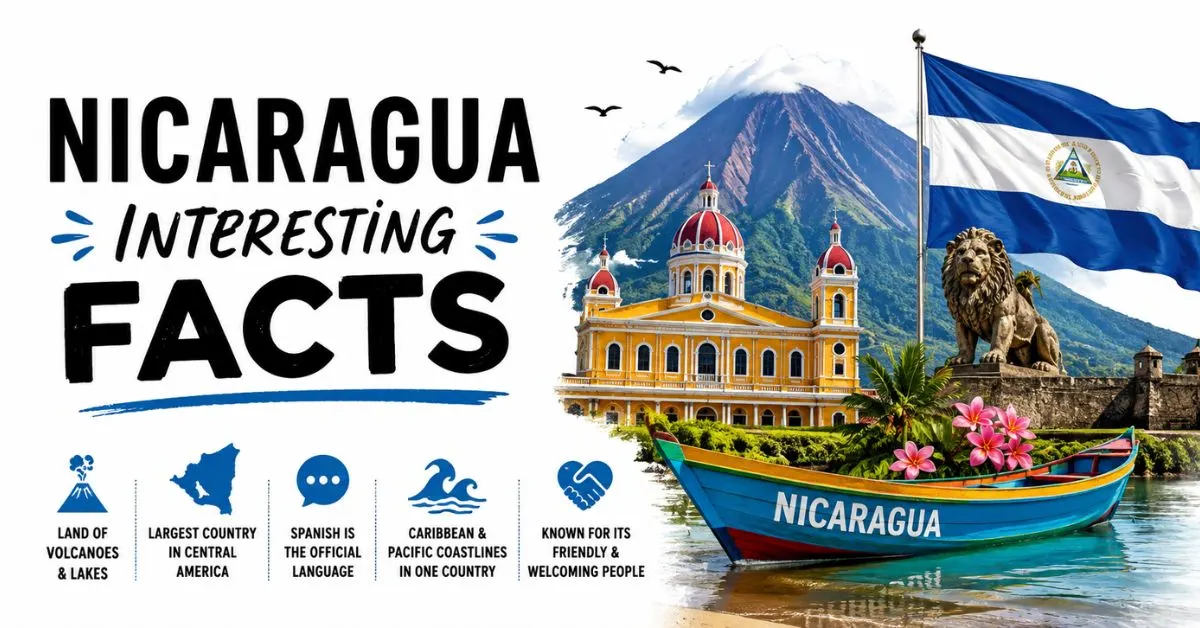
Nicaragua, officially the Republic of Nicaragua, sits in Central America between Honduras and Costa Rica. The capital city is Managua, home to over a million residents. With a population near 6.7 million and an area around 130,370 sq km, it’s the largest Central American republic by landmass, giving it real geographic weight in the region.
Spanish is the official language, though Creole English, Miskito, and Garífuna are spoken along the Caribbean coast. Christianity dominates religious life, and the country runs on Central Standard Time (UTC-6). These fast facts about Nicaragua form the foundation for everything else on this list, from its volcanic terrain to its layered colonial past.
Nicaragua Interesting Facts About the Basics
Geography
Nicaragua borders Honduras to the north and Costa Rica to the south, with coastlines on both the Pacific Ocean and Caribbean Sea. The Pacific side stays more populated and popular for surfing, while the Corn Islands offer a quieter, more affordable Caribbean escape for adventurous travelers seeking authentic island culture.
Elevation
Despite two coastlines, Nicaragua’s average elevation sits around 298 meters above sea level. The highest peak, Pico Mogotón, reaches 2,107 meters. Hikers attempting this remote summit typically hire a local guide, since the trail becomes overgrown and poorly marked in the dense mountainous terrain.
Population
Roughly 6.2 million people call Nicaragua home, with about 90% clustered along the western coastline. Mestizo heritage, a blend of European and indigenous ancestry, makes up the majority population group. Spanish dominates daily life, while Creole and English remain common along the eastern Caribbean region.
Climate
Sitting just 1,350 km from the equator, Nicaragua experiences a tropical climate with only two real seasons: wet (May–October) and dry (November–April). Temperatures typically range from 70°F at night to 99°F during the day, making humidity, not rainfall, the biggest adjustment for first-time visitors.
Indigenous Name
The country’s name traces back to Nicarao, an indigenous chief who ruled communities near Lake Nicaragua during the 15th and 16th centuries. Combined with “agua,” the Spanish word for water, this etymology links Nicaragua’s identity directly to its defining geographic feature the massive freshwater lake at its heart.
Forward-Thinking Country
Nicaragua generated roughly 70% of its electricity from renewable resources in 2020, an impressive figure for one of Central America’s poorest nations. Compare that to the United States, which produced only around 13% from renewables, and Nicaragua’s clean-energy ambitions start looking genuinely progressive on a global scale.
Ring of Fire
Nicaragua belongs to the Pacific Ring of Fire, an active seismic zone responsible for frequent earthquakes and volcanic eruptions. Popular volcanoes include Masaya, where visitors watch glowing lava, and Cerro Negro, the youngest volcano in Central America and a favorite spot for adrenaline-fueled sandboarding adventures.
Nicaragua Interesting Facts Everyone Loves to Share
Some Nicaragua trivia sounds almost too strange to be true, yet it’s well documented. Lake Nicaragua contains the only freshwater bull sharks on Earth, alongside swordfish and tarpon species typically confined to saltwater environments elsewhere on the planet, making this lake a genuine biological anomaly worth exploring.
Granada, founded in 1524, ranks as the oldest Spanish-built city in the Central American isthmus, while León houses Central America’s largest cathedral. Add in over 700 bird species, 40 volcanoes, and a name-inspiring chief called Nicarao, and these fun facts about Nicaragua rarely fail to spark genuine curiosity in first-time listeners.
Nicaragua Interesting Facts About History and Culture
Unique History
Nicaragua holds a rare distinction in Latin America: it’s the only country colonized by both Spain and Britain simultaneously. Spain controlled the western Pacific side starting in the 16th century, while Britain governed the Caribbean coast beginning in the 17th century, creating a genuinely split colonial legacy still visible today.
Independence
Nicaragua declared independence from Spain on September 15, 1821, alongside El Salvador, Honduras, Costa Rica, and Guatemala. All five nations still celebrate independence on the exact same date each year, a shared regional holiday rooted in their joint departure from the collapsing Spanish colonial empire.
Traditional Food
Gallo pinto, a hearty dish of rice mixed with beans, appears on Nicaraguan tables almost daily. While neighboring countries claim similar variations, Nicaraguans consider it deeply their own. Regional differences even exist within the country regarding whether black beans or red beans belong in the authentic recipe.
English-Speaking Community
British colonial influence left a lasting linguistic mark on Nicaragua’s Caribbean coast, known historically as the Mosquito Coast. Despite the region’s underdeveloped reputation, English remains widely spoken there today, alongside the Corn Islands’ growing tourism scene built around turquoise water and laid-back island living.
Earthquake in 1972
A devastating earthquake struck Managua on December 23, 1972, killing over 10,000 people just before Christmas. The disaster was so severe that the capital never rebuilt a traditional downtown core residents instead reconstructed the city around and away from the original destroyed center entirely.
Lake Nicaragua, a Competitor to the Panama Canal
In the late 19th century, engineers seriously considered Lake Nicaragua as an alternate route connecting the Atlantic and Pacific oceans instead of Panama. A 2014 Hong Kong-backed proposal to revive a Nicaragua Canal ultimately collapsed after the company failed to secure adequate funding for construction.
Nicaragua Interesting Facts for Travelers
Affordability
Nicaragua consistently ranks among Central America’s most budget-friendly destinations, drawing backpackers seeking diverse landscapes without steep costs. Its southern neighbor, Costa Rica, typically runs about twice as expensive for comparable food, lodging, and activities, making Nicaragua the go-to pick for travelers stretching a tighter budget.
Surfing Hotspot
More than ten beaches line Nicaragua’s Pacific coast, with San Juan del Sur and Popoyo standing out as the most famous surf destinations. Rising visitor numbers have pushed surf camp prices upward recently, though quieter alternatives like Jiquilillo Beach still offer uncrowded breaks for travelers avoiding the crowds.
Unique Lake Nicaragua
Also called Lago Cocibolca, Lake Nicaragua holds roughly 360 volcanic islands, including Ometepe the largest lake island on Earth, formed by two volcanoes. Don’t be startled if you spot a shark fin; bull sharks genuinely migrate here from Caribbean waters through connected river systems.
No Tourist Visas
Most travelers, including Americans, Canadians, and many Europeans, only need a $10 Tourist Card on arrival rather than a formal visa. This card also permits free movement across Guatemala, El Salvador, Nicaragua, and Honduras for up to 90 days under a regional Central American travel agreement.
Rainforest
Nicaragua’s sparsely populated eastern region is covered largely by rainforest, giving the country the highest forest coverage in Central America. Monkeys, toucans, and sloths frequently appear here, and roughly a quarter of Nicaragua’s total land remains classified as untouched, old-growth virgin forest.
No Actual Address
One of the most talked-about Nicaragua interesting facts involves navigation: the country doesn’t use conventional street names or numbers. Instead, directions rely on landmarks, such as “two blocks north of the church, then three and a half blocks downhill,” a system also historically used in parts of Japan.
Saving Turtles
Nicaragua plays a meaningful role in sea turtle conservation, with wildlife refuges like La Flor near San Juan del Sur and Padre Ramos near Jiquilillo protecting nesting hatchlings. Visitors can witness turtles laying eggs and baby turtles making their first journey toward the ocean during nesting season.
Safe and Authentic
Nicaragua consistently ranks as one of Central America’s safest countries, largely because it’s less entangled in regional drug trafficking than some neighbors. Despite widespread poverty, with many residents living on limited daily income, visitors often describe Nicaragua as one of the last authentically non-westernized destinations left in the region.
Unusual National Sport
Unlike most Latin American countries where soccer reigns supreme, baseball holds the title of Nicaragua’s national sport. This passion traces back to historical American influence in the region, and Nicaraguan players have gone on to compete successfully in Major League Baseball, fueling national pride back home.
More Nicaragua Interesting Facts That Surprised Us
A few Nicaragua interesting facts genuinely catch newcomers off guard. Some of the country’s most expensive hotels sit not in the capital but in the colonial town of León, while Masaya’s central market ranks among the largest and busiest in the entire country, overflowing with crafts, produce, and local energy.
Nearly every tiny island (isleta) scattered around Granada’s shoreline is actually for sale, often for seven-figure sums. And while Nicaragua remains the only place on Earth documented to have freshwater sharks, sightings have grown rare in recent years, leaving researchers still debating whether the population is declining or simply elusive.
Fact Breakdown: Nicaragua at a Glance
| Category | Detail |
| Capital | Managua |
| Population | ~6.7 million |
| Area | 130,370 sq km (largest in Central America) |
| Official Language | Spanish |
| Largest Lake | Lake Nicaragua (Cocibolca) 8,264 sq km |
| Nickname | Land of Lakes and Volcanoes |
| Active Volcanoes | Around 7–19 (of ~40 total) |
| Colonizers | Spain (Pacific coast) and Britain (Caribbean coast) |
| National Sport | Baseball |
| Currency | Córdoba (NIO) |
Frequently Asked Questions
What is Nicaragua best known for?
Nicaragua is best known for its “Land of Lakes and Volcanoes” nickname, driven by its two massive lakes and chain of active volcanoes, alongside colonial cities like Granada and León and its status as the largest country in Central America.
Why is Lake Nicaragua so unusual?
Lake Nicaragua is the only freshwater lake in the world documented to support bull sharks, along with swordfish and tarpon, species normally restricted to saltwater habitats making it a genuine ecological rarity among the world’s lakes.
Is Nicaragua safe to visit?
Nicaragua generally ranks among the safer Central American countries for travelers, with lower involvement in regional drug trafficking compared to some neighbors, though travelers should always check current government travel advisories before booking.
What language is spoken in Nicaragua?
Spanish is Nicaragua’s official language, while Creole English, Miskito, and other indigenous languages are spoken along the Caribbean coast, reflecting the country’s dual Spanish and British colonial history.
Why doesn’t Nicaragua use street addresses?
Nicaragua traditionally relies on landmark-based directions instead of formal street names or numbers, describing locations relative to churches, trees, or other well-known local reference points rather than numbered addresses.

Hi, I’m Benjamin, the person behind FactsAboutDog.com. 🐶
I’m passionate about dogs and love sharing interesting, fun, and educational facts about our furry friends. Through FactsAboutDog.com, I aim to make learning about dogs simple, enjoyable, and informative for dog lovers everywhere.
From amazing dog facts to breed information and fascinating animal knowledge, my goal is to help readers discover something new every day.
Explore the world of dogs with Benjamin at FactsAboutDog.com!