Fun Facts About Nicaragua: 50+ Surprising Facts
Nicaragua is a country full of surprises, making it a fascinating destination for anyone curious about Central America. From towering volcanoes and freshwater lakes to colorful colonial cities and tropical coastlines, its landscape offers plenty of stories worth discovering. These fun facts about Nicaragua reveal unusual details about its geography, history, wildlife, culture, and traditions.
Did you know Nicaragua is home to one of the largest lakes in Central America and has islands formed by volcanic activity? The country also has a rich history, distinctive foods, lively festivals, and natural wonders. Whether you love travel, geography, or learning about unique places, facts give you reasons to explore this captivating country.
Nicaragua at a Glance
| Fact | Detail |
| Capital | Managua |
| Region | Central America |
| Land area | About 130,370 sq km — the largest country in Central America |
| Population | Roughly 6.4 million (2023 est.) |
| Official language | Spanish |
| Currency | Nicaraguan córdoba |
| Independence | Declared 1821; became a republic in 1838 |
| Coastlines | Pacific Ocean and Caribbean Sea |
| Largest lake | Lake Nicaragua |
| Famous island | Ometepe |
| National bird | Turquoise-browed motmot (Guardabarranco) |
| National flower | Sacuanjoche (Plumeria) |
| Most popular sport | Baseball |
Population and area figures are drawn from the CIA World Factbook.
Geography Facts About Nicaragua
- Nicaragua is the largest country in Central America by land area, though not the most populated.
- It’s one of the few countries in the region with coastline on two different oceans: the Pacific and the Caribbean.
- The Pacific and Caribbean sides have noticeably different climates, cultures, and even accents.
- Parts of Nicaragua’s coast have striking black-sand beaches, a result of its volcanic geology.
- The country’s name likely comes from “Nicarao,” an indigenous chief who ruled the area when Spanish explorers arrived.
- Nicaragua has a tropical climate with wet and dry seasons rather than four traditional seasons; the Caribbean side stays wetter year-round.
- The country’s terrain ranges from Pacific coastal plains and volcanic chains to Caribbean lowlands and central highlands.
- Nicaragua shares land borders with Honduras to the north and Costa Rica to the south.
- Despite its size, the overwhelming majority of Nicaragua’s population lives in the western half of the country, near the Pacific coast.
Volcano Facts About Nicaragua
- Nicaragua has more than 20 volcanoes, thanks to its location on the Pacific Ring of Fire.
- Cerro Negro is one of the youngest volcanoes in Central America and one of the most active.
- Cerro Negro is famous for volcano boarding sliding down its ash-covered slope on a modified board, an activity that draws thrill-seekers from around the world.
- Several Nicaraguan volcanoes remain active, and eruptions have periodically reshaped the surrounding landscape.
- Many of Nicaragua’s volcanoes line up along a single chain running roughly parallel to the Pacific coast, visible from space as a nearly continuous ridge.
- Some volcanic crater lakes, like the one atop Ometepe’s Maderas volcano, have formed their own small ecosystems.
Lake Nicaragua Facts
- Lake Nicaragua is the largest lake in Central America, covering roughly 8,000 square kilometers.
- It’s one of the very few lakes in the world documented to contain bull sharks. Reports of the lake’s sharks date back to 1526, and scientists confirmed in 1961 that they were bull sharks rather than a unique freshwater species.
- Researchers later found the sharks reach the lake by swimming up the San Juan River from the Caribbean Sea, not because they evolved there in isolation.
- Sightings have become far rarer in recent decades due to river silt buildup and habitat changes.
- The lake also holds tarpon, snook, and sawfish, some of which historically grew to enormous sizes.
- Lake Nicaragua sits only about 12 miles from the Pacific Ocean at its closest point, despite draining toward the Caribbean.
Ometepe Island Facts
- Ometepe is a volcanic island sitting inside Lake Nicaragua, formed by two volcanoes Concepción and Maderas joined by a narrow strip of land.
- It’s one of the largest lake islands in the world.
- Concepción is still active, while Maderas is dormant and holds a crater lake near its summit.
- Ometepe is also home to pre-Columbian petroglyphs carved into volcanic rock, left behind by Indigenous communities centuries ago.
- The island has its own small road network, howler monkey populations, and several freshwater springs fed by the surrounding volcanoes.
History Facts About Nicaragua
- The Pacific coast of Nicaragua was settled as a Spanish colony in the early 1500s, according to the CIA World Factbook.
- Nicaragua declared independence from Spain in 1821 and became a fully independent republic in 1838.
- Britain controlled parts of the Caribbean coast for much of the 19th century before gradually ceding the region.
- Nicaragua was briefly part of the United Provinces of Central America, a short-lived federation that also included Costa Rica, Honduras, El Salvador, and Guatemala.
- The Nicaraguan Revolution in the late 1970s ended decades of Somoza family rule and brought the Sandinistas to power in 1979.
- The years that followed brought the Contra War of the 1980s, one of the defining conflicts of the Cold War era in Central America.
- The devastating 1972 Managua earthquake destroyed much of the capital and reshaped the city’s layout for decades afterward.
- Much of Managua’s downtown was never fully rebuilt after the earthquake, which is why the city’s layout still looks different from other Central American capitals today.
Culture and Indigenous Facts About Nicaragua
- Indigenous groups including the Miskito, Rama, and Matagalpa peoples have lived in Nicaragua for centuries, particularly along the Caribbean coast.
- The Caribbean side is known as the Mosquito Coast, named after the Miskito people not the insect.
- Nicaraguan culture blends Indigenous, Spanish, and Caribbean influences, especially visible in its music and festivals.
- Unlike most of Central America, baseball, not soccer, is Nicaragua’s most popular sport, and the country has produced professional players who went on to play in the U.S. major leagues.
- Granada and León are two of the oldest colonial cities in the Americas, known for their Spanish colonial architecture and centuries-long historic rivalry.
- Spanish is Nicaragua’s official language, but English and indigenous languages like Miskito are also spoken along the Caribbean coast.
- Nicaragua has a rich tradition of poetry, most famously through Rubén Darío, a founding figure of the Modernismo literary movement.
- Traditional festivals throughout the year blend Catholic feast days with older Indigenous customs, especially in cities like León and Masaya.
- Marimba music and folk dances remain a central part of celebrations in many Nicaraguan towns.
- Nicaragua has also produced notable writers, artists, and musicians whose work is celebrated throughout Latin America.
Fun Facts About Nicaraguan Food
| Dish | What It Is |
| Gallo Pinto | Rice and beans, a daily staple dish |
| Nacatamales | Corn dough and meat steamed in banana leaves |
| Vigorón | A popular street food dish originating in Granada |
| Coffee | A major export crop and source of national pride |
| Quesillo | A soft cheese and cream wrap, a favorite roadside snack |
| Rosquillas | Corn-and-cheese biscuits often served with coffee |
Nicaragua also has a growing cacao industry and a long tradition of producing rum, and many rural communities still prepare meals using recipes passed down for generations.
Wildlife Facts About Nicaragua
- Nicaragua’s rainforests and protected reserves are home to monkeys, sloths, and jaguars.
- Its coastlines provide important nesting habitat for several species of sea turtles.
- The country is an increasingly popular destination for birdwatching, thanks to its wide range of tropical species.
- Lake Nicaragua’s bull sharks remain one of the country’s strangest wildlife facts one of the only documented cases of sharks regularly found deep inland in fresh water.
- The Indio Maíz and Bosawás reserves protect some of the largest remaining rainforest areas in Central America.
- Nicaragua’s Pacific beaches, including those near San Juan del Sur, host seasonal mass nesting events by olive ridley sea turtles known as “arribadas.”
Lesser-Known Fun Facts About Nicaragua
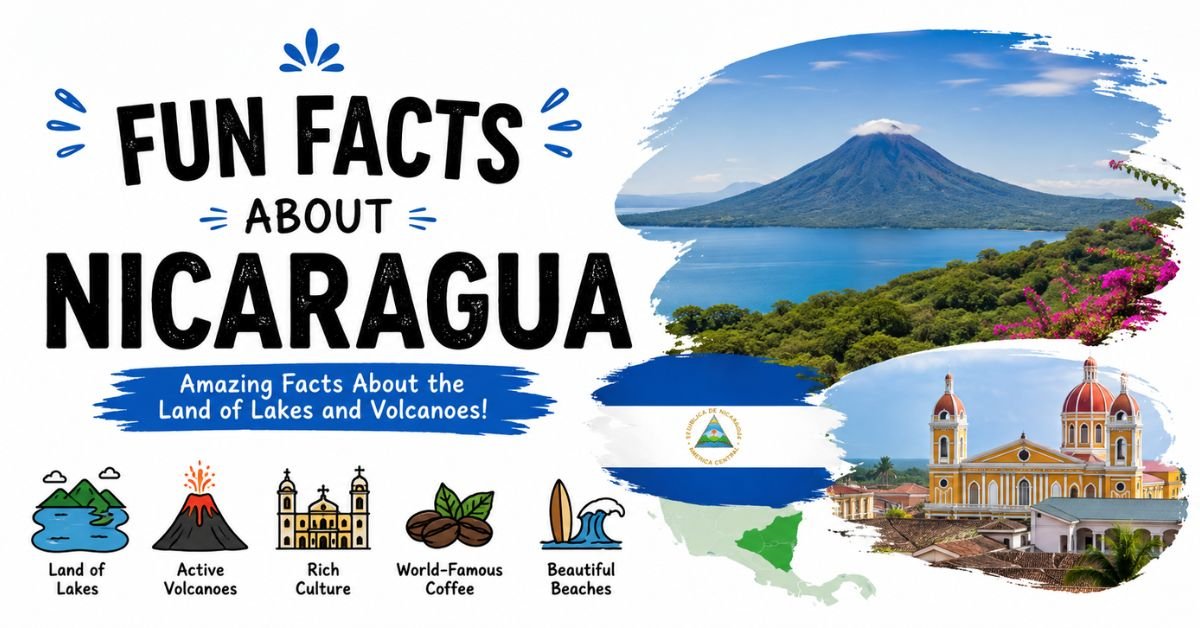
- Nicaragua is sometimes called the “Land of Lakes and Volcanoes” because of how much of its landscape is shaped by both.
- The Pacific town of San Juan del Sur has become a major surfing destination in the past two decades.
- Managua’s Lake Managua sits right beside the capital and has influenced the city’s development for centuries.
- Nicaragua’s national flower, the Sacuanjoche, grows on a tree in the Plumeria family and blooms with a fragrance that’s strongest at night.
- The national bird, the Guardabarranco, appears on Nicaragua’s 200-córdoba banknote.
- Travel costs in Nicaragua are generally lower than in neighboring Costa Rica, though prices vary by region and season.
- Nicaragua’s flag colors, blue and white, are shared with several other Central American nations that once belonged to the same federation.
- The colonial city of León was actually rebuilt at a new location in the 1600s after volcanic activity and disease affected the original settlement, whose ruins remain a UNESCO-recognized archaeological site.
- Nicaragua is one of the least densely populated countries in Central America relative to its size, leaving large stretches of untouched wilderness.
- The country’s highest point, Mogotón, sits along the border with Honduras.
- Nicaragua’s Caribbean coast has strong cultural and linguistic ties to nearby English-speaking Caribbean islands, a legacy of British colonial influence.
- Despite its volcanic activity, several Nicaraguan volcanoes have rich, fertile soil on their slopes, making them ideal for coffee farming.
Fun Facts About Nicaragua for Kids
- Nicaragua is the biggest country in Central America.
- It has over 20 volcanoes.
- One of its lakes has real sharks living in it.
- You can slide down a volcano on a special board.
- Its capital city is called Managua.
- Baseball, not soccer, is the favorite sport.
- Nicaragua touches two different oceans.
- Some of its beaches have black sand from volcanoes.
- Its national bird is a colorful bird called the Guardabarranco.
- An island in the middle of a lake was made by two volcanoes.
Records and Superlatives Nicaragua Holds
- Largest country in Central America by land area.
- Largest lake in Central America (Lake Nicaragua).
- Largest freshwater island in the world sitting inside a single lake (Ometepe).
- Home to one of the only inland freshwater shark populations documented anywhere in the Americas.
- One of the highest concentrations of active volcanoes in Central America.
Is Nicaragua a Good Place to Visit?
Nicaragua draws travelers for its volcanoes, lakes, colonial cities, and beaches, and many find it more affordable than nearby Costa Rica. As with any destination, conditions and travel advisories can change, so it’s worth checking current official guidance before planning a trip.
Frequently Asked Questions About Nicaragua
- What is Nicaragua best known for?
Nicaragua is best known for its volcanoes, beautiful lakes, colonial cities, tropical beaches, and the famous Lake Nicaragua.
- What is a curiosity of Nicaragua?
One fascinating curiosity is that Nicaragua has a lake with freshwater sharks, known as bull sharks, which are unusual because sharks typically live in saltwater.
- What can you tell me about Nicaragua?
Nicaragua is the largest country in Central America, known for its diverse landscapes, rich culture, Spanish heritage, volcanoes, lakes, and Pacific and Caribbean coastlines.
- Is Nicaragua a poor or rich country?
Nicaragua is considered a lower-middle-income country and remains one of the less wealthy economies in Central America, though its economy has grown in recent years.
- How do you say “hi” in Nicaragua?
In Nicaragua, people commonly say “¡Hola!” to mean “Hi” or “Hello.”
developed tourism infrastructure.
Final Thoughts
Nicaragua’s volcanoes, shark-filled lake, twin-peaked island, and two very different coastlines make it one of the most surprising countries in Central America. Whether it’s the strange science behind its freshwater sharks or the simple fact that baseball beats soccer here, Nicaragua has more “did you know” moments than most travelers expect.

Hi, I’m Benjamin, the person behind FactsAboutDog.com. 🐶
I’m passionate about dogs and love sharing interesting, fun, and educational facts about our furry friends. Through FactsAboutDog.com, I aim to make learning about dogs simple, enjoyable, and informative for dog lovers everywhere.
From amazing dog facts to breed information and fascinating animal knowledge, my goal is to help readers discover something new every day.
Explore the world of dogs with Benjamin at FactsAboutDog.com!