
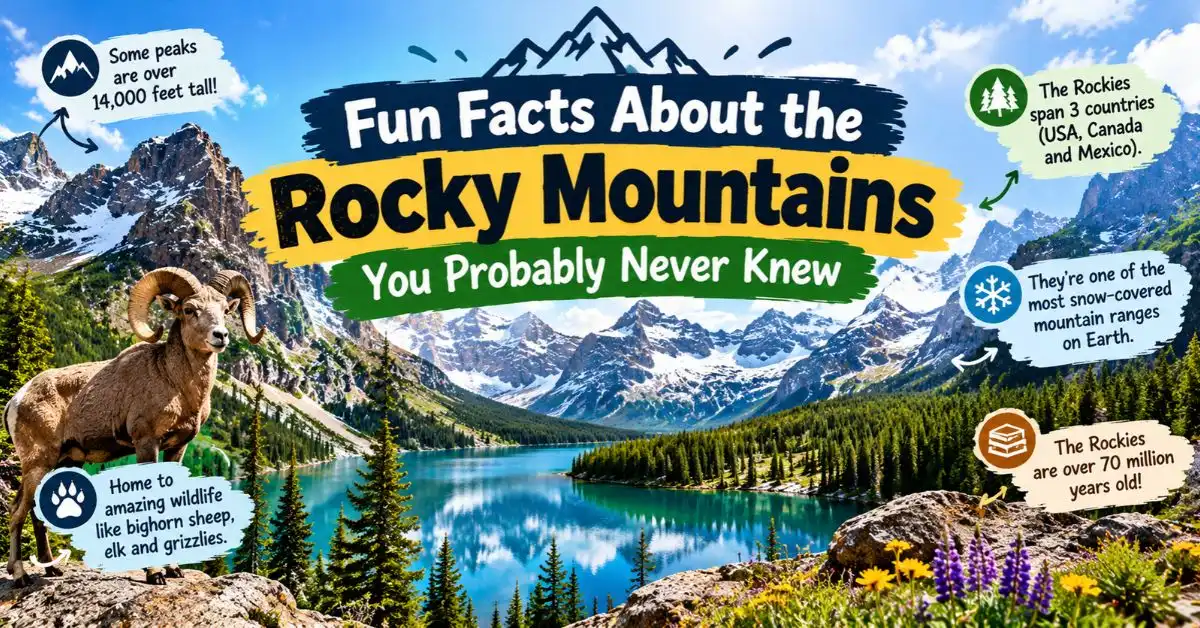
Fun Facts About the Rocky Mountains You Probably Never Knew
The Rocky Mountains are somewhere between 55 and 80 million years old, formed during a dramatic mountain-building period called the Laramide orogeny yet some of the rock inside them is over 1.7 billion years old. I remember standing at an overlook in Colorado thinking these peaks felt ancient and permanent, only to learn later they’re actually younger than the Appalachians.
That contrast between “young mountain range” and “ancient rock” is one of the most fascinating things about the Rockies. Tectonic plates collided, buckled, and pushed up a mountain range from much older continental crust, which is why geologists describe the Rockies as relatively young giants built from some of the oldest material on Earth.
Fun Fact: How Long Are the Rocky Mountains?
Stretching roughly 3,000 miles across North America, the Rocky Mountains form the longest mountain range on the continent, running from British Columbia in Canada down to New Mexico in the United States. That length alone earns them a spot among the world’s great mountain systems.
Along the way, the range crosses six U.S. states Washington, Idaho, Montana, Wyoming, Utah, and Colorado plus two Canadian provinces. It’s wild to think a single mountain system touches that many borders, climates, and ecosystems while still being recognizably “the Rockies” the whole way through.
Fun Fact: The Rockies Are Home to a Supervolcano
Hidden beneath Yellowstone National Park sits the Yellowstone Caldera, a genuine supervolcano tucked inside the Rocky Mountain system. Its massive underground magma chamber is responsible for the geysers, hot springs, and sulfur smell that make Yellowstone one of the most visited national parks in the country.
The good news: supervolcano eruptions occur millions of years apart, so there’s no need to cancel your trip. Still, standing near Old Faithful knowing a dormant giant simmers below adds a thrilling undercurrent to an otherwise peaceful hike through geyser basins and alpine meadows.
Fun Fact: Mount Elbert Is the Highest Peak in the Rocky Mountains
At 14,440 feet, Mount Elbert in Colorado is the tallest peak in the entire Rocky Mountain range and the second-highest point in the contiguous United States. Nicknamed the “Gentle Giant,” it’s considered a relatively approachable climb for beginner mountaineers compared to other fourteeners.
What surprises most people is that globally, Mount Elbert isn’t even close to record-setting roughly 100 mountains in Asia stand taller. Still, for anyone chasing high-altitude adventure in Colorado, summiting this peak remains a bucket-list achievement worth the effort and the altitude headache.
Fun Fact: The Rocky Mountains Divide the North American Continent
The Rockies form the Continental Divide, an invisible line where rainfall and snowmelt split in two directions: water on the western side eventually reaches the Pacific Ocean, while water on the eastern side flows toward the Atlantic. It’s a striking example of how one mountain range can reshape an entire continent’s hydrology.
Hikers can actually stand on marked points along this divide, one foot’s worth of rainfall destined for one ocean, the other destined for a completely different one thousands of miles away. It’s a small, almost poetic reminder of just how much geography quietly controls our world.
Fun Fact: Athabasca Glacier Is the Most-Visited Glacier in North America
Located in the Canadian Rockies, Athabasca Glacier draws more visitors than any other glacier on the continent, stretching about 4 miles long with ice reaching up to 1,000 feet deep in places. Tour buses with oversized tires even drive guests directly onto the ice for a close-up look.
Unfortunately, this glacier is also a sobering symbol of climate change, having retreated more than a mile over the past 125 years and continuing to melt at roughly 10 feet annually. Visiting it today means witnessing both breathtaking beauty and a visible, ongoing environmental transformation.
Fun Fact: Bighorn Sheep Rule the Rocky Mountains
With their thick, curling horns and sure-footed climbing skills, bighorn sheep are practically the unofficial mascot of the Rocky Mountains. Around 400 of them roam Rocky Mountain National Park alone, and despite their intimidating headgear, they’re known to be gentle and relatively calm around respectful observers.
Spring, especially May and June, offers the best odds of spotting them grazing on steep rocky slopes. Alongside elk, moose, and mountain goats, bighorn sheep help make wildlife-watching one of the top reasons travelers plan entire trips around exploring the Rockies.
Fun Fact: Many Indigenous Peoples Still Call the Rockies Home
Long before national park boundaries existed, the Rocky Mountains were home to numerous Indigenous nations, and that connection continues today. Communities including the Ute, Arapaho, Cheyenne, Comanche, Blackfoot, and Kutenai peoples maintain deep cultural, spiritual, and historical ties to this landscape.
Many national parks within the Rockies now work alongside Indigenous groups to better represent this history and honor unceded land. Recognizing this ongoing relationship adds crucial context to any list of Rocky Mountain facts, reminding visitors the region’s story didn’t begin with European exploration.
Fun Fact: There Are Nine National Parks in the Rocky Mountains
Spanning roughly 3,000 miles across two countries, the Rocky Mountains host no fewer than nine U.S. national parks, including Rocky Mountain National Park, Yellowstone, Glacier, and Grand Teton. That’s an extraordinary concentration of protected wilderness in a single mountain system.
Rocky Mountain National Park alone features elevations ranging from 7,860 to 14,259 feet and includes 77 peaks over 12,000 feet high. With that much vertical terrain packed into one park, it’s easy to understand why outdoor enthusiasts treat the Rockies as a lifetime bucket-list destination.
Fun Fact: Francisco Vásquez de Coronado Was the First Explorer
Spanish explorer Francisco Vásquez de Coronado led the first documented march into the Rocky Mountains in 1540, searching for the legendary Seven Cities of Gold. His expedition pushed north from Mexico into present-day New Mexico, chasing rumors rooted in centuries-old Portuguese legends.
Of course, Coronado wasn’t truly “first” in any meaningful sense Indigenous peoples had lived throughout the Rockies for thousands of years before his arrival. Still, his expedition marks the first recorded European contact with this mountain range, an important historical footnote in the Rockies’ broader story.
Fun Fact: The Rocky Mountains Contain Massive Sand Dunes
It sounds contradictory, but the Rocky Mountains contain North America’s tallest sand dunes, found at Great Sand Dunes National Park in Colorado. Some dunes rise more than 750 feet, flanked dramatically by snow-capped peaks in the background.
These dunes formed over tens of thousands of years as ancient lakebeds dried out and southwest winds blew the leftover sand into towering formations. The juxtaposition of desert-like dunes against alpine mountain scenery makes this one of the most visually striking and least expected Rocky Mountain destinations.
Fun Fact: Trail Ridge Road Is the Highest Continuous Paved Road in the U.S.
When Trail Ridge Road opened in Rocky Mountain National Park in 1932, it instantly became the highest continuous paved highway in the United States. The 48-mile route connects Estes Park to Grand Lake, climbing to a peak elevation of 12,183 feet near Fall River Pass.
Driving it means gaining roughly 4,000 feet of elevation within minutes, crossing straight through alpine tundra most people never otherwise see from a car window. As Horace Albright, former National Park Service director, once put it, the road offers “the whole sweep of the Rockies before you in all directions.”
FAQ Section
How old are the Rocky Mountains?
The Rocky Mountains formed roughly 55 to 80 million years ago, though some of the rock within them dates back more than 1.7 billion years.
How long are the Rocky Mountains?
The Rockies stretch approximately 3,000 miles, making them the longest mountain range in North America, spanning six U.S. states and parts of Canada.
What is the highest peak in the Rocky Mountains?
Mount Elbert in Colorado, at 14,440 feet, is the highest peak in the Rocky Mountains and the second-highest point in the contiguous United States.
Is there a volcano in the Rocky Mountains?
Yes the Yellowstone Caldera, a supervolcano, sits beneath Yellowstone National Park within the Rocky Mountain range.
How many national parks are in the Rocky Mountains?
There are nine U.S. national parks located in the Rocky Mountains, including Rocky Mountain National Park, Yellowstone, Glacier, and Grand Teton.
Who was the first explorer in the Rocky Mountains?
Spanish explorer Francisco Vásquez de Coronado led the first recorded European expedition into the Rockies in 1540 while searching for the Seven Cities of Gold.

Hi, I’m Benjamin, the person behind FactsAboutDog.com. 🐶
I’m passionate about dogs and love sharing interesting, fun, and educational facts about our furry friends. Through FactsAboutDog.com, I aim to make learning about dogs simple, enjoyable, and informative for dog lovers everywhere.
From amazing dog facts to breed information and fascinating animal knowledge, my goal is to help readers discover something new every day.
Explore the world of dogs with Benjamin at FactsAboutDog.com!