
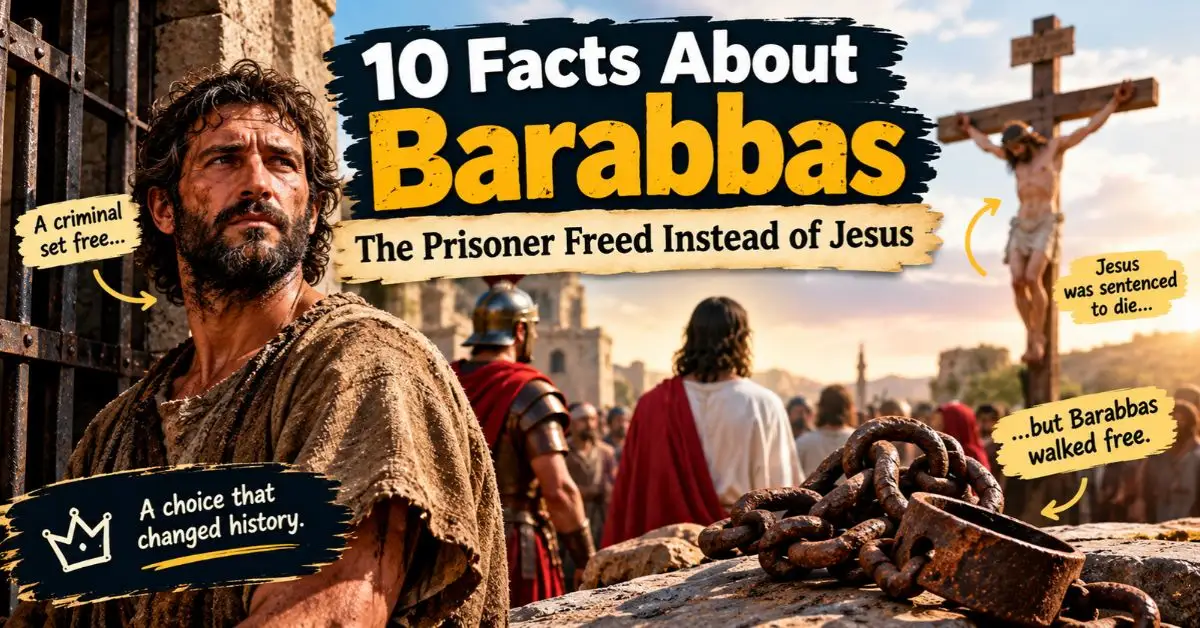
10 Facts About Barabbas: The Prisoner Freed Instead of Jesus
A condemned murderer walked free so an innocent man could die that’s the short answer to who Barabbas was, and it’s one of the most unsettling exchanges in the entire New Testament. I still remember the first time a pastor paused on this story mid-sermon and asked the room, “What if you were the one in the cell next to him?” That question has stayed with me, because Barabbas isn’t just a background character in the Passion narrative he’s a mirror.
Mentioned in all four Gospels Matthew, Mark, Luke, and John Barabbas was a notorious prisoner awaiting punishment for insurrection and murder against Roman authority in Judea. His sudden release, swapped for the crucifixion of Jesus Christ, raises questions about justice, mercy, and substitutionary atonement that theologians are still unpacking today. This list of 10 facts about Barabbas walks through his identity, his name, and what little the Bible actually tells us about his fate.
Fact 1: Barabbas Was Released Instead of Jesus Christ
Pontius Pilate, the Roman governor of Judea, gave the crowd gathered in Jerusalem a choice during the trial of Jesus: pardon Jesus Christ or free Barabbas, a known insurrectionist and murderer. It sounds like an easy call on paper, yet the crowd stirred up by religious leaders shouted for Barabbas. That single decision set the crucifixion narrative in motion.
What strikes me most is how ordinary the mechanics were a governor, a crowd, a routine festival pardon wrapped around a decision with eternal weight. Pilate saw no real fault in Jesus, yet public pressure and political tension in Roman-occupied Jerusalem overruled his judgment, sealing Barabbas’s freedom and Jesus’s fate.
Fact 2: The Meaning of the Name ‘Barabbas’
The name comes from the Aramaic words “bar” (son) and “abba” (father), so Barabbas literally translates to “son of the father.” Biblical scholars have long pointed out the striking irony here: a criminal bearing a name meaning “son of the father” stood beside Jesus Christ, the true Son of the Father, in front of the same crowd.
That etymology isn’t just trivia it’s a built-in symbol inside the Passion narrative itself. Early readers of the Greek New Testament would have caught the wordplay instantly, even if modern readers need a footnote to notice the parallel between the condemned man’s name and Christ’s own identity as God’s Son.
Fact 3: Barabbas Might Have Been His Surname
Some early manuscripts of Matthew’s Gospel refer to him as “Jesus Barabbas,” suggesting Jesus was his actual given name and Barabbas functioned more like a surname or patronymic “son of Abba.” If accurate, that means two men named Jesus stood before Pilate: Jesus Barabbas and Jesus called Christ, distinguished only by a title.
This detail rarely makes it into Sunday school lessons, yet it deepens the irony of the whole scene. Imagine the crowd shouting “Give us Jesus!” and Pilate having to clarify which one. Textual scholars still debate whether this reading survived scribal error or genuine historical memory.
Fact 4: What Was Barabbas in Prison For?
Scripture doesn’t soften his record. Mark and Luke call him a murderer and insurrectionist; John labels him a robber or bandit; Matthew simply calls him a “notorious prisoner.” Together, the Gospel accounts paint a picture of a violent rebel actively fighting Roman occupation in Judea, not a petty criminal caught up in circumstance.
Many scholars think Barabbas may have belonged to a Zealot-style faction seeking to overthrow Roman rule by force. That political backdrop matters: the crowd wasn’t just choosing a stranger over Jesus they were choosing a symbol of armed resistance over a message of spiritual redemption.
Fact 5: The Release of Barabbas Was a Passover Custom
Pilate’s offer wasn’t random generosity. It followed a known Passover custom in which the Roman governor released one prisoner chosen by the crowd as a festival gesture. This tradition gave religious leaders the exact opening they needed to manipulate public sentiment against Jesus.
Historians note this custom isn’t independently attested outside the Gospels, which fuels ongoing debate about its historical authenticity. Whether it was a formal Roman policy or a localized Judean practice, the narrative uses it as the hinge point for the entire Passion story.
Fact 6: Why Did the People Choose Barabbas Over Jesus?
The chief priests and elders actively persuaded the crowd to ask for Barabbas and demand Jesus’s crucifixion instead. Barabbas, as a violent insurrectionist, symbolized physical resistance against Roman oppression something that appealed far more to a politically frustrated crowd than a message of quiet spiritual kingship.
It’s uncomfortable to admit, but crowd psychology hasn’t changed much in two thousand years. People often gravitate toward the loud, familiar fight over the costly, unfamiliar truth. The choice of the crowd remains one of Scripture’s starkest illustrations of misplaced loyalty.
Fact 7: Barabbas’ Fate After His Release Is Unknown
Here’s the detail that surprises most readers: the Bible never says what happened to Barabbas after he walked free. No Gospel records his reaction, his gratitude, or his future. His story simply ends at the moment of release, leaving centuries of speculation in its wake.
Some traditions imagine him present at Golgotha, watching the crucifixion that spared him. Others picture him returning to rebellion and eventually dying at Roman hands anyway. The silence itself is theologically loaded it invites every reader to imagine their own response to undeserved mercy.
Fact 8: Different Gospels Provide Slightly Varied Accounts
While all four Gospels agree Barabbas was released instead of Jesus, the details shift slightly between them. Mark and Luke describe him as a murderer tied to rebellion; Matthew calls him a notorious prisoner; John specifically uses the word “robber” or bandit. These aren’t contradictions so much as different angles on the same violent résumé.
This kind of variation is common across eyewitness-style ancient accounts and actually strengthens historical credibility rather than weakening it. Each Gospel writer emphasized the details that mattered most to their audience and theological purpose.
Fact 9: Barabbas Is a Central Figure in Various Works of Fiction
Barabbas’s enigmatic, unresolved fate has made him a magnet for storytellers. Nobel laureate Pär Lagerkvist wrote an entire novel titled “Barabbas,” later adapted into film, imagining his psychological and spiritual journey after release. Countless sermons, plays, and artworks have done the same.
That creative fascination makes sense a man handed a second chance he never asked for is irresistible material. Fiction fills in the silence Scripture leaves behind, though none of it carries historical authority; it’s interpretation, not revelation.
Fact 10: Barabbas’ Story Has Been Used for Theological Discussions
Perhaps the most enduring legacy of Barabbas is theological rather than historical. His release has long been read as a living illustration of substitutionary atonement the guilty set free while the innocent bears the penalty in his place. Early Christian writers leaned on this parallel heavily.
For many believers, that’s exactly the point: Barabbas represents every person who receives mercy they didn’t earn. Whether or not every historical detail can be verified, the theological weight of “Jesus died so Barabbas could live” has shaped Christian preaching for two thousand years and the historical authenticity of the broader narrative, while debated among scholars, hasn’t diminished its spiritual resonance.
FAQ Section
Who was Barabbas in the Bible?
Barabbas was a notorious prisoner in Jerusalem, convicted of insurrection and murder against Roman authority, who was released instead of Jesus Christ during Passover.
What does the name Barabbas mean?
Barabbas comes from Aramaic and means “son of the father” (bar abba) a name scholars find ironic given Jesus’s identity as the Son of God.
Was Barabbas really named Jesus?
Some ancient manuscripts of Matthew’s Gospel call him “Jesus Barabbas,” suggesting Jesus was his given name and Barabbas functioned as a family or clan name.
What happened to Barabbas after he was released?
The Bible doesn’t say. His fate after release is never recorded in any Gospel, leaving it open to tradition, speculation, and fiction.
Why did the crowd choose Barabbas over Jesus?
Religious leaders persuaded the crowd, and Barabbas’s reputation as a violent rebel against Rome appealed to people hoping for political liberation rather than spiritual salvation.
Is the story of Barabbas historically accurate?
The Passover pardon custom isn’t independently confirmed outside the Gospels, so scholars debate its historical authenticity though the core narrative appears across all four Gospel accounts.

Hi, I’m Benjamin, the person behind FactsAboutDog.com. 🐶
I’m passionate about dogs and love sharing interesting, fun, and educational facts about our furry friends. Through FactsAboutDog.com, I aim to make learning about dogs simple, enjoyable, and informative for dog lovers everywhere.
From amazing dog facts to breed information and fascinating animal knowledge, my goal is to help readers discover something new every day.
Explore the world of dogs with Benjamin at FactsAboutDog.com!