
40 Fun Facts About the Nervous System to Blow Your Mind
The human body is home to one of the most astonishing communication networks ever built, and understanding the nervous system reveals just how strange and fascinating our biology really is. From lightning-fast reflexes to the quiet hum of thoughts running through your brain, this intricate system controls nearly everything we do, feel, and experience.
Packed with billions of neurons, guided by chemical messengers, and wired through an endless web of nerve cells, the body’s control center works nonstop, even while we sleep. Exploring fun facts about brain function and neural pathways doesn’t just satisfy curiosity, it shows how remarkable, complex, and surprisingly quirky the human body truly is beneath the surface.
Quick Nervous System Facts at a Glance
| Fact | Detail |
| Neurons in the brain | Roughly 86 billion |
| Cranial nerve pairs | 12 |
| Spinal nerve pairs | 31 |
| Fastest nerve signals | Roughly 120 m/s (about 268 mph) in some myelinated fibers |
| Brain’s share of body weight | About 2% |
| Brain’s share of resting energy use | About 20% |
40 Fun Facts About the Nervous System
Amazing Brain Facts
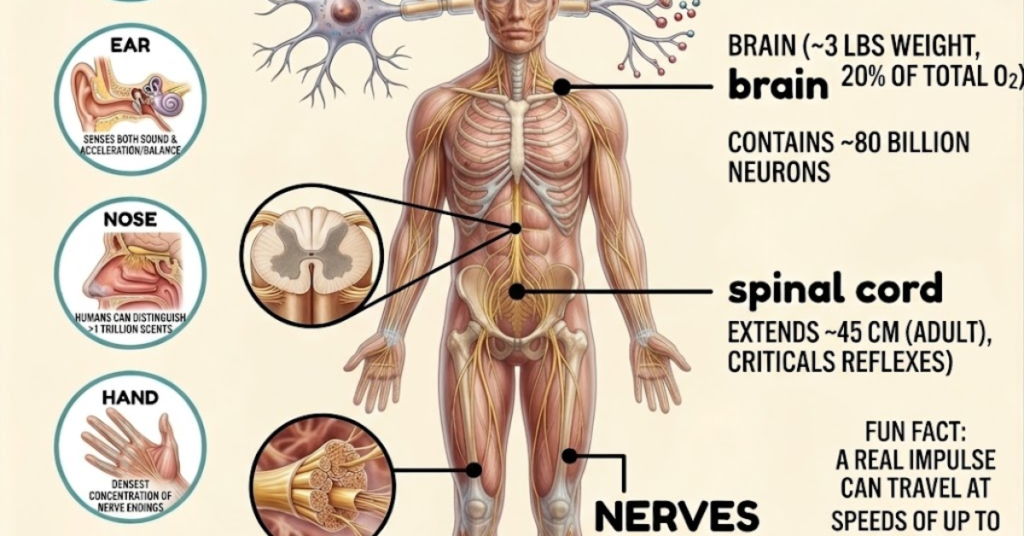
- The average adult brain weighs about 3 pounds (1.4 kg) light, but responsible for almost everything you do.
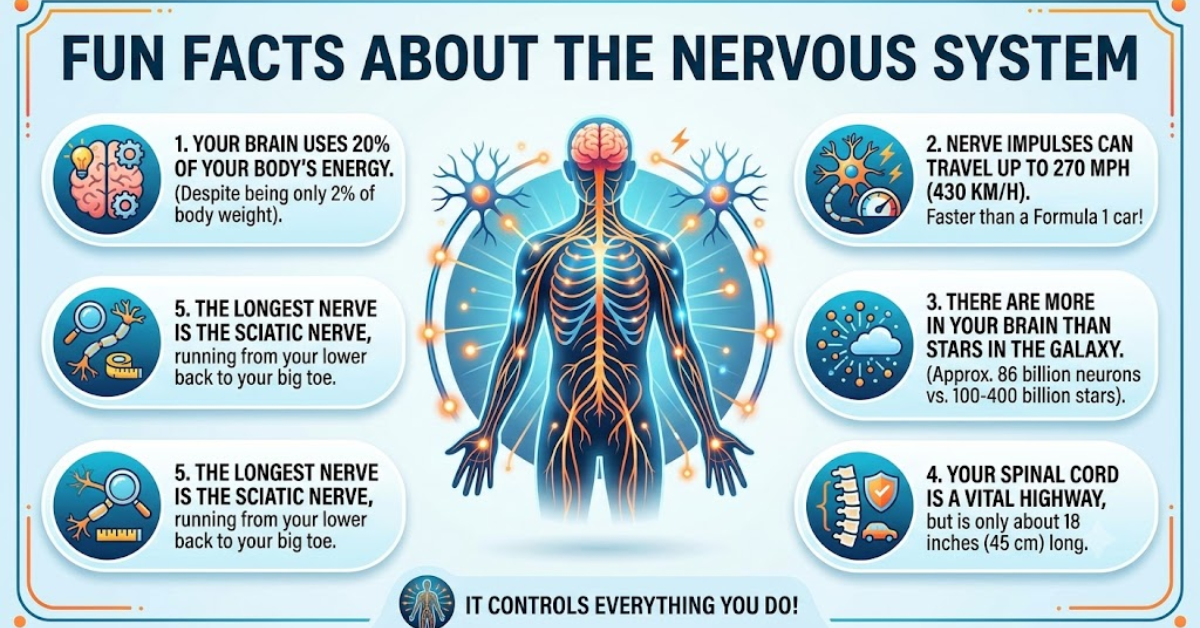
- The brain uses roughly 20% of the body’s resting energy despite being only about 2% of body weight, because neurons fire constantly even at rest.
- Brain tissue itself lacks pain receptors, though surrounding structures like the meninges and blood vessels can generate pain which is why some brain surgeries can be done while a patient is awake.
- The brain stays active during sleep, consolidating memories and clearing metabolic waste rather than shutting down.
- The cerebrum the brain’s largest structure handles thought, voluntary movement, and sensory processing.
Interesting Neuron Facts
- Neurons contain a cell body, branching dendrites, and an axon each part plays a distinct role in sending and receiving signals, similar to a mailroom, an inbox, and an outgoing mail chute.
- Many axons are wrapped in myelin, a fatty coating that dramatically speeds up signal conduction nerves with damaged myelin, as in multiple sclerosis, transmit signals more slowly or unreliably.
- Some myelinated fibers conduct signals at roughly 120 m/s (about 268 mph) faster than a Formula 1 car while unmyelinated fibers conduct far more slowly.
- Neurons pass signals across tiny gaps called synapses using chemical messengers called neurotransmitters.
- A single neuron can form thousands of synaptic connections, though the exact number varies by neuron type and brain region.
Fascinating Nerve Facts
- Humans have 12 pairs of cranial nerves and 31 pairs of spinal nerves 43 major pairs that then branch into many smaller nerves throughout the body.
- Cranial nerves connect directly to the brain and control functions like vision, smell, and facial movement.
- Spinal nerves branch from the spinal cord to carry signals to the trunk and limbs.
- Sensory nerves carry information toward the brain; motor nerves carry instructions back out to muscles.
- Nerve signals are both electrical (within a neuron) and chemical (between neurons) a hybrid system unlike most man-made networks.
Spinal Cord Facts
- The spinal cord is about 18 inches (45 cm) long in adults.
- It’s protected by the vertebrae, three layers of membrane called the meninges, and a cushioning layer of cerebrospinal fluid.
- The spinal cord can trigger some reflexes on its own, without waiting for the brain to finish processing the signal a shortcut that can save precious milliseconds in a dangerous situation.
- Spinal cord injuries can disrupt communication between the brain and everything below the injury site, which is why rapid treatment matters the sooner pressure or swelling is addressed, the better the odds for recovery.
- The spinal cord isn’t just a cable it also does real signal processing, not just relaying.
Nervous System Facts About Your Senses
- Vision is processed mainly in the occipital lobe, at the back of the brain.
- Hearing is processed in the temporal lobe, alongside language comprehension.
- Smell has a comparatively short pathway to emotion-related brain regions, which may explain why certain scents trigger strong memories more powerfully than sights or sounds do.
- Taste and smell work together closely, which is part of why food seems to lose flavor when your nose is blocked most of what we call “taste” is actually smell.
- Touch and spatial awareness are processed mainly in the parietal lobe.
Surprising Reflex and Movement Facts
- Many simple reflexes like pulling your hand off a hot surface are processed largely by the spinal cord, allowing a faster reaction than waiting for full brain involvement.
- The brain typically still receives information about the stimulus, just slightly after the reflex has already occurred.
- Voluntary movement starts as a decision in the brain and travels through motor neurons to the muscles involved.
- Balance relies on the vestibular system in the inner ear feeding constant data to the brain.
- Reflex speed is one reason humans can react to danger before consciously recognizing what happened.
Sleep, Memory & Learning Facts
- The hippocampus plays a central role in converting short-term memories into long-term storage.
- Sleep supports memory consolidation and the clearance of metabolic waste from brain tissue.
- Learning can strengthen, weaken, or reorganize connections between neurons through a process called neuroplasticity.
- Neuroplasticity is strongest in childhood but continues throughout adulthood.
- Stress and emotion are processed partly through the amygdala, which is why fear can sharpen memory formation.
Autonomic Nervous System Facts
- The sympathetic nervous system triggers the “fight-or-flight” response, raising heart rate and alertness.
- The parasympathetic nervous system supports “rest-and-digest” functions, slowing heart rate and aiding digestion.
- The enteric nervous system, embedded in the gut wall, can regulate digestion largely independent of the brain earning it the nickname “second brain,” since it can trigger digestive movement even when signals from the brain are interrupted.
- The autonomic nervous system also regulates breathing rate and body temperature without conscious effort, which is why you don’t have to remember to breathe or sweat when you’re hot.
- These two branches sympathetic and parasympathetic generally work in opposition to keep the body in balance.

Nervous System by the Numbers
| Number | What It Represents |
| 3 lbs (1.4 kg) | Average adult brain weight |
| 86 billion | Estimated neurons in the human brain |
| 43 | Pairs of cranial and spinal nerves combined |
| 120 m/s | Approximate top speed of the fastest myelinated nerve fibers |
| 18 in (45 cm) | Approximate length of the adult spinal cord |
| 20% | Share of resting energy used by the brain |
How the Nervous System Works
| Division | Main Parts | Role |
| Central Nervous System (CNS) | Brain, spinal cord | Processes information, coordinates responses |
| Peripheral Nervous System (PNS) | Cranial nerves, spinal nerves | Connects the CNS to muscles, organs, and skin |
The brain and spinal cord work together rather than in a strict one-way chain the spinal cord also participates in some reflexes without requiring the brain to initiate the immediate response.
Signals move through this system as electrical impulses called action potentials, traveling along a neuron’s axon until they reach a synapse. There, chemical neurotransmitters carry the message across the gap to the next neuron, continuing the relay until it reaches muscles, organs, or the brain itself.
Neurotransmitters at a Glance
| Neurotransmitter | Main Role |
| Dopamine | Motivation, reward, movement |
| Serotonin | Mood regulation, sleep |
| Acetylcholine | Muscle activation, memory |
| GABA | Calms neural activity |
Nervous System Fact Check: Myths vs. Facts
| Claim | Verdict | Why |
| We only use 10% of our brain | Myth | Brain imaging shows activity distributed across nearly the entire brain |
| All nerve signals travel at the same speed | Myth | Speed varies significantly by fiber type and myelination |
| Reflexes always require conscious thought first | Myth | Many simple reflex pathways operate mainly through the spinal cord |
| Brain size determines intelligence | Myth | Neural connectivity and efficiency matter more than raw size |
| The brain can’t feel pain | Partly true | Brain tissue itself has no pain receptors, but surrounding structures can |
Common Nervous System Disorders
Briefly, common conditions include Parkinson’s disease, Alzheimer’s disease, epilepsy, multiple sclerosis, stroke, and peripheral neuropathy each involving disruption to how neurons or nerve pathways function.
Warning signs worth taking seriously include:
- Sudden numbness, tingling, or weakness, especially on one side of the body
- Persistent headaches or dizziness
- Noticeable changes in memory or concentration
- Difficulty with coordination or movement
This isn’t a diagnostic guide; anyone experiencing these symptoms should consult a medical professional.
How We Verify Nervous System Facts
We prioritize information from government health agencies, academic institutions, peer-reviewed research, and established anatomy and neuroscience references. Where a statistic varies across studies or depends on fiber type, age, or methodology such as nerve conduction speed or neuron connection counts we explain that context rather than presenting one number as universal. Facts are periodically reviewed and updated as new research or clarified guidance becomes available.
Nervous System Vocabulary Cheat Sheet
| Term | Simple Definition |
| Neuron | A specialized cell that transmits electrical and chemical signals |
| Synapse | The gap where one neuron passes a signal to the next |
| Myelin | A fatty coating that speeds up signal conduction along an axon |
| Action potential | The electrical impulse that travels along a neuron |
| Neurotransmitter | A chemical messenger that crosses a synapse |
| Neuroplasticity | The brain’s ability to form and reorganize neural connections |
| CNS | The brain and spinal cord together |
| PNS | The network of nerves connecting the CNS to the rest of the body |
Frequently Asked Questions About the Nervous System
What are some interesting facts about the nervous system?
The nervous system sends signals throughout the body at very high speeds. The human brain contains billions of nerve cells called neurons.
- What is the nervous system?
The nervous system is the body’s communication and control network. It helps the brain receive information, process it, and control body actions.
- What are the major components of the nervous system? How do they work?
The major components are the brain, spinal cord, and nerves. They work together to send and receive signals between the brain and the rest of the body.
- What is the nervous system and its influence on human behavior?
The nervous system controls how we think, feel, learn, react, and behave. It connects the brain with the body and responds to internal and external signals.
- What are the different functions of the nervous system?
Its main functions include sensing, processing information, controlling movement, regulating organs, and producing responses. It also supports memory, emotions, and learning.
Final Thoughts
The nervous system runs on a mix of speed, precision, and constant background coordination — from reflexes that beat conscious thought to a brain that never fully switches off. These facts only scratch the surface, but they show just how much engineering is packed into every signal your body sends.
Sources and References
- National Institute of Neurological Disorders and Stroke (NINDS) general nervous system structure, function, and disorder information
- NIH/NCBI neuroscience literature supports estimates such as the ~86 billion neuron figure and nerve conduction ranges
- Standard human anatomy and physiology references cranial/spinal nerve counts, spinal cord length, and structural facts
- Peer-reviewed neuroscience research on nerve conduction velocity supports the fiber-speed ranges cited above, which vary by myelination and fiber diameter
This article is for educational purposes and isn’t a substitute for professional medical advice.

Hi, I’m Benjamin, the person behind FactsAboutDog.com. 🐶
I’m passionate about dogs and love sharing interesting, fun, and educational facts about our furry friends. Through FactsAboutDog.com, I aim to make learning about dogs simple, enjoyable, and informative for dog lovers everywhere.
From amazing dog facts to breed information and fascinating animal knowledge, my goal is to help readers discover something new every day.
Explore the world of dogs with Benjamin at FactsAboutDog.com!