Fun Facts About Copper: 12 Surprising Truths You’ll Love
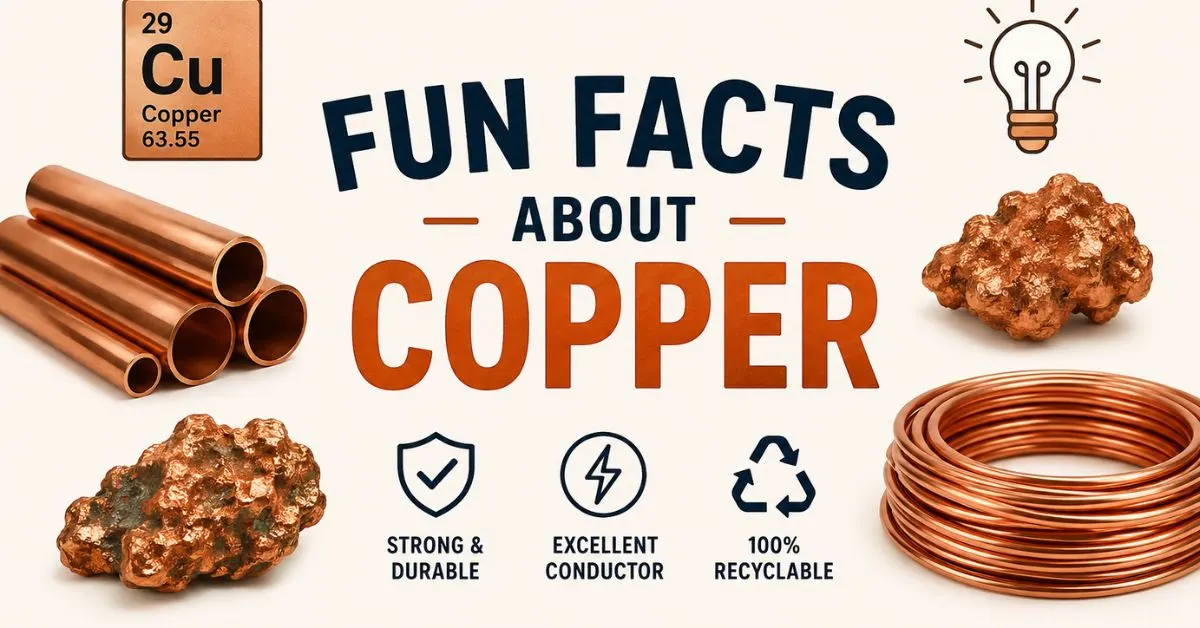
Copper is the reddish metal quietly running through your walls, your pocket change, and even your own bloodstream, and these fun facts about copper prove it’s far more fascinating than most people realize. I’ve spent hours digging through metallurgy archives and museum records, and copper still manages to surprise me every time. If you’ve ever wondered why an old penny feels different from a new one, this guide answers that and so much more.
From ancient Egyptian jewelry to NASA’s golden records drifting through deep space, copper’s story spans nearly every chapter of human history. This element, symbol Cu, atomic number 29, connects biology, engineering, and art in ways few metals ever manage, and each fact below traces back to real archaeological and scientific sources.
Fun Facts About Copper Humans Have Used It for 10,000+ Years
Long before written history, people were already shaping copper into tools, and that timeline stretches back further than most metals can claim. Archaeologists date the earliest copper use to roughly 8,000 to 10,000 years ago, making it genuinely one of humanity’s oldest worked materials.
The most famous evidence comes from Ötzi, the glacier mummy discovered in 1991, whose preserved axe was crafted from 99.7% pure copper. Ancient Egyptians considered the metal sacred, believing it carried magical properties, while Neolithic communities used copper tools as practical alternatives to stone implements.
Fun Facts About Copper Chemistry: An Elemental Introduction
Copper’s chemical symbol, Cu, comes from the Latin cuprum, itself rooted in Cyprium aes, meaning “metal from Cyprus,” where much ancient ore originated. With atomic number 29, this reddish element sits in Group 11 of the periodic table, prized for exceptional electrical and thermal conductivity.
Alongside gold, copper is one of only two metals with a naturally occurring color instead of silver or gray. It reacts with oxygen but resists water, forming a protective patina rather than corroding, which is exactly why ancient copper artifacts survive in remarkably good condition today.
Fun Facts About Copper and the Statue of Liberty
Lady Liberty wasn’t always green; when unveiled in 1886, her copper skin actually appeared dark brown, closer to a freshly minted penny than the mint-colored icon we recognize now. That transformation took decades of exposure to New York’s salty harbor air and rain.
By 1920, oxidation had fully coated the statue in copper carbonate, creating the iconic green patina that now protects roughly 80 tons of copper sheeting from further weathering. Far from weakening the structure, this thin coating actually shields the metal underneath from corrosion.
Fun Facts About Copper at Sea: Stopping Barnacles on Ship Hulls
Wooden ships once suffered constant damage from barnacles, mussels, and shipworms that slowed vessels and rotted hulls from within, a problem that plagued sailors for centuries. Copper sheathing solved this by proving naturally toxic to the invertebrates clinging to ship bottoms.
The Royal Navy pioneered copper-hulled ships in the 1750s, and the practice spread quickly across merchant fleets sailing warmer waters. The famous clipper ship Cutty Sark still displays its copper-sheathed hull today, a preserved reminder of this maritime engineering breakthrough.
Fun Facts About Copper: It’s Naturally Antibacterial
Copper doesn’t just conduct electricity efficiently; it actively kills bacteria, viruses, and fungi on contact through a process that damages microbial cell membranes and genetic material. This antimicrobial property has been documented and confirmed by modern laboratory research.
Hospitals now install copper surfaces on bed rails, doorknobs, and call buttons specifically to curb infection spread, with studies showing meaningfully fewer antibiotic-resistant infections in copper-equipped rooms. Even copper-infused socks have been used to combat foot fungus in real-world medical settings.
Fun Facts About Copper and the Final Frontier
In 1977, NASA launched two gold-plated copper phonograph records into deep space aboard the Voyager probes, intending them as a message for any future extraterrestrial encounter. These Golden Records carried images, natural sounds, and greetings in 55 languages.
Engineers chose copper specifically because the metal could preserve encoded data for potentially a billion years, far outlasting humanity itself. Today, these records remain the farthest human-made objects from Earth, drifting silently through interstellar space as a permanent time capsule.
Fun Facts About Copper Wires and the Electromagnet
In 1824, British scientist William Sturgeon wrapped bare copper wire around an iron horseshoe and ran current through it, creating the world’s first electromagnet and unknowingly launching an electrical revolution. That simple experiment reshaped modern technology entirely.
Copper’s high ductility and malleability let it stretch into thin wires without breaking, while its superior conductivity ensures minimal energy loss during transmission. This combination explains why copper wiring still dominates telegraphs, telephones, motors, generators, and household electronics today.
Fun Facts About Copper and the American Penny
The first American penny, designed by Benjamin Franklin in 1787, was minted entirely from copper and featured a cryptic sundial motto reading “Mind Your Business.” That early design set a precedent copper would hold for nearly two centuries.
Penny composition shifted repeatedly through history, eventually settling at 97.5% zinc with a thin copper coating after 1982. You can actually test which type you’re holding: flick it onto a hard surface a bright ring means real copper, while a dull thud signals modern zinc.
Fun Facts About Copper in Your Body
Copper isn’t just structural or electrical; it’s biologically essential, functioning as a trace mineral your body needs for forming red blood cells, nerve tissue, and connective collagen. Without adequate copper, several core metabolic processes simply can’t function properly.
The World Health Organization recommends roughly 1.3 milligrams of copper daily, easily met through foods like nuts, seeds, chickpeas, liver, and oysters. Your heart, thyroid, and nervous system all quietly depend on this mineral, making copper deficiency a genuine, if uncommon, health concern.
Fun Facts About Copper It’s in Virtually All Gold Products
Pure gold is famously soft, closer in firmness to a stick of butter than a durable metal, which is precisely why jewelers rarely use it alone. Even 24-karat gold products typically contain a small percentage of copper for structural strength.
This blending isn’t a shortcut; it’s a necessity, since copper and silver remain the only metals strong enough to stand entirely on their own without alloying. Interestingly, mixing gold with copper was actually banned across parts of Europe until the 19th century.
Fast Fun Facts About Copper
Beyond the headline stories, copper carries a stack of standalone statistics worth knowing on their own. It ranks as the third most-consumed industrial metal worldwide, trailing only iron and aluminum in global demand and production.
Copper’s electrical conductance trails only silver among all known metals, and roughly three-quarters of mined copper becomes wiring, cables, or electronics. Fully recyclable without any quality loss, copper can theoretically be reused indefinitely across countless future products.
Fun Facts About Copper Alloys: From Metals to Trumpets
When copper blends with tin, it forms bronze, a discovery made around 2900 BC that literally launched the Bronze Age and transformed early agriculture, warfare, and city-building. Combined with zinc instead, copper produces brass, prized for its gold-like shine.
Brass didn’t just decorate jewelry and coins; it revolutionized music through instruments like the trumpet, with metal horns dating back to 1500 BC. From Louis Armstrong’s jazz to modern orchestras, copper alloys have literally shaped the sound of human culture.
Comparison Table: Copper Alloys and Their Signature Uses
| Alloy | Copper Combined With | Best Known For |
| Bronze | Tin | Statues, medals, ship fittings, ancient tools |
| Brass | Zinc | Trumpets, doorknobs, decorative fixtures |
| Cupronickel | Nickel | Coinage, marine hardware |
| Muntz Metal | Zinc (higher ratio) | Historic ship hull sheathing |
FAQ Section
How long has copper been used by humans? Copper has been used for at least 8,000 to 10,000 years, with evidence including Ötzi the Iceman’s copper axe and Neolithic tools dating back to roughly 8,000 BC, making it one of the oldest worked metals in human history.
Why did the Statue of Liberty turn green? The statue’s copper skin reacted with oxygen and moisture over decades, forming a protective patina called copper carbonate. This oxidation process completed by 1920, permanently shifting the statue from brown to its now-iconic green color.
Is copper actually antibacterial? Yes. Copper surfaces disrupt bacterial and viral cell membranes on contact, a property confirmed in medical research. Hospitals use copper-coated surfaces on bed rails and doorknobs to measurably reduce infection rates in high-touch areas.
What is copper used for today? Copper’s primary modern use is electrical wiring and electronics, thanks to its excellent conductivity, but it also appears in plumbing, coinage, medical devices, antimicrobial surfaces, and alloys like bronze and brass.
Does the human body need copper? Yes. Copper is an essential trace mineral required for forming red blood cells, supporting nerve function, and maintaining collagen. Foods like nuts, seeds, oysters, and chickpeas provide the roughly 1.3 mg recommended daily.
Why do pennies contain so little copper today? Rising copper prices made pure-copper pennies too costly to produce. Since 1982, U.S. pennies have been made from 97.5% zinc with only a thin copper coating, though older pennies remain closer to pure copper.

Hi, I’m Benjamin, the person behind FactsAboutDog.com. 🐶
I’m passionate about dogs and love sharing interesting, fun, and educational facts about our furry friends. Through FactsAboutDog.com, I aim to make learning about dogs simple, enjoyable, and informative for dog lovers everywhere.
From amazing dog facts to breed information and fascinating animal knowledge, my goal is to help readers discover something new every day.
Explore the world of dogs with Benjamin at FactsAboutDog.com!