
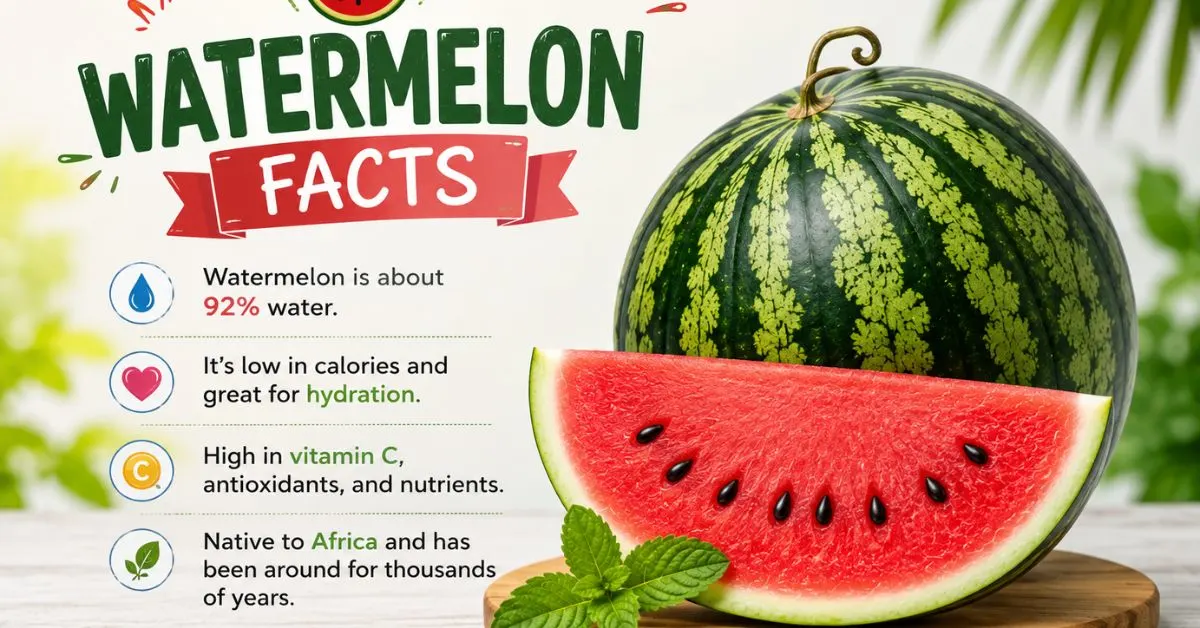
Watermelon Facts: 30 Fun, Surprising, and Science-Backed Truths
Is watermelon a fruit or a vegetable? Both, actually and that’s just the beginning of the watermelon facts that surprise most people. I grew up on a small backyard patch of these vines, and every summer I learn something new about this juicy, 92%-water treasure. If you’ve ever wondered how a picnic staple ended up tied to Egyptian tombs, square Japanese farms, and Oklahoma politics, you’re in the right place. This guide answers it all, straight from the science and the source.
Watermelon nutrition, watermelon history, and watermelon varieties all intersect in one oddly fascinating fruit. Botanists, farmers, and dietitians each see it differently, and that’s part of the charm. We’ll walk through the lycopene content, the seedless-watermelon myths, and the record-breaking melons that make headlines. By the end, you’ll have real, memorable watermelon facts worth sharing at your next cookout.
Watermelon Facts: Is It a Fruit or a Vegetable?
Here’s one of the most debated watermelon facts: botanically, watermelon is a fruit because it grows from a pollinated flower and carries seeds, just like a tomato or pepper. Yet agriculturally, it behaves like a vegetable, planted and harvested using vegetable production systems in the cucurbit family.
That’s why Merriam-Webster’s vegetable definition technically applies too. Watermelon belongs to Cucurbitaceae, related to cucumbers, squash, and pumpkins. So whichever camp you land in, science backs you watermelon truly straddles both categories depending on the lens you use.
Watermelon Facts: Why It’s Called “Water”melon
Among the simplest watermelon facts is also the most literal: this fruit is roughly 91–92% water, making it one of the most hydrating foods you can eat. That water content explains the refreshing crunch and why it’s a summer cookout favorite nationwide.
This high water content also keeps calories lowabout 46 per cupwhile still delivering natural sugars, fiber, and electrolytes. Nutritionally, watermelon behaves like a hydration source and a light snack rolled into one juicy package.
Watermelon Facts: You Can Eat the Entire Fruit
Most people toss the rind, but one of the lesser-known watermelon facts is that the whole fruit is edible. The rind is often stir-fried or pickled, especially across the American South and China, while the seeds get dried and roasted into a crunchy snack.
This zero-waste angle matters more than people realizeroughly 70% of a watermelon is flesh and 30% is rind, and none of it needs to go in the trash. Try pickling rind or roasting seeds before composting them next time.
Watermelon Facts: Over 1,200 Varieties Exist
Among the more surprising watermelon facts: there are over 1,200 varieties grown across 96 countries, with more than 300 cultivated in the U.S. and South America alone. They range from classic seeded picnic melons to compact icebox minis and cream-fleshed novelties.
| Variety | Typical Weight | Key Trait |
| Seeded (Picnic) | 15–45 lb | Classic deep-red flesh |
| Seedless | 10–25 lb | ~85% of U.S. sales |
| Mini/Icebox | 1–7 lb | Personal-size, thin rind |
| Yellow & Orange | 10–30 lb | Lacks lycopene pigment |
Crimson Sweet remains a favorite for its deep red flesh, while the Golden Midget turns yellow when ripe and the Cream of Saskatchewan offers pale, cream-colored flesh instead of the usual red.
Watermelon Facts: Seedless Watermelons Aren’t Genetically Modified
A persistent myth debunked by real watermelon facts: seedless watermelons are not GMOs. They’re created through hybridizationcrossing a diploid plant with a tetraploid one to produce a sterile triploid seed, similar to how a mule results from crossing a horse and donkey.
Today, seedless varieties make up around 85–90% of U.S. sales because shoppers prefer convenience. The natural cross-breeding process took decades of agricultural refinement, not laboratory gene-editing, to reach the sweet, crisp seedless melons found in stores today.
White Seeds in Seedless Watermelon
Those small white flecks in a “seedless” slice aren’t seeds at allthey’re empty seed coats where a seed never fully matured. They’re completely safe to swallow, contrary to old backyard warnings about seeds sprouting in your stomach.
Watermelon Facts: They Can Grow Incredibly Large
Among the wildest watermelon facts on record: the heaviest watermelon ever grown weighed 350.5 pounds, cultivated by Christopher Kent of Sevierville, Tennessee, in 2013officially recognized by Guinness World Records as a Carolina Cross variety.
That’s roughly the weight of an NFL lineman packed into a single melon. Competitive growers still chase that record every season, using specialized soil, irrigation, and pollination techniques to push their vines toward record-breaking size year after year.
Watermelon Facts: Nutrition, Lycopene, and Health Benefits
Nutritionally rich watermelon facts reveal it’s the best fresh source of lycopene, an antioxidant linked to reduced cancer risk, cardiovascular protection, and eye healthactually outranking tomatoes in lycopene concentration per serving, according to nutrient data.
It’s also loaded with citrulline, an amino acid converted into arginine in the body, supporting nitric oxide production. One cup provides notable vitamin A and C, plus potassium, all for under 50 caloriesa genuinely nutrient-dense choice.
Lower Blood Pressure
Citrulline and arginine in watermelon support nitric oxide production, which relaxes blood vessels and may reduce blood pressure. Supplementing with watermelon or its juice has shown measurable reductions in arterial stiffness among people with elevated blood pressure in clinical research.
Reduced Muscle Soreness After Exercise
Watermelon juice has been shown in studies to ease muscle soreness following intense exercise, thanks largely to its citrulline content. Athletes increasingly use it as a natural recovery drink, though perform

Hi, I’m Benjamin, the person behind FactsAboutDog.com. 🐶
I’m passionate about dogs and love sharing interesting, fun, and educational facts about our furry friends. Through FactsAboutDog.com, I aim to make learning about dogs simple, enjoyable, and informative for dog lovers everywhere.
From amazing dog facts to breed information and fascinating animal knowledge, my goal is to help readers discover something new every day.
Explore the world of dogs with Benjamin at FactsAboutDog.com!