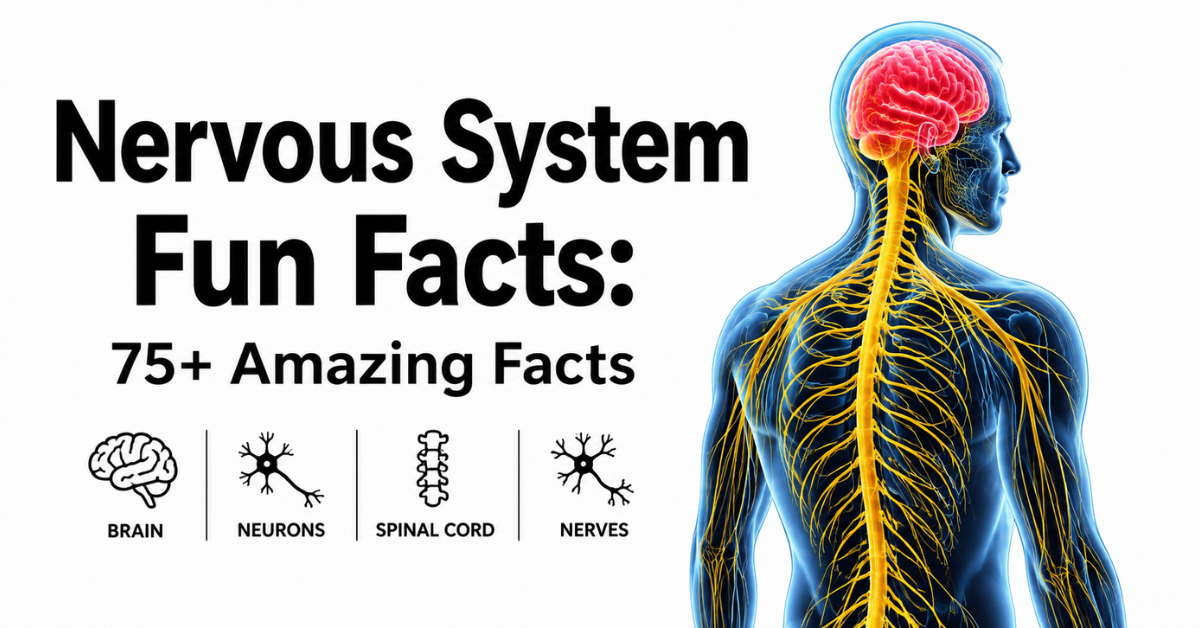
Nervous System Fun Facts: 75+ Amazing Facts
The human nervous system is one of the most complex and fascinating parts of the body. It controls movement, senses, thoughts, emotions, memory, and many functions that happen without conscious effort. From the brain and spinal cord to billions of neurons working together, this incredible network sends signals throughout the body in remarkably short periods.
Learning nervous system facts can reveal surprising details about how we react, learn, sleep, and interact with the world around us. In this guide, you’ll discover fascinating facts about the brain, spinal cord, and nervous system while exploring how nerve signals travel and connect different parts of the body. These fun facts make neuroscience easy to understand and interesting for readers of all ages.
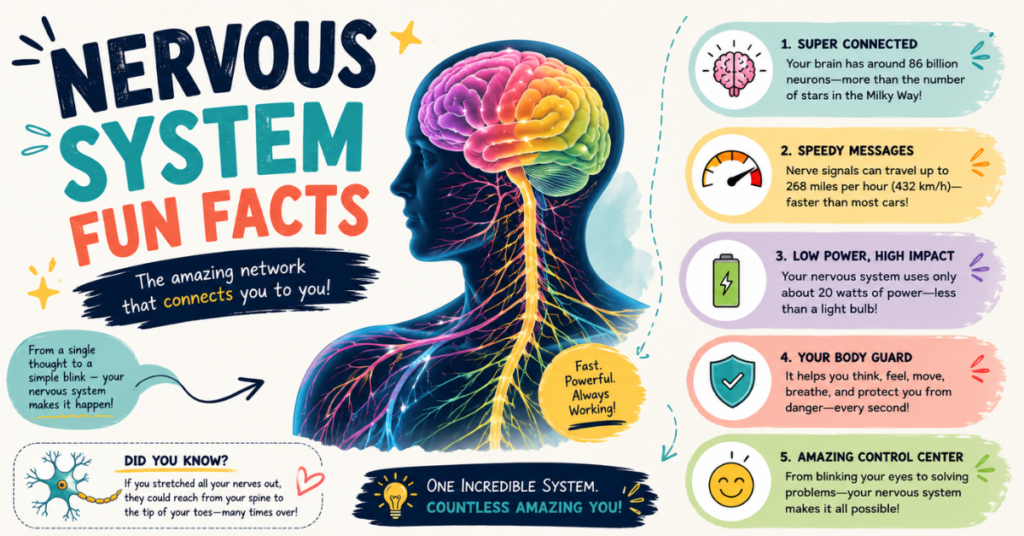
Quick Nervous System Facts at a Glance
| Fact | Number |
| Neurons in the human brain | ~86 billion |
| Total length of nerve fibers in the body | Roughly 45 miles (72 km) |
| Fastest nerve signal speed | Up to 120 meters/second (268 mph) |
| Pairs of cranial nerves | 12 |
| Pairs of spinal nerves | 31 |
| Percentage of body energy the brain uses | About 20% |
| Longest nerve in the body | Sciatic nerve |
| Time for a reflex arc to fire | As little as 0.1 seconds |
What Is the Nervous System?
The nervous system is the body’s built-in communication and control network.
- It’s made of specialized cells called neurons and support cells called glial cells.
- It collects information from the environment, processes it, and triggers a response.
- It works closely with the endocrine system, though nerve signals travel far faster than hormones.
- Nervous tissue first appeared in simple, worm-like organisms roughly 550–600 million years ago.
What Does the Nervous System Do?
- Senses the environment through sight, sound, touch, taste, and smell.
- Coordinates voluntary movement, from typing to sprinting.
- Regulates involuntary functions like heartbeat, digestion, and breathing.
- Stores and retrieves memories, and generates thought and emotion.
- Maintains homeostasis your body’s internal balance.
How the Nervous System Is Organized
| Division | Includes | Main Role |
| Central Nervous System (CNS) | Brain, spinal cord | Processing and decision-making |
| Peripheral Nervous System (PNS) | Nerves outside the CNS | Carrying signals to/from the body |
| Somatic | Skeletal muscles | Voluntary movement |
| Autonomic | Organs, glands | Involuntary regulation |
| Enteric | Digestive tract | Gut function |
Central Nervous System Facts
- The central nervous system (CNS) consists only of the brain and spinal cord.
- It’s protected by bone (skull and vertebrae), membranes called meninges, and cushioning cerebrospinal fluid.
- The CNS processes essentially all conscious thought and voluntary command.
- Unlike peripheral nerves, CNS tissue has very limited natural ability to repair itself after injury.
Peripheral Nervous System Facts
- The peripheral nervous system (PNS) includes every nerve outside the brain and spinal cord.
- It links the CNS to muscles, skin, and internal organs.
- The PNS splits into the somatic and autonomic nervous systems.
- Unlike the CNS, peripheral nerves can often regenerate slowly after damage.
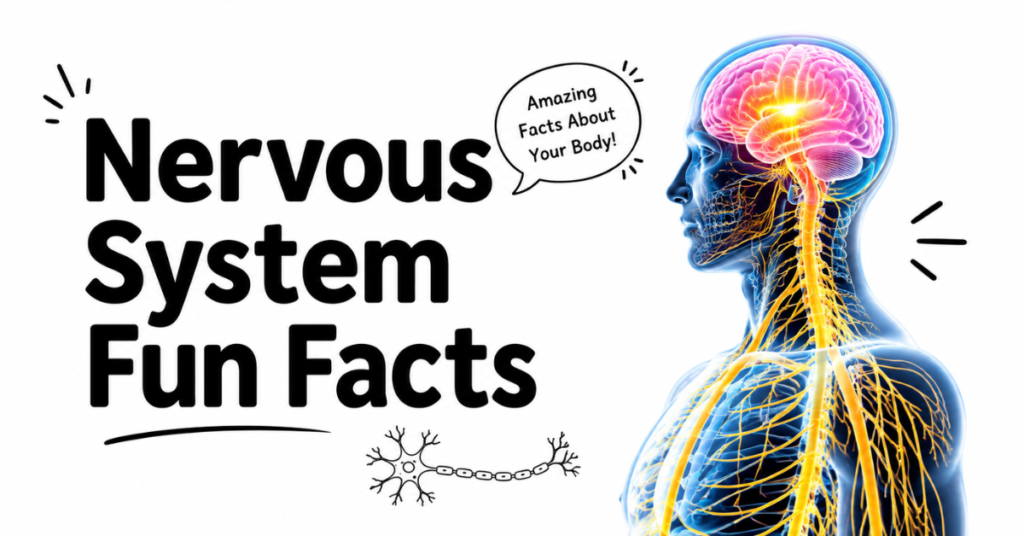
Somatic Nervous System Facts
- The somatic nervous system controls voluntary, conscious movements.
- It carries sensory information (touch, pain, temperature) from skin and muscles to the brain.
- Every deliberate action walking, writing, waving runs through this system.
- Skeletal muscle contractions are triggered directly by somatic motor neurons.
Autonomic Nervous System Facts
- The autonomic nervous system (ANS) runs functions you don’t consciously control.
- It regulates heart rate, digestion, breathing rate, and pupil size.
- The ANS has two main opposing branches: sympathetic and parasympathetic.
Sympathetic Nervous System Facts
- Known as the body’s “fight-or-flight” system.
- It speeds up heart rate, dilates pupils, and redirects blood flow to muscles.
- It’s activated instantly during stress, danger, or intense exercise.
- Adrenaline (epinephrine) is a key chemical messenger in this response.
Parasympathetic Nervous System Facts
- Known as the “rest-and-digest” system.
- It slows heart rate, stimulates digestion, and promotes recovery.
- The vagus nerve is its primary highway, reaching most major organs.
- It dominates during calm, restful states like sleep.
Enteric Nervous System Facts
- Often called the body’s “second brain.”
- Contains an estimated 100–600 million neurons lining the gut.
- Can operate digestion independently, even without input from the brain.
- Communicates directly with the brain via the gut-brain axis.
Brain Facts
- The average adult brain weighs about 3 pounds (1.4 kg).
- It uses roughly 20% of the body’s total energy despite being about 2% of body weight.
- The brain has no pain receptors of its own, which is why brain surgery can be done while a patient is awake.
- It’s about 73% water.
Spinal Cord Facts
- The spinal cord runs from the base of the brain to roughly the first lumbar vertebra.
- It’s about 18 inches (45 cm) long in adults.
- It relays signals between the brain and the rest of the body.
- Damage location along its length determines which body functions are affected.
Nerve Facts
- A nerve is a bundle of many individual nerve fibers (axons).
- Nerves can be sensory, motor, or mixed (carrying both signal types).
- If every nerve fiber in the body were laid end to end, the total would stretch roughly 45 miles.
- Some peripheral nerves can regenerate at about 1 millimeter per day after injury.
Neuron Facts
- The neuron is the basic functional unit of the nervous system.
- Each neuron has a cell body (soma), branching dendrites, and a long axon.
- Neurons don’t divide like most cells most you’re born with are the ones you keep.
- A single neuron can connect to thousands of other neurons.
How Many Neurons Are in the Human Brain?
- The brain contains an estimated 86 billion neurons.
- It also contains roughly the same number of non-neuronal (glial) cells.
- The spinal cord contains far fewer around 13.5 million neurons.
- That’s more brain cells than there are stars in the Milky Way galaxy.
Interesting Facts About Neuroglia and Glial Cells
- Glial cells support, protect, and nourish neurons.
- Some glial cells produce myelin, the insulating layer around axons.
- Others clear away waste, dead cells, and pathogens in nervous tissue.
- Glial cells also help regulate the chemical environment around neurons.
How Neurons Communicate With Each Other
- Neurons “talk” using a combination of electrical and chemical signals.
- An electrical signal travels down the axon to its tip.
- At the tip, it triggers the release of chemical messengers into a tiny gap.
- Those chemicals cross the gap and trigger a new signal in the next neuron.
Synapse Facts
- A synapse is the junction where one neuron communicates with another.
- The average human brain is estimated to contain over 100 trillion synapses.
- Synaptic transmission typically takes less than a millisecond.
- Synapses can strengthen or weaken over time the biological basis of learning.
Neurotransmitter Facts
- Neurotransmitters are chemical messengers released at synapses.
- Common examples include dopamine, serotonin, and acetylcholine.
- Dopamine plays a key role in motivation and reward.
- Imbalances in neurotransmitters are linked to several mood and neurological conditions.
Action Potential Facts
- An action potential is the electrical impulse that travels along a neuron.
- It’s triggered by the movement of sodium and potassium ions across the cell membrane.
- Action potentials follow an “all-or-nothing” rule they either fire fully or not at all.
- After firing, a neuron needs a brief recovery period before it can fire again.
Myelin and Myelination Facts
- Myelin is a fatty layer that insulates axons, similar to insulation on an electrical wire.
- It allows signals to jump between gaps called nodes of Ranvier, a process called saltatory conduction.
- Myelinated nerves can conduct signals up to 100 times faster than unmyelinated ones.
- Loss of myelin is a hallmark of conditions like multiple sclerosis.
How Fast Does the Nervous System Send Signals?
- Signal speed depends heavily on whether a fiber is myelinated.
- The fastest signals travel at roughly 100–120 meters per second (about 220–268 mph).
- Unmyelinated fibers can be over 100 times slower.
- Pain signals from a stubbed toe reach the brain in a fraction of a second.
Reflex Arc and Reflex Facts
- A reflex arc is a short neural pathway that triggers an automatic response.
- Many reflexes bypass the brain entirely, routing only through the spinal cord.
- This is why you pull your hand off a hot surface before you consciously register pain.
- The knee-jerk reflex is one of the most commonly tested reflex arcs.
Cranial Nerve Facts
- There are 12 pairs of cranial nerves, numbered I through XII.
- Most originate directly from the brain rather than the spinal cord.
- They control functions like smell, vision, eye movement, facial expression, and hearing.
- The vagus nerve (cranial nerve X) is the longest, reaching organs throughout the torso.
Longest Nerve in the Human Body
- The sciatic nerve is the longest and widest nerve in the human body.
- It runs from the lower spine through the hip and down each leg to the foot.
- It’s about as thick as a finger near its origin.
- Compression of this nerve causes the pain condition known as sciatica.
Spinal Nerve Facts
- There are 31 pairs of spinal nerves branching from the spinal cord.
- They’re grouped by region: cervical, thoracic, lumbar, sacral, and coccygeal.
- Each pair serves a specific area of the body, roughly like a segmented map.
- Spinal nerves carry both sensory and motor signals.
Sensory Nervous System Facts
- Sensory neurons carry information from the body toward the brain and spinal cord.
- They detect stimuli like light, sound, pressure, temperature, and chemicals.
- Specialized receptors exist for each sense for example, photoreceptors for vision.
- Sensory input is constantly filtered so the brain isn’t overwhelmed.
Motor Nervous System Facts
- Motor neurons carry commands from the brain and spinal cord to muscles.
- A single motor neuron can control anywhere from a few to thousands of muscle fibers.
- Fine motor tasks, like finger movements, use motor units with very few fibers per neuron.
- Motor neuron damage can lead to conditions such as ALS.
Touch and Pain Sensation Facts
- Skin contains multiple receptor types for touch, pressure, temperature, and pain.
- Every square centimeter of skin holds roughly 200 pain receptors.
- Fingertips and lips have some of the highest concentrations of touch receptors in the body.
- Pain signals can travel via both fast and slow nerve fiber pathways, which is why sharp pain often precedes a dull ache.
Vision and the Nervous System
- The optic nerve carries visual information from each eye to the brain.
- The visual cortex, at the back of the brain, processes this information into images.
- The eye’s retina contains over 100 million light-sensitive cells.
- Roughly a third of the brain’s cortex is involved in some aspect of visual processing.
Hearing and the Nervous System
- The auditory nerve (part of cranial nerve VIII) carries sound signals from the inner ear.
- Tiny hair cells in the cochlea convert sound vibrations into electrical signals.
- The brain calculates the direction of a sound using tiny timing differences between the ears.
- Hearing loss often results from damage to these hair cells, which don’t regenerate in humans.
Smell and the Nervous System
- Smell is detected by receptors in the nasal cavity connected to the olfactory nerve.
- It’s the only sense with a direct pathway to the brain’s memory and emotion centers.
- This is part of why certain smells trigger vivid memories.
- Humans can distinguish an estimated 1 trillion different odors, according to some studies.
Taste and the Nervous System
- Taste buds detect five basic tastes: sweet, salty, sour, bitter, and umami.
- Signals travel to the brain via several cranial nerves, not just one.
- Taste and smell work together closely, which is why food seems bland with a blocked nose.
- Taste bud cells are replaced roughly every 1–2 weeks.
Balance and Coordination Facts
- The cerebellum is the brain’s main center for balance and coordination.
- The inner ear’s vestibular system detects head position and motion.
- Balance relies on combined input from the eyes, inner ear, and muscles/joints.
- Damage to the cerebellum can cause unsteady movement even with normal muscle strength.
How the Nervous System Controls Movement
- The motor cortex plans and initiates voluntary movement.
- Signals travel down the spinal cord to motor neurons controlling specific muscles.
- The cerebellum fine-tunes movement for smoothness and accuracy.
- The basal ganglia help regulate movement initiation and suppress unwanted motion.
How the Nervous System Controls the Heart
- The autonomic nervous system adjusts heart rate without conscious effort.
- The sympathetic branch speeds the heart up; the parasympathetic branch slows it down.
- The vagus nerve is the primary parasympathetic connection to the heart.
- This balance adjusts constantly based on activity, stress, and even breathing pattern.
How the Nervous System Controls Breathing
- Breathing rate is primarily controlled by the medulla oblongata in the brainstem.
- It’s largely automatic but can be consciously overridden, like holding your breath.
- Chemical sensors detect carbon dioxide levels and adjust breathing rate accordingly.
- This is why breathing speeds up automatically during exercise, before you consciously notice.
Nervous System and Digestion Facts
- The enteric nervous system can regulate digestion independently of the brain.
- The vagus nerve provides a major communication link between gut and brain.
- Stress can measurably slow or disrupt digestive function via nervous system signals.
- The gut contains more neurons than the spinal cord.
Nervous System and Sleep Facts
- Sleep is regulated by specific brain regions, including the hypothalamus.
- The parasympathetic nervous system becomes more active during rest.
- Even during deep sleep, the nervous system keeps regulating breathing and heart rate.
- The brain remains highly active during REM sleep, the stage most linked to dreaming.
Nervous System and Memory Facts
- The hippocampus plays a central role in forming new memories.
- Memory formation strengthens specific synaptic connections between neurons.
- Repetition and emotional significance both make memories more likely to stick.
- Different memory types (short-term, long-term, procedural) rely on different brain circuits.
Nervous System Facts About Emotions
- The amygdala plays a key role in processing fear and emotional responses.
- Emotional reactions can occur faster than conscious thought, especially with threats.
- The limbic system is the broader brain network involved in emotion regulation.
- Chronic stress can physically alter nervous system structure and function over time.
Nervous System Facts in Babies and Children
- A newborn’s brain already contains close to its full adult number of neurons.
- Myelination continues well into a child’s early adult years, especially in the frontal lobe.
- Infant reflexes, like grasping and rooting, are present from birth and fade over time.
- Early childhood is a critical period for forming synaptic connections through experience.
Nervous System Facts About Animals
- Nervous system complexity varies enormously across species.
- Simple animals like jellyfish have a diffuse nerve net instead of a centralized brain.
- Octopuses have a highly distributed nervous system, with most neurons in their arms.
- African elephants have an estimated 250–300 billion neurons, more than humans.
How Human and Animal Nervous Systems Differ
| Feature | Humans | Many Animals |
| Neuron count | ~86 billion | Varies widely (few cells to 250+ billion) |
| Brain structure | Highly developed cortex | Ranges from none to complex |
| Reflexes | Present, brain-independent | Present in nearly all species |
| Regeneration | Very limited in CNS | Some species regenerate CNS tissue |
The Most Surprising Nervous System Facts
- Your brain has no dedicated pain receptors, despite controlling all pain perception elsewhere.
- Some reflexes fire and complete before your brain even registers the stimulus.
- Nerve signal speed rivals highway traffic up to 268 mph in myelinated fibers.
- The enteric nervous system can function almost independently of brain input.
Weird but True Nervous System Facts
- You can “feel” a limb that’s no longer there a phenomenon called phantom limb sensation.
- Yawning may be linked to regulating brain temperature, not just tiredness.
- Some peripheral nerves can regrow after being severed, just very slowly.
- The brain can rewire itself throughout life, a trait called neuroplasticity.
Nervous System Facts About Speed and Reaction Time
- Average human reaction time to a simple visual stimulus is roughly 200–250 milliseconds.
- Reflexes that bypass the brain (spinal reflexes) are even faster, often under 100 milliseconds.
- Trained athletes can shave reaction time down through repeated practice, not faster nerves.
- Fatigue and distraction measurably slow nervous system reaction speed.
Nervous System Facts You May Not Know
- The nervous system develops from the same embryonic tissue as skin.
- Multiple sclerosis specifically damages the myelin sheath, disrupting signal speed.
- The brain generates enough electrical activity to be measured externally via EEG.
- Some nerve pathways can be “rerouted” after injury through neuroplasticity-based rehabilitation.
Frequently Asked Questions About the Nervous System
What are some interesting facts about the nervous system?
The nervous system controls movement, senses, thoughts, memory, emotions, and many automatic body functions.
What are some surprising facts about how the brain works?
The brain can constantly change and form new neural connections through neuroplasticity, allowing us to learn and adapt.
Why is the nervous system the most important?
It connects and coordinates the body, controlling essential functions such as movement, breathing, sensation, and thinking.
What are some interesting facts a neurologist knows?
Different brain regions have specialized jobs, such as memory, movement, balance, and language, while the spinal cord also controls many reflexes.
What is the rarest and most interesting fact about the human brain?
One fascinating fact is that the brain can reorganize its connections throughout life, helping us learn new skills and adapt to changes.
Final Thoughts on Nervous System Fun Facts
The nervous system is proof that biology can out-engineer technology. Billions of neurons, trillions of synapses, and signals racing at highway speeds all work together every second to keep you moving, thinking, and feeling. From reflexes that outrun conscious thought to a gut that runs its own show, this network deserves its reputation as the most complex system in the human body and hopefully, these facts gave you a new appreciation for the one running inside you right now.

Hi, I’m Benjamin, the person behind FactsAboutDog.com. 🐶
I’m passionate about dogs and love sharing interesting, fun, and educational facts about our furry friends. Through FactsAboutDog.com, I aim to make learning about dogs simple, enjoyable, and informative for dog lovers everywhere.
From amazing dog facts to breed information and fascinating animal knowledge, my goal is to help readers discover something new every day.
Explore the world of dogs with Benjamin at FactsAboutDog.com!