35 Fun Facts About Summer You Never Knew
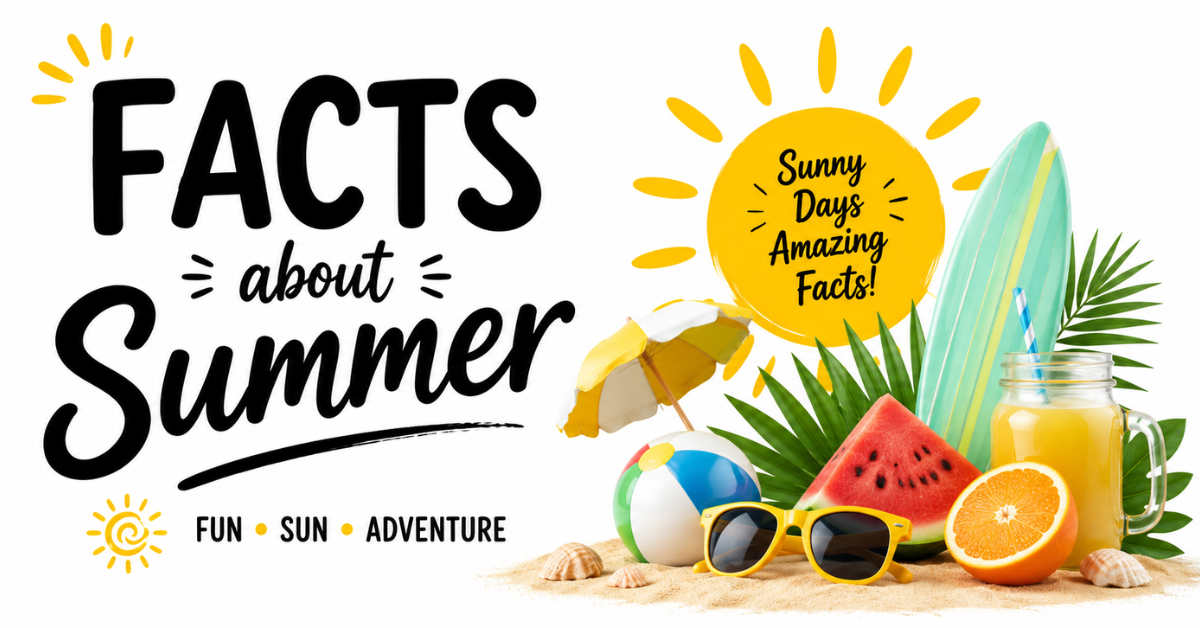
Summer is one of the most exciting seasons of the year, bringing longer days, warmer temperatures, vacations, and plenty of outdoor fun. But beyond beach trips and ice cream, summer is filled with fascinating science facts, unusual traditions, and surprising natural events. From the reason we experience longer daylight to the way animals adapt to rising temperatures, there is much more to this season than meets the eye.
In this guide, you’ll discover interesting facts about summer, including its history, weather, solstice, wildlife, and cultural traditions. Whether you love sunny days or simply enjoy learning something new, these fun and surprising summer facts will give you a fresh perspective on the season.
Quick Summary: Summer at a Glance
| Category | Fact |
| Astronomical dates (Northern Hemisphere) | June 20/21 – September 22/23 |
| Meteorological dates | June 1 – August 31 |
| Cause of summer heat | Earth’s axial tilt, not distance from the sun |
| Hottest temperature ever recorded | 134°F (56.7°C), Death Valley, 1913 |
| Longest day of the year | The summer solstice |
| National Ice Cream Month (US) | July |
1. Summer Isn’t Caused by Earth Being Closer to the Sun
It feels logical to assume summer happens because Earth moves nearer the sun but the opposite is true. In the Northern Hemisphere, Earth is actually farther from the sun during summer. The real cause is axial tilt: as Earth orbits, its 23.5-degree tilt points the Northern Hemisphere more directly toward the sun, concentrating sunlight and driving up temperatures.
2. July Is National Ice Cream Month
Ice cream and summer go hand in hand, and in the United States, that pairing is official. President Ronald Reagan declared July National Ice Cream Month in 1984, along with the third Sunday of the month as National Ice Cream Day. It’s one of the more delicious examples of a seasonal tradition turning into federal recognition.
3. Watermelon Is Technically a Vegetable
One of the most-shared fun facts about summer is also one of the most surprising: watermelon is botanically classified as a vegetable, not a fruit. It belongs to the same family as cucumbers and squash (Cucurbitaceae), and its growth pattern and plant structure line up with vegetables rather than typical fruit.
4. The Eiffel Tower Grows in Summer Heat
Thermal expansion is a real engineering phenomenon, and the Eiffel Tower is one of its most famous examples. During peak summer temperatures, the tower’s iron structure expands and the landmark grows by roughly six inches. The side facing direct sun can even lean away from it by several inches due to uneven heating.
5. The Hottest Temperature Ever Recorded Was 134°F
Death Valley, California, holds the record for the highest reliably measured air temperature on Earth: 134°F (56.7°C), recorded in July 1913. It’s a stark reminder of just how extreme summer heat can get in the right (or wrong) conditions.
6. You Can See the Sun at Midnight in the Arctic Circle
Inside the Arctic Circle, summer brings a phenomenon called the midnight sun. For weeks at a time, the sun never fully sets, staying visible even at midnight. This happens because of Earth’s tilt and the region’s high latitude, which keeps the sun above the horizon around the clock during peak summer months.
7. Manhattanhenge Lights Up New York Twice a Year
New York City has its own solar spectacle known as Manhattanhenge, when the setting sun aligns perfectly with the city’s east-west street grid. It happens twice a year, typically in late May and mid-July, drawing crowds who gather to watch the sun frame the skyline like a corridor of light.
8. The Longest Day and Shortest Day Share the Same Length
Here’s a fact that trips people up: the summer solstice (the longest day of the year) and the winter solstice (the shortest day) are both, technically, 24 hours long. What changes isn’t the length of the day itself, but the number of daylight hours packed into it.
9. The First Summer Olympics Were Held in 776 BC
Long before broadcast rights and opening ceremonies, the ancient Olympic Games began in Olympia, Greece, in 776 BC. These early competitions were held during the summer and included events like foot races and wrestling a tradition that eventually evolved into the modern Summer Olympics.
10. The “Dog Days of Summer” Come From the Stars, Not Dogs
The phrase “dog days of summer” doesn’t refer to panting pets. It comes from ancient astronomy: the term marks the period when Sirius, known as the “Dog Star,” rises and sets alongside the sun typically between early July and mid-August. Ancient civilizations associated this stretch with the year’s most intense heat.
11. Thunderstorms Peak During Summer Months
It might seem like a winter phenomenon, but thunderstorms are actually far more common in summer than any other season. Warm, humid air rises quickly and forms the towering clouds needed to generate thunder and lightning conditions that summer heat produces in abundance.
12. Sunflowers Track the Sun’s Movement
Young sunflowers exhibit a behavior called heliotropism, turning their heads to follow the sun from east to west throughout the day. Once mature, most sunflowers settle into a fixed east-facing position, but the tracking behavior in younger plants remains one of nature’s more visible summer phenomena.
13. Bioluminescent Plankton Make Beaches Glow
In certain coastal regions, summer nights bring a glowing tide. Blooms of bioluminescent plankton emit light when disturbed by waves or movement, making the shoreline appear to sparkle blue in the dark. It’s a rare but real natural light show tied closely to warm ocean temperatures.
14. Bees Are at Their Busiest in Summer
With flowers in full bloom, summer is peak pollination season. Bees work longer hours and travel farther distances to collect nectar and pollen, making this the most productive stretch of the year for hives and, by extension, for the crops and gardens that depend on pollinators.
15. Sunlight Helps the Body Produce Vitamin D
Extended daylight hours in summer aren’t just good for outdoor plans they support vitamin D production. When skin is exposed to sunlight, the body synthesizes this essential nutrient, which plays a role in bone health and immune function.
Fast Facts Table: Summer by the Numbers
| Fun Fact | Detail |
| Ice cream tradition | National Ice Cream Month = July (US) |
| Eiffel Tower growth | ~6 inches taller in summer heat |
| Hottest recorded temp | 134°F, Death Valley (1913) |
| First Olympics | 776 BC, Olympia, Greece |
| Dog days of summer | Early July – mid-August |
| Watermelon water content | About 92% water |
Why These Facts Matter Beyond Trivia Night
Understanding the science behind summer from axial tilt to thermal expansion gives everyday observations a new layer of meaning. It also makes summer content genuinely useful for classrooms, parenting blogs, and general-knowledge readers, not just a list of disconnected trivia.
These facts also tie together several fields: astronomy explains the solstice and daylight hours, meteorology explains the thunderstorms, biology explains the bees and sunflowers, and engineering explains why a 130-year-old iron tower quietly grows every June.
Conclusion
Summer earns its reputation as the most anticipated season of the year, but there’s far more going on beneath the surface than sunburns and popsicles. From a midnight sun in the Arctic to a Parisian landmark that stretches in the heat, these fun facts about summer show how much science, history, and culture are packed into just a few warm months. Next time someone asks why summer feels so special, you’ll have more than one good answer ready.
Frequently Asked Questions
1. What are some interesting facts about the summer solstice?
The summer solstice is the longest day and shortest night of the year in the Northern Hemisphere. It happens when Earth’s North Pole is tilted most toward the Sun.
2. What do you think about summer?
Summer is a lively season known for warm weather, longer days, outdoor activities, vacations, beaches, and fresh seasonal fruits. It is also a great time for enjoying nature and spending time outdoors.
3. Why do summer and winter happen on Earth?
Summer and winter happen because Earth is tilted about 23.5° as it orbits the Sun. When a hemisphere tilts toward the Sun, it gets more direct sunlight and experiences summer; when it tilts away, it experiences winter.
4. What is the starting month of summer?
In the Northern Hemisphere, summer usually begins in June, while meteorological summer starts on June 1. Astronomical summer begins around June 20 or 21, depending on the year.
5. What are some things that represent summer?
Common symbols of summer include sunshine, beaches, ice cream, swimming, sunglasses, vacations, flowers, cold drinks, barbecues, and outdoor games.

Hi, I’m Benjamin, the person behind FactsAboutDog.com. 🐶
I’m passionate about dogs and love sharing interesting, fun, and educational facts about our furry friends. Through FactsAboutDog.com, I aim to make learning about dogs simple, enjoyable, and informative for dog lovers everywhere.
From amazing dog facts to breed information and fascinating animal knowledge, my goal is to help readers discover something new every day.
Explore the world of dogs with Benjamin at FactsAboutDog.com!