
Hoop Tea Nutrition Facts: Calories, Carbs & Sugar Explained
Hoop tea nutrition facts vary more than most drinkers realize, and that gap in the numbers is exactly why so many people search for clarity before cracking open a can. As someone who has spent years comparing spiked iced tea nutrition labels against what brands actually print on the can, I’ve learned that a flavored malt beverage rarely matches the “light and refreshing” marketing at first glance. If you’ve ever stood in a cooler aisle wondering whether Hoop Tea fits your carb count or your calorie goal, you’re not alone, and you deserve a straight answer.
This guide breaks down Hoop Tea’s calories, carbohydrates, sugar content, and alcohol by volume using the brand’s own published data, cross-checked against independent nutrition databases. You’ll also see where third-party sources disagree, so you can make an informed choice about this spiked iced tea instead of guessing. No fluff, no marketing spin just the nutrition facts, flavor by flavor, in plain language.
Hoop Tea Nutrition Facts
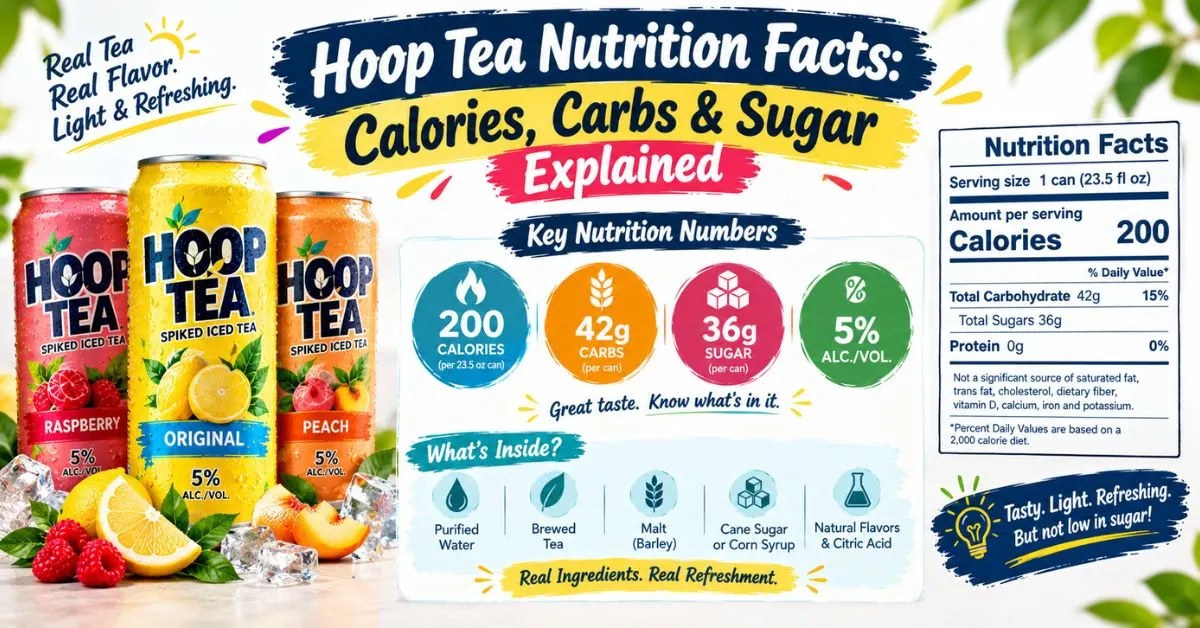
Hoop Tea nutrition facts differ by flavor, but the brand’s own average analysis, confirmed by independent nutrition-tracking databases, gives the clearest picture available. For a 12 fl oz Original Hoop Tea, expect 221 calories, 31.7 grams of carbohydrates, 0 grams of fat, and 0 grams of protein, at 5% alcohol by volume. These figures come straight from Hoop Tea’s own FAQ page rather than a secondhand estimate.
Lighter options exist across the lineup: Hoop Tea Light comes in at just 90 calories and 3.8 grams of carbohydrates, making it the leanest flavored malt beverage in the collection. Peach sits in the middle at 173 calories, while Mango and Watermelon land around 201 and 217 calories. Comparing the whole lineup side by side makes portion planning far easier than reading one can in isolation.
| Flavor | Calories (12 fl oz) | Carbohydrates | ABV |
| Original | 221 | 31.7 g | 5% |
| Mango | 201 | 26 g | 5% |
| Watermelon | 217 | 29.9 g | 5% |
| Peach | 173 | 19.1 g | 5% |
| Light | 90 | 3.8 g | 4% |
Calories
Calories in Hoop Tea come from two sources: the fermented malt base and the added cane sugar or corn syrup used for flavoring. Original Hoop Tea carries the highest calorie count in the lineup at 221 calories per can, largely because it uses the most sugar of any flavor. Hoop Tea Light strips much of that sweetening back, cutting calories by more than half.
Alcohol Content
Alcohol content across most Hoop Tea flavors sits at 5% ABV, which is roughly in line with a standard domestic beer and slightly below many canned cocktails. Hoop Tea Light is brewed slightly lower at 4% ABV. That alcohol content directly drives a meaningful share of the total calorie count in every flavor, since alcohol itself supplies roughly seven calories per gram.
Sugar Content
Sugar content is where flavors diverge the most within this spiked iced tea line. Cane sugar, corn syrup, and barley malt all contribute sweetness depending on the flavor, and Original carries noticeably more sugar than Peach or Light. Anyone managing blood sugar or simply cutting back should compare flavors carefully rather than assuming “iced tea” implies a low-sugar drink.
Carbohydrates
Carbohydrates in Hoop Tea track closely with sugar content, since almost all the carbs come from added sweeteners rather than fiber or starch. Original Hoop Tea’s 31.7 grams of carbohydrates is a significant number for anyone counting daily carb intake, while Light’s 3.8 grams is dramatically more moderate. Net carbs and total carbs are essentially identical here, since these beverages contain no dietary fiber.
Caffeine
Caffeine levels in Hoop Tea are modest, since the flavors use decaffeinated black or green tea rather than fully caffeinated brews. This keeps the drink closer to a traditional malt beverage in effect, without the stacked stimulant-plus-alcohol combination found in some energy-tea hybrids. Anyone sensitive to caffeine shouldn’t expect a noticeable jolt from this spiked iced tea.
Other Nutrients
Beyond calories, carbs, and sugar, Hoop Tea contributes essentially no protein, fat, fiber, or micronutrients worth tracking. It is not a source of vitamins or antioxidants in any meaningful amount, despite being brewed with real tea leaves. Treat it nutritionally as a flavored malt beverage first and a tea product a distant second.
Understanding Hoop Tea Spiked Iced Tea
Hoop Tea spiked iced tea blends a fermented malt base with real brewed tea and fruit flavoring, giving it a lighter, more sessionable profile than traditional beer. It was founded on the boardwalk in Ocean City, Maryland, by Danny Robinson and Billy Gilman, and the brand later partnered with Anheuser-Busch to scale distribution nationally. That backstory matters for nutrition purposes too, since it explains why the recipe leans on cane sugar and barley malt rather than distilled spirits.
Understanding this spiked iced tea category helps explain the nutrition numbers above: unlike a hard seltzer built on fermented cane sugar alone, Hoop Tea’s malt-and-tea base means gluten is present, and sweetness comes from multiple ingredients layered together. That combination is what pushes Original’s carbohydrate count noticeably higher than a typical hard seltzer, even though both categories market themselves as “light” alcoholic beverages.
Hoop Tea Sugar Content
Hoop Tea sugar content is the number most health-conscious drinkers ask about first, and it’s also where published figures disagree most. Some sources cite roughly 9 grams of sugar per can, while others cite closer to 19 grams for the same Original flavor, which is a meaningful difference for anyone tracking added sugar. Checking the actual can label in hand remains the most reliable way to resolve that gap for your specific batch.
Regardless of which figure applies, sugar in Hoop Tea comes from cane sugar, corn syrup, and barley malt rather than fruit juice, so it counts fully as added sugar under American Heart Association guidelines. Comparing flavors, Peach and Light consistently test lower in sugar than Original, Mango, or Watermelon. If lowering added sugar intake matters to you, those two flavors are the more sensible starting point.
Is Hoop Tea Healthy?
Is Hoop Tea healthy compared to other alcoholic beverages? Relative to a heavier craft beer or a sugary cocktail, Hoop Tea’s Light and Peach flavors are genuinely lower in calories and carbohydrates, which counts as a real advantage for moderation-minded drinkers. But “lower calorie” and “healthy” aren’t the same claim, and it’s worth being precise about which one actually applies here.
Hoop Tea still delivers meaningful alcohol, added sugar, and zero fiber, protein, or micronutrients in any flavor. Health considerations should weigh the alcohol itself, not just the calorie count on the can, since alcohol carries its own separate set of health guidance from federal dietary recommendations. Moderate consumption, awareness of ABV, and picking a lower-sugar flavor are the most useful levers available to a health-conscious drinker.
Hoop Tea Is Vegan and Does Not Contain Any Animal Products
Hoop Tea is vegan and does not contain any animal products, since its ingredient list relies on purified water, malt, cane sugar or corn syrup, natural flavors, citric acid, and brewed tea. No dairy, honey, gelatin, or animal-derived clarifying agents appear in the published ingredient lists across flavors. That makes it a straightforward option for vegan drinkers within the flavored malt beverage category.
Gluten is a separate consideration entirely, and it’s the more restrictive one for many drinkers. Because Hoop Tea is a malt beverage brewed from barley, it is not gluten-free, even though it is vegan-friendly. Anyone managing celiac disease or a gluten sensitivity should treat this as a hard no regardless of the vegan status.
It Is Important to Drink Responsibly and Never Drink and Drive
It is important to drink responsibly and never drink and drive when consuming any 5% ABV beverage like Hoop Tea, since its lighter taste can make people underestimate how much alcohol they’ve actually had. Pacing drinks, eating food alongside alcohol, and alternating with water are simple, well-supported habits that reduce risk during any gathering. These aren’t unique to Hoop Tea, but they matter more with a drink that’s marketed as light and easy-drinking.
Never getting behind the wheel after drinking, and having a plan for a safe ride home, remains the single most important piece of responsible-drinking guidance regardless of a beverage’s calorie count or flavor. Pregnant or breastfeeding individuals should avoid Hoop Tea entirely, since alcohol crosses the placenta and enters breast milk regardless of how “light” the can looks.
Bottom Line
Hoop Tea’s nutrition facts genuinely vary by flavor, and Original is not the same nutritional choice as Light or Peach. The brand’s own numbers put Original at 221 calories and 31.7 grams of carbohydrates, while Light drops to just 90 calories and 3.8 grams, a difference large enough to matter for anyone watching intake closely.
The bottom line for most drinkers: pick your flavor based on your actual nutrition goals rather than the “spiked iced tea” branding alone, check the can’s label against the numbers here since third-party sources disagree, and remember this is still an alcoholic beverage that deserves the same moderation as any other. Used thoughtfully, Hoop Tea can fit into a reasonably balanced approach to occasional drinking.
FAQs
How many calories are in Hoop Tea?
A 12 fl oz Original Hoop Tea contains 221 calories according to the brand’s own published nutrition data, though some third-party listings report lower figures closer to 130 calories, so checking your specific can’s label is the safest confirmation.
How many carbs are in Hoop Tea?
Original Hoop Tea has 31.7 grams of carbohydrates per 12 fl oz can, while Hoop Tea Light has only 3.8 grams, making Light the far more carb-friendly option in the lineup.
How much sugar is in Hoop Tea?
Sugar content is reported anywhere from about 9 to 19 grams per can depending on the source, all coming from added cane sugar, corn syrup, and barley malt rather than natural fruit sugar.
Is Hoop Tea gluten-free?
No, Hoop Tea is not gluten-free. It’s a malt beverage brewed from barley, so it should be avoided by anyone with celiac disease or a gluten sensitivity.
Is Hoop Tea vegan?
Yes, Hoop Tea is vegan. Its ingredients are limited to water, malt, sugar or corn syrup, natural flavors, citric acid, and tea, with no animal-derived ingredients in any flavor.
Is Hoop Tea keto-friendly?
No, Hoop Tea is not considered keto-friendly. Even the lowest-carb flavor, Light, carries 3.8 grams of carbohydrates, and Original’s 31.7 grams would consume most of a strict daily keto carb allowance in one can.
What is the alcohol content (ABV) of Hoop Tea?
Most Hoop Tea flavors are 5% ABV, with Hoop Tea Light brewed slightly lower at 4% ABV.
Which Hoop Tea flavor is lowest in calories?
Hoop Tea Light is the lowest-calorie option at 90 calories per 12 fl oz can, roughly 60% fewer calories than Original.
Does Hoop Tea contain caffeine?
Yes, but only a small amount, since Hoop Tea is brewed with decaffeinated black or green tea rather than a fully caffeinated blend.
Is Hoop Tea safe to drink while pregnant or breastfeeding?
No. Hoop Tea is an alcoholic beverage, and no amount of alcohol is considered safe during pregnancy or breastfeeding, regardless of a product’s calorie or sugar content.

Hi, I’m Benjamin, the person behind FactsAboutDog.com. 🐶
I’m passionate about dogs and love sharing interesting, fun, and educational facts about our furry friends. Through FactsAboutDog.com, I aim to make learning about dogs simple, enjoyable, and informative for dog lovers everywhere.
From amazing dog facts to breed information and fascinating animal knowledge, my goal is to help readers discover something new every day.
Explore the world of dogs with Benjamin at FactsAboutDog.com!