Interesting Facts About Copper: 25 Facts That Amaze
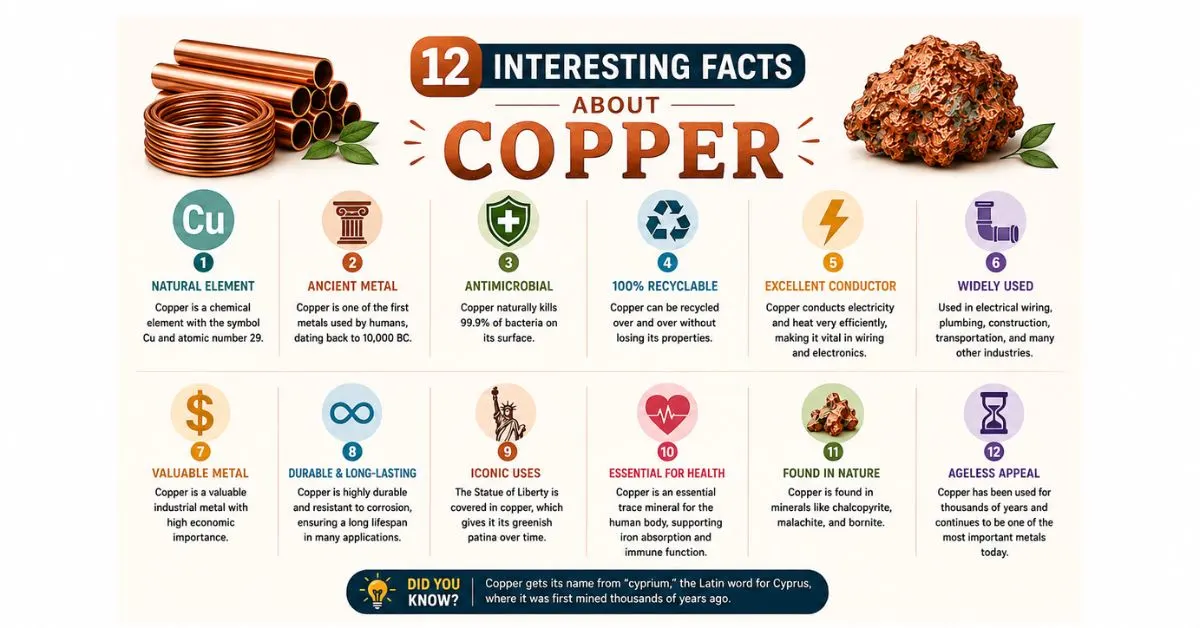
Copper is one of the most useful metals on Earth, valued for its electrical conductivity, thermal conductivity, ductility, corrosion resistance, and recyclability. Its atomic number is 29, its symbol is Cu, and its familiar reddish color makes it unusual among common metals.
What makes copper especially fascinating is its journey from ancient tools and Bronze Age technology to modern wiring, computers, renewable energy, and transportation. After researching copper’s properties and history, one thing stands out: this old metal remains essential to modern life, and the U.S. now classifies copper as a critical mineral.
Interesting Facts About Copper: Copper Wires and the Electromagnet
Copper became a natural choice for electrical wiring because electrons move through it efficiently. It is highly ductile, so manufacturers can draw it into thin wire without easily breaking it. Its combination of conductivity, formability, and durability explains why copper remains important in electrical systems.
One historical connection is especially fascinating. In 1824, William Sturgeon demonstrated an electromagnet using copper wire wrapped around iron. Copper wiring later became fundamental to technologies such as telegraphs, telephones, motors, generators, and modern electrical networks.
Why copper is so good for electrical wiring
Copper offers excellent electrical conductivity, thermal conductivity, ductility, and formability. Silver conducts electricity better, but copper is much more practical for large-scale applications because it combines strong performance with useful mechanical and economic characteristics.
Interesting Facts About Copper: The Statue of Liberty
The Statue of Liberty is one of America’s most recognizable examples of copper architecture. Its outer skin is made from copper sheets, and the metal’s surface gradually changed from its original reddish-brown appearance to the familiar green patina seen today.
That green surface is not ordinary rust. Copper reacts with oxygen, moisture, and atmospheric compounds, creating a protective weathered layer called a patina. The transformation illustrates why copper can remain useful outdoors for very long periods while developing a distinctive appearance rather than simply falling apart.
Why did the Statue of Liberty turn green?
The copper exterior gradually oxidized after exposure to the atmosphere. Over decades, chemical changes produced the green surface associated with Lady Liberty. The transformation was essentially complete by about 1920, showing how copper’s surface chemistry can dramatically change its appearance over time.
Interesting Facts About Copper: The American Penny
American pennies have a surprisingly complicated relationship with copper. Earlier U.S. cents contained substantial amounts of copper, while modern pennies are primarily zinc with a thin copper coating. Since 1982, the standard composition has been 97.5% zinc and 2.5% copper.
The history of the penny also connects copper with Benjamin Franklin, Abraham Lincoln, American currency, metallurgy, and coin production. The Fugio cent of 1787 was made from copper, making it an especially interesting piece of early American monetary history.
Are modern U.S. pennies made of copper?
Not mostly. Modern U.S. pennies are composed primarily of zinc with a thin copper outer layer. That familiar copper color therefore does not mean the entire coin is solid copper. Older U.S. cents had significantly higher copper content, making historical pennies different from today’s circulating cents.
Interesting Facts About Copper: Copper at Sea
Copper has played an important role in marine engineering, shipbuilding, corrosion protection, and naval history. Beginning in the 18th century, copper sheathing was used on wooden ships because it could discourage organisms such as barnacles and shipworms from damaging vessels.
The material was not perfect. Copper could interact with iron components through galvanic corrosion, creating engineering challenges. Even so, its combination of durability, corrosion resistance, and antifouling behavior made copper sheathing valuable to historical navies and merchant vessels.
Why was copper used on ships?
Copper sheathing helped protect wooden hulls from marine organisms and environmental damage. The Royal Navy adopted copper sheathing extensively during the 18th century. Later alternatives, including Muntz metal, emerged because copper was relatively expensive and could create problems with iron fasteners.
Interesting Facts About Copper: Copper in Computers
Copper may look old-fashioned, but it has an important place inside modern technology. Its electrical conductivity and thermal performance make it useful in computer circuitry, microelectronics, connectors, motors, and other electronic systems where efficient movement of electricity and heat matters.
This relationship becomes increasingly important as technology expands. Copper appears across data transmission, personal electronics, telecommunications, processors, power systems, and infrastructure. The same physical property that made copper useful in early electrical experiments continues to make it valuable in today’s digital economy.
Why is copper important in electronics?
Electronics depend on materials that can move electrical current efficiently while remaining practical to manufacture. Copper combines high conductivity with ductility and useful thermal properties, making it suitable for wires, connectors, circuit features, motors, and many other electrical components.
Interesting Facts About Copper: Copper in Your Body
Copper is not only an industrial metal; it is also an essential trace nutrient. The human body uses copper in several biological processes, including enzymes involved in energy metabolism, connective-tissue formation, iron metabolism, and nervous-system function. The important lesson is that copper is beneficial in appropriate amounts.
Copper is naturally present in foods including nuts, seeds, legumes, seafood, meats, and whole grains. However, more is not automatically better. Copper is an essential nutrient, but excessive exposure can cause health problems, which is why nutritional and environmental discussions should distinguish normal dietary needs from excessive intake.
Why does the human body need copper?
Copper helps support normal biological functions by participating in enzyme systems and processes involving iron, connective tissue, and cellular metabolism. It is therefore classified as an essential nutrient. Like other trace minerals, copper needs to remain within an appropriate range rather than being treated as something the body needs in unlimited amounts.
Interesting Facts About Copper: Copper in Medicine
Copper’s biological properties have also attracted interest in healthcare, antimicrobial surfaces, medical technology, and infection-control research. Copper-containing surfaces can damage certain microorganisms through contact, which has encouraged research into applications on frequently touched surfaces.
Its medical story requires some care, however. Copper should not be portrayed as a universal treatment or cure. Its value comes from specific material and biological properties studied in particular applications. That distinction keeps copper facts scientifically useful rather than turning an interesting property into an exaggerated health claim.
Does copper have antimicrobial properties?
Yes. Copper and some copper alloys can exhibit antimicrobial activity when microorganisms contact their surfaces. Research has investigated these properties for high-touch surfaces and healthcare environments. The effect depends on the material, organism, conditions, and exposure, so it should not be confused with a general medical cure.
Interesting Facts About Copper: Copper And The Final Frontier
Copper has even traveled beyond Earth. The Voyager Golden Records, launched aboard NASA’s Voyager spacecraft in 1977, used gold-plated copper records to preserve information intended to communicate something about Earth and humanity to potential finders far in the future.
The records contained images, spoken greetings, music, and natural sounds, making them a remarkable intersection of science, engineering, culture, and exploration. Copper’s role was practical: the material provided a durable base for the information carried into deep space.
Why was copper used for the Voyager records?
The Voyager records used a copper base covered with gold because the designers wanted a durable medium capable of carrying information through space. Their construction connects copper with astronomy, spacecraft engineering, long-term preservation, and one of humanity’s most ambitious attempts to tell a story about Earth.
Copper Facts at a Glance
| Property or fact | Copper |
| Chemical symbol | Cu |
| Atomic number | 29 |
| Atomic weight | About 63.55 |
| Room-temperature state | Solid |
| Melting point | About 1,084.6°C |
| Boiling point | About 2,927°C |
| Appearance | Reddish-brown |
| Crystal structure | Face-centered cubic |
| Major strength | Electrical and thermal conductivity |
| Common alloys | Brass and bronze |
| Major uses | Wiring, electronics, plumbing, transportation |
| Major ore | Chalcopyrite is an important copper sulfide ore |
| U.S. status | Added to the 2025 Critical Minerals List |
The basic chemical figures above are consistent with established reference data, while the U.S. critical-mineral designation comes from the 2026 USGS Mineral Commodity Summaries.
Why Copper Still Matters in 2026
One of the most important modern facts about copper is its strategic role in the U.S. economy. The USGS reported that copper was added to the U.S. 2025 Critical Minerals List. Its applications span electricity, construction, transportation, electronics, renewable energy, telecommunications, and manufacturing.
The latest USGS summary estimated 2025 U.S. mine production at about 1 million metric tons and refined production at about 850,000 metric tons. Globally, mined copper production was estimated at approximately 23 million metric tons in 2025. These figures show why copper is not merely an interesting chemistry topic but a major industrial resource.
25 Interesting Facts About Copper
- Copper’s chemical symbol is Cu.
- Its atomic number is 29.
- Copper is naturally reddish-brown rather than silver-gray.
- It is a transition metal.
- Copper has a face-centered cubic crystal structure.
- Silver is a better electrical conductor than copper.
- Copper is highly ductile, making it useful for wire.
- It also conducts heat efficiently.
- Copper is found in minerals such as chalcopyrite.
- Native copper can occur naturally in metallic form.
- Humans have used copper for thousands of years.
- Copper helped lead into the Bronze Age when combined with tin.
- Bronze is primarily an alloy of copper and tin.
- Brass is primarily an alloy of copper and zinc.
- Copper’s name is linked to the Latin cuprum and Cyprus.
- Copper develops a patina when exposed to the environment.
- The Statue of Liberty’s green appearance comes from weathering of its copper exterior.
- Modern U.S. pennies are primarily zinc with copper plating.
- Copper has been used extensively in electrical wiring.
- Copper is important in computers and electronic devices.
- Copper has antimicrobial properties under appropriate conditions.
- Copper is an essential trace nutrient for humans.
- Copper has been used in marine applications.
- Copper helped carry humanity’s message into deep space through the Voyager records.
- Copper was added to the U.S. critical minerals list in 2025.
Copper’s story is unusual because few materials connect ancient history, chemistry, architecture, electricity, biology, computing, and space exploration so naturally. From an early copper tool to the wiring inside modern technology, the same element has repeatedly adapted to what civilization needs next.
11. FAQ Section
What are some interesting facts about copper?
Copper has atomic number 29 and the chemical symbol Cu. It is reddish-brown, highly conductive, ductile, recyclable, and widely used in electrical wiring, electronics, plumbing, transportation, and renewable-energy systems. It is also an essential trace nutrient and develops a green patina when weathered.
Why is copper so special?
Copper combines several useful properties in one material: excellent electrical conductivity, strong thermal conductivity, ductility, malleability, corrosion resistance, and recyclability. That combination makes it valuable across electrical infrastructure, construction, electronics, transportation, and manufacturing.
What are 5 uses of copper?
Five major uses are electrical wiring, electronics, plumbing, transportation equipment, and power infrastructure. Copper is also used in renewable-energy systems, telecommunications, heat exchangers, architecture, and many copper alloys.
Why does copper turn green?
Copper turns green because its surface reacts with oxygen, moisture, and atmospheric compounds. Over time, these reactions create a protective patina. The Statue of Liberty is the most famous U.S. example of this natural surface transformation.
Is copper a critical mineral in the United States?
Yes. Copper was added to the U.S. 2025 Critical Minerals List, reflecting its importance to infrastructure, manufacturing, electronics, energy systems, and supply-chain security.
Is copper recyclable?
Yes. Copper can be repeatedly recovered and reused while retaining its useful properties. Its recyclability is one reason copper remains valuable even after products such as wiring, plumbing, and electronics reach the end of their first useful life.

Hi, I’m Benjamin, the person behind FactsAboutDog.com. 🐶
I’m passionate about dogs and love sharing interesting, fun, and educational facts about our furry friends. Through FactsAboutDog.com, I aim to make learning about dogs simple, enjoyable, and informative for dog lovers everywhere.
From amazing dog facts to breed information and fascinating animal knowledge, my goal is to help readers discover something new every day.
Explore the world of dogs with Benjamin at FactsAboutDog.com!