
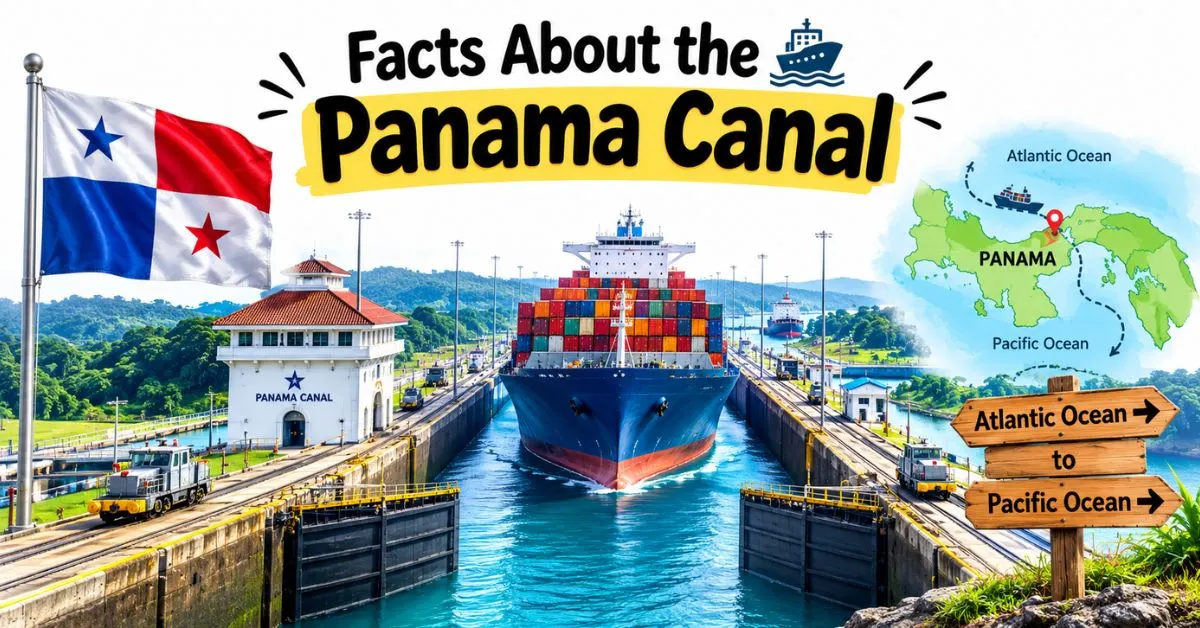
Facts About the Panama Canal: History, Engineering & Trade
The Panama Canal is an approximately 80-kilometer waterway that connects the Caribbean side of the Atlantic with the Pacific, using locks to raise ships about 26 meters to Gatun Lake. After researching its history, engineering, and maritime role, one fact stands out: this shortcut changed global shipping forever.
For readers who find canal history confusing, the story becomes much easier when you connect the Isthmus of Panama, Gatun Lake, the lock system, French construction attempt, American construction, and Panama Canal Authority. These facts explain not just what the canal is, but why its creation was such a remarkable achievement.
The idea for a canal across Panama dates back to the 16th century.
One of the most surprising Panama Canal facts is that the idea is centuries older than the finished waterway. After Vasco Núñez de Balboa reached the Pacific in 1513, Europeans recognized that the narrow Isthmus of Panama might provide a route between two oceans. In 1534, Charles V ordered a survey.
For centuries, the geography seemed almost impossible to overcome. Engineers faced mountains, heavy rainfall, dense tropical conditions, and rivers. The eventual solution was not simply to dig a straight channel, but to create a sophisticated system involving locks, artificial lakes, dams, and excavated channels.
The men behind the Suez Canal and Eiffel Tower were convicted in connection with failed effort to build a canal.
The first major construction attempt came from France in the 1880s under Ferdinand de Lesseps, who had become famous for the Suez Canal. His team originally pursued a sea-level canal, but Panama presented far greater engineering and environmental challenges than the Suez route.
Gustave Eiffel later became involved in designing locks, but the French enterprise collapsed amid engineering difficulties, disease, financial problems, and scandal. The failed attempt left behind excavated material and valuable knowledge that the United States later inherited when it took over the project.
America originally wanted to build a canal in Nicaragua, not Panama.
The United States did not initially consider Panama its only option. During the 19th century, American planners examined Nicaragua as another possible location for an interoceanic canal. Political lobbying and arguments about Nicaragua’s volcanic geography helped shift American attention toward Panama.
The political story then became closely connected with Panama’s separation from Colombia. In 1903, Panama declared independence, and the United States subsequently gained rights to construct the canal. The project ultimately cost roughly $375 million, including payments connected with the treaty and acquisition of French assets.
More than 25,000 workers died during the canal’s construction.
The human cost is among the most difficult facts about the Panama Canal to understand. Workers faced tropical diseases, especially yellow fever and malaria, along with accidents, heat, rainfall, unstable ground, and demanding excavation. HISTORY reports more than 25,000 deaths across the French and American construction efforts.
Medical understanding eventually transformed the project. William C. Gorgas and other health officials introduced sanitation measures aimed at reducing mosquito breeding and exposure. Draining standing water, improving sanitation, and installing screens helped dramatically reduce disease transmission and made continued construction more feasible.
History
The American construction period began in 1904 after the French effort had failed. Engineers changed the concept from a sea-level canal to a lock canal, with Gatun Lake becoming the central elevated waterway. John Stevens and later George Washington Goethals played major roles in turning the difficult project into a functioning canal.
The canal officially opened on August 15, 1914. Its completion transformed maritime geography because vessels no longer needed to travel around Cape Horn to move between the Atlantic and Pacific. The Panama Canal thus became both an engineering landmark and a major commercial shortcut.
Canal
The canal is roughly 80 kilometers, or about 50 miles, from deep water to deep water. Rather than remaining at sea level, ships travel through a sequence of locks that raise them to Gatun Lake, approximately 26 meters or 85 feet above sea level, before lowering them toward the opposite ocean.
The original lock complexes are Gatun, Pedro Miguel, and Miraflores. The expanded waterway later added Agua Clara and Cocoli locks for larger Neopanamax vessels. This combination of lakes, channels, dams, and locks is what makes the Panama Canal fundamentally different from a simple sea-level canal.
Navigation
A ship does not simply sail through the canal under its captain’s independent control. Panama Canal pilots guide vessels through the waterway, while the locks carefully manage water levels. The original chambers are about 110 feet wide and 1,000 feet long, dimensions that helped create the famous Panamax vessel category.
The lock system works largely through gravity, rather than giant pumps. Freshwater from Gatun Lake flows through channels and culverts into the lock chambers. The water level rises or falls, carrying the vessel with it. It is an elegant example of using geography and hydraulic engineering together.
Gatun Lake
Gatun Lake is one of the most important pieces of the canal system. Created by damming the Chagres River, it forms the elevated section across the Isthmus and provides the freshwater needed for lock operations. When created, it was among the world’s largest artificial lakes.
The lake also demonstrates why water is central to the canal’s future. Each vessel passing through the original lock system requires a huge quantity of freshwater, much of which ultimately flows toward the sea. Rainfall and watershed management therefore matter directly to canal operations.
Between 13,000 and 14,000 ships use the canal every year.
The canal became a vital international shipping route because it can eliminate thousands of miles from certain ocean voyages. A commonly cited example is the route between New York and San Francisco, where using the canal dramatically reduces the distance compared with traveling around South America.
Every vessel pays a toll based on factors including its size and cargo characteristics. Transit normally takes several hours; the Panama Canal Authority says the waterway serves vessels around the clock, while HISTORY reports typical transit times of roughly eight to ten hours.
| Panama Canal fact | Key detail |
| Approximate length | 80 km / 50 miles |
| Official opening | August 15, 1914 |
| Gatun Lake elevation | About 26 m / 85 ft |
| Original lock width | About 110 ft |
| Original lock usable length | About 1,000 ft |
| Main original locks | Gatun, Pedro Miguel, Miraflores |
| Expansion opened | 2016 |
| Modern larger vessels | Neopanamax |
The canal’s commercial importance is also tied to its ability to accommodate different vessel sizes. The original locks created the Panamax standard, while the newer locks allow much larger Neopanamax ships to use the expanded route.
The United States transferred control of the canal to Panama in 1999.
For much of the 20th century, the United States played the dominant role in administering the canal and Canal Zone. That arrangement eventually became politically controversial, contributing to tensions between Panama and the United States over sovereignty and control.
The Torrijos-Carter Treaties, signed in 1977, established the process for transferring control. On December 31, 1999, control passed peacefully to Panama. Today, the Panama Canal Authority is responsible for administration, operation, maintenance, conservation, and modernization.
The canal was recently expanded to handle today’s megaships.
The original canal was designed for vessels that now seem modest compared with the largest modern container ships. As global shipping grew, larger vessels increasingly exceeded the original Panamax dimensions, creating pressure for a wider route.
Construction of the expansion began in 2007, and the expanded canal opened in 2016. The new locks were designed for Neopanamax vessels and created a third lane of traffic. This expansion significantly increased the types and sizes of ships that could use the waterway.
The new lock chambers are approximately 1,400 feet long and 180 feet wide. They also use water-saving basins that recycle a substantial portion of the water used during a transit.
Issues leading to expansion
The expansion was fundamentally about capacity. Ships were becoming larger, international cargo volumes were increasing, and the original Panamax locks limited the dimensions of vessels able to make a transit. The solution was a new set of locks capable of accommodating Neopanamax ships.
Water availability has also become an important operational issue. Because the canal depends heavily on freshwater from its watershed, rainfall and lake levels can influence how many vessels can safely transit and what draft restrictions may apply. This makes water management as important as physical infrastructure.
Capacity
The expansion added a third lane and opened the canal to much larger ships. HISTORY notes that the expanded canal can accommodate cargo vessels carrying up to around 14,000 twenty-foot-equivalent containers, compared with substantially lower capacity under the original system.
The difference between Panamax and Neopanamax is therefore more than a technical measurement. It represents the canal adapting to modern global commerce. Larger locks, deeper channels, tugboats, new gates, and water-saving basins allow the waterway to remain competitive in international shipping.
More Fascinating Facts About the Panama Canal
1. The canal is not simply a sea-level ditch. Ships are lifted to Gatun Lake and later lowered toward the opposite ocean.
2. Gatun Lake is artificial. It was created through major dam construction involving the Chagres River.
3. The original canal uses gravity-fed water movement. No conventional pumping system is required to raise vessels through the original lock system.
4. Culebra Cut was one of the hardest sections to excavate. The cut passes through the Continental Divide and required enormous excavation work.
5. The canal operates around the clock. The Panama Canal Authority states that it provides transit services 24 hours a day, 365 days a year.
6. Richard Halliburton swam through the canal. In 1928, he paid only 36 cents, the lowest toll ever recorded.
7. The canal has multiple lock complexes. Gatun, Pedro Miguel, and Miraflores form the original lock system, while Agua Clara and Cocoli belong to the expanded system.
8. The canal changed the geography of global shipping. Ships can avoid the much longer journey around the southern tip of South America.
9. Panamax became a ship-size standard. The dimensions of the original locks effectively defined the maximum dimensions for vessels designed to use them.
10. The expansion introduced Neopanamax capability. The larger locks opened in 2016 made it possible for much larger vessels to transit.
FAQ Section
How long is the Panama Canal?
The Panama Canal is approximately 80 kilometers, or 50 miles, long from deep water in the Atlantic to deep water in the Pacific.
When did the Panama Canal open?
The Panama Canal officially opened on August 15, 1914. The project followed an earlier failed French construction effort and was completed under U.S. leadership.
Why does the Panama Canal use locks?
The land crossing rises substantially above sea level. Engineers therefore created a lock-and-lake system that lifts ships to Gatun Lake instead of attempting to excavate an extremely deep sea-level channel.
How high do ships rise in the Panama Canal?
Ships are raised approximately 85 feet, or 26 meters, above sea level to the level of Gatun Lake before eventually being lowered toward the opposite ocean.
How long does it take to pass through the Panama Canal?
A typical full transit takes approximately 8 to 10 hours, although the actual time can vary with vessel type, traffic, scheduling, and operating conditions.
Who controls the Panama Canal today?
The Panama Canal Authority administers and operates the waterway. Control was transferred from the United States to Panama on December 31, 1999.
What is the difference between Panamax and Neopanamax?
Panamax refers to vessels designed around the dimensions of the original locks. Neopanamax vessels are larger and can use the expanded locks that opened in 2016.
How many ships use the Panama Canal each year?
Recent figures vary by year and operating conditions. HISTORY reports roughly 13,000 to 14,000 annual ship transits, while the Panama Canal Authority provides current operating statistics and route information.
Was the Panama Canal built by France or the United States?
Both played major roles. France began the first major construction effort in the 1880s, but that project failed. The United States later acquired French assets and completed the canal in 1914.

Hi, I’m Benjamin, the person behind FactsAboutDog.com. 🐶
I’m passionate about dogs and love sharing interesting, fun, and educational facts about our furry friends. Through FactsAboutDog.com, I aim to make learning about dogs simple, enjoyable, and informative for dog lovers everywhere.
From amazing dog facts to breed information and fascinating animal knowledge, my goal is to help readers discover something new every day.
Explore the world of dogs with Benjamin at FactsAboutDog.com!