
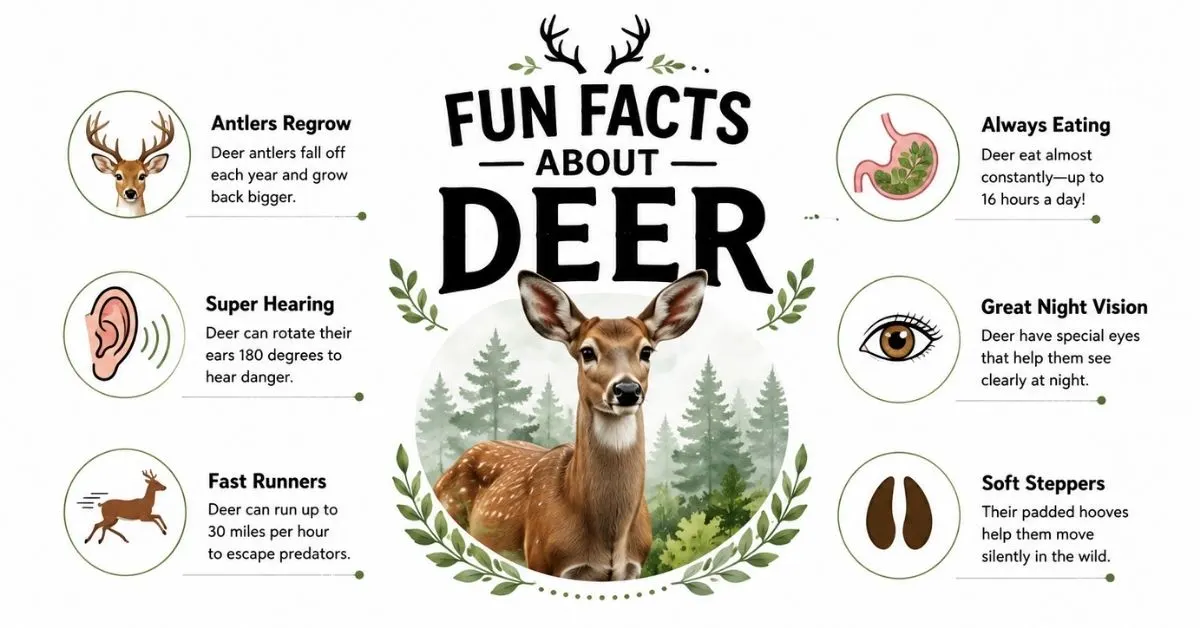
Fun Facts About Deer: 12 Surprising Truths You Never Knew
White-tailed deer are the animal most Americans see the most and understand the least. I’ve spent hours parked at the edge of a hayfield at dusk, watching a doe freeze mid-step, and every time I learn something new about these quiet, watchful animals. If you’ve ever wondered why a deer “freezes in headlights” or how it hears you before you even see it, these fun facts about deer answer exactly that.
This guide pulls together verified wildlife biology, National Park Service data, and Cervidae research to give you real answers, not folklore. From antler growth to their four-chambered stomach, you’ll walk away knowing why white-tailed deer, mule deer, and their Cervidae cousins behave the way they do.
Fun Facts About Deer How Many Species Actually Exist
Most people picture one animal when they hear “deer,” but the Cervidae family is far bigger than that. There are roughly 40 species worldwide, including white-tailed deer, mule deer, moose, elk, reindeer, and the tiny pudu, spread across every continent except Antarctica and Australia.
North America’s white-tailed deer, Odocoileus virginianus, is the most widespread of the bunch, with an estimated 30 million living across the United States. Texas alone holds over 5 million, making it the single most deer-dense state in the entire country.
Fun Facts About Deer Built for Speed
Speed is a white-tailed deer’s best defense against predators, and it’s genuinely impressive. They can sprint up to 35–40 mph over short distances, and some reports place mule deer even faster, easily outrunning coyotes, dogs, and most threats in open terrain.
Beyond flat-out running, deer are elite jumpers and swimmers too. A healthy adult can clear a 10-foot fence in a single bound and paddle across a lake at roughly 13 mph, which explains why “deer-proof” fencing rarely works as advertised.
Fun Facts About Deer Vision Why They See the World Differently
Deer don’t see color the way humans do. Their eyes pick up short blue and middle green wavelengths well but are nearly blind to reds and oranges, making them functionally red-green colorblind, which is exactly why hunters wear blaze orange that deer barely register.
Interestingly, biologists believe deer can also detect ultraviolet light, a spectrum invisible to humans that’s abundant at dawn and dusk. This adaptation likely helps them spot predators moving through shadowed brush during their most active hours.
Fun Facts About Deer Intelligence
The “deer in headlights” stereotype has done real damage to how people view these animals. Contrary to popular belief, white-tailed deer are highly intelligent, adapting their movement patterns and habitat use based on past encounters with hunters, vehicles, and other threats.
That frozen stare under headlights isn’t stupidity at all it’s temporary blindness from sudden brightness, similar to flipping on a light in a pitch-black room. Deer also learn to avoid specific trails and fields entirely once they associate them with danger during hunting season.
Fun Facts About Deer Antlers and Who Grows Them
Almost every male deer species grows antlers, with reindeer being the notable exception where females grow them too, mainly to defend food and protect themselves during pregnancy. Antlers are actually extensions of the skull and rank among the fastest-growing bone tissue in the animal kingdom.
Bucks shed and regrow a full set every single year, sometimes gaining a quarter-inch of new antler growth in a single day while covered in velvet. Once the rutting season ends, the antlers fall off, and the whole remarkable cycle starts again from scratch.
Fun Facts About Deer Lifespan, Wild vs. Captive
Life in the wild is tough on deer. The average lifespan for a wild white-tailed buck is around 4–6 years, while does tend to survive slightly longer, generally reaching 10–12 years thanks to lower predation pressure and reduced hunting exposure.
Remove the predators and hunting risk, though, and deer age very differently. In protected or captive environments, white-tailed deer can live 15–20 years, more than triple their typical wild lifespan, which shows just how much environment shapes survival.
Fun Facts About Deer Hearing and Sense of Smell
A deer’s ears are essentially built-in radar. They can detect sounds up to 54,000 hertz, roughly three times better than human hearing, and each ear can rotate independently to pinpoint a sound’s exact direction long before danger comes into view.
Their nose might be even sharper. Some researchers estimate a deer’s sense of smell is around 100 times more sensitive than a human’s, letting them detect predators, food sources, and even other deer’s scent markings from remarkable distances downwind.
Fun Facts About Deer Diet and Daily Routine
Deer are herbivores most of the time, grazing on grasses, leaves, fruit, acorns, and tender buds depending on the season. Their diet shifts constantly leafy greens in spring and summer, then corn, nuts, and bark once colder months make food scarcer.
They’re also crepuscular, meaning they’re most active at dawn and dusk rather than midday. Occasionally, though, deer surprise researchers by eating meat when minerals like phosphorus run low, with rare documented cases of them scavenging birds, fish, or even carrion.
Fun Facts About Deer and Their Hollywood Fame
Disney’s Bambi is arguably the most famous deer on Earth, and he’s specifically modeled after a white-tailed deer rather than the roe deer used in the original novel. An animator from Maine drew on his own childhood surroundings to bring the character to life.
The production team even had a live fawn flown from Maine to Hollywood for reference sketches. Bambi wasn’t alone in stardom either Rudolph, despite being billed as a reindeer, was actually modeled after a white-tailed deer in his classic 1964 TV special.
Fun Facts About Deer That Explain Why They’re More Dangerous Than Sharks
It sounds backwards, but deer statistically cause more human deaths per year in the United States than sharks do. Most incidents aren’t direct attacks they’re deer-vehicle collisions, especially common during autumn rutting season when bucks are distracted and less cautious near roads.
Estimates put deer-related deaths somewhere between 120 and 200 annually nationwide, largely from drivers swerving to avoid a deer and losing control or colliding with oncoming traffic. It’s a sobering reminder that “gentle” animals can still pose real road hazards.
Fun Facts About Deer Tails and Their Warning Signal
White-tailed deer earn their name from one unmistakable feature: the bright white underside of their tail. When a deer senses danger, it raises that tail like a flag, flashing the white patch to warn the rest of the herd instantly.
This “tail flagging” isn’t the only message deer send this way. Does also raise their tails during rutting season to signal they’re ready to breed, making tail position one of the clearest, most consistent forms of communication in deer behavior.
Fun Facts About Deer Babies and Family Bonds
Female deer usually give birth to a single fawn, though older, well-fed does can have twins or, rarely, triplets. Newborn fawns arrive with white spots scattered across reddish-brown fur, natural camouflage that fades completely by their first winter.
Maternal instinct runs deep, too. Researchers have found that mother deer respond to the sound of a crying human baby almost the same way they respond to their own fawn’s distress calls, approaching within 10–25 meters out of pure protective instinct.
Quick-Reference Fact Table
| Fact Category | Detail |
| Top running speed | 35–40 mph |
| Hearing range | Up to 54,000 Hz |
| Wild lifespan (buck/doe) | ~6 years / ~12 years |
| Captive lifespan | 15–20 years |
| U.S. white-tailed deer population | ~30 million |
| Deer species worldwide | ~40 |
| Jump height | Up to 10 feet |
| Deaths caused annually (U.S.) | 120–200, mostly vehicle collisions |
FAQ Section
How fast can a deer run?
White-tailed deer can reach speeds of 35–40 mph over short bursts, fast enough to outrun most natural predators across open ground.
Are deer color blind?
Not entirely, but deer are effectively red-green colorblind. They see blues and greens clearly but have very limited sensitivity to reds and oranges.
What is a baby deer called, and how many does a doe have?
A baby deer is called a fawn. Most does have a single fawn, though older does occasionally have twins or, rarely, triplets.
Why do deer freeze in headlights?
Sudden bright light temporarily blinds a deer’s eyes, causing it to freeze rather than flee it’s a sensory reaction, not a sign of low intelligence.
Do all deer grow antlers?
Nearly all male deer grow antlers, with reindeer being the exception where females grow them too. Antlers are shed and regrown annually.
Are deer actually dangerous to humans?
Directly, rarely but deer cause 120–200 deaths a year in the U.S. through vehicle collisions, more than shark attacks cause nationwide.

Hi, I’m Benjamin, the person behind FactsAboutDog.com. 🐶
I’m passionate about dogs and love sharing interesting, fun, and educational facts about our furry friends. Through FactsAboutDog.com, I aim to make learning about dogs simple, enjoyable, and informative for dog lovers everywhere.
From amazing dog facts to breed information and fascinating animal knowledge, my goal is to help readers discover something new every day.
Explore the world of dogs with Benjamin at FactsAboutDog.com!