
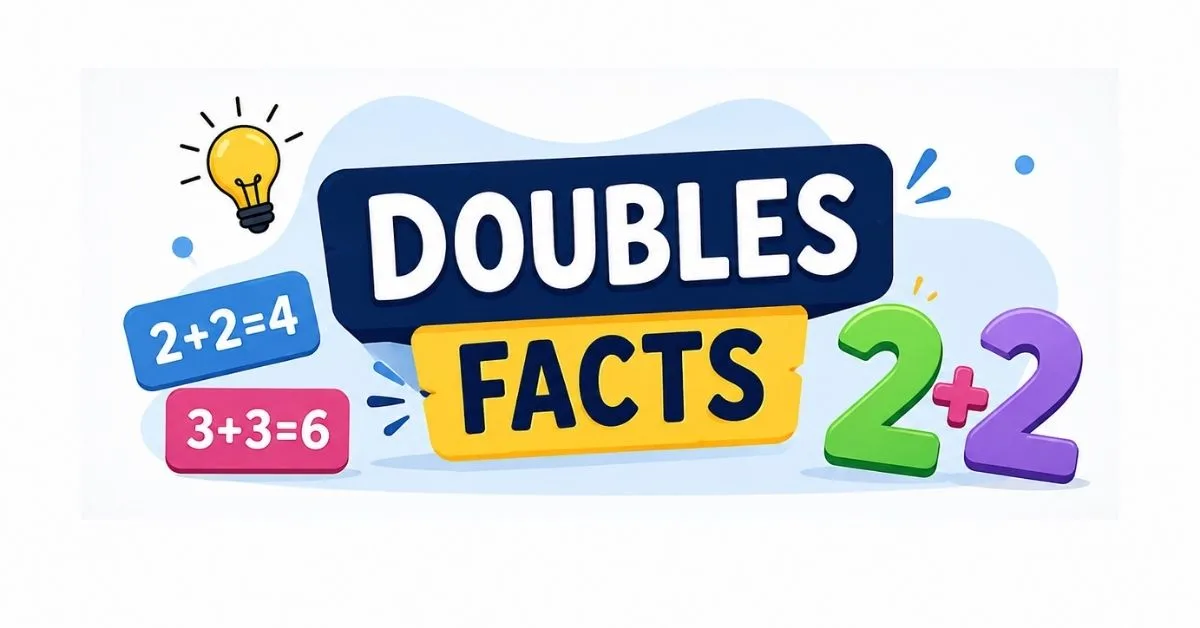
Doubles Facts: The Complete Guide to Teaching and Learning Them With Confidence
A doubles fact is simply a math fact where a number is added to itself like 4+4 or 8+8 and it’s one of the fastest ways young learners build real addition fluency. I’ve watched dozens of first and second graders freeze up over basic addition, only to relax the moment doubles facts click into place. This guide walks through what they are, why they matter, and how to make them stick using near doubles, real-life examples, and mental math strategies that actually work at home or in the classroom.
Parents often feel a quiet panic when homework mentions “doubles” and “near doubles” in the same sentence, unsure how the two connect. That frustration is completely normal, and it fades fast once the pattern behind doubles addition facts becomes visible. Below, you’ll find clear examples, number-sense explanations, greatest common factor and least common multiple connections, and practice challenges pulled straight from how real teachers introduce this concept.
What Are Doubles Facts?
Doubles facts describe any equation where the same number is added to itself, such as 3+3=6 or 7+7=14. There are only eleven of these doubles addition facts total, running from 0+0 up through 10+10, which makes them one of the smallest, most memorable sets in early math fact fluency. Kids often master them faster than any other addition category.
What makes doubles facts special is pattern recognition, not brute memorization. Every doubles equation produces an even number, so students quietly absorb a rule about whole numbers without anyone stating it outright. This early number sense becomes the quiet engine behind mental math strategies used well into third and fourth grade classrooms nationwide.
Why Are Doubles Facts Important?
Doubles facts matter because they’re a foundation stone, not a standalone skill. Once a student memorizes that 8+8=16, subtraction problems like 16−8 become instant recall instead of a laborious count-back. This single connection saves enormous cognitive effort during timed math fact fluency drills and standardized testing.
Beyond subtraction, doubles facts quietly set up multiplication. A child who knows 6+6=12 has already seen what 2×6 means: adding six two times, or repeated addition. Teachers lean on doubles addition facts because every future strategy near doubles, mental math, even algebra assumes these eleven facts are already automatic.
Doubles Facts in Real Life
Doubles facts aren’t abstract flashcard drills; they’re everywhere once you start pointing them out. Wheels on a car total 2+2, a spider’s legs total 4+4, fingers and toes together make 5+5, and a carton of eggs holds 6+6. These physical, countable examples turn doubles addition facts into something tangible rather than memorized noise.
Connecting doubles facts to everyday objects builds retention faster than isolated worksheets ever could. When a child spots two shoes, two eyes, or a pair of chopsticks, they’re rehearsing doubles math facts without realizing it. This real-world exposure reinforces number sense and keeps math fact fluency practice from feeling like rote memorization.
Remembering the Doubles Facts
Doubles facts stick best through hands-on representation, not memorization alone. Ten frames are one of the most effective tools: students build a doubles fact using two colors of counters across two ten frames, physically seeing 5+5 or 7+7 take shape. This visual model bridges the gap between counting and instant recall of doubles addition facts.
Rekenreks and simple colored cubes work the same way, letting students manipulate doubles facts with their hands before committing them to memory. Mental math strategies grow naturally from this hands-on stage. Once students can picture a doubles fact, they stop needing manipulatives and start solving doubles facts automatically in their heads.
How Doubles Facts Help Us Solve Math Problems
Doubles facts do more than answer isolated addition problems they become a mental toolkit. Once a student is fluent, they start applying doubling logic to subtraction, multiplication, and even factor relationships without formal instruction, simply because the doubles pattern is now hardwired into their number sense and daily mental math strategies.
This is where doubles addition facts prove their real value: as a bridge, not an endpoint. A child who has internalized 6+6=12 can suddenly access near doubles, 2× multiplication tables, and even greatest common factor shortcuts. Below are four concrete ways doubles facts extend into bigger math concepts students will meet for years.
Near Doubles
A near double is a fact just one more or one less than a doubles fact, like 6+7. Instead of counting from scratch, a student thinks: “I know 6+6=12, and 7 is one more than 6, so 6+7=13.” This doubles-plus-one strategy turns eleven memorized doubles facts into dozens of solvable problems instantly.
Doubles and Multiplication
Doubles facts are a natural on-ramp into multiplication because multiplication is repeated addition. When a child knows 7+7=14, they’ve already demonstrated understanding of 2×7 without realizing it. Teachers use this doubles-to-multiplication bridge heavily when introducing the 2 times table in second and third grade classrooms.
Greatest Common Factor of a Number and Its Double
When one number is exactly double another, the smaller number is always their greatest common factor. For example, the GCF of 6 and 12 is 6, and the GCF of 9 and 18 is 9. Doubles facts make this factor relationship visually obvious for students first learning greatest common factor concepts.
Least Common Multiple of a Number and Its Double
The opposite pattern applies to least common multiple: when a number is doubled, the larger number is always the LCM. The LCM of 4 and 8 is 8, and the LCM of 10 and 20 is 20. Doubles facts give students an intuitive shortcut before formal LCM instruction even begins.
Doubles Facts Practice
Doubles facts practice works best through short, playful repetition rather than long worksheet sessions. A simple one-minute game called Dice Doubles has students roll a die, double the number, and race against their own previous score competing with themselves keeps anxiety low while reinforcing doubles addition facts automatically.
Partner games amplify this further. In games like Doubles Race to 100, students take turns doubling rolled numbers and racking up a running total, turning doubles facts practice into something closer to play than drill. Ten frames, task cards, and quick oral chants also reinforce doubles facts without draining classroom time.
Quick Math Challenges with Doubles Facts
Doubles facts challenges let students stretch beyond simple recall into applied reasoning, using near doubles, word problems, and factor relationships together. These short challenges work well as warm-ups, exit tickets, or homework, giving students a low-pressure way to prove they’ve truly internalized their doubles addition facts, not just memorized a chart.
Mixing challenge types pure computation, word problems, and factor/multiple questions mirrors how doubles facts actually show up on standardized assessments. Working through a few each week keeps doubles facts fresh well past the initial teaching unit, especially heading into multiplication and early algebra content later in the school year.
Challenge 1
Use a nearby double to solve: 13+14, 26+25, and 31+30. Each can be solved two ways rounding down to the lower double and adding one, or rounding up to the higher double and subtracting one. Both paths land on the same answer, reinforcing flexible doubles-based thinking.
Challenge 2
Emma jumped rope 15 times. Her friend jumped double that amount. This word problem transforms a doubles fact into real-world reasoning, asking students to recognize “double” as a keyword signaling multiplication by two rather than simple addition of two separate numbers.
Challenge 3
Find the greatest common factor of 24 and 48, 16 and 32, and 50 and 100. In every pair, one number is exactly double the other, so the smaller number is automatically the GCF a pattern doubles facts make immediately visible to observant students.
Challenge 4
Find the least common multiple of 18 and 36, 12 and 24, and 14 and 28. Since each larger number is double the smaller, the LCM is simply the bigger number. This challenge cements the LCM-doubles relationship introduced earlier in the guide.
Frequently Asked Questions About Doubles Facts
Doubles facts questions tend to repeat across classrooms and kitchen tables, especially around subtraction, zero, and negative numbers. Below are the most common ones, answered directly so parents and teachers can clear up confusion in seconds rather than searching through multiple math fact fluency resources.
These answers also work well as quick verbal quizzes once a student has learned their doubles addition facts. Reading through them together reinforces number sense while showing how far a small set of eleven facts can actually stretch across arithmetic, algebra, and beyond.
Can We Use Doubles Facts for Subtraction?
Yes. Doubles facts work in reverse for subtraction because subtraction undoes addition. If 8+8=16, then 16−8=8 automatically. This backward thinking turns eleven doubles addition facts into eleven instant subtraction facts too, doubling their practical value for young learners.
What Happens When We Double Zero?
Doubling zero still equals zero, since 0+0=0 and 2×0=0. It’s a simple but important doubles fact reminder: adding or multiplying nothing always produces nothing, helping students understand zero’s unique behavior within the number system early on.
Are Doubles Facts Just for Early Grades?
No. While doubles facts are typically taught in first and second grade, students keep using them for multiplication, mental math, factors, multiples, and eventually algebra. What starts as a simple addition shortcut becomes a lifelong mental math tool.
Does Doubling a Number Always Give an Even Sum?
For whole numbers, yes doubling always produces an even result, since you’re adding identical values together. However, doubling decimals doesn’t follow this rule; for example, 1.5+1.5=3, which is odd, showing doubles facts behave differently outside whole numbers.
Do Negative Numbers Have Doubles?
Yes, negative numbers double just like positive ones. Adding −4 to itself gives −8, matching 2×(−4)=−8. This confirms that doubles facts apply consistently across the entire number line, not just to the positive whole numbers taught in early elementary math.
FAQ SECTION (Featured Snippet Optimized condensed for schema use)
What is a doubles fact in math? A doubles fact is an addition equation where the same number is added to itself, such as 5+5=10 or 9+9=18, typically covering 0+0 through 10+10 or 12+12.
How many doubles facts are there? There are eleven core doubles facts from 0+0 through 10+10, though some curricula extend the set up to 12+12.
What is the difference between doubles and near doubles? A doubles fact adds the same number to itself (6+6), while a near double adds two consecutive numbers (6+7), solved by adjusting a known doubles fact by one.
Why are doubles facts taught before multiplication? Because multiplication is repeated addition, a known doubles fact like 7+7=14 already demonstrates 2×7, making doubles facts a natural bridge into multiplication tables.

Hi, I’m Benjamin, the person behind FactsAboutDog.com. 🐶
I’m passionate about dogs and love sharing interesting, fun, and educational facts about our furry friends. Through FactsAboutDog.com, I aim to make learning about dogs simple, enjoyable, and informative for dog lovers everywhere.
From amazing dog facts to breed information and fascinating animal knowledge, my goal is to help readers discover something new every day.
Explore the world of dogs with Benjamin at FactsAboutDog.com!