40+ Fun Facts About Martin Luther King Jr You Never Knew
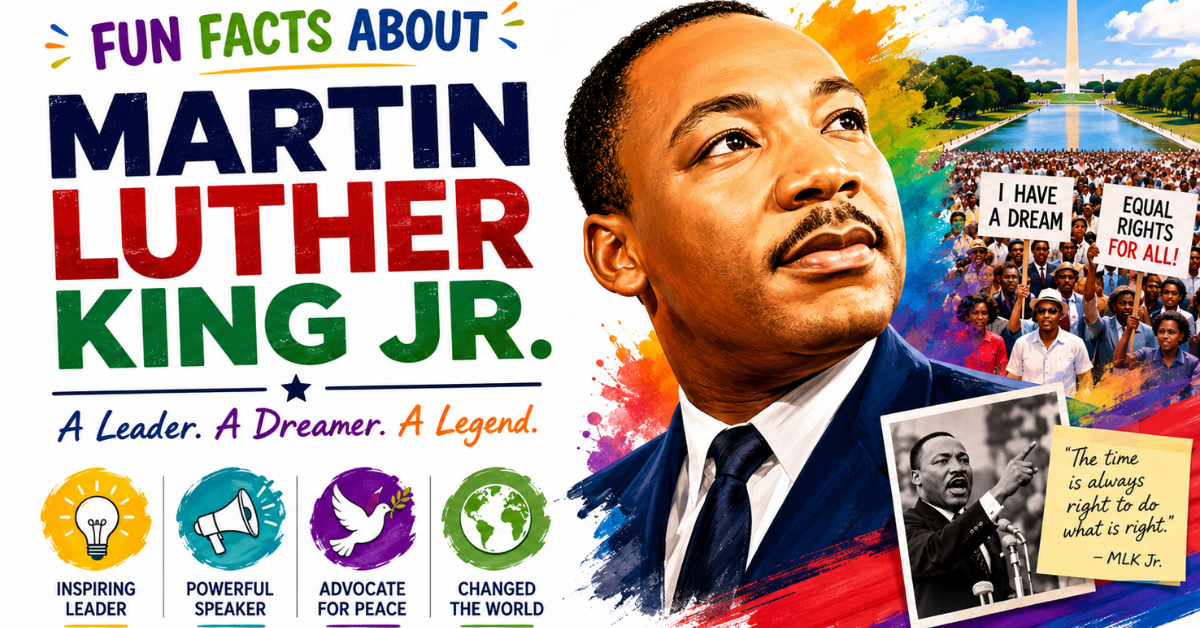
Looking for fun facts about Martin Luther King Jr.? Dr. Martin Luther King Jr. was one of the most influential leaders of the civil rights movement in American history. Known for his powerful speeches, peaceful protests, and commitment to equality, King inspired millions to challenge racial injustice through nonviolent activism.
From entering college at a remarkably young age to becoming a Nobel Peace Prize winner, his life was filled with remarkable achievements. He also played a major role in the fight against racial segregation and became an enduring symbol of equality and justice. These fascinating facts reveal lesser-known details about his childhood, education, family, leadership, achievements, and lasting legacy.
Quick Facts About Martin Luther King Jr.
| Fact | Detail |
| Full name | Martin Luther King Jr. |
| Born | January 15, 1929, Atlanta, Georgia |
| Original name | Michael King Jr. |
| Died | April 4, 1968, Memphis, Tennessee, age 39 |
| Occupation | Baptist minister and civil rights leader |
| Wife | Coretta Scott King (married 1953) |
| Children | Four Yolanda, Martin III, Dexter, Bernice |
| Education | Morehouse College, Crozer Theological Seminary, Boston University (PhD) |
| Key organization | Southern Christian Leadership Conference (SCLC) |
| Nobel Peace Prize | 1964, age 35 |
| MLK Day | Third Monday of January, federal holiday since 1986 |
Fun Facts About Martin Luther King Jr.
Early Life
- He was born Michael King Jr.; his father later renamed them both after German reformer Martin Luther.
- He skipped two grades in high school and entered Morehouse College at age 15.
- His first job was as a paperboy for the Atlanta Journal.
- Both his father and maternal grandfather were Baptist ministers.
Education
- He earned a bachelor’s degree in sociology from Morehouse by age 19.
- He completed a divinity degree at Crozer Theological Seminary.
- He earned his PhD in systematic theology from Boston University in 1955, at age 26.
- He received five honorary degrees during his lifetime.
Family
- He married musician and activist Coretta Scott in 1953.
- The couple had four children, born between 1955 and 1963.
- He became pastor of Ebenezer Baptist Church in Atlanta the same church his father led.
Civil Rights Leadership
- He was only 26 years old when the Montgomery Bus Boycott began.
- The boycott lasted 381 days, from December 1955 to December 1956.
- He co-founded the Southern Christian Leadership Conference (SCLC) in 1957 and served as its president until his death.
- His nonviolent philosophy was directly influenced by Mahatma Gandhi.
- He was named Time magazine’s Man of the Year in 1963.
- An estimated 250,000 people attended the 1963 March on Washington.
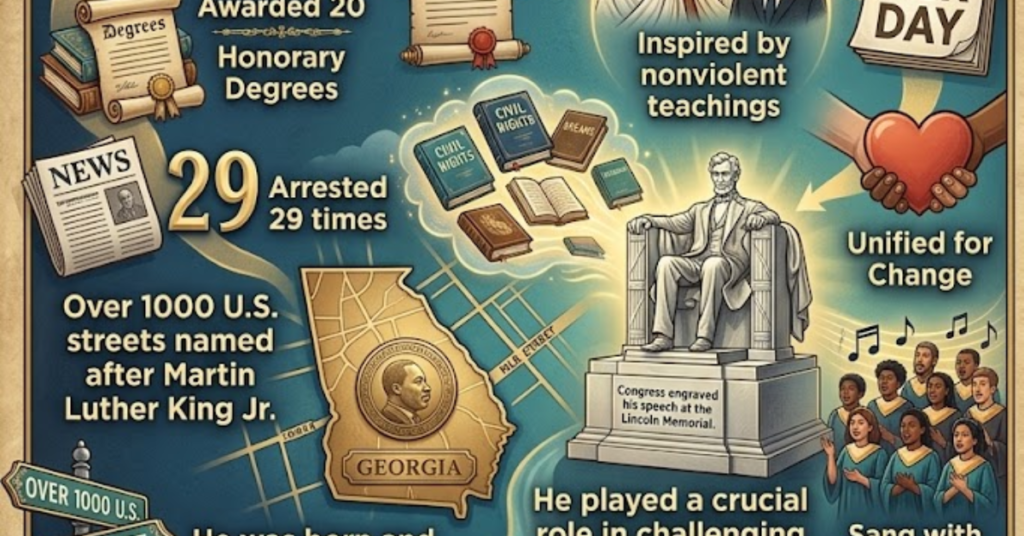
- He was arrested upwards of 20 times and assaulted at least four times during his activism.
- He traveled more than six million miles and spoke at over 2,500 events during his career.
Nobel Peace Prize
- He won the Nobel Peace Prize in 1964 for leading the nonviolent struggle for civil rights.
- At 35, he became the youngest man to receive the award at that time.
- He pledged the full $54,123 prize money to the civil rights movement.
Legacy
- Over 700 streets across the United States are named after him.
- He and George Washington and Abraham Lincoln are among the only Americans to have had their birthdays observed as national holidays.
- The Martin Luther King Jr. Memorial on the National Mall opened on August 28, 2011.
His Religious Beliefs and Influences
- King grew up steeped in Black Baptist church tradition; his father, grandfather, and great-grandfather were all ministers.
- His approach to nonviolent resistance blended Christian teachings with the philosophy of Mahatma Gandhi, whom he studied closely and later traveled to India to learn more about in 1959.
- He viewed nonviolent direct action as both a moral principle and a practical strategy for social change.
- His theology training at Boston University focused on systematic theology, shaping how he combined faith with activism.
Achievements at a Glance
- Became pastor of a major Baptist congregation before age 26.
- Led the Montgomery Bus Boycott, a 381-day campaign that ended bus segregation in Alabama.
- Co-founded and led the SCLC for over a decade.
- Helped organize the Birmingham Campaign, a turning point in the movement.
- Delivered his best-known address to roughly 250,000 people in Washington, D.C.
- Directly influenced the passage of the Civil Rights Act of 1964.
- Directly influenced the passage of the Voting Rights Act of 1965.
- Became the youngest man to win the Nobel Peace Prize at the time, at age 35.
- Organized the Poor People’s Campaign to address economic inequality.
- Has a national federal holiday and a National Mall memorial dedicated in his honor.
Key Civil Rights Movement Milestones
King became one of the most prominent leaders of the civil rights movement, though its major victories depended on many organizers working alongside him.
- Montgomery Bus Boycott (1955–56) sparked by Rosa Parks’s arrest; ended after the Supreme Court ruled Alabama’s bus segregation unconstitutional.
- Birmingham Campaign (1963) protests against segregation that drew national attention.
- Letter from Birmingham Jail (1963) written while jailed, defending civil disobedience against unjust laws.
- March on Washington (1963) around 250,000 attendees; King delivered his best-known address at the Lincoln Memorial.
- Selma to Montgomery March (1965) a campaign for voting rights.
- Civil Rights Act of 1964 outlawed discrimination based on race, color, religion, sex, or national origin.
- Voting Rights Act of 1965 banned discriminatory voting practices used to suppress Black voters.
Arrests, Surveillance, and Challenges
- King was arrested upwards of 20 times for his role in nonviolent protests, according to his official Nobel biography.
- He survived a near-fatal stabbing in New York in 1958.
- The FBI, under J. Edgar Hoover, placed King under years of surveillance, viewing him as a threat to national security.
The Poor People’s Campaign and Memphis
In his final year, King organized the Poor People’s Campaign to address poverty across racial lines. In early 1968, he traveled to Memphis, Tennessee, to support striking Black sanitation workers demanding fair pay and safer conditions. He was assassinated there on April 4, 1968, while standing on the balcony of the Lorraine Motel.
Books and Public Speaking
- King wrote five books during his lifetime, along with numerous articles and essays.
- He spoke at more than 2,500 public events over the course of his career.
- His most widely read works include Stride Toward Freedom and Why We Can’t Wait.
Legacy and Influence
- King’s leadership directly shaped landmark U.S. civil rights legislation still in effect today.
- His writings and speeches continue to be studied in schools, universities, and seminaries worldwide.
- His nonviolent approach influenced later movements for social change both in the U.S. and internationally.
- Coretta Scott King continued civil rights advocacy for decades after his death, including founding the King Center in Atlanta.
- His children, particularly Martin Luther King III and Bernice King, have carried on public advocacy work connected to his legacy.
Martin Luther King Jr. Timeline
| Year | Event |
| 1929 | Born in Atlanta, Georgia |
| 1944 | Enters Morehouse College at age 15 |
| 1948 | Graduates from Morehouse |
| 1951 | Graduates from Crozer Theological Seminary |
| 1953 | Marries Coretta Scott |
| 1955 | Earns PhD; Montgomery Bus Boycott begins |
| 1957 | Co-founds the SCLC |
| 1963 | Birmingham Campaign; March on Washington |
| 1964 | Civil Rights Act signed; wins Nobel Peace Prize |
| 1965 | Selma march; Voting Rights Act signed |
| 1968 | Poor People’s Campaign; assassinated in Memphis |
| 1983 | MLK Day signed into law by President Reagan |
| 1986 | First MLK Day observed nationally |
| 2011 | MLK Memorial dedicated in Washington, D.C. |
Why Is Martin Luther King Jr. Day Celebrated?
Martin Luther King Jr. Day honors his leadership in the civil rights movement and his lifelong commitment to nonviolent activism.
- President Reagan signed the holiday into law in 1983.
- It was first observed nationally on January 20, 1986.
- It falls on the third Monday of January every year.
- Utah was the last state to formally adopt the holiday under King’s name, in 2000.
- Many communities observe it as a national “Day of Service.”
The Martin Luther King Jr. Memorial
- Located on the National Mall in Washington, D.C., between the Lincoln and Jefferson Memorials.
- Dedicated on August 28, 2011 the 48th anniversary of the March on Washington.
- Its centerpiece, the Stone of Hope, depicts King emerging from a mountain of granite.
- It was the first memorial on the National Mall honoring a Black American.
Common Myths vs. Facts
| Myth | Fact |
| King led the Montgomery Bus Boycott alone | It was a collective effort involving the Montgomery Improvement Association, Rosa Parks, E.D. Nixon, Jo Ann Robinson, and many other organizers, with King as one of its most prominent leaders |
| King organized the March on Washington by himself | It was a joint effort by major civil rights and labor organizations, with King as its most famous speaker |
| King was universally popular during his lifetime | Polling at the time showed he was a controversial figure to many Americans; his approval grew significantly after his death |
| The FBI investigated King for criminal activity | The FBI’s surveillance was tied to Cold War-era concerns about civil rights leaders, not evidence of wrongdoing |
Martin Luther King Jr. Facts for Kids
- He loved reading as a child and skipped two grades in school.
- He started college at just 15 years old.
- He became a doctor of theology, which is why he’s often called “Dr. King.”
- He believed in solving problems through peaceful protest instead of violence.
- His birthday is now a national holiday celebrated every January.
- There’s a giant statue of him at his memorial in Washington, D.C., called the Stone of Hope.
Sources
Facts in this article were checked against NobelPrize.org’s official King biography, the National Park Service’s records on the March on Washington and the MLK Memorial, and archival material from the Stanford King Institute.
Frequently Asked Questions About Martin Luther King Jr.
1. What are 10 facts about Martin Luther King Jr.?
- Martin Luther King Jr. was born on January 15, 1929, in Atlanta, Georgia.
- He was a Baptist minister and civil rights leader.
- He strongly promoted nonviolent protest.
- He helped lead the Civil Rights Movement in the United States.
- He gave his famous “I Have a Dream” speech in 1963.
- He helped organize the Montgomery Bus Boycott.
- He received the Nobel Peace Prize in 1964.
- He was one of the youngest people to receive the Nobel Peace Prize at that time.
- His birthday is observed as a U.S. federal holiday.
- He was assassinated on April 4, 1968, in Memphis, Tennessee.
2. What are 5 interesting facts about Martin Luther King Jr.?
- He entered Morehouse College at age 15.
- He earned a Ph.D. in systematic theology from Boston University.
- He traveled to India in 1959 and studied the ideas of Mahatma Gandhi.
- He was arrested numerous times during the civil rights movement.
- He received the Nobel Peace Prize at age 35.
3. What are 5 things that Martin Luther King Jr. did?
- Led campaigns against racial segregation and discrimination.
- Helped lead the Montgomery Bus Boycott.
- Helped establish the Southern Christian Leadership Conference (SCLC).
- Organized and supported nonviolent civil rights demonstrations.
- Helped advocate for legislation that strengthened civil rights protections.
4. What was Martin Luther King Jr.’s favorite?
There isn’t a reliably documented single favorite food, color, or hobby that can confidently be called his favorite. Some popular websites make claims about his favorites without strong historical evidence, so it’s better to treat those claims cautiously.
5. What did Martin Luther King Jr. say before he died?
On the night before his assassination, King delivered his famous “I’ve Been to the Mountaintop” speech in Memphis. He spoke about the civil rights struggle, his hopes for the future, and his willingness to continue the work despite danger. He was assassinated the following day, April 4, 1968.

Hi, I’m Benjamin, the person behind FactsAboutDog.com. 🐶
I’m passionate about dogs and love sharing interesting, fun, and educational facts about our furry friends. Through FactsAboutDog.com, I aim to make learning about dogs simple, enjoyable, and informative for dog lovers everywhere.
From amazing dog facts to breed information and fascinating animal knowledge, my goal is to help readers discover something new every day.
Explore the world of dogs with Benjamin at FactsAboutDog.com!