
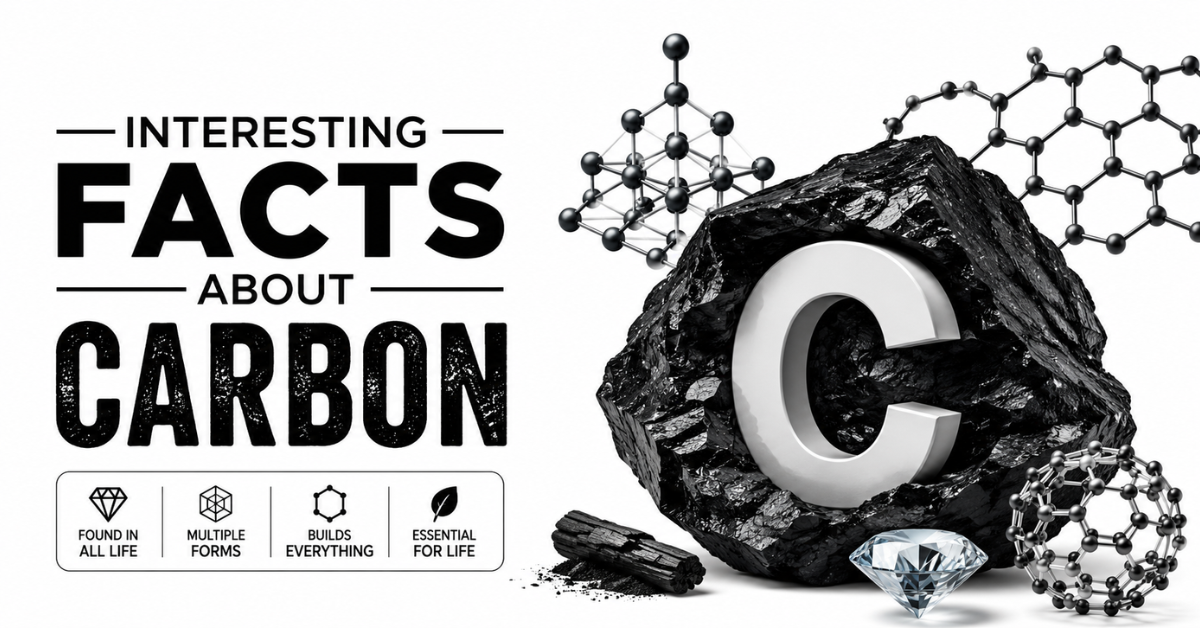
Interesting Facts About Carbon You Never Knew Before
Carbon is one of the most fascinating elements on Earth, forming the foundation of life and appearing in everything from living cells to fuels, plastics, and diamond. These interesting facts about carbon reveal why this versatile element is so important in science and everyday life. Carbon has the unique ability to bond with many other elements and with itself, creating millions of different compounds.
It can also exist in several forms, known as allotropes, including graphite, diamond, and graphene. From the carbon cycle that moves carbon through nature to its role in organic chemistry, this element connects biology, geology, technology, and climate science. Explore these surprising carbon facts to discover what makes carbon truly extraordinary.
Quick Carbon Facts at a Glance
| Fact | Detail |
| Symbol | C |
| Atomic number | 6 |
| Atomic weight | ~12.011 |
| Group / Period | 14 / 2 |
| Stable isotopes | Carbon-12, Carbon-13 |
| Radioactive isotope | Carbon-14 (half-life ~5,730 years) |
| % of Earth’s crust | ~0.025% |
| % of human body (by mass) | ~18.5% |
| Universe abundance rank | 4th most abundant element by mass |
What Is Carbon and How Was It Named?
- Carbon’s name comes from the Latin word “carbo,” meaning charcoal or coal.
- French chemist Antoine Lavoisier identified carbon as a distinct chemical element in 1789, helping establish it within the modern framework of chemistry.
- Carbon has been used by humans since prehistoric times in the form of charcoal and soot, long before it was understood as an element.
- Every carbon atom has 6 protons and 6 electrons, placing it at atomic number 6 on the periodic table.
Carbon’s Allotropes: Diamond, Graphite, and Beyond
Carbon can arrange its atoms in dramatically different structures called allotropes and each one behaves completely differently.
| Allotrope | Structure | Key Property |
| Diamond | Rigid 3D tetrahedral lattice | Hardest known natural material |
| Graphite | Layered hexagonal sheets | Soft, conducts electricity |
| Graphene | Single-layer sheet of graphite | Extremely strong and lightweight |
| Fullerenes | Hollow cage/tube structures | Used in nanotechnology |
| Amorphous carbon | No fixed crystal structure | Found in soot, charcoal, coal |
- Diamond and graphite are both pure carbon, yet diamond is transparent and one of the hardest materials on Earth, while graphite is soft, black, and slippery.
- Graphene, a single layer of graphite just one atom thick, is prized for being both incredibly strong and an excellent electrical conductor.
- Fullerenes, including spherical “buckyballs” and cylindrical carbon nanotubes, were significant enough to earn their discoverers a Nobel Prize in Chemistry in 1996.
- Despite their different appearances, all common carbon allotropes exist as solids at room temperature and pressure.
Carbon Is the Backbone of Life
- Carbon is often called the “backbone of organic chemistry” because it can bond with itself and many other elements to form long, stable chains and rings.
- A single carbon atom can form up to four covalent bonds, enabling an enormous diversity of molecular structures.
- Carbon is estimated to form nearly 10 million known compounds, far more than any other element.
- All known living organisms are carbon-based, since carbon’s bonding versatility makes it uniquely suited to building complex biological molecules like DNA and proteins.
- Carbon makes up roughly 18.5% of the human body by mass, making it the second most abundant element in you after oxygen.
Carbon Dating and Carbon’s Isotopes
- Natural carbon exists mainly as two stable isotopes: carbon-12 (about 99%) and carbon-13 (about 1%).
- Carbon-14, a radioactive isotope, occurs naturally in trace amounts and decays with a half-life of about 5,730 years.
- Because living organisms constantly exchange carbon with their environment, measuring how much carbon-14 remains in organic material allows scientists to estimate its age a technique known as radiocarbon dating.
- Radiocarbon dating is reliable for organic material up to roughly 50,000 years old, after which too little carbon-14 remains to measure accurately.
The Carbon Cycle and Carbon Dioxide
- Carbon continuously moves between the atmosphere, oceans, soil, and living things in a process called the carbon cycle.
- Plants absorb carbon dioxide (CO₂) during photosynthesis, converting it into sugars and releasing oxygen as a byproduct.
- When organisms respire, decompose, or burn fossil fuels, carbon is released back into the atmosphere, mostly as CO₂.
- Fossil fuels like coal, oil, and natural gas are essentially ancient carbon, formed from organic matter buried and transformed over millions of years.
Everyday Uses of Carbon
- Activated carbon, treated to have an extremely porous structure, is used in water filters, air purifiers, and even emergency treatment for certain poisonings.
- Carbon black, a fine powder form of amorphous carbon, is what gives most car tires their black color and adds durability and UV resistance to the rubber.
- Carbon fiber, made of tightly bonded carbon atoms, is prized in aerospace and sports equipment for being lightweight yet extremely strong.
- Carbon nanotubes and graphene are driving advances in electronics, batteries, and medical technology thanks to their strength and conductivity.
- Not all carbon compounds are helpful some, like carbon monoxide, are toxic and dangerous in enclosed spaces.
Weird and Surprising Carbon Facts
- Carbon is the 4th most abundant element in the universe by mass, behind only hydrogen, helium, and oxygen.
- Despite its cosmic abundance, carbon makes up only about 0.025% of Earth’s crust.
- A pencil “lead” isn’t lead at all it’s actually graphite, a form of pure carbon.
- Diamonds can theoretically form from graphite under extreme heat and pressure, meaning two dramatically different materials share an identical chemical identity.
Frequently Asked Questions About Carbon
1. What are the most amazing facts about carbon?
Carbon is one of the most versatile elements on Earth. It can form diamonds, graphite, graphene, and countless organic compounds, making it essential for life and modern technology.
2. What are the lesser-known facts about Carbon?
A lesser-known fact is that carbon can form extremely strong structures such as graphene, which is only one atom thick. Carbon also exists in different forms called allotropes, each with very different properties.
3. What makes carbon such an interesting material?
Carbon is interesting because its atoms can bond with each other and with many other elements in countless ways. This versatility allows carbon to form everything from DNA and proteins to fuels, plastics, and advanced materials.
4. What are some characteristics of carbon?
Carbon is a nonmetallic element with atomic number 6. It has four valence electrons, allowing it to form stable bonds and complex molecules. It occurs naturally in several forms, including graphite and diamond.
5. What are some things that have carbon in them?
Carbon is found in humans, animals, plants, food, wood, coal, petroleum, natural gas, plastics, and many minerals. Carbon dioxide in the atmosphere also contains carbon.
Final Thoughts
From the graphite in your pencil to the diamond in a ring, and from the carbon dioxide you exhale to the carbon atoms holding your DNA together, this single element quietly shapes an extraordinary range of the world around you. Understanding carbon’s versatility is really understanding one of chemistry’s most fundamental building blocks.

Hi, I’m Benjamin, the person behind FactsAboutDog.com. 🐶
I’m passionate about dogs and love sharing interesting, fun, and educational facts about our furry friends. Through FactsAboutDog.com, I aim to make learning about dogs simple, enjoyable, and informative for dog lovers everywhere.
From amazing dog facts to breed information and fascinating animal knowledge, my goal is to help readers discover something new every day.
Explore the world of dogs with Benjamin at FactsAboutDog.com!