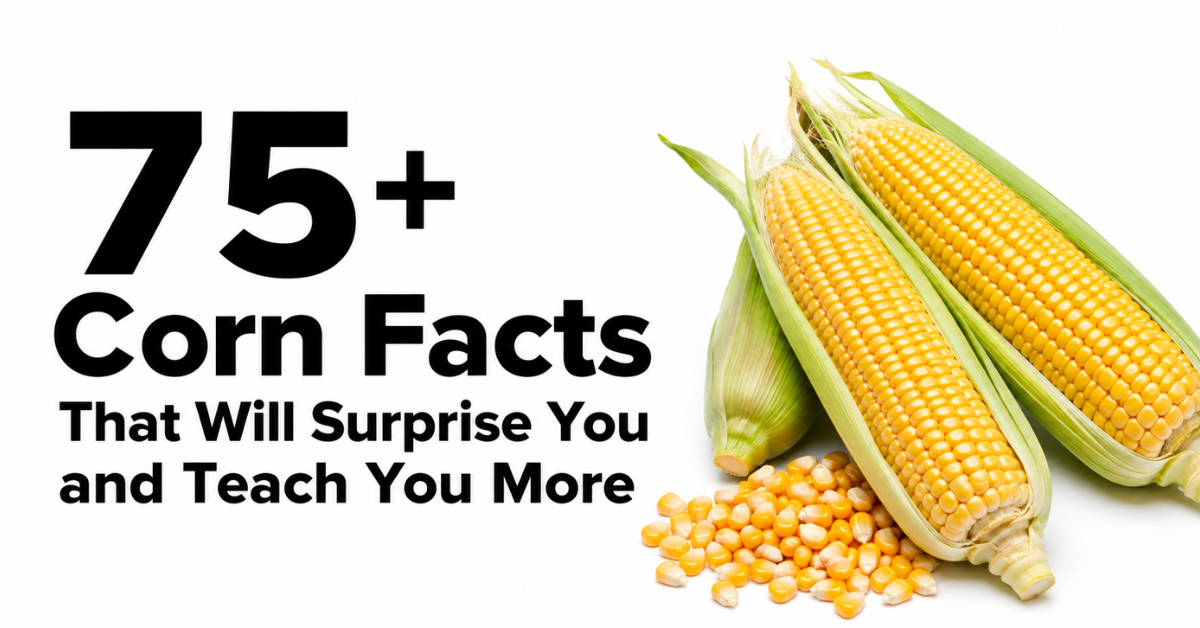
75+ Corn Facts That Will Surprise You and Teach You More
Corn is far more than a simple vegetable on your dinner plate. It is one of the world’s most important cereal crops, feeding billions of people, supporting livestock, and serving as a key ingredient in countless everyday products. From its ancient origins in Mexico to its role in modern farming, corn has shaped civilizations, economies, and global food systems.
Key Takeaways
- Corn (Zea mays) was domesticated in Mexico ~9,000 years ago from a wild grass called teosinte.
- There are four main types: dent, sweet, popcorn, and flint corn.
- The United States, China, and Brazil are the world’s top corn producers.
- Each corn silk connects to exactly one kernel no silk, no kernel.
- Less than 1% of U.S. corn grown is sweet corn; most is field corn for feed and industry.
- The tallest sweetcorn plant on record measured 48 ft 2 in (Guinness World Records, 2021).
Corn at a Glance
| Fact | Detail |
| Scientific name | Zea mays |
| Wild ancestor | Teosinte |
| Domesticated | ~9,000 years ago, southern Mexico |
| Main types | Dent, sweet, popcorn, flint |
| Top producers | USA, China, Brazil |
| U.S. “Corn Belt” states | Iowa, Illinois, Nebraska, Indiana, Minnesota |
| Kernels per ear | 400–600 (up to 1,000 potential ovules) |
| Primary global use | Livestock feed & ethanol |
Corn History Timeline
- ~9,000 years ago: Indigenous peoples in southern Mexico begin domesticating teosinte into early maize.
- ~4,000 years ago: Corn cultivation spreads across Mesoamerica and becomes central to Maya, Aztec, and later Inca agriculture.
- 1493: Corn is brought to Europe by explorers returning from the Americas.
- 1800s: Farmer-bred varieties like Reid’s Yellow Dent improve U.S. corn yields.
- 1930s: Hybrid corn seed becomes commercially available, transforming American agriculture.
- 1996: The first genetically modified (GMO) corn is approved for U.S. commercial planting.
- Today: Corn is the most-produced grain crop in the world by volume.
What Are the Different Types of Corn?
| Type | Also Known As | Main Use |
| Dent corn | Field corn | Livestock feed, ethanol, processed food |
| Sweet corn | Fresh eating, canning, freezing | |
| Popcorn | A flint corn variety | Snack food |
| Flint corn | Indian/calico corn | Tortillas, hominy, grits, decoration |
- Dent corn gets its name from the small dent that forms in each kernel as it dries; it makes up the majority of U.S. corn acreage.
- Sweet corn is harvested early, while sugar levels are highest (~10% sugar vs. ~4% in field corn), and its kernels always grow in an even number of rows.
- Popcorn has a hard shell that traps steam; when heated, internal pressure builds until the kernel bursts inside-out.
- Flint corn has a thick, glassy outer layer and is still a dietary staple in Central and South America.
Corn Plant Anatomy & Pollination Facts
- The corn plant is monoecious it has separate male and female flowers on the same plant.
- The tassel at the top is the male flower; it releases pollen.
- Corn silk is the female flower’s stigma, and each strand connects to exactly one ovule (potential kernel).
- Silk can grow 1–1.5 inches per day and remains receptive to pollen for about 10 days.
- Pollen travels down the silk through a pollen tube, fertilizing the ovule in under 24 hours.
- A single ear can form up to 1,000 ovules, but typically only 400–600 kernels survive to harvest.
- Corn is primarily wind-pollinated (anemophily), though bees and other insects occasionally assist.
- Heat stress, drought, and heavy rain during silking can all reduce pollination success and cause missing kernels.
Corn Root & Growth Facts
- Corn roots grow in two stages: shallow seminal roots first, then a deeper, wider nodal root system that anchors the plant and absorbs water and nutrients.
- Above-ground brace roots form near the base of the stalk, helping prevent the plant from toppling in strong wind a phenomenon farmers call “lodging” when it fails.
- A healthy corn plant can grow 1.5–2 inches per day during peak summer growth.
- Corn typically reaches full maturity in 60–100 days, depending on the variety and climate.
Corn Pests & Diseases
Corn faces several recurring threats that farmers actively manage each season:
- Corn earworm one of the most damaging pests, feeding directly on developing kernels at the ear tip.
- European corn borer tunnels into stalks, weakening the plant and reducing yield.
- Gray leaf spot & northern corn leaf blight fungal diseases that reduce photosynthesis by damaging leaf tissue.
- Bt corn (see above) was specifically developed to reduce reliance on chemical pesticides against pests like the corn borer.
Corn Around the World
Corn is grown on nearly every inhabited continent, but production is concentrated in a few dominant regions.
- United States the world’s largest producer, centered in the Corn Belt (Iowa, Illinois, Nebraska, Indiana, Minnesota).
- China second-largest producer, driven by domestic feed and food demand.
- Brazil a major exporter, especially to Asian markets.
Organizations like the USDA and FAO track global corn production, trade, and price data, and corn remains one of the most heavily traded agricultural commodities worldwide.
Corn Exports & Global Trade
| Country | Role in Global Corn Trade |
| United States | Largest exporter by volume |
| Brazil | Fast-growing exporter, major supplier to Asia |
| Argentina | Significant exporter to Latin America & the EU |
| China | Largest consumer; imports to meet feed demand |
Global corn trade is closely tracked by the USDA and FAO, since shifts in export volume directly affect livestock feed costs and food prices worldwide.
Corn Festivals Around the World
- The National Sweet Corn Festival (Illinois) celebrates the harvest with free sweet corn for tens of thousands of visitors.
- La Guelaguetza in Oaxaca, Mexico, honors indigenous corn-growing traditions alongside music and dance.
- Numerous Corn Maze festivals across the U.S. and Canada turn autumn harvest fields into seasonal tourist attractions.
Corn in History & Culture
- Corn’s wild ancestor, teosinte, differs from modern corn by only about five genes.
- Corn was sacred to the Maya, Aztec, and Inca civilizations, often tied to creation myths and the “Corn Mother” figure.
- Many Native American nations, including the Haudenosaunee (Iroquois), practiced the “Three Sisters” method planting corn, beans, and squash together so each crop supports the others.
- Corn acted as a natural trellis for beans; beans fixed nitrogen into the soil; squash leaves shaded the ground and suppressed weeds.
- Glass Gem corn, famous for its rainbow, translucent kernels, was bred in Oklahoma in the 1980s by Carl “White Eagle” Barnes from heirloom Pawnee and Osage corn varieties, and went viral worldwide in 2012.
Corn Uses Beyond Food
Corn’s byproducts show up far outside the kitchen:
- Corn starch thickener in food and industrial products
- Corn syrup sweetener in processed foods and beverages
- Corn oil cooking oil and industrial lubricant base
- Corn flour & cornmeal baking, tortillas, cornbread
- Ethanol a major U.S. biofuel additive
- Bioplastics & adhesives corn starch is used to make biodegradable plastics and industrial glues
- Bt corn a genetically modified variety engineered to produce a natural pesticide, reducing the need for chemical spraying
- Organic corn grown without synthetic pesticides or GMO seed, under certified standards
Rare & Unusual Corn Varieties
| Variety | Standout Feature |
| Glass Gem corn | Translucent, jewel-toned kernels |
| Blue corn | Used in traditional Southwestern and Mexican dishes |
| Baby corn | Harvested extremely young, eaten whole |
| Waxy corn | Sticky texture, popular in Asian cooking |
| Rainbow/Indian corn | Multicolor flint corn, often decorative |
Corn World Records
- Tallest sweetcorn plant: 14.69 m (48 ft 2 in), grown by Jason Karl in New York, USA Guinness World Records, 2021.
- Largest temporary corn/crop maze: 266,106 m² (65.8 acres), built by Luc Pelletier in Quebec, Canada verified 2022.
- One of the most famous corn mazes, Cool Patch Pumpkins in Dixon, California, has twice held the Guinness title for largest corn maze and uses over 3.6 million corn stalks.
Weird & Surprising Corn Facts
- No two ears of corn have the exact same number of kernel rows most have between 12 and 20, always an even number.
- Corn cannot pollinate itself effectively over long distances; that’s why farmers plant it in blocks, not single rows, to improve pollination.
- Popcorn is technically thousands of years older than sweet corn as a cultivated variety.
- A bushel of corn (56 lbs) can produce roughly 2.8 gallons of ethanol.
- Corn is grown on every continent except Antarctica.
Corn Myths vs. Facts
| Myth | Fact |
| “All corn is edible off the stalk.” | Most field corn is starchy and unpalatable raw; only sweet corn is bred for fresh eating. |
| “Popcorn is a separate plant species.” | Popcorn is simply a type of flint corn, still Zea mays. |
| “GMO corn and hybrid corn are the same thing.” | Hybrid corn is bred through cross-pollination; GMO corn involves direct genetic modification in a lab. |
| “Corn silk means the ear failed to grow.” | Every kernel requires a silk strand to be pollinated silk is essential, not a defect. |
Corn Kernel Structure
Each individual kernel is built from four main parts, and knowing them explains a lot about how corn is processed:
- Pericarp the tough outer skin that protects the kernel.
- Endosperm the starchy interior that makes up most of the kernel’s mass and provides energy.
- Germ the nutrient-dense embryo, rich in oil, which is pressed to make corn oil.
- Tip cap the point where the kernel attaches to the cob, allowing nutrients to flow in during development.
Corn Nutrition Facts
Corn is a solid source of carbohydrates and dietary fiber, along with B vitamins like thiamin and folate, plus minerals such as magnesium and phosphorus. Nutritional value varies by type and preparation boiled sweet corn retains more nutrients than heavily processed corn products like corn syrup.
Corn Facts for Kids
- Corn seeds were shared by Native Americans with early European settlers, helping them survive.
- One corn plant usually grows just one or two ears.
- Corn tassels look like feathers and release pollen that blows in the wind to help make kernels.
- The world’s biggest corn mazes are large enough to explore for hours.
Corn Sustainability & Climate-Smart Farming
Many modern corn farmers use precision agriculture GPS-guided planting, targeted irrigation, and no-till methods to protect long-term soil and water health:
- Healthy soil: cover cropping and no-till farming reduce erosion.
- Clean water: reduced fertilizer runoff protects nearby waterways.
- Climate: corn residue and cover crops help sequester carbon.
- Air: efficient equipment cuts fuel emissions during planting and harvest.
The Future of Corn
Researchers and farmers are focused on breeding drought-tolerant and heat-resistant corn varieties to withstand shifting climate patterns, while precision agriculture tools aim to increase yield per acre without expanding farmland. Continued interest in heirloom and non-GMO varieties, like Glass Gem corn, is also driving renewed attention to genetic diversity and seed preservation.
Frequently Asked Questions About Corn
What are some facts about corn?
Corn, also called maize, is one of the world’s most widely grown crops. It originated in Mexico thousands of years ago and comes in several types, including sweet, dent, popcorn, and flint corn.
What are the uses of corn?
Corn is used as food for people and livestock and is also processed into products such as cornmeal, starch, syrup, cooking oil, and ethanol. It is also used in some industrial products.
What are the nutritional benefits of corn?
Corn provides carbohydrates for energy and contains fiber, folate, vitamin C, magnesium, and antioxidants such as lutein and zeaxanthin. Whole corn can be part of a balanced diet.
Why is corn/maize the most grown crop in the world?
Corn is grown extensively because it is versatile, productive, and useful for food, animal feed, fuel, and industrial products. It also grows successfully across many different climates.
Is corn a healthy vegetable to love?
Yes. Whole corn can be a nutritious food because it provides fiber, vitamins, minerals, and plant compounds. Portion size and preparation matter, especially when corn is served with lots of added butter, salt, or sugar.
Final Thoughts
From a nine-thousand-year-old wild grass to record-breaking mazes and GMO debates, corn’s story is far bigger than a summer side dish. Understanding its types, science, history, and uses shows just how deeply this single crop is woven into farming, food, culture, and industry worldwide.

Hi, I’m Benjamin, the person behind FactsAboutDog.com. 🐶
I’m passionate about dogs and love sharing interesting, fun, and educational facts about our furry friends. Through FactsAboutDog.com, I aim to make learning about dogs simple, enjoyable, and informative for dog lovers everywhere.
From amazing dog facts to breed information and fascinating animal knowledge, my goal is to help readers discover something new every day.
Explore the world of dogs with Benjamin at FactsAboutDog.com!