
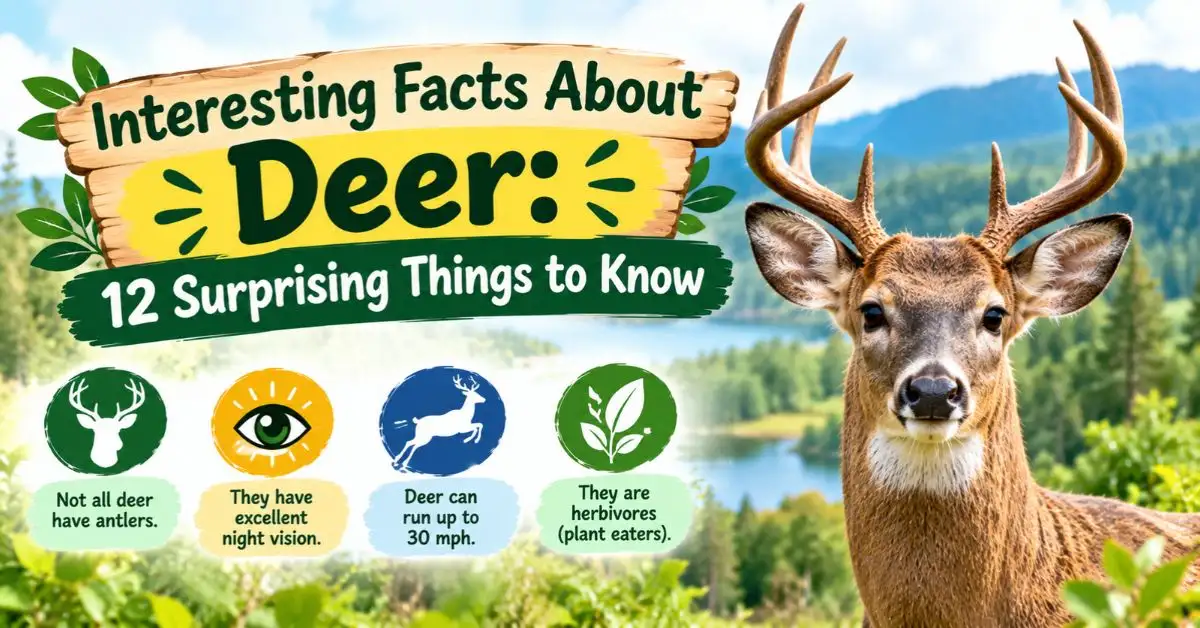
Interesting Facts About Deer: 12 Surprising Things to Know
Deer are among North America’s most fascinating herbivores, growing and shedding antlers every year, sprinting over 30 mph, and communicating through scent, sound, and body language. If you’ve ever watched a white-tailed deer bound across your backyard at dusk, you already know these woodland creatures hide more complexity than most people realize.
From the tiny pudu to the extinct, seven-foot-tall Irish giant deer, the Cervidae family spans more than 60 species worldwide, including mule deer, red deer, and reindeer. This guide breaks down the most interesting facts about deer antlers, naming, diet, hearing, and migration so you’ll understand exactly why these graceful mammals captivate hunters, photographers, and backyard observers alike.
Interesting Facts About Deer Species Found Across the World
The deer family, Cervidae, includes more than 60 species spread across every continent except Antarctica and Australia. In the United States, two species dominate: the white-tailed deer and the mule deer, each adapted to different terrain, from dense eastern forests to open western grasslands and sagebrush flats.
Globally, this diversity ranges from the tiny pudu, barely 14 inches tall, to large-bodied red deer roaring through European woodlands. One of the most interesting facts about deer species is how differently they’ve evolved to survive climates from Arctic tundra to tropical rainforest.
Interesting Facts About Deer Antlers and Why Only Males Grow Them
Antlers are one of the most interesting facts about deer biology: they’re the fastest-growing living tissue on Earth, sometimes lengthening nearly an inch per day in summer. Covered in velvet, a soft layer of skin and blood vessels, antlers harden by autumn just in time for the breeding season, known as the rut.
Almost every male deer species grows antlers, with the Chinese water deer as the lone exception it relies on long, fang-like tusks instead. Bucks shed their antlers each winter once testosterone drops, then regrow a larger set the following spring, often signaling age and health to rivals and does.
How Often Do Deer Shed Their Antlers?
Bucks shed antlers annually, typically between December and March depending on latitude and daylight length. New growth begins within weeks, covered in protective velvet, and most bucks regrow a full rack by late summer, ready for the next rutting season.
Interesting Facts About What Deer Are Called Buck, Doe, and Fawn
Deer terminology trips up plenty of people, which makes it one of the more interesting facts about deer most never learn in school. A male deer is called a buck, though in larger species like red deer and elk, he’s known instead as a stag or hart.
A female deer is a doe, while females of bigger species including red deer and elk are called hinds. Baby deer, regardless of species, are universally known as fawns, typically born each spring with white-spotted coats that fade as they mature into adulthood.
Interesting Facts About How Fast White-Tailed Deer Can Run
White-tailed deer can sprint up to 35 miles per hour, making them faster than most dogs and quick enough to outrun many natural predators. That burst of speed, paired with explosive jumping ability over eight feet high, lets them clear fences and obstacles without breaking stride.
This athleticism isn’t just for show it’s survival. Startled, a deer can go from standing still to full sprint almost instantly, weaving unpredictably through brush to shake off coyotes, bears, or mountain lions chasing from behind.
Interesting Facts About Deer Intelligence
Despite the unflattering phrase “deer in headlights,” white-tailed deer are genuinely intelligent animals. They learn hunting patterns, recognize safe zones within days of a threat appearing, and adjust daily movement schedules around human activity, traffic, and seasonal hunting pressure.
Researchers have documented deer shifting nighttime versus daytime activity based on which period carries less risk. This adaptive behavior reflects real problem-solving, not the panicked freeze response their reputation suggests a genuinely interesting fact about deer survival instincts.
Interesting Facts About the Average Lifespan of Deer
Wild deer generally live six to ten years, a surprisingly short lifespan driven by predation, vehicle collisions, disease, and hunting pressure. In protected environments like sanctuaries, deer can live considerably longer, sometimes reaching twenty years without those same threats.
Bucks tend to have shorter lifespans than does because the physical toll of fighting during rut, combined with hunting pressure targeting antlered males, raises their mortality risk each year compared to does raising fawns in relative safety.
Interesting Facts About a Deer’s Incredible Hearing
A deer’s hearing range stretches past 54,000 hertz, roughly three times sharper than human hearing and comparable to an average dog’s. Large, independently rotating ears let deer pinpoint distant sounds with remarkable precision, often detecting danger long before it’s visible.
This heightened hearing works alongside an exceptional sense of smell, which deer use to detect predators, locate food, and communicate with other deer through scent glands. Together, these senses explain why sneaking up on a wild deer is nearly impossible.
Interesting Facts About the Herbivore Diet of Deer
Deer are herbivores with a four-chambered stomach built for digesting tough plant material through rumination, or chewing cud. Their diet shifts seasonally between grasses, acorns, fruit, and woody browse depending on what’s available in their habitat.
When food grows scarce in harsh winters, deer resort to eating bark, twigs, and ornamental garden plants, which is why homeowners near forests often battle deer-proofing their yards. Despite this flexibility, deer remain selective feeders whenever better options exist.
Interesting Facts About Seasonal Deer Migration
Not every deer stays put year-round. Populations in mountainous or northern regions migrate seasonally, moving to lower elevations once snow makes foraging difficult, then returning to higher ground once spring growth returns.
These migration routes, sometimes spanning dozens of miles, are learned behaviors passed down through generations rather than pure instinct. Wildlife biologists increasingly track these corridors to protect them from highway development and habitat fragmentation.
Interesting Facts About Deer and Their Swimming Ability
Few people expect this, but deer are excellent swimmers, capable of crossing rivers, lakes, and even short ocean channels when necessary. Their hollow guard hairs trap air for buoyancy, while powerful legs provide surprisingly strong propulsion through water.
Swimming helps deer escape predators that can’t follow into deep water, reach isolated feeding grounds, or disperse to new territory. Island populations of white-tailed deer, in fact, often arrived by swimming rather than any human transport.
Interesting Facts About “Vampire Deer” With Fangs Instead of Antlers
One of the strangest interesting facts about deer involves species that never grow antlers at all. Chinese water deer and Siberian musk deer instead grow long, visible canine teeth, earning them the nickname “vampire deer” among wildlife enthusiasts and researchers.
These elongated fangs aren’t used for hunting the animals remain strict herbivores but rather for sparring with rival males during breeding season, functioning much like antlers do in every other deer species worldwide.
Interesting Facts About the Largest Deer Species That Ever Lived
The largest deer species ever recorded was the Irish giant deer, which stood roughly seven feet tall at the shoulder and carried antlers spanning up to twelve feet before going extinct around 11,000 years ago at the end of the last Ice Age.
Today’s largest living deer relatives are found among moose and red deer populations across Europe, Asia, and North America, though nothing alive compares to the sheer scale of that prehistoric giant, whose fossilized remains are still unearthed in Irish bogs.
White-Tailed Deer vs. Mule Deer at a Glance
| Feature | White-Tailed Deer | Mule Deer |
| Primary US Region | Eastern forests, farmland, suburbs | Western deserts, grasslands, sagebrush |
| Ears | Proportional to head | Large, mule-like ears |
| Tail Behavior | Raises white tail as warning flag | Smaller, black-tipped tail |
| Antler Shape | Single main beam, upward tines | Bifurcated (forked) branching |
| Top Speed | Up to 35 mph | Slightly slower; known for a stiff-legged “stotting” bound |
| US Population | Roughly 30 million | Smaller, concentrated in western states |
FAQ Section
What is a baby deer called?
A baby deer is called a fawn. Fawns are typically born in spring with white-spotted coats that help camouflage them in dappled forest light until the spots fade with age.
How fast can a deer run?
White-tailed deer can run up to 35 miles per hour and jump obstacles over eight feet tall, giving them a strong edge when escaping predators like coyotes or mountain lions.
Do all deer species grow antlers?
No. Only males in most deer species grow antlers, with caribou (reindeer) as the exception, since females grow them too. Chinese water deer grow neither sex antlers at all.
How long do deer live in the wild?
Most wild deer live six to ten years due to predation, vehicle collisions, and hunting pressure. In captivity or protected sanctuaries, some individuals live twenty years or more.
Are deer good swimmers?
Yes. Deer are strong swimmers thanks to buoyant, hollow guard hairs and powerful legs, allowing them to cross rivers, lakes, and even short ocean channels when needed.
What was the largest deer species ever?
The extinct Irish giant deer was the largest, standing about seven feet tall with antlers spanning up to twelve feet, before dying out roughly 11,000 years ago.
Why do white-tailed deer raise their tails?
Raising the tail exposes its white underside as a visible warning signal, alerting other deer nearby that a predator or threat has been detected.

Hi, I’m Benjamin, the person behind FactsAboutDog.com. 🐶
I’m passionate about dogs and love sharing interesting, fun, and educational facts about our furry friends. Through FactsAboutDog.com, I aim to make learning about dogs simple, enjoyable, and informative for dog lovers everywhere.
From amazing dog facts to breed information and fascinating animal knowledge, my goal is to help readers discover something new every day.
Explore the world of dogs with Benjamin at FactsAboutDog.com!