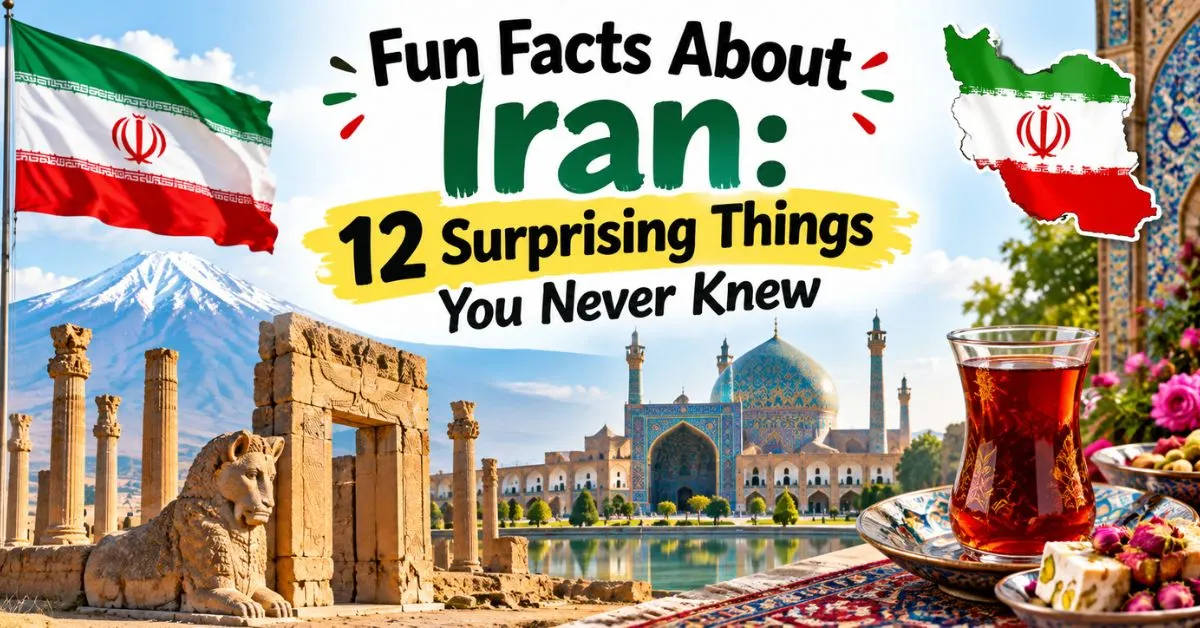
Fun Facts About Iran: 12 Surprising Things You Never Knew
Iran is one of the most misunderstood countries on Earth and these fun facts about Iran prove there’s far more to the story than headlines suggest. I’ve spent years researching Persian history and culture, and every time I dig deeper, I find another detail that reshapes how I see this ancient land. If you’ve ever felt like the news only shows one narrow slice of Iran, you’re not alone, and that gap in understanding is exactly what this guide closes.
From the ruins of the Persian Empire to a literal rainbow-colored island in the Persian Gulf, Iranian culture blends thousands of years of history with customs that still baffle first-time visitors. This isn’t a dry textbook rundown it’s a collection of the same startling, delightful details that travel writers, historians, and Iranians themselves love sharing. By the end, you’ll have a genuinely richer picture of Iran, its people, and its Persian roots.
Fun Facts About Iran: Iranians Are Persian, Not Arab
One of the most common misconceptions in the Middle East region is language. Iranians don’t speak Arabic; they speak Persian, also called Farsi, a completely separate language family from Arabic entirely. This single distinction explains a lot about Iranian identity and cultural pride.
Roughly 61% of Iran’s population identifies as ethnically Persian, while Azeris, Kurds, Lors, Baluchs, and Arabs make up the rest of this remarkably diverse nation. That ethnic mix shapes everything from regional cuisine to festival traditions, making “Iranian” a much broader identity than outsiders often assume.
Fun Facts About Iran and the Persian Empire’s Power
Long before Rome or Athens reached their peak, the Achaemenid Persian Empire under Cyrus the Great had already become the largest empire the ancient world had ever seen. Founded around 550 BCE, it stretched from Egypt to parts of modern-day Pakistan, uniting dozens of cultures under one administration.
Visitors today can walk through Persepolis, the empire’s ceremonial capital, where towering stone columns and detailed reliefs still stand. The Cyrus Cylinder, often cited as an early human-rights document, also emerged from this era a genuinely progressive artifact for its time, now housed in the British Museum.
Fun Facts About Iran’s Own Calendar System
Here’s a fun fact about Iran that trips up nearly every visitor: the country doesn’t use the Gregorian calendar as its primary system. The Iranian solar calendar begins on the spring equinox and is calculated from astronomical observations made in Tehran, not fixed mathematical rules.
The Iranian year has twelve months the first six carry 31 days, the remaining six carry 30 which keeps the calendar closely tied to the seasons. Government documents even display three dates side by side: Iranian, Islamic, and Gregorian, which can understandably confuse international travelers and businesses alike.
Fun Facts About Iran: Why a Thumbs-Up Is an Insult
If you’re planning a trip, remember this cultural fact about Iran before you gesture to anyone. The thumbs-up sign, a universal symbol of approval in most Western countries, is considered the equivalent of showing someone the middle finger in Iranian culture.
This gesture mix-up has embarrassed plenty of well-meaning tourists over the years, and it’s a genuinely useful piece of cultural etiquette to memorize. A simple nod, smile, or spoken thank-you communicates the same positive sentiment without the risk of causing offense in social or business settings.
Fun Facts About Iran: Alcohol Is Banned Country-Wide
Since the 1979 Islamic Revolution, alcohol has been illegal to sell or consume publicly anywhere in Iran, a sharp contrast with most of its Middle Eastern neighbors. Restaurants often list beer on the menu, but it’s strictly the non-alcoholic variety, brewed in a surprising range of fruity flavors.
Rather than mourning the absence of wine or spirits, Iranians lean on sharbat, a tradition of chilled herbal and floral drinks made from rosewater, mint, or sour cherry. Popular varieties like sekanjabin and bahar narenj offer a refreshing, distinctly Persian alternative that’s worth trying on any visit.
Fun Facts About Iran’s Rainbow Island
Hormuz Island, sitting in the Strait of Hormuz near the Persian Gulf, might be the most photogenic fun fact about Iran on this entire list. Its Rainbow Valley features striped, multicolored mountains, while nearby Red Beach turns the shoreline a deep crimson against turquoise water.
The island’s Salt Goddess Cave reveals marble-like rainbow patterns inside a cavern locals link to ancient folklore, and the dome-shaped Majara Residence offers architecture unlike anywhere else in Iran. Combined with a centuries-old Portuguese fortress, Hormuz packs an astonishing amount of color and history into one small landmass.
Fun Facts About Iran: The Word “Assassin” Came From Here
Few English speakers realize their vocabulary owes a debt to medieval Iran. The word “assassin” traces back to the Hashishin, a secretive order that operated from mountain strongholds in Iran during the 11th and 12th centuries, targeting specific rivals rather than waging open war.
Their reputation for calculated, targeted killings was so notorious across the medieval world that the term eventually entered European languages and stuck permanently. Today, “assassin” and “assassination” remain everyday English words with a direct linguistic line back to Persian history.
Fun Facts About Iran’s Hottest Place on Earth
The Lut Desert in southeastern Iran has recorded some of the highest surface temperatures ever measured on the planet, with NASA satellite data showing readings well above 70°C (159°F). This UNESCO-listed desert landscape is as scientifically fascinating as it is punishing to visit in summer.
Beyond the extreme heat, the Lut Desert is known for its “kaluts,” dramatic wind-carved rock formations that resemble sprawling sandcastles stretching across the horizon. It’s a striking reminder that Iran’s geography ranges from snowy peaks to some of Earth’s most inhospitable terrain within the same country.
Fun Facts About Iran’s Hospitality and the Culture of Taarof
Iranian hospitality is legendary, and much of it centers on a social custom called taarof, a ritual of polite, repeated offers and equally polite refusals. A host might offer tea three or four times before a guest finally accepts, and this dance of generosity is considered a sign of deep respect rather than insincerity.
This same etiquette extends to paying for meals, offering seats, or complimenting someone’s home, where the “correct” response often isn’t the literal one. Understanding taarof helps visitors read Iranian social cues accurately and avoid awkwardly accepting or declining too quickly.
Fun Facts About Iran’s UNESCO World Heritage Sites
Iran ranks among the top ten countries worldwide for UNESCO World Heritage Sites, with more than two dozen officially inscribed locations spanning ancient cities, mosques, and archaeological sites. That density of protected heritage reflects thousands of years of continuous civilization within its borders.
Sites like Persepolis, Isfahan’s Naqsh-e Jahan Square, and the mud-brick city of Yazd showcase architectural styles found nowhere else on Earth. For history lovers, few countries pack this much verified cultural significance into a single itinerary.
Fun Facts About Iran: Tea Beats Alcohol as the National Drink
With alcohol off the table, tea fills the social and cultural role that wine or beer might occupy elsewhere. Iranians drink “chaiee” throughout the day, brewed using a traditional samovar that keeps water hot while a teapot steeps on top, producing a strong, aromatic cup.
Tea accompanies nearly every social interaction in Iran, from morning breakfast to late-night conversations with friends and family. It’s such a cultural staple that offering tea to a guest is often the very first gesture of taarof-driven hospitality described earlier.
Fun Facts About Iran: More Women Than Men Attend University
A genuinely surprising fun fact about Iran involves higher education demographics. Women make up roughly 60% of university students nationwide, outnumbering their male peers by a notable margin at the undergraduate level.
That ratio shifts significantly at the graduate level, where fewer women pursue master’s or doctoral degrees due to social and career pressures after marriage. Still, the undergraduate gender gap challenges many outside assumptions about educational access for women in Iran.
FAQ Section
What is Iran best known for?
Iran is best known for the ancient Persian Empire, Persian carpets, saffron production, poetry traditions tied to Hafez and Rumi, and landmarks like Persepolis and Isfahan’s blue-tiled mosques.
Is alcohol really illegal in Iran?
Yes. Alcohol has been banned nationwide since the 1979 Islamic Revolution. Restaurants serve only non-alcoholic beer, and Iranians often drink sharbat or tea instead.
Do people in Iran speak Arabic?
No. The official language is Persian (Farsi), which is linguistically unrelated to Arabic, though Iran does have Arabic-speaking minority communities near its southwestern border.
Why is a thumbs-up offensive in Iran?
The thumbs-up gesture carries the same meaning as the middle finger in Iranian culture, making it one of the most important etiquette facts for visitors to know before traveling.
What is taarof in Iranian culture?
Taarof is a social custom of polite, repeated offers and refusals such as declining an invitation or gift at first that reflects respect and hospitality rather than genuine reluctance.
How many UNESCO World Heritage Sites does Iran have?
Iran has more than two dozen UNESCO-listed sites, placing it among the top ten countries in the world for verified cultural and historical heritage.

Hi, I’m Benjamin, the person behind FactsAboutDog.com. 🐶
I’m passionate about dogs and love sharing interesting, fun, and educational facts about our furry friends. Through FactsAboutDog.com, I aim to make learning about dogs simple, enjoyable, and informative for dog lovers everywhere.
From amazing dog facts to breed information and fascinating animal knowledge, my goal is to help readers discover something new every day.
Explore the world of dogs with Benjamin at FactsAboutDog.com!