
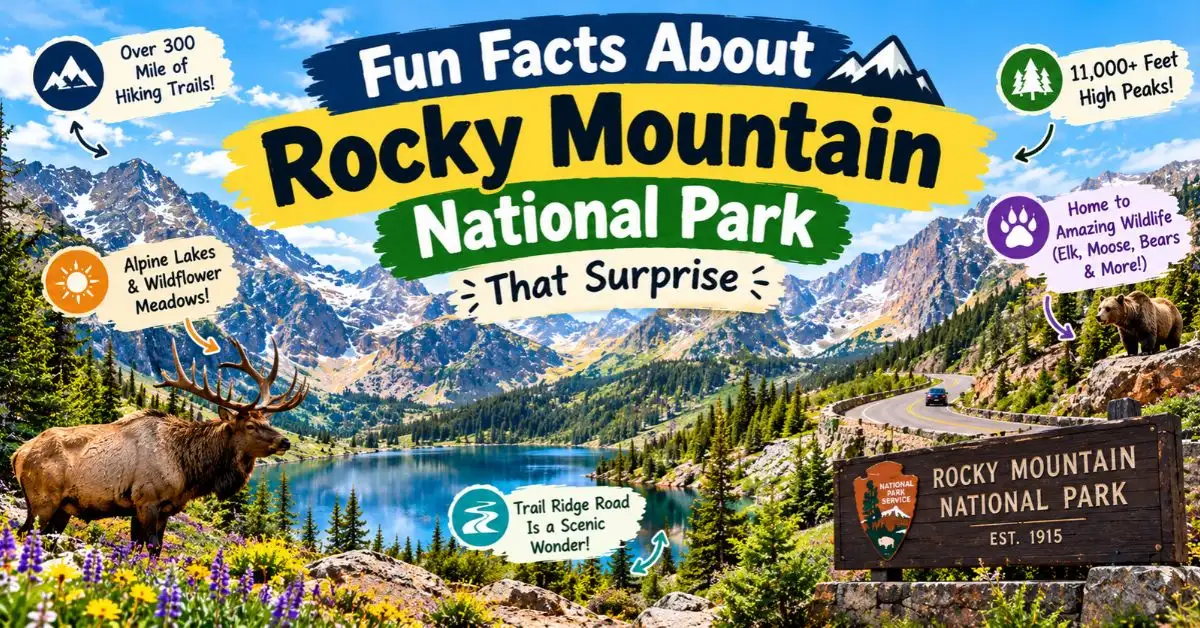
Fun Facts About Rocky Mountain National Park That Surprise
Rocky Mountain National Park spans 415 square miles of Colorado’s Front Range, where 77 peaks top 12,000 feet and roughly 95 percent of the land is protected wilderness. After years of researching national park history, I know how overwhelming scattered trivia feels when you just want facts you can trust.
Here are fun facts about Rocky Mountain National Park, cross-checked against several trusted park guides and including the latest 2025 visitor numbers. They cover Longs Peak, Trail Ridge Road, Estes Park, Grand Lake, elk, and moose, so you can plan a smarter visit and share stories worth telling around the campfire.
Fun Facts About Rocky Mountain National Park: Here Are Some Of The Basic Facts
Rocky Mountain National Park covers 415 square miles, about 265,807 acres, of Colorado’s Front Range. President Woodrow Wilson signed the park into existence in 1915. Elevations run from roughly 7,860 feet at the lowest points to 14,259 feet on Longs Peak, so you feel the altitude fast.
Popularity matches the scenery. The park logged 4,171,431 recreation visits in 2025, making it one of the busiest in the National Park System. Even the entrance fee has history: Abner Sprague reportedly paid the first $3 fee, and Sprague Lake still carries his name.
| Fact | Figure |
| Established | 1915 |
| Size | 415 square miles (about 265,807 acres) |
| Elevation range | About 7,860 to 14,259 feet |
| Peaks over 12,000 feet | 77 |
| Share designated wilderness | More than 95% |
| Recreation visits (2025) | 4,171,431 |
Fun Facts About Rocky Mountain National Park: Rocky Mountain Has 77 Peaks Over 12,000 Feet
Few parks feel this vertical. Seventy-seven peaks rise well above 12,000 feet, and the Continental Divide runs right through the park. Longs Peak, at 14,259 feet, is the only fourteener inside the boundary and ranks as Colorado’s 15th highest summit.
Rain that falls here chooses a side: water on the west flows toward the Pacific, while the east drains toward the Atlantic and the Gulf. The park’s Alpine Visitor Center also sits at the highest elevation of any National Park Service site, so pack layers even in July.
Fun Facts About Rocky Mountain National Park: The Paleo-Indians Were The Earliest Peoples To Inhabit The Rocky Mountains
People were here long before any park boundary. Paleo-Indians moved through these valleys some 11,000 to 12,000 years ago, hunting big game as the great ice sheets retreated. Archaeologists have dated a site inside the park to that era using radiocarbon dating.
Later, the Ute and Arapaho followed game between plains and high country, and some park trails, including the Tonahutu Trail, began as their routes. The Ute called today’s Grand Lake Spirit Lake, believing its cold waters held the souls of the departed.
Fun Facts About Rocky Mountain National Park: Longs Peak Is Named For An Army Explorer Who Mapped The Front Range
Longs Peak honors Stephen Harriman Long, a U.S. Army officer born in New Hampshire in 1784. As a topographical engineer, he was sent west to survey the Great Plains and Rockies, and his name stuck to the summit that now dominates Estes Park’s skyline.
Climbing Longs Peak remains a serious mountaineering challenge. It is the park’s only fourteener, and the summit can hold snow and ice even in midsummer. In 1868, William Byers and John Wesley Powell joined the first party known to reach the top.
The Long Expedition
In 1820, Long led twelve civilian volunteers and a small military contingent to explore the Front Range. They sighted the peak, then known as Les Deux Oreilles, or Two Ears. Their detailed maps and published account helped Americans picture the Rockies long before roads reached them.
Fun Facts About Rocky Mountain National Park: A Famous French Author Immortalized Longs Peak
Jules Verne, the pioneering science-fiction novelist, put Longs Peak in his 1865 novel From the Earth to the Moon. He imagined an 80-foot telescope on the summit, just three years before anyone had climbed the mountain. It remains one of the park’s most delightful literary connections.
In the story, engineers struggle to haul a giant lens weighing nearly 30,000 pounds above the line of perpetual snow. Reality has proved just as demanding: today, climbers still face steep terrain, thin air, and sudden weather on this famed Estes Park summit.
From The Earth To The Moon & Apollo 11
Verne gave his spaceship 97 hours, 13 minutes and 20 seconds to reach the Moon and launched it from Florida. Apollo 11 took 103 hours, 30 minutes and also lifted off from Florida. Armstrong even mentioned Verne’s book during a 1969 broadcast.
Fun Facts About Rocky Mountain National Park: An Englishwoman Of Rare Grit Scaled Longs Peak And Wrote Of Her Exploits
Isabella Bird, a frail yet fearless British traveler, arrived in Estes Park in 1873 and set out to climb Longs Peak. Her guide was Jim Nugent, famous as Rocky Mountain Jim, and their unlikely friendship became part of local legend.
Bird was among the earliest women known to climb the mountain, and she turned her trip into a travel classic. She also became one of the first women accepted into Britain’s Royal Geographical Society, proof that mountains weren’t the only barriers she crossed.
A Lady’s Life In The Rocky Mountains
Bird chronicled the journey in A Lady’s Life in the Rocky Mountains, published in 1879 and built from letters she wrote to her sister in Scotland. The book was popular in Britain and helped spark tourist interest in Estes Park.
Fun Facts About Rocky Mountain National Park: An Irish Aristocrat Tried To Purchase All Of Estes Park
The Earl of Dunraven, a wealthy Irish sportsman, first visited Estes Park in 1872 and quickly dreamed of owning the valley. By 1874 he had claimed about 8,000 acres, and by 1880 his holdings reached roughly 8,200 acres plus control of key springs and streams.
Settlers were furious. His agents used homestead claims, then transferred land to his company, and critics called the scheme one of Colorado’s biggest land grabs. Dunraven sold his land in 1907, and the so-called “English Hotel” burned down four years later.
One Of The Most Gigantic Land Steals In The History Of Colorado
Thirty-one claims were filed for his use of the land, and a grand jury was set to investigate. The legal wrangling lasted for years, leaving one of the most dramatic land disputes in the early story of Estes Park and the future park.
Fun Facts About Rocky Mountain National Park: The Park’s Trail Ridge Road Is A Scenic Wonder
Trail Ridge Road runs 48 miles between Estes Park on the east side and Grand Lake on the west. Completed in 1932, it crosses the Continental Divide and climbs through forest into alpine tundra, with 11 miles above treeline. Seasonal closures are common, so check road status first.
Fall River Road came first and was the first road over the Continental Divide here, a slower, steeper route that still thrills drivers when it’s open. Trail Ridge Road later became the park’s showpiece, with views of the whole sweep of the Rockies.
The Highest Continuous Paved Highway In The Nation
At its high point of 12,183 feet, Trail Ridge Road is widely described as the highest continuous paved highway in the United States. Drivers can gain about 4,000 feet in elevation within minutes, so allow time to adjust and watch for wildlife along the shoulders.
| Year | Milestone |
| 1820 | Long’s expedition sights the peak later named for him |
| 1865 | Verne places a telescope on Longs Peak in fiction |
| 1868 | First party known to reach the summit |
| 1873 | Isabella Bird climbs Longs Peak |
| 1915 | Rocky Mountain National Park established |
| 1932 | Trail Ridge Road completed |
| 2009 | Most of the park designated wilderness |
Fun Facts About Rocky Mountain National Park: The Park Protects A Wide Range Of Native Wildlife
Sixty-seven mammal species are native to the park, including elk, bighorn sheep, black bears, coyotes, marmots, and mountain lions. Grizzly bears, gray wolves, and bison were locally extirpated in the 19th and early 20th centuries, which is why today’s wildlife viewing feels precious.
Smaller residents matter too. Pikas, tiny alpine-tundra mammals that look like wild hamsters, are called an indicator species because warm temperatures can threaten them, so park scientists monitor their numbers. More than 250 bird species have also been recorded here.
Moose Like the West Side More
Elk bugle across the park, but moose prefer the west side’s Kawuneeche Valley, where marshy ground and willows feed them. Moose were scarce here until 24 were relocated from Wyoming in 1978 and 1979; the herd reached roughly 700 by 1994 (an older count).
Fish Native To Rocky Mountain
Seven native fish and four non-native species now live in the park’s waters. Native cutthroat trout, suckers, and sculpins were historically limited to lower reaches by waterfalls. Recovery work for greenback and Colorado River cutthroat trout has run since 1975 with the U.S. Fish and Wildlife Service.
Fun Facts About Rocky Mountain National Park: Most Of Rocky Mountain Is Wilderness
More than 95 percent of the park is designated wilderness, protected from roads and development. A 2009 designation covered most of it, ensuring extra care for alpine tundra, subalpine forests, and montane meadows. For hikers, that means solitude is still possible, even in a park this popular.
Roughly a third of the park’s acreage sits above treeline as tundra, where hardy plants hug the ground. A single careless step can destroy hundreds of years of growth, so stay on established trails, follow Leave No Trace principles, and keep a respectful distance from wildlife.
Fun Facts About Rocky Mountain National Park: You Can Get a Little Taste of Yellowstone
On the park’s west side, Little Yellowstone offers a smaller-scale echo of Yellowstone’s Grand Canyon, with multihued seams of volcanic ash. The difficult Little Yellowstone Trail starts at the Colorado River Trailhead and often follows the river past tumbling waterfalls.
Along the way, hikers pass remains of Lulu City, a former mining town now reduced to a ghost town. It’s a quiet reminder that people have chased riches and solitude in these mountains for generations, long before the park was created.
There’s a Bright Side to the West Side
Most visitors enter from the east, so the west side often feels calmer. An older Grand County estimate said about 2.4 million of roughly 3 million annual visitors came through the east. With the park now topping four million visits, the quieter west entrance is even more appealing.
Frequently Asked Questions
How many peaks in Rocky Mountain National Park are over 12,000 feet?
Seventy-seven peaks rise above 12,000 feet. Longs Peak, at 14,259 feet, is the highest point and the park’s only fourteener, ranking 15th among Colorado’s 58 fourteeners.
Is Trail Ridge Road the highest paved road in the U.S.?
It is widely described as the highest continuous paved highway in the country, reaching 12,183 feet over 48 miles between Estes Park and Grand Lake. It is open seasonally, so check National Park Service road status before driving.
When was Rocky Mountain National Park established?
President Woodrow Wilson signed the Rocky Mountain National Park Act in 1915, after a campaign led by Enos Mills. It became the nation’s 10th national park.
Are dogs allowed in Rocky Mountain National Park?
Pets are allowed on paved roads, parking areas, and campgrounds, but not on trails or in the backcountry. Keep them leashed, and confirm current rules with the National Park Service before your trip.
Is Rocky Mountain National Park open year-round?
Yes, it is open year-round, 24 hours a day, though some roads, facilities, and visitor centers keep seasonal hours. A timed-entry permit has been required from late May to mid-October, so verify current rules on Recreation.gov.

Hi, I’m Benjamin, the person behind FactsAboutDog.com. 🐶
I’m passionate about dogs and love sharing interesting, fun, and educational facts about our furry friends. Through FactsAboutDog.com, I aim to make learning about dogs simple, enjoyable, and informative for dog lovers everywhere.
From amazing dog facts to breed information and fascinating animal knowledge, my goal is to help readers discover something new every day.
Explore the world of dogs with Benjamin at FactsAboutDog.com!