
Cheesecake Nutrition Facts: Calories, Sugar & Fat Per Slice
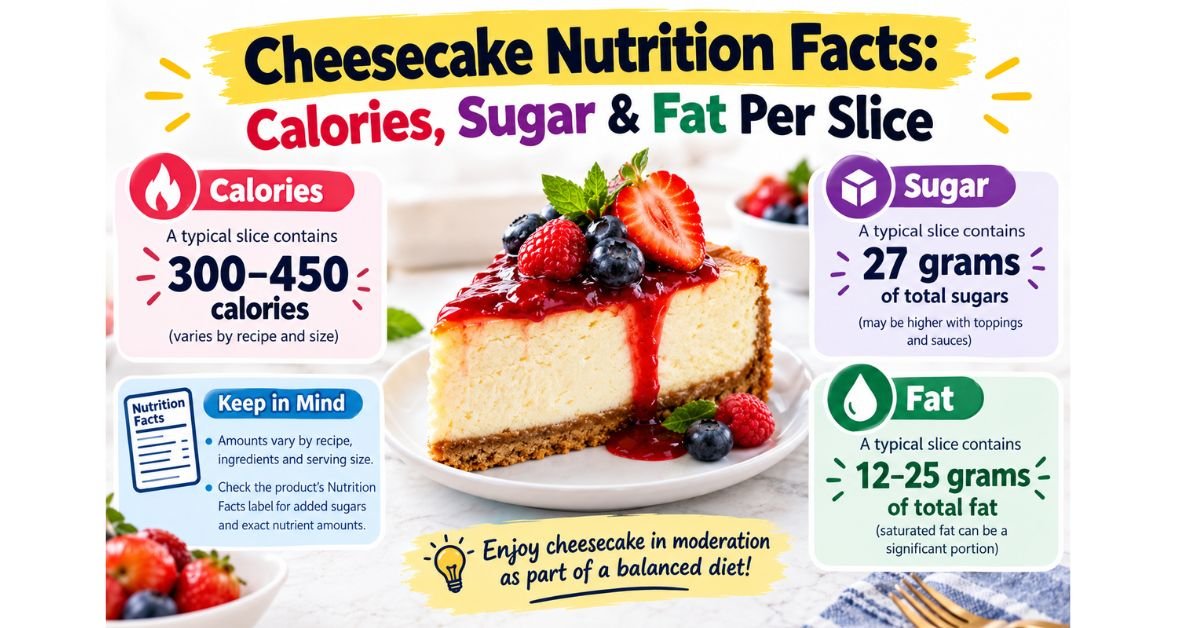
A typical slice of plain cheesecake delivers about 257 calories, 18 grams of fat and 17 grams of sugar, so these cheesecake nutrition facts describe a rich dessert best enjoyed mindfully. If you’ve ever stared at a label wondering about portion size, saturated fat or hidden added sugar, you’re not alone.
This guide breaks down calories, macros, vitamins and glycemic impact using USDA FoodData Central values and current product labels. Then it shows how to fit a slice into a balanced diet without guilt. Think of it as a dietitian-style walkthrough: clear numbers, honest trade-offs and practical swaps.
Cheesecake Nutrition Facts: Top Nutrition Facts for Cheesecake
For 100 grams of commercially prepared plain cheesecake, USDA data lists 321 calories, 22.5 grams of fat, 25.5 grams of carbohydrates and 5.5 grams of protein. That’s the baseline every label, calorie counter and restaurant menu ultimately gets compared against.
Saturated fat reaches roughly 9.9 grams, about half your Daily Value, while sugar sits near 22 grams and fiber barely registers at 0.4 grams. Net carbs land around 25 grams, and the mix leans on fat and sugar far more than fiber or protein.
| Nutrient | 80 g slice (1/6 of a 17 oz cake) | 100 g | 125 g (est.*) |
| Calories | 257 | 321 | ~401 |
| Total fat | 18 g | 22.5 g | ~28 g |
| Saturated fat | 8 g | 9.9 g | ~12 g |
| Carbohydrates | 20 g | 25.5 g | ~32 g |
| Sugar | 17 g | 22 g | ~28 g |
| Protein | 4 g | 5.5 g | ~7 g |
| Sodium | 350 mg | 438 mg | ~548 mg |
*Scaled from the per-100 g USDA values. 125 g is the standard FDA serving reference amount.
Cheesecake Nutrition Facts: Nutritional Profile of Cheesecake
Not every slice is built alike. A chocolate cheesecake runs about 388 calories per 100 grams, while a keto cheesecake can drop to roughly 210 calories for an 80-gram serving, trading sugar for sweeteners like erythritol or allulose.
Here’s the surprise: dairy-free isn’t automatically lighter. A 130-gram slice of Daiya’s dairy-free New York cheezecake lists 480 calories and 31 grams of fat, proving that ingredient swaps and serving size matter more than marketing labels. Always read the panel before you buy.
| Type | Serving | Calories | Fat | Carbs | Protein |
| Plain | 100 g | 321 | 22.5 g | 25.5 g | 5.5 g |
| Chocolate | 100 g | 388 | 24.1 g | 38.8 g | 5.3 g |
| Keto (Enlightened) | 80 g | 210 | 20 g | 18 g (2 net) | 4 g |
| Dairy-free (Daiya) | 130 g | 480 | 31 g | 47 g | 3 g |
Cheesecake Nutrition Facts: Cheesecake Calories (kcal)
Calories scale quickly with slice size. One ounce carries about 91 calories, and a full 100 grams reaches 321. The 80-gram slice from a 17-ounce cake lands near 257, and a generous restaurant wedge can run well beyond that.
Brand matters too. A grab-and-go single slice of The Cheesecake Factory At Home Original lists 320 calories, 19 grams of fat and 23 grams of sugar, while thicker restaurant wedges and loaded flavors can climb far higher. Compare labels, not logos, before you commit.
Cheesecake Nutrition Facts: Calorie Breakdown
Where do cheesecake’s calories come from? Roughly 62% fat, 31% carbohydrates and 7% protein for a standard slice. Cream cheese, butter, eggs and a graham cracker crust drive that fat-heavy macronutrient split, which is why cheesecake feels so rich and dense.
That ratio matters if you track macros. With only about 4 to 6 grams of protein per slice, cheesecake works as an occasional treat rather than a protein source. Pairing it with fresh berries adds a little fiber and freshness to the plate.
Fat Type Information
Per 100 grams, the fat splits into about 9.9 grams saturated, 8.6 grams monounsaturated and 1.6 grams polyunsaturated. Saturated fat makes up roughly half of the total, so the unsaturated-to-saturated ratio hovers around 1, below the 2 often cited for heart health.
Cheesecake Nutrition Facts: Glycemic Index (GI)
Cheesecake carries a glycemic index of about 50, which counts as low. Fat and protein slow how fast sugars reach the bloodstream, which helps anyone tracking blood sugar. Still, a low GI doesn’t make the dessert low in carbs.
Context matters. Toppings like caramel, fruit sauce or cookie crumbs push the total carbohydrate load higher, and eating a slice after a balanced meal behaves differently than eating it alone. People managing diabetes should talk with a registered dietitian about portions.
Glycemic Load (GL)
Glycemic load blends GI with portion size, and 100 grams of cheesecake scores about 16, a medium rating. Because GL scales with carbohydrate grams, a larger restaurant slice raises the number fast. That’s why serving size deserves as much attention as the dessert itself.
Cheesecake Nutrition Facts: All Nutrients for Cheesecake per 100g
Beyond macros, cheesecake isn’t a nutritional blank slate. Per 100 grams, it supplies roughly 159 micrograms of vitamin A (18% of the Daily Value), about 93 milligrams of phosphorus and 5.2 micrograms of selenium, thanks mainly to cream cheese, eggs and dairy.
Sodium deserves a glance too: about 438 milligrams per 100 grams, or 19% of the Daily Value, plus 55 milligrams of cholesterol. None of these numbers are alarming alone, but they stack with the rest of your day’s meals and snacks.
Vitamin Coverage Chart
A 100-gram portion covers about 15% of riboflavin (B2), 11% of pantothenic acid (B5), 7% of vitamin B12 and 18% of vitamin A needs. Vitamin C is negligible and vitamin E is minor, so cheesecake won’t replace fruit, vegetables or whole foods in a nutrient-dense eating pattern.
Mineral Coverage Chart
For minerals, 100 grams provides roughly 13% of phosphorus, 9.5% of selenium, 7.9% of iron and 5.1% of calcium. Potassium and magnesium stay low at about 2.6% each, so cheesecake isn’t a meaningful source of bone-supporting calcium compared with milk or yogurt.
Cheesecake Nutrition Facts: Is Cheesecake Healthy?
Honestly, cheesecake wasn’t designed for nutrition; it was designed for joy. Like ice cream or pie, it shouldn’t be eaten for its nutritional value, even though it contains protein, calcium and selenium. Treat it as a dessert, not a nutrient source.
Frequency is the real lever. Small amounts of any dessert, cheesecake included, can fit into most diets within an overall nutritious eating pattern. Daily sweets, though, can raise risks tied to excess calories and added sugar, such as obesity and type 2 diabetes.
Cheesecake Nutrition Facts: Downsides of Eating Cheesecake
The downsides come down to concentration. Cheesecake packs calories, saturated fat and added sugar into a small, easy-to-finish portion, so overeating happens quietly. Frequent servings of high-calorie desserts can nudge weight upward and crowd out foods richer in fiber and micronutrients.
Think of it like a budget. If a slice uses up half your daily calories or your whole added-sugar allowance, the rest of your day has little room left. Knowing where those numbers go makes enjoying dessert far less stressful.
High in Calories
Cream cheese, sour cream and butter make cheesecake calorie-dense. A Cheesecake Factory Caramel Pecan Turtle slice packs 1,330 calories, over half what most people need daily. Sharing a slice, or freezing half for later, keeps the treat while trimming the energy load.
Rich in Sugar
The American Heart Association recommends no more than 36 grams of added sugar daily for men and 25 grams for women. One 113-gram slice of Favorite Day Triple Chocolate Cheesecake contains 30 grams, about 7.5 teaspoons, so a single dessert can exceed the recommended limit for women
Some Types Are Highly Processed
Homemade cheesecake relies on simple ingredients like eggs, cream cheese and sugar. Commercial versions may add fillers, stabilizers and artificial colors, sweeteners and flavors. Ultra-processed foods are linked with heart disease, obesity and type 2 diabetes, so scanning the ingredient list is a smart habit.

Cheesecake Nutrition Facts: Healthier Recipes for Cheesecake Lovers
You don’t have to give up cheesecake to eat well. Recipes that cut sugar, swap in nutrient-dense ingredients or use sweeteners like monk fruit can create cheesecake-inspired desserts that fit paleo, low-carb or dairy-free preferences while keeping that creamy, tangy comfort.
Still, healthier isn’t a free pass. Vegan or paleo labels don’t guarantee fewer calories or less sugar, and sugar-free versions can still be energy-dense. Compare nutrition panels, watch portion size and remember that a traditional slice enjoyed occasionally is perfectly reasonable.
Dairy-Free Cheesecake Recipes
Dairy-free recipes often get their creaminess from coconut milk and cashews. Paleo and vegan versions work well for people avoiding dairy, but they can still match traditional cheesecake in calories and sugar. Check nutrition details instead of assuming plant-based means light
Low-Carb Cheesecake Recipes
Keto versions use almond flour, cream cheese, eggs and monk fruit or erythritol. One brand’s keto cheesecake lists about 210 calories and 2 net carbs per 80-gram serving, while homemade recipes report as few as 1 to 5 net carbs, which can suit low-carb and diabetes-conscious plans.
Cheesecake Nutrition Facts: Calorie Burn Time
Here’s a real-world way to picture one 257-calorie slice. For a 35-year-old woman who is 5’7″ and 144 pounds, burning it takes about 21 minutes of swimming, 29 of jogging, 39 of cycling or 71 of walking.
Your numbers will differ with body weight, pace and metabolism, so treat these as rough guides, not a penalty. Movement supports health, but dessert doesn’t need to be “earned.” Use the comparison to understand energy balance, then enjoy your slice guilt-free.
| Activity | Minutes to burn 257 kcal |
| Swimming | 21 |
| Jogging | 29 |
| Cycling | 39 |
| Walking | 71 |
Cheesecake Nutrition Facts: Health Checks
Automated nutrient checks can mislead. One popular database flags cheesecake as low in saturated fat and low in sugars, yet its own data shows 9.9 grams of saturated fat, half the Daily Value, and 22 grams of sugar per 100 grams. Trust the numbers, not the badges.
What holds up: the USDA plain-cheesecake entry shows no trans fat, though some commercial labels list 0.5 to 1 gram, and cholesterol is 55 milligrams per 100 grams. Guidance to keep saturated fat under about 10% of daily calories makes portion size the deciding factor.
Cheesecake Nutrition Facts: The Bottom Line
The cheesecake nutrition facts tell a clear story: roughly 257 calories, 18 grams of fat and 17 grams of sugar in an 80-gram slice, with far more in bigger restaurant portions. It’s calorie-dense, high in saturated fat and sugar, and light on fiber.
But food is also memory, celebration and comfort. Enjoy a slice on occasion, share it, choose a sensible portion and balance the rest of your day with whole foods. Knowledge, not guilt, is what makes cheesecake fit a healthy, well-rounded diet.
FAQ
How many calories are in a slice of cheesecake?
A standard 80-gram slice (1/6 of a 17-ounce cake) has about 257 calories. 100 grams has about 321. Bakery and restaurant slices are usually larger, so calories can be much higher.
Is cheesecake healthy?
Cheesecake is high in calories, saturated fat and sugar, so it isn’t considered a nutritious food. An occasional small slice can still fit into a balanced eating pattern.
How much sugar is in a slice of cheesecake?
An 80-gram slice has about 17 grams of sugar, or roughly 22 grams per 100 grams. Branded slices can contain 23 to 30 grams, which approaches or exceeds the American Heart Association’s daily added-sugar limits.
Is cheesecake high in protein?
Not really. A slice provides about 4 to 6 grams of protein, around 7% of its calories, which comes from cream cheese and eggs.
Is cheesecake keto-friendly?
Traditional cheesecake has about 25 grams of carbs per 100 grams, so it isn’t keto. Versions made with erythritol, allulose or monk fruit can have around 2 net carbs per serving.
How many calories are in a Cheesecake Factory cheesecake?
The At Home single Original slice lists about 320 calories. Restaurant slices vary widely by flavor, and the Caramel Pecan Turtle reaches 1,330 calories. Labels differ by product and year, so check the current panel.
Does cheesecake raise blood sugar?
Cheesecake has a low glycemic index of about 50 and a medium glycemic load of 16 per 100 grams. Larger slices and sweet toppings raise the impact, so people with diabetes should confirm portions with a dietitian.
How can I make cheesecake healthier?
Use smaller slices, share one, or choose recipes with less sugar or sweeteners like monk fruit. Check the label, because dairy-free and vegan versions aren’t automatically lower in calories.

Hi, I’m Benjamin, the person behind FactsAboutDog.com. 🐶
I’m passionate about dogs and love sharing interesting, fun, and educational facts about our furry friends. Through FactsAboutDog.com, I aim to make learning about dogs simple, enjoyable, and informative for dog lovers everywhere.
From amazing dog facts to breed information and fascinating animal knowledge, my goal is to help readers discover something new every day.
Explore the world of dogs with Benjamin at FactsAboutDog.com!


One Comment