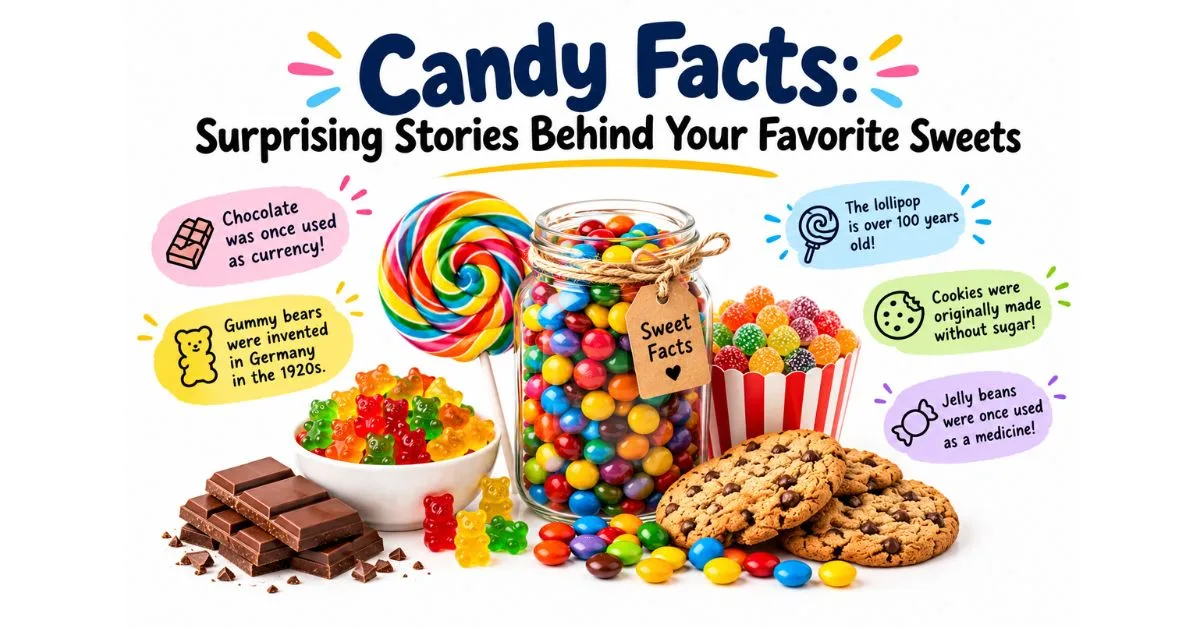
Candy Facts: Surprising Stories Behind Your Favorite Sweets
Candy facts are bite-sized stories about how sugar, chocolate, and a lot of happy accidents became America’s favorite treats. From NECCO wafers to Pop Rocks, many classics began as medicine, military rations, or lab mistakes. After years of researching food history, I still smile at how strange candy’s past really is.
If you’ve ever wondered why bubble gum is pink or how a jawbreaker gets made, you’re in the right place. This guide walks through the history, the science, and the surprising stories behind your favorite sweets, from hard candy to gummies, using trusted sources, so you can share candy facts with confidence.
Candy Facts: The Story of Candy
The word candy traces back through French, Arabic, Persian, and Sanskrit terms for sugar, and it entered English in the late 1200s. Long before that, cultures from Egypt to China coated fruit and flowers in honey to preserve them. Early candy was part pantry staple, part science project.
For centuries, sugar was a luxury. Before the Industrial Revolution, candy often doubled as medicine for sore throats and upset stomachs, and in the Middle Ages mostly wealthy households served spiced sugar sweets. Candy reached America from Britain and France in the early 1700s.
Candy for Everyone
Everything changed in the 1830s, when new technology and plentiful sugar put candy within reach of working families. Penny candy became the first thing many children bought with their own money, and neighborhood candy stores soon depended on young customers.
The First Candy-Making Machine: Candy Facts From 1847
In 1847, Oliver R. Chase invented a machine that could mass-produce candy, which led to the first U.S. candy brand: NECCO, the New England Confectionery Company, famous for its wafers. Suddenly, sweets became cheaper, more accessible, and far easier to find.
That same decade, the candy press made it possible to make many shapes and sizes at once, and by 1851 a spinning steam pan let candy makers boil sugar without constant stirring. Soon, one or two people could run a successful candy shop.
How Candy Is Made: Candy Facts From the Factory Floor
Candy making starts with a simple idea: dissolve sugar in water or milk to make a syrup, then boil it until it thickens or caramelizes. How hot you cook it, and what you add, shapes the texture, from soft and chewy to hard and crunchy.
Most candy today comes from factories, and the recipes are often guarded as trade secrets, since candy formulas are hard to protect with a patent or copyright. Even tiny differences in machines, timing, or temperature can change the final bite, so copying a favorite is harder than it looks.
Bubble Gum Wasn’t Always Pink: Candy Facts About Gum
The first successful bubble gum, Dubble Bubble, was created in 1928 by Walter Diemer, an accountant at the Fleer Chewing Gum Company. He stumbled onto the recipe by accident, and the stretchy result could finally hold a big, satisfying bubble.
Its famous color was a lucky shortcut. Pink was the only dye available at the factory, and the shade stuck, so bubble gum has looked pink around the world ever since. Sometimes a candy’s biggest trademark is simply whatever happened to be on the shelf.
PEZ Dispensers’ Surprising Start: Candy Facts From Austria
PEZ began in Austria in 1927 as a peppermint candy marketed as an alternative to smoking. The name comes from Pfefferminz, the German word for peppermint. For years, the mints came in simple tins, nothing like the character-topped dispensers collectors chase today.
The famous flip-top dispensers arrived in the 1950s, and PEZ was later rebranded for children with fruity flavors. Today, PEZ dispensers featuring characters from many franchises are popular collectibles, which proves a clever container can matter as much as the candy inside.
Jawbreakers Take a Long Time to Make: Candy Facts About Layers
Jawbreakers, also known as gobstoppers, are famous for their many layers of hard candy. Each layer is added one at a time in a process called hot panning, which means no shortcuts and plenty of patience from the candy maker.
Making a single jawbreaker can take up to three weeks, which helps explain why one lasts so long in your mouth. Every ring you reveal as it slowly shrinks is another round of hardened sugar syrup that dried before the next coat went on.
Gummy Bears’ German Origin: Candy Facts From Haribo
Gummy bears were invented by German confectioner Hans Riegel in 1922. He drew inspiration from the dancing bears seen at festivals and fairs, and he named his chewy creation Gummibärchen, which means “little rubber bears.” That playful idea has lasted a century.
Riegel founded Haribo, which remains one of the largest gummy producers in the world today. Those soft, fruity, gelatin-based bears launched an entire category of gummi candy, and now it fills grocery aisles and pick-and-mix bins across the entire United States.
Lollipops Are Over a Century Old: Candy Facts on a Classic
The first modern lollipop was created by George Smith in 1908, who named it after a popular racehorse called Lolly Pop. His invention turned a simple hard candy into something easy to hold, and it means the lollipop is now more than a century old.
Sweets on sticks go back much further. Some historians believe ancient people dipped sticks loaded with fruit or nuts into honey and let it harden, creating a primitive lollipop that was easy to carry on long journeys. The stick, it turns out, is one of candy’s oldest inventions.
Pop Rocks’ Explosive History: Candy Facts That Fizz
Pop Rocks were invented by accident. Chemist William A. Mitchell created them in 1956 while trying to develop an instant soft drink, and what he got instead was a fizzy, crackling candy unlike anything else on the market at the time.
The candy didn’t reach store shelves until the 1970s, but it has been surprising taste buds ever since. That tingly pop on your tongue comes from tiny pockets of carbonation trapped inside the hard candy, released as it melts in your mouth.
Candy Facts on Flavor: Skittles Taste the Rainbow, But Not All at Once
Skittles promise a rainbow of flavors, but taste is only part of the story. Your nose and eyes do a lot of the work, so color and aroma strongly shape what you think you’re tasting. Pinch your nose, and many fruity flavors suddenly become hard to tell apart.
That’s why bright colors and scents matter so much in candy design. A red candy that smells like strawberry tells your brain what to expect before the first bite. Try the pinched-nose test at home; it’s a fun, free science experiment for kids and adults.
M&M’s and Space Travel: Candy Facts Beyond Earth
M&M’s were built for travel. Their hard sugar shell kept chocolate from melting in soldiers’ hands during World War II, inspiring the slogan “melts in your mouth, not in your hand.” Bite-sized and candy-coated, they also make tidy, low-mess snacks for astronauts.
Sources disagree on which sweet flew first. One account says astronauts carried a chocolate bar on Gemini 3 in 1965, while another says NASA picked M&M’s in 1981. Either way, candy has been part of the space program for decades.
| Year | Candy milestone | Who / where |
| 1847 | First candy-making machine and candy press | Oliver R. Chase, NECCO |
| 1908 | Modern lollipop | George Smith |
| 1922 | Gummy bears | Hans Riegel (Haribo), Germany |
| 1927 | PEZ | Austria |
| 1928 | Dubble Bubble bubble gum | Walter Diemer, Fleer |
| 1956 | Pop Rocks invented (sold in the 1970s) | William A. Mitchell |
Candy and Your Health: Candy Facts Worth Knowing
Candy is mostly sugar, and sugar feeds bacteria like Streptococcus mutans in your mouth. As they break it down, they produce acids that wear away tooth enamel and cause cavities. Hard candies, lollipops, and cough drops that linger in your mouth raise that risk the most.
You don’t have to give up sweets. Brush soon after eating sugary treats, and leave a few hours between them so your teeth get a break. Enjoying candy occasionally, rather than all day, is the easiest way to protect your smile and keep the fun going.
Good Things About Some Candies
A few candies do come with small perks. Peppermint can calm an upset stomach, and dark chocolate in small amounts offers antioxidants and may support heart health. Enjoy them as treats, not health plans. Keep these candy facts in mind next time you reach for something sweet.
Note: Intro mein “after years of researching food history” placeholder hai. Apni asli experience se badal lein.
11. FAQ Section
(Competitor content se, asli PAA nahi.)
Where does the word candy come from?
Candy comes from old French çucre candi, which traces back to Arabic, Persian, and Sanskrit words for sugar. It began appearing in English in the late 1200s.
Why is bubble gum pink?
Walter Diemer’s first successful bubble gum, Dubble Bubble (1928), was pink because pink was the only dye available at the factory. The color became the standard.
Who invented gummy bears?
German confectioner Hans Riegel invented gummy bears in 1922. He founded Haribo and named them Gummibärchen, meaning “little rubber bears.”
Is candy bad for your teeth?
Yes, in large amounts. Sugar feeds mouth bacteria that make acids, which wear down enamel and cause cavities. Brushing soon after sweets and spacing them out reduces the risk.
How long does it take to make a jawbreaker?
A single jawbreaker can take up to three weeks, because each hard-candy layer is added one at a time through hot panning.

Hi, I’m Benjamin, the person behind FactsAboutDog.com. 🐶
I’m passionate about dogs and love sharing interesting, fun, and educational facts about our furry friends. Through FactsAboutDog.com, I aim to make learning about dogs simple, enjoyable, and informative for dog lovers everywhere.
From amazing dog facts to breed information and fascinating animal knowledge, my goal is to help readers discover something new every day.
Explore the world of dogs with Benjamin at FactsAboutDog.com!