
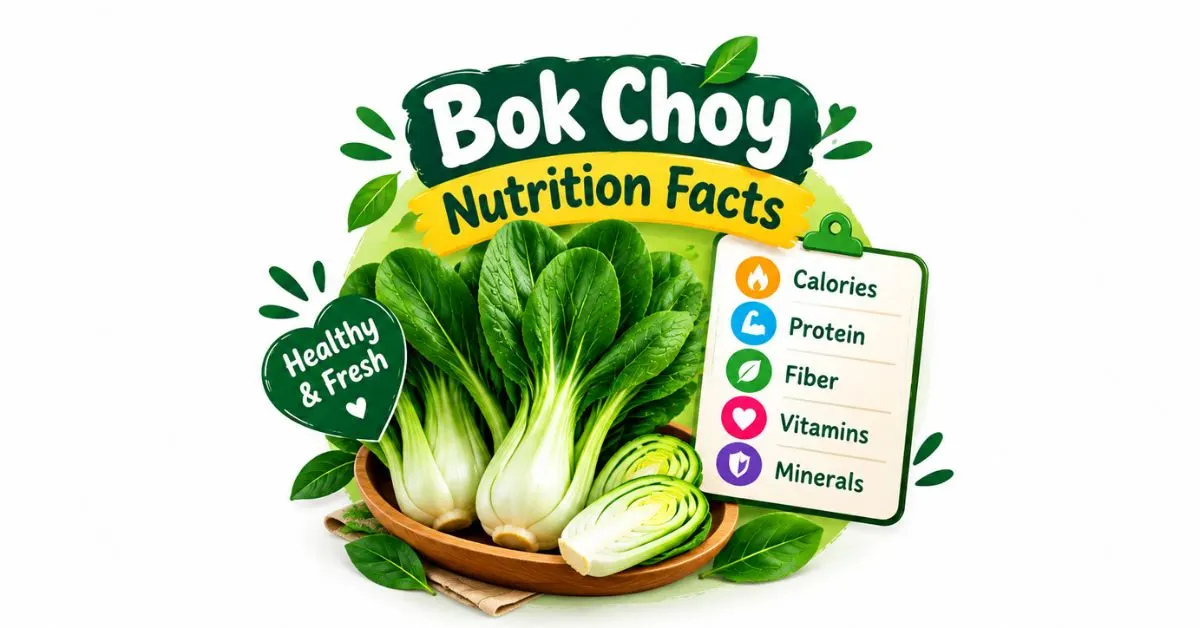
Bok Choy Nutrition Facts: Calories, Vitamins & Benefits
Bok choy nutrition facts are impressive for such a light vegetable: one cup of raw shredded bok choy provides about 9 calories, while supplying vitamin C, vitamin K, vitamin A, calcium, fiber, and other micronutrients. This crisp Chinese cabbage, also called pak choi, belongs to the cruciferous vegetable family and is naturally low in carbohydrates and fat.
If you’ve ever wondered whether the crunchy stems are worth adding to your plate, the answer is yes. From dietary fiber and antioxidants to glucosinolates, bok choy offers a useful nutrient package without many calories. The guide below uses USDA-linked nutrition data and evidence reviewed by nutrition professionals to separate established nutrition facts from potential benefits.
Bok Choy Nutrition Facts: Nutrition Facts
The most useful reference point is 100 grams of raw bok choy. That amount contains about 13 calories, 2.2 grams of carbohydrates, 1 gram of fiber, 1.2 grams of sugars, 0.2 grams of fat, and 1.5 grams of protein. It is also mostly water, making it a very low-energy-density vegetable.
For a familiar kitchen measurement, 1 cup of shredded raw bok choy weighs about 70 grams and provides roughly 9 calories, 1.5 grams of carbohydrate, 0.7 grams of fiber, 0.8 grams of sugar, 0.1 grams of fat, and 1.1 grams of protein.
Bok choy nutrition facts per 100 grams
| Nutrient | Amount |
| Calories | 13 kcal |
| Carbohydrates | 2.2 g |
| Dietary fiber | 1.0 g |
| Sugars | 1.2 g |
| Protein | 1.5 g |
| Total fat | 0.2 g |
| Calcium | 105 mg |
| Potassium | 252 mg |
| Vitamin C | 45 mg |
| Vitamin K | 46 mcg |
| Vitamin A | 223.5 mcg RAE |
| Folate | 66 mcg |
These figures are based on USDA-linked data reported by Nutrition Advance; nutrient values can vary somewhat by variety, growing conditions, serving size, and preparation.
Bok Choy Nutrition Facts: Vitamins and Minerals
Bok choy stands out more for its micronutrients than its calories. Per 100 grams, it provides about 50% of the Daily Value for vitamin C, 38% for vitamin K, 25% for vitamin A, 17% for folate, and 11% for vitamin B6.
Its mineral profile is useful too. The same serving provides calcium, manganese, potassium, magnesium, iron, phosphorus, zinc, copper, and selenium. That combination makes bok choy a practical way to add nutritional variety without dramatically increasing calories or carbohydrates.
Vitamin C and vitamin K
Vitamin C supports normal immune function and tissue maintenance, while vitamin K plays important roles in normal blood clotting and bone metabolism. Bok choy’s combination of these vitamins is one reason it appears frequently in nutrient-dense vegetable recommendations.
Calcium and vitamin A
Bok choy provides calcium alongside provitamin A carotenoids. Nutrition Advance reports about 105 mg of calcium and 223.5 mcg of vitamin A activity equivalents per 100 grams. The body can convert provitamin A carotenoids into active vitamin A.
Bok Choy Nutrition Facts: Health Benefits
The nutritional profile explains much of bok choy’s appeal. It provides fiber, vitamins, minerals, carotenoids, and plant compounds while remaining very low in calories. Healthline notes that its vitamin C, vitamin K, antioxidants, and fiber contribute to its overall nutritional value.
Still, nutrition should not be confused with a cure. Research into compounds found in cruciferous vegetables is promising in some areas, but evidence differs depending on the compound and health outcome. Nutrition Advance specifically notes that human evidence for disease-protective effects of glucosinolates remains limited.
Fights inflammation and oxidative stress
Bok choy contains antioxidant compounds, including flavonoids such as quercetin. Antioxidants help protect cells from oxidative damage, although eating one vegetable cannot eliminate inflammation or prevent disease by itself. The broader dietary pattern matters much more.
Bok Choy Nutrition Facts: Bok Choy Is Low in Oxalates
One particularly interesting nutrition detail is bok choy’s relatively low oxalate content. Nutrition Advance notes that, compared with several popular leafy greens, bok choy contains very low amounts of oxalate. This makes it an interesting alternative for people paying attention to dietary oxalates.
Oxalates occur naturally in many plant foods and aren’t inherently a problem for most healthy people. However, people who have been advised by a healthcare professional to follow a low-oxalate diet may consider the oxalate content of different vegetables when planning meals.
Bok Choy Nutrition Facts: Bok Choy Contains Glucosinolates
Like broccoli, kale, and Brussels sprouts, bok choy belongs to the Brassica or cruciferous vegetable family. These vegetables contain sulfur-containing compounds called glucosinolates, which can break down into metabolites such as isothiocyanates.
Scientists are interested in these compounds because laboratory research has found biologically active effects. However, laboratory findings do not automatically mean the same effect occurs in humans. More human research is needed before making strong disease-prevention claims about bok choy.
Glucosinolates and cooking
Preparation can change plant compounds. Raw and cooked vegetables don’t necessarily have identical nutrient and phytochemical profiles, and cooking can affect enzymes involved in glucosinolate metabolism. For everyday eating, variety and reasonable portions matter more than trying to maximize one particular compound.
Bok Choy Nutrition Facts: A Rich Source of Polyphenols
Bok choy contains polyphenols, including flavonoids and hydroxycinnamic acids. These plant compounds are being studied for their biological activity, although researchers are still working to understand exactly how individual compounds and dietary patterns influence human health.
Purple varieties add another interesting layer. Nutrition Advance reports that purple bok choy cultivars can contain substantial amounts of anthocyanins, the pigments responsible for blue, purple, and red colors in many plants.
Purple bok choy
Purple bok choy is visually different from the familiar green variety because of its higher concentration of anthocyanin pigments. It also contains other polyphenols, including compounds such as kaempferol and quercetin, making colorful varieties an interesting part of vegetable diversity.
Bok Choy Nutrition Facts: May Support Bone Health
Bok choy supplies several nutrients associated with bone health, including vitamin K, calcium, magnesium, phosphorus, and smaller amounts of zinc. Healthline explains that these nutrients participate in processes involved in maintaining the skeletal system and connective tissues.
A useful everyday example is a stir-fry containing bok choy, tofu, mushrooms, and a whole grain. Instead of thinking about one food as a magic bone-health solution, this approach combines several nutrient sources within an overall balanced meal pattern.
Non-dairy calcium
For people who don’t regularly consume dairy, bok choy can contribute some calcium. A 100-gram serving contains about 105 mg according to the USDA-linked figures reported by Nutrition Advance, making it a useful supporting source alongside other calcium-rich foods.
Bok Choy Nutrition Facts: May Promote Heart Health
Bok choy provides potassium, magnesium, calcium, folate, and vitamin B6, nutrients that have roles in normal cardiovascular function. Healthline notes that potassium, magnesium, and calcium contribute to blood-pressure regulation, while folate and B6 are involved in homocysteine metabolism.
That doesn’t mean bok choy independently prevents heart disease. A better interpretation is that vegetables like bok choy can contribute to a dietary pattern rich in fiber, micronutrients, and plant compounds. Overall eating habits, physical activity, sleep, and other factors also influence cardiovascular health.
Bok choy and sodium
Raw bok choy itself contains relatively little sodium. Purdue Extension lists about 46 mg in a 70-gram cup of shredded bok choy. The bigger sodium issue can come from sauces, broths, soy sauce, or other ingredients used when cooking it.
Bok Choy Nutrition Facts: How to Incorporate It Into Your Diet
Bok choy is flexible in the kitchen. You can use the green leaves and white stems, adding them to soups, stir-fries, salads, grain bowls, or rice dishes. Healthline specifically recommends combinations with garlic, ginger, vegetables, grains, and proteins such as chicken or tofu.
The texture is part of its charm. The leaves soften quickly, while the thicker stems retain a pleasant crunch. For a fast weeknight meal, slice the stems and cook them first, then add the leaves toward the end so everything finishes together.
Simple ways to eat bok choy
| Method | Easy pairing |
| Stir-fry | Garlic, ginger, tofu |
| Soup | Mushrooms, noodles, broth |
| Roast | Olive oil and seasonings |
| Salad | Carrots, cucumber, sesame |
| Grain bowl | Brown rice, tofu, vegetables |
| Side dish | Garlic and a small amount of oil |
These approaches are consistent with the practical preparation ideas covered by Healthline and Verywell Fit.
Bok Choy Nutrition Facts: Storage and Food Safety
Fresh bok choy should be refrigerated and kept dry until you’re ready to prepare it. Verywell Fit recommends storing it in the refrigerator’s crisper drawer in a loose or perforated plastic bag and washing it shortly before use.
Purdue Extension gives a storage window of up to about five days. As with other fresh produce, keep bok choy away from raw meat and its juices to reduce cross-contamination risk, and wash the vegetable appropriately before eating.
Choosing fresh bok choy
Look for firm white stems and crisp green leaves without obvious yellowing, bruising, or slimy areas. Baby bok choy is smaller and tender enough to cook whole, while mature bok choy can be separated into stems and leaves for more even cooking.
Bok Choy Nutrition Facts: How to Prepare
Bok choy can be eaten raw, steamed, stir-fried, braised, grilled, or stewed. Short cooking tends to preserve a crisp texture, while longer cooking produces softer stems and leaves. Verywell Fit notes that several preparation methods work well because bok choy cooks relatively quickly.
For maximum practicality, don’t overthink it. Halve baby bok choy, add garlic and ginger, cook briefly in a hot pan, and serve beside rice and a protein. The result is quick, colorful, crunchy, and naturally low in calories before added oils or sauces.
Raw versus cooked bok choy
Cooking changes the weight and nutrient concentration of vegetables because water moves in or out and some nutrients can be lost into cooking liquid. The most useful comparison is therefore to use consistent serving sizes rather than assuming raw and cooked values are interchangeable.
Bok Choy Nutrition Facts: Final Thoughts
The biggest takeaway from these bok choy nutrition facts is how much nutrition fits into a low-calorie vegetable. A 100-gram serving provides only about 13 calories while supplying vitamin C, vitamin K, vitamin A, calcium, fiber, folate, and several other micronutrients.
Bok choy is not a miracle food, but it is an easy way to make meals more nutrient-dense. Whether you toss it into ramen, stir-fry it with tofu, or serve it beside rice, its combination of crisp texture and useful nutrients makes it a smart addition to a varied diet.
11. FAQ Section
How many calories are in 1 cup of bok choy?
One cup of raw, shredded bok choy, weighing about 70 grams, contains approximately 9 calories. It also provides about 1.5 grams of carbohydrates, 0.7 grams of fiber, and 1.1 grams of protein.
Is bok choy high in carbohydrates?
No. Bok choy is naturally low in carbohydrates. A 100-gram serving contains about 2.2 grams of carbohydrates, including approximately 1 gram of dietary fiber.
Is bok choy a good source of vitamin C?
Yes. A 100-gram serving provides approximately 45 mg of vitamin C, equivalent to about 50% of the Daily Value in the data reported by Nutrition Advance.
Is bok choy high in vitamin K?
Bok choy contains a meaningful amount of vitamin K. Nutrition Advance reports about 46 mcg per 100 grams, or roughly 38% of the Daily Value.
Is bok choy good for a low-carb diet?
Bok choy can fit easily into many lower-carbohydrate eating patterns because it provides relatively few carbohydrates and calories while adding fiber, vitamins, minerals, and plant compounds.
Is bok choy healthier raw or cooked?
Neither preparation is universally “healthier.” Raw and cooked bok choy have different textures and nutrient profiles. Short cooking can make it easier to eat larger portions, while raw preparation avoids heat-related nutrient changes.
Can you eat the stems of bok choy?
Yes. Both the white stems and green leaves are edible. The stems are crisp and watery, while the leaves soften more quickly during cooking.
Is bok choy low in oxalates?
Yes. Nutrition Advance describes bok choy as having one of the lower oxalate contents among vegetables, although individual dietary needs vary.
Does bok choy contain protein?
Yes, but it is not a high-protein food. A 100-gram serving contains about 1.5 grams of protein, while one cup of raw shredded bok choy provides about 1.1 grams.
Can bok choy be eaten every day?
For most people, bok choy can be part of a varied diet. However, people taking vitamin-K-sensitive blood thinners should discuss consistent vitamin K intake with their healthcare professional.

Hi, I’m Benjamin, the person behind FactsAboutDog.com. 🐶
I’m passionate about dogs and love sharing interesting, fun, and educational facts about our furry friends. Through FactsAboutDog.com, I aim to make learning about dogs simple, enjoyable, and informative for dog lovers everywhere.
From amazing dog facts to breed information and fascinating animal knowledge, my goal is to help readers discover something new every day.
Explore the world of dogs with Benjamin at FactsAboutDog.com!