25 Cool Shark Facts You Won’t Believe Are Real
Quick 25 Cool Shark Facts
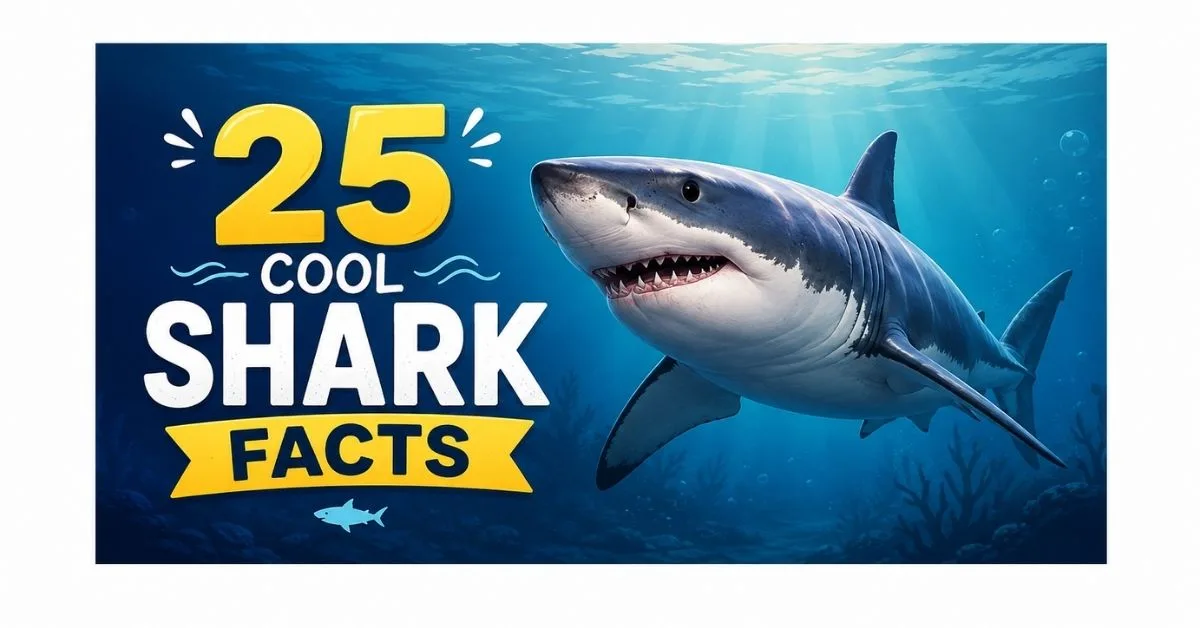
Sharks have prowled the ocean for over 450 million years, and these 25 cool shark facts prove they’re nowhere close to boring. From cartilage skeletons to electroreception, sharks blend prehistoric survival with genuinely strange biology that keeps marine biologists fascinated decade after decade.
I’ve spent years diving into ocean-life research, and nothing hooks a reader faster than sharks misunderstood apex predators with senses, speed, and longevity that outclass almost anything else in the sea. If you’ve ever wondered why sharks feel both terrifying and oddly lovable, this guide answers that directly. Below you’ll find bite-sized shark facts, real entities like the whale shark and hammerhead shark, and the semantic context behind why sharks matter to ocean ecosystems worldwide.
25 Cool Shark Facts
These 25 cool shark facts cover species diversity, apex predator behavior, and the biology that makes sharks so uniquely built for survival. Each one is grounded in real marine science, not movie myths, and together they paint a much more accurate picture of what sharks actually are.
- There are over 500 shark species swimming in oceans worldwide.
- Sharks have existed for more than 450 million years older than trees.
- Some sharks, like the Greenland shark, can live over 400 years.
- The dwarf lantern shark is smaller than a human hand.
- The whale shark is the largest fish, growing up to 40 feet.
- Whale sharks can weigh as much as 40 tons.
- Basking sharks reach up to 32 feet, the second-largest fish species.
- Great white sharks can grow to roughly 20 feet long.
- Sharks have no bones their skeletons are made of cartilage.
- Cartilage is lighter than bone, helping sharks stay buoyant.
- Shark skin feels like sandpaper due to dermal denticles.
- A dorsal fin keeps sharks stable while swimming.
- Baby sharks, called pups, are born with a full set of teeth.
- Sharks can lose thousands of teeth across a lifetime.
- A lost tooth is replaced in less than a day.
- Great whites may grow over 30,000 teeth in their lifetime.
- Shark teeth move forward like a conveyor belt.
- Sharks can sense electricity to find hidden prey.
- Great white sharks are partially warm-blooded, unlike most fish.
- Sharks live in every ocean, from reefs to Arctic waters.
- The shortfin mako can swim up to 46 miles per hour.
- Sharks tear off chunks of food instead of chewing.
- Most sharks live 20–30 years, though some live far longer.
- Each whale shark has a fingerprint-like spot pattern.
- You’re statistically more likely to be struck by lightning than bitten by a shark.
25 Cool Shark Facts: Random Facts You Won’t Believe
Beyond the core list, these random shark facts reveal just how strange shark biology gets once you dig past the surface. Sharks have survived five mass extinction events, and some species reproduce without mating at all a phenomenon scientists call parthenogenesis, or a “virgin birth.”
Sharks also carry natural fluoride in their teeth, essentially built-in toothpaste that prevents cavities despite constant tooth replacement. Tiger shark embryos practice intrauterine cannibalism before birth, and some species enter tonic immobility, a trance-like state, when flipped upside down a reflex researchers still study closely today.
25 Cool Shark Facts About Shark Size & Speed
Shark size and swimming speed vary dramatically across species, and that range is part of what makes marine biology around sharks so compelling. From the dwarf lantern shark barely bigger than a human hand to the whale shark stretching 40 feet, size differences shape hunting strategy and habitat.
Speed matters just as much as size for apex predators chasing fast-moving prey through open water. The shortfin mako shark, often called the cheetah of the ocean, reaches roughly 46 miles per hour, while the slow-moving Greenland shark barely tops one mile per hour in cold Arctic depths.
The Mako Shark Is the Fastest Shark in the Sea
The shortfin mako averages a 31 mph cruising speed but bursts past 46 mph when chasing prey, making it the fastest documented shark species. Its torpedo-shaped body and powerful tail give this apex predator an edge few ocean animals can match in open water.
The Goblin Shark Has the Fastest Fish Jaws in the Ocean
The goblin shark’s jaw shoots forward at roughly 10 feet per second too fast for the human eye to track without slow motion. This deep-sea predator relies on that explosive jaw extension rather than raw swimming speed to capture prey in near-total darkness.
25 Cool Shark Facts: Teeth & Body Facts
Shark teeth and shark bodies are engineered for constant replacement and lightweight agility, two traits that separate sharks from nearly every other fish species. Cartilage, dermal denticles, and conveyor-belt dentition all work together to keep apex predators hunting efficiently for decades.
Because shark teeth lack roots, they fall out easily and regrow within roughly a day, letting sharks cycle through tens of thousands of teeth across a lifetime. Great white sharks alone may produce over 30,000 teeth, which is why fossilized shark teeth are far more common than shark skeletons.
Sharks Do Not Have Bones
Instead of a bone skeleton, sharks rely on cartilage the same flexible tissue found in human ears and noses. This cartilaginous structure makes sharks lighter and more agile, letting apex predators move rapidly through the water without expending excess energy while hunting.
Sharks Can Go Through 25,000–35,000 Teeth in a Lifetime
Since survival depends heavily on biting ability, sharks evolved multiple rows of backup teeth. When one tooth falls out, another moves forward almost immediately, functioning like a natural conveyor belt that keeps every shark species hunting without interruption.
25 Cool Shark Facts About How Sharks Hunt & What They Eat
Sharks are apex predators sitting at the very top of the marine food chain, and their hunting methods vary wildly by species and habitat. Some ambush prey from below, others use suction, and a few rely on specialized jaw mechanics unique among all fish species.
A shark’s jaw isn’t fused to its skull, allowing it to thrust forward for maximum bite force during an attack. Because sharks can’t chew, they tear prey into swallowable chunks, and many apex predators like great whites can go months between substantial meals.
The Nurse Shark Creates a Powerful Suction
Rather than chasing prey aggressively, the nurse shark generates strong suction that pulls food directly into its mouth. This suction is powerful enough to extract a queen conch from its shell, making the nurse shark one of the ocean’s more efficient ambush feeders.
25 Cool Shark Facts: Baby Sharks & How Sharks Reproduce
Shark reproduction is one of the most varied processes in the animal kingdom, spanning egg-laying, live birth, and even asexual reproduction in select species. Baby sharks, called pups, typically receive no parental care and must fend for themselves from the moment of birth.
Litter sizes vary enormously: a blue shark can birth over 100 pups, while a great white typically produces just 2 to 10. Some species also practice natal philopatry, returning to their own birthplace to give birth, reinforcing population patterns marine biologists still track closely.
Different Sharks Reproduce in Different Ways
Sharks reproduce through oviparity (egg cases), ovoviviparity (internal eggs with live birth), viviparity (true live birth), or occasionally asexual reproduction. This reproductive diversity across shark species reflects millions of years of evolutionary adaptation to different ocean environments and predation pressures.
25 Cool Shark Facts – How Long Do Sharks Live?
Shark lifespan varies enormously by species, ranging from a couple of decades to several centuries in the most extreme cases. Most sharks live between 20 and 30 years, though whale sharks and spiny dogfish are believed to occasionally exceed 100 years in the wild.
Scientists estimate shark age using growth layers in cartilage, similar to counting tree rings, since cartilage doesn’t preserve the same way bone fossils do. Late sexual maturity in many species also means shark populations recover slowly from overfishing and other environmental pressures.
Greenland Sharks Are the World’s Oldest Living Vertebrate
Radiocarbon dating suggests Greenland sharks can live over 400 years, with one 16-foot female estimated between 400 and possibly 512 years old. This makes the Greenland shark the longest-living vertebrate species known to modern marine science today.
25 Cool Shark Facts: What Do Sharks Look Like?
Shark coloration and body shape vary far more than most people assume, ranging from muted grays to striking pinks and bold zebra-like stripes. Most sharks display gray, white, or black tones that provide natural camouflage against predators and prey in open ocean water.
Some species break that pattern entirely: blue sharks display a genuine blue hue, goblin sharks appear pink from visible blood vessels, and zebra sharks carry bold black-and-white markings. Hammerhead sharks stand out structurally, named for their uniquely shaped, hammer-like heads.
25 Cool Shark Facts About Shark Senses & Superpowers
Shark senses go far beyond sight and smell, giving these apex predators near-superhuman detection abilities underwater. Sharks can smell a single drop of blood from up to a third of a mile away, and their hearing detects thrashing fish from 500 meters out.
Electroreception is perhaps the most remarkable shark superpower, letting sharks detect the electrical signals produced by other animals’ heartbeats. This sixth sense, powered by specialized organs, helps sharks locate prey hidden under sand even in complete darkness or murky water.
Sharks Can Detect Electricity
Using organs called the ampullae of Lorenzini near their mouths, sharks detect the earth’s electromagnetic field and tiny electrical signals from nearby animals. This electroreception ability allows sharks to hunt effectively and navigate vast stretches of open ocean with precision.
Hammerhead Sharks Have 360-Degree Vision
The hammerhead’s uniquely evolved head, called a cephalofoil, gives this shark species a near-360-degree field of view. Its only blind spots sit directly above and below its head, making the hammerhead one of the most visually equipped predators in the ocean.
25 Cool Shark Facts: Sharks and Humans (Are Sharks Dangerous?)
Despite their fearsome reputation, sharks pose far less danger to humans than popular culture suggests, and shark attack statistics back that up clearly. Only about 5 to 10 unprovoked shark attacks occur globally each year, most caused by mistaken identity in low-visibility water.
Movies like Jaws, loosely inspired by real bull shark attacks along the Jersey Shore, shaped decades of unwarranted shark fear. In reality, everyday activities carry higher risk than shark encounters, which is exactly why marine biologists keep pushing back against outdated shark stereotypes.
You’re More Likely to Be Killed Taking a Selfie Than by a Shark
Statistics show more people die annually from selfie-related accidents, falling out of bed, or driving than from shark attacks combined. This comparison highlights just how rare and overstated shark danger to humans actually is in day-to-day life.
25 Cool Shark Facts: Are Sharks Endangered?
Sharks face a far greater threat from humans than humans face from sharks, with roughly 100 million sharks killed every year through overfishing and finning. Of the roughly 500 known shark species, around 143 are currently listed as vulnerable to critically endangered.
Shark fins remain in high demand across parts of Asia, driving large-scale hunting that outpaces the slow reproductive rates of most shark species. Climate change compounds the problem by damaging coral reef habitats, making shark conservation an urgent priority for ocean ecosystems worldwide.
The Biggest Threat to Sharks Is Humans
Roughly 100 million sharks are killed annually, primarily for their meat and fins, driving sharp declines across shark populations globally. Reversing this trend depends on stronger fishing regulations and public awareness, since sharks reproduce far too slowly to offset current losses.
FAQ Section
Do sharks have bones?
No. Sharks have no bones at all their skeletons are made entirely of cartilage, the same flexible tissue found in human ears and noses, which is why full shark skeletons rarely fossilize.
Do sharks lay eggs?
Some shark species lay eggs, while others give birth to live young. Either way, there’s no parental care after birth pups are independent from the moment they’re born.
Are sharks mammals?
No, sharks are fish, not mammals. Even species that give birth to live young still breathe through gills and lack the traits that define mammals.
Are sharks older than trees?
Yes. Sharks have existed for over 450 million years, making them older than both trees and dinosaurs by tens of millions of years.
How long do sharks live?
Most sharks live 20 to 30 years, but the Greenland shark is believed to live several centuries, making it the longest-living vertebrate on record.
Are sharks endangered?
Many are. Of roughly 500 known shark species, about 143 are considered vulnerable to critically endangered, primarily due to overfishing and habitat loss.
What do sharks eat?
Diet varies by age and species young sharks eat fish and smaller sharks, while adults often eat seals, sea turtles, and larger fish.
Can sharks smell blood?
Yes. Sharks can detect extremely small amounts of blood in water from up to a third of a mile away, thanks to an exceptionally refined sense of smell.

Hi, I’m Benjamin, the person behind FactsAboutDog.com. 🐶
I’m passionate about dogs and love sharing interesting, fun, and educational facts about our furry friends. Through FactsAboutDog.com, I aim to make learning about dogs simple, enjoyable, and informative for dog lovers everywhere.
From amazing dog facts to breed information and fascinating animal knowledge, my goal is to help readers discover something new every day.
Explore the world of dogs with Benjamin at FactsAboutDog.com!