
Spider Facts: 12 Real Truths About Spiders You Never Knew
Spiders aren’t insects, and that’s just the first surprise in a long line of spider facts that flip everything you thought you knew about these eight-legged arachnids. I’ve spent years reading entomology reports and still catch myself gasping at how strange spider biology really is. If you’ve ever frozen at the sight of a web in the garage, this guide turns that fear into fascination, one verified fact at a time.
Every section below draws on real research from wildlife biologists, exterminator field data, and taxonomists who study the class Arachnida daily. You’ll learn how spiders hunt, why their blood runs blue, and which species genuinely deserve their fearsome reputation and which don’t.
Spider Facts Prove Spiders Aren’t Insects
Here’s a foundational truth buried in almost every credible source: spiders are arachnids, not insects, and confusing the two muddles everything else you’ll read about them. Arachnids share a class with scorpions, mites, harvestmen, and ticks, all bound by shared anatomical traits that separate them from six-legged bugs entirely.
The distinguishing markers are simple once you know them: eight legs instead of six, two body segments instead of three, and spinnerets that produce silk. Insects have antennae and three-part bodies; spiders have neither antennae nor a middle segment, which is a core piece of entomology every naturalist confirms.
Spider Facts: Spiders Really Are Everywhere
One of the most repeated spider facts in pest-control literature is unsettling but true: you’re rarely more than ten feet from a spider at any given moment, indoors or out. These arachnids favor cracks, corners, and undisturbed garden plants, so their presence stays hidden even in heavily trafficked homes.
Despite the closeness, most species avoid human contact entirely and serve a quiet ecological purpose. Spiders control insect populations that would otherwise overwhelm gardens and crops, making their constant nearby presence more beneficial than threatening for homeowners and farmers alike.
How Many Spiders Live in an Average House?
No exact household census exists, but common tenants include cellar spiders and prowling mouse spiders that favor corners and cupboards. True “house spiders” in the genus Tegenaria build tube-webs and become more visible in autumn when males roam looking for mates, a seasonal pattern pest researchers document yearly.
Spider Facts on Just How Many Species Exist
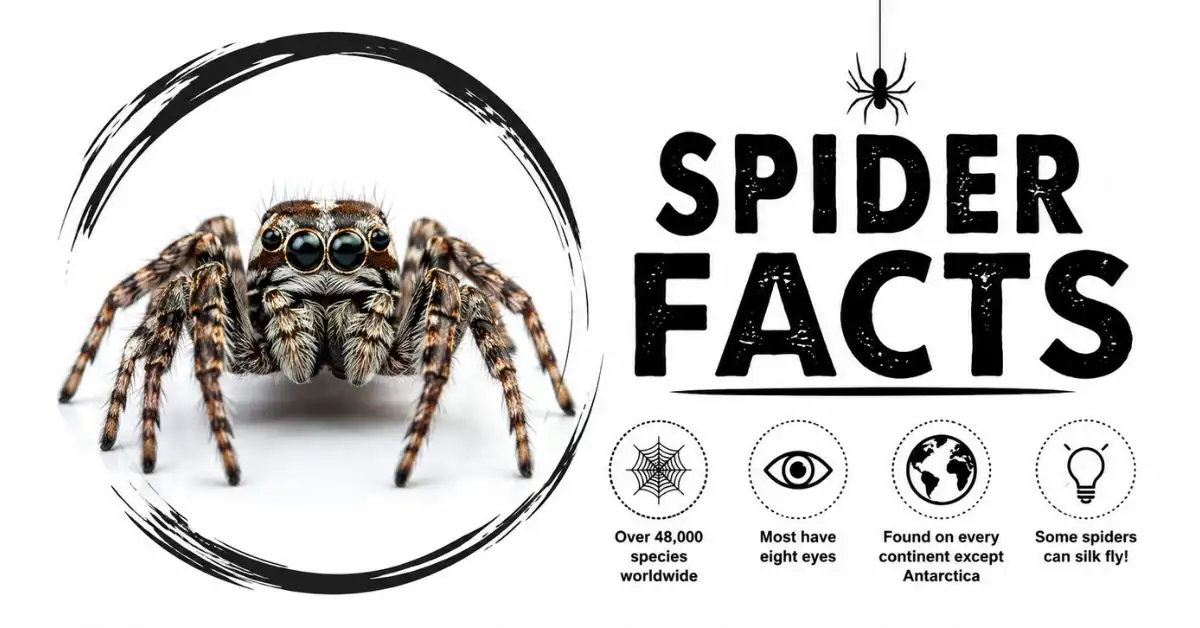
Taxonomists currently recognize somewhere between 40,000 and 51,500 spider species, with fresh discoveries added constantly across rainforests and grasslands. This staggering biodiversity means spiders vary wildly in size, hunting style, and habitat preference across nearly every ecosystem on the planet.
Some species measure less than a millimeter, while the Goliath birdeater tarantula spans nearly a foot, leg to leg. That range in body size, venom potency, and web-building behavior is exactly why generalizing about “spiders” as one uniform creature misses the real diversity of the arachnid world.
Spider Facts About Spider Eyes
Contrary to popular belief, not every spider carries the classic eight-eye arrangement biology textbooks describe. Most species do have eight eyes arranged for near-360-degree awareness, but some families get by with six, and a rare few have even fewer eyes than that.
Eye count always comes in even numbers, arranged in pairs across the front of the cephalothorax for depth perception. Jumping spiders push this further, using specialized eye filters to detect ultraviolet and red light, giving them sharper color vision than most other arachnids and even some mammals.
Spider Facts on How Spiders Make Silk
Silk begins inside the spider’s abdomen as a watery protein gel stored in dedicated silk glands, not as the solid thread you see in a finished web. As this liquid protein travels down a narrowing duct, the spider’s body adds coatings that control stickiness, elasticity, and water resistance before release.
The gel only hardens once it’s pulled through spigots on the spinnerets and stretched by tension, not simply squeezed out like paste. A single spider can produce up to seven distinct silk types, each engineered chemically for a different job, from dragline support to sticky prey capture.
Spider Facts: Do All Spiders Build Webs?
It’s a common myth that every spider spins a trap web, but only a fraction of known families actually rely on webs to catch prey. Wolf spiders, jumping spiders, and tarantulas hunt actively instead, stalking or pouncing on prey rather than waiting in silk traps.
Among the web-builders, styles vary from delicate orb webs to tangled cobwebs and funnel-shaped retreats near garden walls. Some webs last for years and house multiple spider generations, while fragile orb webs often get rebuilt nightly after wind, rain, or trapped insects damage the structure.
Spider Facts on What Silk Is Used for Beyond Webs
Silk does far more work than trapping insects; spiders use it for egg sacs, safety draglines, and even underwater air storage in aquatic species. Spiderlings also rely on silk for dispersal, climbing to a high point and releasing strands that catch rising air currents in a behavior called ballooning.
Some orb-weavers recycle old silk by eating it, reclaiming amino acids before rebuilding, since manufacturing fresh silk every night is energetically expensive. Other species repurpose discarded silk for wrapping egg sacs instead, showing how resourceful this material remains across different arachnid lifestyles.
Spider Facts About How Spiders Eat and Hunt
Because spiders lack chewing mouthparts, nearly every species relies on digestive fluid injected directly into prey through hollow fangs. This fluid liquifies the insides of captured insects, letting the spider suck up nutrients rather than swallow solid food like most predators do.
Different families hunt differently: some ambush from flowers, others chase prey across open ground, and a few use webs purely as passive traps. This variety in hunting strategy is one reason entomologists consider spiders such efficient natural pest controllers across farmland and residential gardens alike.
How Do Spiders Catch Their Prey?
Crab spiders wait motionless on flowers with front legs extended, while wolf spiders actively run down prey across sunny ground during the day. Jumping spiders stalk and pounce with precision vision, and nocturnal hunters like woodlouse spiders use powerful fangs to target prey hidden under stones.
Harmful Spider Facts: Not All Bites Are Deadly
Despite their fearsome reputation, the overwhelming majority of spider bites cause little more than mild irritation, if they happen at all. Only a small handful of species, including the black widow and brown recluse, carry venom potent enough to threaten human health seriously.
Spiders rarely bite defensively unless startled or protecting an egg sac, and most prefer retreat over confrontation entirely. Medical sources note that many mystery skin reactions blamed on spiders actually come from other causes, meaning genuine dangerous bites remain far rarer than folklore suggests.
Spider Facts: What’s the Biggest Spider in the World?
The Goliath birdeater tarantula holds the title for the world’s largest spider by mass and body length, covered in dense reddish-golden hair. Its leg span can reach nearly a foot, roughly the size of a dinner plate, making it an intimidating sight despite posing little real danger to humans.
This tarantula’s size lets it prey on frogs, mice, and even small snakes in South American rainforests, a diet far beyond typical insect fare. Despite the alarming scale, its venom is comparatively mild, more akin to a bee sting than the lethal reputation its size might suggest.
Is There Really a Vampire Spider?
Yes Evarcha culicivora, nicknamed the vampire spider, doesn’t drink blood directly but targets mosquitoes that have recently fed on blood. Researchers believe it’s drawn to the scent of blood-fed mosquitoes specifically, an unusual predatory preference documented in East African jumping spider studies.
Spider Facts: What Is the Deadliest Spider in the World?
The Sydney funnel-web spider carries a reputation as the world’s deadliest spider, thanks to venom potent enough to threaten human life in rare cases. Found in and around Sydney, Australia, this species delivers a bite capable of causing serious harm without prompt antivenom treatment.
That said, the “deadliest” label deserves context: no confirmed deaths have occurred since antivenom was developed in 1980. Bites remain uncommon overall, and modern medical response has effectively neutralized the risk that once made this spider one of the most feared creatures on the continent.
Strange Spider Facts: Blue Blood and Odd Muscles
Unlike humans, spiders carry blue blood because their oxygen-transport molecule, hemocyanin, contains copper instead of iron. Human blood relies on hemoglobin for its red color, so this copper-based chemistry is a genuinely distinctive trait separating arachnid physiology from mammalian biology entirely.
Spider legs work just as strangely: muscles can only pull limbs inward, never extend them back out again. Instead, hydraulic fluid called hemolymph gets pumped into the legs to straighten them, which is exactly why a dead spider’s legs always curl inward with no fluid left to push them out.
Do Spiders Eat Each Other?
Cannibalism is common among spiders, with females of species like black widows sometimes consuming males before, during, or after mating. In some cases, males offer silk-wrapped gifts to distract females, though this doesn’t always prevent them from becoming a post-mating meal.
Comparison Table: Notable Spiders at a Glance
| Spider | Known For | Danger Level to Humans |
| Goliath Birdeater | World’s largest spider by mass | Low mild, bee-sting-level venom |
| Sydney Funnel-Web | Reputation as world’s deadliest spider | Serious if untreated; no deaths since 1980 antivenom |
| Black Widow | Red hourglass marking, sexual cannibalism | Moderate dangerous but rarely fatal with treatment |
| Brown Recluse | Necrotic venom, painless initial bite | Moderate requires prompt medical care |
| Wolf Spider | Active hunter, carries young on back | Low bites are painful but not medically serious |
| Vampire Spider (Evarcha culicivora) | Targets blood-fed mosquitoes | None to humans |
FAQ Section
Are spiders insects? No. Spiders are arachnids, a class that also includes scorpions, mites, and ticks. Arachnids have eight legs and two body segments, while insects have six legs, three body segments, and antennae that spiders lack entirely.
How many spider species exist? Estimates range from roughly 40,000 to over 51,000 known species, with new spiders discovered regularly. Scientists believe thousands more remain undocumented across remote rainforests, deserts, and grassland ecosystems worldwide.
Do all spiders spin webs? No. Many species, including wolf spiders, jumping spiders, and tarantulas, hunt actively instead of relying on silk traps. Every spider produces silk, but web-building is just one of many survival strategies across the group.
What is the deadliest spider in the world? The Sydney funnel-web spider is often cited as the deadliest due to its potent venom, though no confirmed deaths have occurred since antivenom became available in 1980, making treated bites rarely fatal today.
Why do spiders have blue blood? Spider blood uses hemocyanin, a copper-based molecule, to transport oxygen instead of the iron-based hemoglobin found in human blood. Copper gives the blood its distinctive blue tint rather than red.
Can a spider bite kill you? It’s extremely rare. Only a few species, like the black widow and brown recluse, carry venom strong enough to seriously harm humans, and fatalities are uncommon with prompt medical treatment available today.

Hi, I’m Benjamin, the person behind FactsAboutDog.com. 🐶
I’m passionate about dogs and love sharing interesting, fun, and educational facts about our furry friends. Through FactsAboutDog.com, I aim to make learning about dogs simple, enjoyable, and informative for dog lovers everywhere.
From amazing dog facts to breed information and fascinating animal knowledge, my goal is to help readers discover something new every day.
Explore the world of dogs with Benjamin at FactsAboutDog.com!