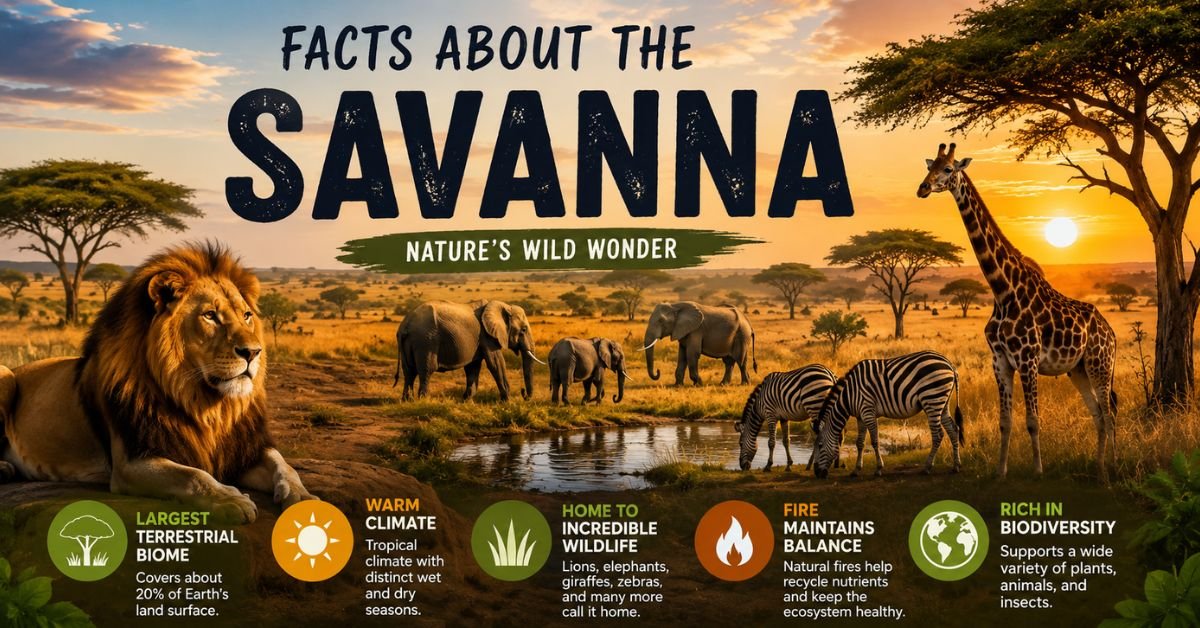
Facts About the Savanna: 25+ Wild Things to Know
Facts about the savanna rarely stop at “hot grassland with lions” this biome hides termite skyscrapers, trees that survive wildfires on purpose, and a migration involving over a million animals. After years teaching field ecology and leading safari-prep sessions, I’ve watched students light up the moment they learn savannas cover nearly a fifth of the planet, not just Africa.
If you’re researching for a school project, planning a safari, or just fell down a wildlife rabbit hole, this guide breaks down the savanna’s climate, wildlife, fires, and culture in one place. Every fact here is grounded in real ecological research, not recycled trivia so let’s get into what makes this grassland biome so genuinely remarkable.
Facts About the Savanna’s Climate
Understanding the savanna’s climate explains almost everything else on this list from why acacia trees grow thorns to why wildebeest migrate on a schedule. Savannas sit in a hot, seasonally dry climate zone, meaning nearly all life here has adapted around one predictable rhythm: rain, then none.
That rhythm shapes the entire grassland ecosystem, from soil chemistry to which plants can survive a six-month dry season. Unlike temperate biomes with four seasons, savannas typically cycle through just two: a wet season packed with growth and a dry season defined by scarcity and fire risk.
The Savanna Receives About 59 Inches of Rain a Year
Despite its reputation for being parched, the savanna biome receives roughly 59 inches of rainfall annually, concentrated almost entirely in the wet season. This surprising volume supports lush grass growth for months, even though the dry season that follows can feel bone-dry and dusty for weeks at a stretch.
Savannas Are Subdivided into Wet, Dry, and Thornbush Types
Not every savanna experiences the same climate pattern. Wet savannas endure a dry season lasting three to five months, dry savannas stretch five to seven months, and thornbush savannas go even longer. This tropical grassland subdivision explains why wildlife density and vegetation vary so dramatically across different savanna regions.
Water, Water Nowhere
During peak dry season, water sources across the savanna become dangerously scarce, forcing animals to travel long distances toward shrinking waterholes. This scarcity creates some of the most dramatic wildlife encounters on Earth, as predators and prey are forced into close, tense proximity around the same shrinking water source.
The Soil in Savannas Is Often Nutrient-Poor
Frequent wildfires, rapid organic decomposition, and heavy seasonal rainfall combine to strip savanna soil of nitrogen and phosphorus. This nutrient-poor soil creates real challenges for plant growth, yet savanna vegetation has adapted remarkably well, proving just how resilient this grassland ecosystem truly is under pressure.
Facts About the Savanna’s Size on Earth
One of the most surprising facts about the savanna is simply how much of the planet it covers. This grassland biome doesn’t just border the equator in a thin strip it spans a substantial share of Earth’s land surface across multiple continents entirely.
Because savannas sit between two better-known biomes, tropical rainforest and desert, they often get overlooked in casual geography conversations. Yet their sheer scale means savanna ecosystems play an outsized role in global biodiversity, carbon cycling, and the livelihoods of millions of people worldwide.
The Savanna Is a Transitional Biome
Ecologists often describe the savanna as a “middle ground” biome, sitting between dense tropical rainforests and arid deserts. This transitional positioning creates a unique blend of species and ecological traits, borrowing enough rainfall to support scattered trees while remaining too dry to sustain a closed forest canopy.
The World’s Largest Savanna Is the Serengeti in Africa
The Serengeti spans over 30,000 square kilometers and is widely cited as the most iconic savanna on Earth, home to more than 1.5 million wildebeest. Some researchers instead point to Brazil’s Cerrado as the largest tropical savanna region by total area, showing this “biggest savanna” title depends on how you measure it.
Facts About the Savanna It Isn’t Limited to Africa
Say “savanna” and most people picture Kenya or Tanzania, but this grassland biome actually spans nearly every continent except Antarctica. South America’s cerrado, Australia’s tropical grasslands, and pockets of India and Southeast Asia all qualify as genuine savanna ecosystems too.
Each region develops its own distinct wildlife and vegetation despite sharing the same core climate pattern. That global spread is exactly why savanna facts matter beyond Africa this biome shapes ecosystems, economies, and cultures on multiple continents simultaneously, not just one.
Savanna Ecoregions Go Beyond the Grass
Savannas aren’t one uniform landscape; they range from tropical and subtropical zones to Mediterranean and temperate variations worldwide. Australia’s savannas support kangaroos and wallabies, while South America’s cerrado hosts dense tree populations rivaling tropical forests, proving this biome’s remarkable ecological diversity.
Some Savannas Have Regions Known as “Kopjes”
Kopjes are rocky outcrops scattered across certain savannas, acting as biodiversity hotspots and wildlife refuges. These elevated formations help preserve soil moisture and give predators valuable vantage points, making them small but ecologically vital features within the broader savanna landscape.
Facts About the Savanna’s Diverse Animal Life
No list of savanna facts feels complete without its most famous residents. This biome supports one of the richest concentrations of large mammals anywhere on the planet, from towering giraffes to fast-sprinting cheetahs chasing prey across open grassland.
That diversity isn’t accidental it’s the direct result of millions of years of evolutionary adaptation to seasonal droughts, recurring wildfires, and intense predator-prey dynamics. Grazers, browsers, and predators all carved out separate ecological niches, allowing an extraordinary number of species to coexist on the same stretch of grass.
Elephants Are the Architects of the Savanna
African elephants earn the nickname “architects of the savanna” by pushing over trees and uprooting vegetation as they forage. This behavior actively maintains the balance between grassland and forest, making elephants a keystone species whose presence shapes the entire savanna ecosystem around them.
The Savanna Is Home to the World’s Biggest Bird
The ostrich, the largest bird on Earth, calls the savanna home despite being unable to fly. Built for speed instead, ostriches can reach up to 60 mph across open grassland, making them one of the savanna’s most surprising athletic residents.
Carnivore Competition Shapes the Savanna
Lions, cheetahs, and hyenas compete directly for the same prey across savanna grasslands, creating constant tension among top predators. This rivalry shapes hunting behavior, territory size, and even activity patterns, as each species adapts its strategy to avoid direct conflict with the others.
Several Endemic Animals Call the Savanna Home
Beyond the famous “big five,” savannas support species found almost nowhere else, from social meerkats to specialized grazers adapted to nutrient-poor grass. These endemic animals highlight just how specifically savanna wildlife has evolved to thrive within this particular seasonal, fire-prone ecosystem.
Savanna Animals Have Developed Excellent Camouflage
Lions’ tawny coats blend seamlessly into dry savanna grass, while leopards and cheetahs rely on spotted patterns honed over generations. This camouflage isn’t decorative it’s a survival mechanism refined through evolution, letting predators stalk prey and prey evade detection across open terrain.
Facts About the Savanna’s Fires
Wildfires might sound purely destructive, but they’re actually essential to how the savanna ecosystem functions. Lightning-sparked fires clear dead vegetation, recycle nutrients back into nutrient-poor soil, and trigger fresh grass growth that herbivores depend on almost immediately afterward.
Over evolutionary time, savanna vegetation didn’t just tolerate fire it built entire survival strategies around it. Understanding this fire cycle reframes one of the most misunderstood facts about the savanna: flames here aren’t a disaster, they’re a built-in maintenance system this ecosystem genuinely requires.
Wildfire-Resistant Trees in the Savanna Regrow Quickly
Certain savanna trees have evolved protective bark and underground root systems that let them survive direct fire exposure. Some even shed leaves strategically during fires to conserve energy, enabling remarkably fast regrowth once the flames pass and conditions stabilize again.
Threats to the Savanna Are Growing
Climate change is making savannas measurably drier, with longer dry seasons and less predictable rainfall stressing plants and animals alike. Combined with deforestation, poaching, and habitat fragmentation, these mounting threats are pushing conservationists to prioritize savanna protection more urgently than ever.
Facts About the Savanna’s Termite Mounds
Termite mounds might be the most underrated architectural marvel in the entire savanna biome. Some structures rise up to 30 feet high, built entirely by insects working collectively to regulate temperature and humidity for their colony deep underground.
These mounds do far more than house termites they function as biodiversity hotspots, boosting soil fertility and water retention in an otherwise nutrient-poor landscape. Vegetation around termite mounds often grows noticeably denser, drawing herbivores toward these small but ecologically powerful nutrient islands scattered across the grassland.
Facts About the Savanna’s Plant Adaptations
Savanna plants survive conditions that would kill vegetation in most other biomes, and their adaptations are genuinely remarkable. Long taproots reach deep underground water reserves, thick bark resists fire damage, and small waxy leaves minimize water loss during brutal dry-season heat.
Some species take defense even further, deploying sharp thorns or bitter-tasting chemical compounds to deter grazing herbivores. Together, these survival strategies allow savanna vegetation to persist through drought, fire, and constant grazing pressure that few other ecosystems’ plants could realistically withstand.
The Baobab Is Known as the Tree of Life
Baobab trees can live for thousands of years, storing enormous water reserves inside trunks that sometimes exceed 35 feet in diameter. Their fruit provides essential nutrition for both humans and wildlife, cementing the baobab’s reputation as the savanna’s most iconic survival specialist.
Savannas Are Home to Other Iconic Trees Too
Beyond the baobab, savannas host the thorny acacia, the toxic-sapped candelabra tree, and the sausage tree with its distinctive hanging fruit. Each species evolved a different survival strategy, together creating the scattered, drought-adapted tree canopy that defines the savanna’s unmistakable silhouette.
Facts About the Savanna’s Sacred Groves
Beyond biology, savannas carry deep cultural and spiritual significance for the communities who call them home. Certain wooded areas within the grassland are protected as sacred groves, considered dwellings for ancestral spirits rather than ordinary patches of vegetation to be cleared or farmed.
This spiritual protection often achieves genuine conservation results, preserving biodiversity that might otherwise be lost to agriculture or development. In India alone, over a million sacred forests reflect just how deeply intertwined savanna landscapes are with human belief systems and cultural heritage.
Facts About the Savanna A Bird-Watcher’s Paradise
With roughly 500 bird species recorded across the African savanna alone, this biome rivals any dedicated birding destination on Earth. From towering ostriches to the vividly plumed lilac-breasted roller, savanna skies stay remarkably active during early morning and late afternoon hours.
Vultures clear carcasses and limit disease spread, hornbills disperse seeds across vast distances, and ground-dwelling species like the southern ground hornbill add even more variety. This sheer avian diversity makes the savanna genuinely rewarding territory for dedicated bird-watchers and casual wildlife spotters alike.
Facts About the Savanna and Carbon Storage
Savannas may lack the density of tropical rainforests, but they still play a critical, often underappreciated role in global carbon storage. Grasses and scattered trees capture carbon dioxide through photosynthesis, converting it into biomass that gets stored both above and below ground.
Remarkably, savanna ecosystems are estimated to hold around 21.5% of all carbon stored in Earth’s terrestrial vegetation. Even periodic wildfires don’t erase this benefit savannas continue functioning as meaningful carbon sinks despite regular burning, challenging assumptions about fire’s overall ecological impact.
Facts About the Savanna’s Migration Marvels
Few natural events rival the scale of the savanna’s Great Migration, where over 1.5 million wildebeest join hundreds of thousands of zebras and gazelles crossing the Serengeti annually. This journey is driven entirely by the relentless search for fresh grazing pastures and reliable water sources.
This migration doesn’t just sustain the herds themselves it directly feeds predators like lions and crocodiles who time their own behavior around it. The sheer movement of that many animals also physically reshapes vegetation patterns, making migration a defining ecological force across the savanna.
African Savanna’s National Parks
Protected areas like the Serengeti, Masai Mara, and Botswana’s Chobe National Park give travelers direct access to the savanna’s migration spectacle and dense wildlife populations. Zambia’s South Luangwa, meanwhile, pioneered walking safaris, offering an intimate alternative to traditional vehicle-based game viewing experiences.
Facts About the Savanna’s Indigenous Cultures
Long before safari tourism, indigenous communities built entire ways of life around the savanna’s rhythms. The Maasai people are perhaps the most recognized, maintaining a pastoral lifestyle centered on cattle herding that has persisted across East Africa for generations despite land pressure.
Other groups, like the Kikuyu and Dorobo, developed their own distinct relationships with this landscape, from settled agriculture to hunting and foraging traditions. Together, these cultures reveal that savanna facts aren’t purely ecological they’re deeply human too.
The First Human Remains Were Found in African Savannas
Olduvai Gorge, within the Serengeti’s Great Rift Valley, produced some of the earliest known evidence of human ancestors crafting and using stone tools. This discovery fundamentally reshaped our understanding of human evolution, tying the savanna directly to the origin story of our species.
The Savanna Even Inspired Disney’s “The Lion King”
The sweeping visuals and vibrant wildlife of the African savanna directly inspired Disney’s The Lion King, right down to iconic landmarks like Pride Rock. That cultural reach has introduced generations of viewers worldwide to savanna wildlife long before many ever consider visiting in person.
Quick Reference: Savanna Facts at a Glance
| Category | Fact |
| Land coverage | Approximately 20% of Earth’s land surface |
| Continents | Africa, South America, Australia, India, Southeast Asia |
| Annual rainfall | About 59 inches, concentrated in the wet season |
| Largest savanna (by fame) | The Serengeti, Tanzania (30,000+ sq km) |
| Migration size | Over 1.5 million wildebeest annually |
| Termite mound height | Up to 30 feet |
| Carbon stored | ~21.5% of global terrestrial vegetation carbon |
Frequently Asked Questions
What is the biggest savanna in the world?
The Serengeti in Tanzania is the most famous savanna and one of the largest by wildlife concentration, though Brazil’s Cerrado is often cited as the largest tropical savanna region by total land area.
What are some famous savannas?
The Serengeti and Masai Mara in East Africa are the most recognized, largely due to the Great Migration. Australia’s tropical savannas and Brazil’s Cerrado are also significant, biodiverse savanna regions worth knowing.
How hot can the savanna get?
Savanna temperatures typically range between 68°F and 86°F during the wet season, with cooler dry-season nights occasionally dipping toward 40°F depending on the specific region and elevation.
How much of the world is savanna?
Savannas cover approximately 20% of Earth’s total land surface, making this grassland biome one of the most extensive ecosystem types found anywhere on the planet.
Why do savannas have so many wildfires?
Savanna wildfires are typically sparked by lightning during transitional seasons and are a natural, necessary part of the ecosystem, clearing dead vegetation and triggering fresh grass growth that wildlife depends on.
What animals live in the savanna?
Savannas support lions, elephants, giraffes, zebras, cheetahs, wildebeest, and hundreds of bird species, alongside smaller residents like termites, meerkats, and hyraxes that fill essential ecological niches.

Hi, I’m Benjamin, the person behind FactsAboutDog.com. 🐶
I’m passionate about dogs and love sharing interesting, fun, and educational facts about our furry friends. Through FactsAboutDog.com, I aim to make learning about dogs simple, enjoyable, and informative for dog lovers everywhere.
From amazing dog facts to breed information and fascinating animal knowledge, my goal is to help readers discover something new every day.
Explore the world of dogs with Benjamin at FactsAboutDog.com!