Facts About Minerals: 30+ Amazing Things You Never Knew
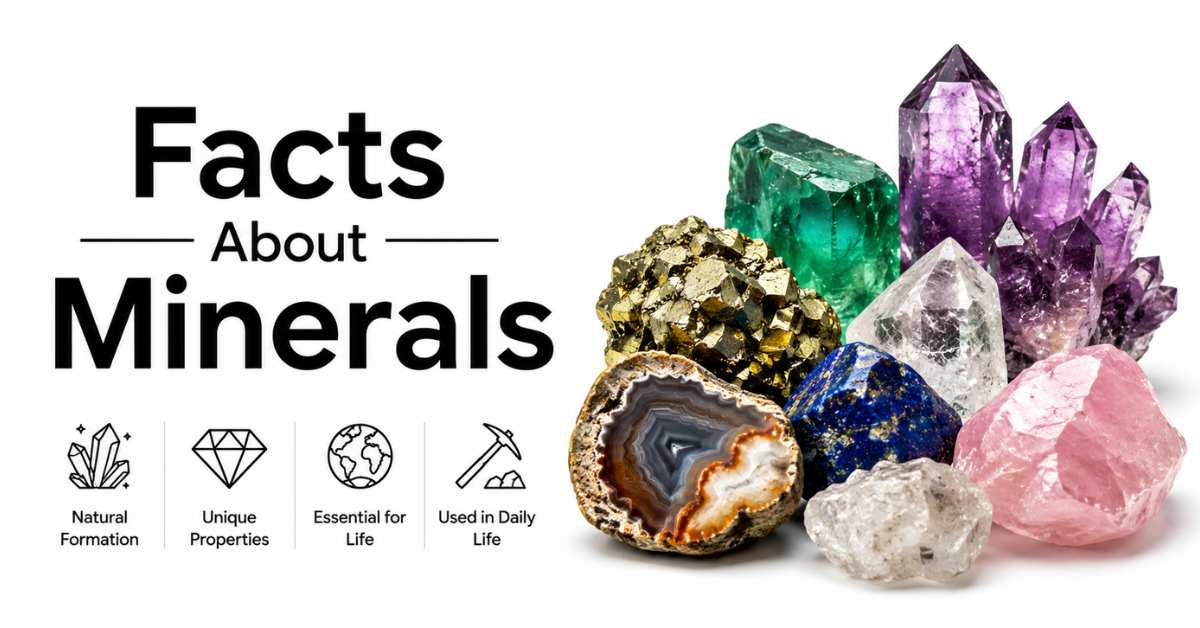
Facts about minerals reveal that every rock on Earth is built from combinations of naturally occurring, crystal-structured substances with a fixed chemical formula. After years photographing quartz veins and testing hardness with a pocket streak plate, I’ve learned minerals are far stranger than any textbook chapter suggests hiding magnetic properties, hidden technology metals, and geological secrets in plain sight.
If you’ve ever wondered why diamond scratches everything or why your phone depends on cobalt and lithium, this guide answers it clearly. We’ll cover mineral formation, identification methods like the Mohs scale, and surprising real-world uses the kind of grounded, expert-checked facts about minerals that actually stick with you.
Facts About Minerals: What Makes a Mineral a Mineral
Not every rock or shiny substance qualifies as a true mineral, and that’s one of the most misunderstood facts about minerals among beginners. Geologists apply a strict five-point checklist: naturally occurring, inorganic, solid, a definite chemical composition, and an ordered internal crystal lattice miss one, and it doesn’t count.
This is why steel, coal, and liquid water are automatically disqualified, while solid ice technically passes the test. A helpful way to picture it: a rock is like a cookie made of several ingredients, while minerals are the individual ingredients the sugar, flour, and chocolate chips themselves.
Facts About Minerals: How They’re Forged Inside the Earth
Minerals aren’t simply discovered lying around they’re manufactured by intense, patient geological forces working over millions of years. Molten magma cools and crystallizes into orderly atomic patterns, forming rock-building minerals like quartz, feldspar, and mica, the same crystalline ingredients that make up granite countertops.
Beyond magma cooling, mineral-rich water evaporating from ancient seas or dripping slowly through caves creates entirely different formations, from rock salt deposits to towering stalactites. Each formation pathway leaves a distinct chemical fingerprint, which is exactly what geologists use to trace a mineral’s origin story.
Transformation Under Duress
Existing minerals can also transform without ever melting, through a process called metamorphism. Intense heat and pressure rewire a mineral’s atomic structure entirely, turning humble shale into garnet a dramatic reminder that minerals are rarely a finished, static product underground.
Surface-Level Creations
Not all mineral formation happens deep underground. When water evaporates from a salt lake, it leaves shimmering halite deposits behind, while slow mineral-rich drips inside caves gradually build stalactites and stalagmites, sometimes revealing hidden crystal-lined geode pockets over centuries.
Facts About Minerals: A Geologist’s Guide to Identification
With thousands of known mineral species, telling one apart from another takes more than a glance at color, which is often the least reliable clue due to trace impurities. Geologists instead rely on a mineral’s streak the color of its powder as a far more consistent identifying fingerprint.
Hardness, tested against the 1-to-10 Mohs scale, adds another dependable layer, alongside luster (how light reflects off the surface) and how a mineral physically breaks. Together, these physical properties form a reliable identification system used by professionals and hobbyist collectors alike.
First Clues: Color and Streak
Quartz alone can appear pink, purple, or smoky brown depending on trace impurities, making color a misleading identifier. Hematite might look black or reddish on the surface, yet its streak test always produces a consistent reddish-brown powder, proving far more diagnostic than surface color.
Hardness, Luster, and Breakage
Diamond scores a perfect 10 on the Mohs hardness scale, while talc sits at a soft 1, scratchable with a fingernail. Luster ranges from metallic pyrite to glassy quartz, and breakage patterns like clean cleavage or jagged fracture reveal even more about internal crystal structure.
Comparing Common Mineral Properties
| Property | Quartz | Halite (Salt) | Pyrite (Fool’s Gold) |
| Color | Variable (clear, white, pink, purple) | Clear to white | Brassy yellow |
| Luster | Glassy | Glassy | Metallic |
| Hardness | 7 | 2.5 | 6–6.5 |
| Cleavage | None (conchoidal fracture) | Perfect cubic cleavage | None (conchoidal fracture) |
| Streak | White | White | Greenish-black |
Facts About Minerals: The Hidden Minerals Powering Your Daily Life
Most people interact with dozens of minerals daily without realizing it, hidden inside everyday technology and household materials. A smartphone screen relies on indium and tin, while its battery depends on lithium and cobalt real mined minerals quietly powering modern digital convenience.
Even a simple pencil owes its function to graphite, and the drywall inside your home is manufactured from gypsum. The table salt on your dinner plate is simply the mineral halite, proving that geology and daily life are far more intertwined than most people ever consider.
From the Earth to Your Home
Tracing materials from mine to household reveals surprisingly complex global supply chains. The Democratic Republic of Congo alone produces a significant share of the world’s cobalt, an essential mineral for electric vehicle batteries and consumer electronics manufactured across the United States and beyond.
Facts About Minerals: Which Countries Are Mineral Superpowers
Earth’s mineral wealth isn’t distributed evenly, creating a handful of genuine mineral superpowers with outsized influence on global trade. Australia stands out for diamond-rich regions like the Kimberley, while Russia and the United States leverage sheer geological size and diversity of deposits.
Control over these resources carries real strategic weight, tying geology directly to international politics and manufacturing power. Nations without significant domestic mineral deposits must rely heavily on imports, making mineral-rich countries disproportionately influential in modern global supply negotiations.
China’s Dominant Role
China currently leads global mining output by sheer volume, producing billions of tonnes of minerals annually. More critically, China dominates the processing of rare earth elements the essential, non-negotiable ingredients behind modern electronics, green energy technology, and advanced defense systems worldwide.
Facts About Minerals: Meeting the Future Demand for Critical Minerals
As the world shifts toward renewable energy, demand for critical minerals like lithium, cobalt, and nickel is accelerating faster than ever before. These aren’t obscure specialty rocks anymore they’re the essential building blocks behind electric vehicle batteries, wind turbines, and sprawling solar farms.
This surging demand is reshaping mining practices and sparking new geopolitical competition simultaneously. Roughly 19.2 billion metric tons of minerals are now extracted globally each year, with Asia leading production, pushing recycling and circular-economy solutions higher up the priority list.
Historical Facts About Minerals and Weird Discoveries
Some of the strangest facts about minerals come straight from ancient history and unexpected geological extremes. Salt crystals once functioned as literal currency, giving us the word “salary” from the Latin salarium, since Roman soldiers were sometimes paid directly in salt.
Elsewhere, Mexico’s Cave of the Crystals holds selenite formations weighing over 55 tons and stretching 36 feet long, while ancient Egyptians applied graphite as eyeliner centuries before it ever touched a pencil. Even the Dead Sea’s mineral-saturated water makes sinking physically impossible.
Strange Facts About Minerals and Modern Uses
Beyond history, minerals show up in genuinely unexpected modern contexts, from cosmetics to space rocks. Peridot, remarkably, has been discovered inside meteorites, proving this vivid green mineral genuinely formed outside our own planet before eventually landing on Earth’s surface.
Meanwhile, kyanite defies typical hardness rules entirely, scoring differently depending on which crystal axis gets tested, while baryte gets used as a contrast agent in medical X-ray imaging. These modern applications prove minerals still surprise scientists and collectors alike.
Facts About Minerals: Your Questions Answered
A few core questions come up constantly once people start exploring mineralogy seriously, and clearing them up builds a much stronger foundation. These aren’t trick questions they’re the exact confusions that trip up most beginners browsing rock shops or classroom collections.
Working through rock-versus-mineral confusion, hardness rankings, and gemstone classification resolves nearly every common misconception in one pass. Once these fundamentals click, every other mineral fact on this page becomes significantly easier to place into context.
Rock Versus Mineral
Think of a mineral as a single pure ingredient, like flour or sugar, with a specific chemical recipe and consistent internal structure. A rock, by contrast, is the finished cookie a solid mixture of multiple mineral ingredients bonded together, such as granite’s blend of quartz, feldspar, and mica.
The Hardest Mineral
Diamond claims the title of hardest known mineral, scoring a perfect 10 on the Mohs hardness scale. Its extreme durability comes from powerful, tightly locked bonds between carbon atoms, allowing it to scratch literally every other mineral found on the planet.
Are Gemstones Minerals?
Most gemstones are simply special varieties of common minerals ruby is red corundum, emerald is green beryl. However, organic gems like pearls, amber, and jet come from living or once-living sources, meaning they don’t technically meet the strict geological definition of a mineral.
Frequently Asked Questions
What is the difference between a rock and a mineral?
A mineral is a single naturally occurring substance with a fixed chemical formula and crystal structure, while a rock is a solid mixture made of one or more different minerals combined together.
What is the hardest mineral on Earth?
Diamond is the hardest known mineral, scoring a perfect 10 on the Mohs hardness scale thanks to its tightly bonded carbon atom structure.
Are gemstones considered minerals?
Most gemstones, like ruby, sapphire, and emerald, are mineral varieties. However, organic gems such as pearls and amber form from living organisms and don’t meet the strict mineral definition.
How are minerals formed?
Minerals form through cooling magma, evaporating mineral-rich water, metamorphic heat and pressure, or precipitation from underground fluids each process producing distinct crystal structures.
What are the 5 characteristics of a mineral?
A true mineral must be naturally occurring, inorganic, solid, have a definite chemical composition, and possess an ordered internal crystal structure.
Which country produces the most minerals?
China currently leads global mineral production by volume and also dominates the processing of rare earth elements used in electronics and green technology.
Why are minerals important in everyday life?
Minerals power daily technology and infrastructure, from lithium and cobalt in phone batteries to gypsum in drywall and halite in table salt.

Hi, I’m Benjamin, the person behind FactsAboutDog.com. 🐶
I’m passionate about dogs and love sharing interesting, fun, and educational facts about our furry friends. Through FactsAboutDog.com, I aim to make learning about dogs simple, enjoyable, and informative for dog lovers everywhere.
From amazing dog facts to breed information and fascinating animal knowledge, my goal is to help readers discover something new every day.
Explore the world of dogs with Benjamin at FactsAboutDog.com!